The mud in Cooper’s Crossing had a way of making everything look half-ruined.
It coated wagon wheels, froze in ruts, clung to hems and boot soles, and dried in ugly brown scales along the edges of buildings that had gone up too quickly and leaned too far. Men came to the town with bright talk about gold, claims, and luck. Most of them ended up red-eyed, in debt, and mean.
Gideon Hale hated the place.
He lived alone high in the mountain timber where the air was clean, the snow honest, and danger at least came at a man with teeth or weather instead of a grin. Twice a year he rode down to Cooper’s Crossing for what he could not trap, hunt, or grow. Salt. Coffee. Powder. Shot. Nails. Lamp oil. Then he left before anyone got curious or friendly.
He was in Cooper’s Mercantile on one of those trips, trading beaver pelts for cartridges, when he heard the kind of argument most men pretended not to hear.
“I owe you fifty dollars, Boyd, not the girl. She ain’t yours to take.”
The speaker was Uncle Jeb Mercer, a ruined man in a ruined coat. His hands shook with drink. His eyes were wet with the shame of someone who had reached the bottom, found a trapdoor there, and gone through it anyway.
Boyd Turner stood opposite him, broad, smug, and freshly shaved in the way of men who believed cruelty looked better when polished.
“You don’t have fifty dollars,” Boyd said. “The bank’s taking your lot. I’m offering mercy.”
Then Gideon heard the laugh in Boyd’s voice and turned.
The girl was standing beside a flour barrel near the wall. She was younger than Gideon expected, though not a child. Thin enough that the cold seemed to have carved itself into her face. She wore a faded brown dress and old church shoes already dark with mud. Her hands were clasped at her waist like she was trying to hold herself together by force. She was pale, silent, and not crying.
That was what got him.
Not tears. Not pleas. The absence of both.
Boyd caught her by the arm and gave the room a smile meant to invite witness.
“She’s young, clean, quiet, and untouched. A lonely man would get more use from her than a mule.”
No one moved.
Uncle Jeb looked sick. “She was my brother’s girl.”
“Then you should’ve treated her better,” Boyd said. “Now pay up or step aside.”
Gideon did not remember deciding to interfere. He only knew that one moment he was standing at the counter and the next he was crossing the room in three heavy strides, bear-hide coat swinging around his boots, old scar standing white against the weather-dark skin of his jaw.
“Let her go.”
The room went silent enough that the stove could be heard ticking in the corner.
Boyd looked him over. Gideon was a large man, rough-built, with a face people remembered even when they wished they did not. Still, Boyd held on to the girl’s arm.
“This ain’t your business, mountain man.”
Gideon set a leather pouch on the flour barrel. Gold dust hit wood with a thick, final sound.
“There’s eighty dollars in there,” he said. “Debt is paid. She comes with me.”
Boyd’s eyes flicked from the pouch to the Colt at Gideon’s side. He released the girl with a sneer.
“Enjoy your bargain.”
Gideon ignored him.
When Boyd left, Uncle Jeb sagged with relief and cowardice in equal measure. “If she stays in town, he’ll come back. You know he will. If you leave her here, she’s done for.”
“I paid for her freedom,” Gideon said. “Not for a bride.”
Jeb licked his lips. “Then marry her on paper. Just on paper. Magistrate can do it now. Boyd won’t touch another man’s wife. Not openly.”
The suggestion filled Gideon with disgust. He was not a rescuer, and certainly not a husband. He looked at the girl expecting fear, or pleading, or gratitude. Instead she only looked back at him with a strange still steadiness, as if he were dangerous but possibly survivable.
The town had spoken around her, over her, about her. She had not lowered her gaze once.
“Fetch the magistrate,” Gideon said.
They signed in the saloon ten minutes later. Gideon’s handwriting came out rough and slanted. The girl’s name appeared below his with neat precision.
Clara Mercer.
He did not know then that even the name was only half the truth.
Outside, under a hard gray sky, he loaded his mule. “In spring, I’ll take you to Cheyenne. You’ll get a stage ticket and enough money to start over. Until then, stay out of my way.”
“Yes, sir.”
“Gideon,” he corrected. “Just Gideon.”
The climb to his cabin was brutal in any season and merciless in October. Clara was dressed for a church bench, not a mountain trail. Gideon expected tears within the hour. He expected questions, weakness, resentment.
Instead he got silence and endurance.
She stumbled, slipped, gashed her hands on rock, and kept walking. By the time they camped the first night, her shoes were torn and her feet bloody. Gideon gave her resin salve, cloth, black coffee, and beans. She thanked him as if receiving hospitality in a parlor instead of medical supplies beside a cold mountainside fire.
“Why didn’t you fight Boyd?” he asked.
She held the bandage against her heel. “Because men like Boyd enjoy screams. Screams don’t change anything.”
“And me?”
“You didn’t look at me like meat,” she said. “You looked at me like furniture. A person can survive being furniture.”
The answer sat in Gideon’s chest like a stone all through the night.
By the time they reached the cabin the next day, the first snow had started. Clara hesitated at the threshold. Gideon saw her look at the single bed in the corner and understood immediately.
“You take the bed,” he said. “I sleep in the loft.”
Relief loosened her face, but it did not make her trust him.
That took longer.
The first week passed in careful silence. Gideon chopped wood, checked snares, repaired hinges, and kept his distance. Clara cleaned, cooked when shown how, and stitched like someone born to needlework. She moved quietly through the cabin, never wasting steps, never taking more room than necessary. Gideon noticed she startled at raised voices, even his own, but not at thunder, wolves, or wind.
He found that strange.
He found many things about her strange.
She ate too fast at first. She hid stale crusts in her apron pocket before she realized there would be more food tomorrow. She slept lightly and woke at the smallest sound. But put her outside in the dawn among snow, pines, and empty sky, and something in her face eased. The wilderness did not frighten her half as much as men did.
One night a storm came down hard and she woke from a nightmare choking on a scream she clearly hated herself for making. Gideon came down from the loft, stopped himself from touching her, and said only, “You’re safe.”
She stared at him, dazed, then reached for his hand.
He froze.
No woman had ever taken his hand like that. Not flirtation. Not desperation. Recognition.
“I thought I imagined you,” she whispered.
He sat by the bed until she slept again and told himself the heaviness in his chest was pity.
The lie lasted about three days.
Then he rode down the ridge line to inspect traps and found evidence of riders below. Before evening he had confirmed it. Boyd had come sniffing near the lower timber with two men. Gideon sent them away with a rifle, a warning, and a fist to Boyd’s cheek hard enough to split his lip. He came home with bruised knuckles and no explanation Clara believed.
That same evening a letter arrived by way of a passing freighter heading west.
It was from the magistrate.
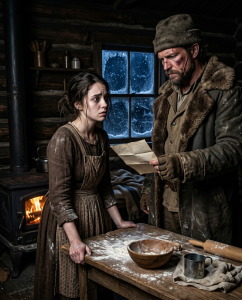
Gideon unfolded it at the table while Clara stood with flour on her hands and dread in her eyes.
The magistrate had remembered her name after all. Not because of sentiment. Because a man from the railroad camps east of Cheyenne had ridden through Cooper’s Crossing asking after a young woman once called Clara Mercer. The man had money, influence, and no interest in discretion.
There was a second page.
A name.
Nathaniel Voss.
The bowl slid from Clara’s hands and cracked on the floor.
Gideon looked up. “Who is he?”
She sat down hard in the nearest chair as if her knees no longer belonged to her. For a long moment he thought she might say nothing. Then the story began to come out in pieces. Not graceful. Not complete. But enough.
Her real name was Clara Bell. Her mother had worked as a housemaid for a hotel owner in Cheyenne after Clara’s father died in a rail accident. Nathaniel Voss was the hotel owner’s partner—rich, polished, respected in public, and rotten underneath. He liked vulnerable girls because they had no one powerful to contradict them. Clara had learned to avoid being alone in a room with him. Her mother had learned too late.
When Clara was seventeen, her mother took ill with fever and died inside ten days. After the funeral, Voss became generous in the way men are when they believe kindness purchases silence. He offered Clara a room in the boarding house he owned. Work in the laundry. Safety.
She knew better and refused.
Three weeks later, money went missing from the office safe. Voss accused her quietly, then kindly offered not to bring in the sheriff if she agreed to travel east with him under his protection until the matter cooled. Clara said no again.
That was when a woman from the kitchen, older and frightened, told her the truth: Voss had done the same to two girls before. One had married a cattle buyer twice her age inside a month and never been seen again. The other had vanished before the arrangement was finished. People said she ran off. The woman did not believe it.
So Clara fled to her mother’s brother in Cooper’s Crossing. Jeb took her in for one reason only: Voss had paid him monthly to keep her nearby and quiet until “a suitable solution” could be arranged. Jeb, drunk and useless though he was, had put it off. Then his debts swallowed him and Boyd saw a different kind of profit.
When she finished, Gideon’s face had gone still in a way that frightened even her.
“He paid your uncle to hold you in place,” Gideon said.
“Yes.”
“And Boyd nearly sold you to settle a debt.”
“Yes.”
“And now this Voss wants you back.”
She lowered her eyes. “He won’t want me back publicly. He’ll want me removed.”
The next morning Gideon saddled his horse without a word.
“Where are you going?” Clara asked.
“To town.”
Her fear showed instantly. “Don’t.”
He paused. “He’s already reached for this mountain. He doesn’t get to do that twice.”
By dusk he returned with supplies, a fresh coil of wire, and information. Voss had indeed come through Cooper’s Crossing two days earlier. He had shown the magistrate papers claiming Clara Bell was under his lawful guardianship due to unpaid theft restitution. The papers were almost certainly false, but Voss had money enough to make men hesitate.
“He’ll come here,” Clara said.
“Yes.”
She looked at the loaded rifle over the door. “Then he’ll kill you.”
Gideon met her gaze. “Not before I have something to say.”
Snow sealed the high passes within the week. Gideon used the time like a man preparing for war. He cut extra wood, set snares along the lower approach, cleared sight lines between trees, and showed Clara how to load the spare rifle. Her hands shook the first two times. The third time they did not.
“You ever fired one?” he asked.
“No.”
“You may have to.”
She nodded and said nothing.
The waiting changed them both. Clara stopped shrinking from every sound. Gideon began speaking more, though only a little. He told her how his wife and infant son had died years earlier in a fever winter while he was trapped by avalanche on the far side of the ridge. By the time he fought his way home, both were gone and the cabin had already become a place of ghosts. Since then he had preferred animals to people and solitude to grief.
“That’s why you looked at me like furniture,” Clara said one evening by the fire.
His mouth almost curved. “That may be.”
“And now?”
He studied the flames too long. “Now I look too much.”
Color rose slowly in her face, but she did not look away.
By the time the riders came, the truth between them had become impossible to ignore and too dangerous to touch.
There were four of them. Voss, Boyd, and two hired men.
Gideon saw them first from the ridge and came down fast. “Inside,” he told Clara. “Bolt the door after me. Do not open it unless I call your name.”
“I won’t hide while they take you.”
“You won’t help me dead.”
She grabbed his sleeve before he stepped away. “Come back.”
The words hit harder than any plea. He covered her hand once, briefly, then turned toward the yard.
Voss dismounted with the smooth composure of a man who believed civilization traveled with him. He was handsome in the polished, well-fed way some women mistook for trustworthiness. Boyd, standing half a step behind, wore a split lip and old malice.
“Mr. Hale,” Voss called. “I’ve come for my ward.”
“She’s no ward of yours.”
Voss smiled. “I have papers.”
“So does she.”
“That marriage is fraudulent.”
“Try telling a judge.”
Voss’s gaze sharpened. “You are harboring stolen property.”
The sentence changed the air. Gideon’s rifle lifted a fraction.
“She is not property.”
“Everything is property,” Voss said softly. “Land. labor. women, when the right debt is owed.”
From inside the cabin, Clara heard every word through the wall. Her terror burned into fury so intense it steadied her. When Boyd began circling toward the side window, she raised the spare rifle exactly as Gideon had shown her.
Outside, the first shot came from one of Voss’s hired men.
After that, politeness ended.
The yard exploded into noise—rifles cracking, horses shrieking, snow kicking up in dirty bursts. Gideon dropped one man before the second shot. Boyd dived behind the water trough. Voss retreated toward the trees, cursing, as if this were all a vulgar inconvenience instead of a hunt gone wrong.
Then Boyd lunged for the porch.
Clara fired through the side window.
The bullet slammed into the post inches from Boyd’s head, showering him with splinters. He stumbled back with a howl.
“She’s armed!”
“Good,” Gideon thundered. “Now run.”
The second hired man tried to swing around the rear of the cabin and hit one of Gideon’s wire traps. His horse went down screaming. The man tumbled into the snow and did not get back up. Voss, seeing the shape of failure at last, drew a small pistol and aimed not at Gideon, but at the cabin window.
Clara saw him through the glass.
Gideon saw him a heartbeat later.
He fired first.
Voss staggered, spun, and dropped to one knee, the pistol falling from his hand into the snow. Boyd bolted for the trees without another look back. Gideon crossed the yard in seconds and kicked the gun away.
Voss clutched his bleeding shoulder, his handsome face shredded into something much closer to the truth.
“You fool,” he gasped. “Do you know who I am?”
“Yes,” Gideon said. “That’s why you’re still breathing. Dead men can’t hang.”
The storm moving in from the west hit before nightfall. Gideon bound Voss’s wound just enough to keep him alive and lashed him to a sled. The surviving hired man, half senseless from the fall, got the same mercy. At first light Gideon took them down the mountain straight to the sheriff in Cheyenne, with Clara beside him and the false guardianship papers tucked into his coat.
It turned out Nathaniel Voss had made more enemies than he knew. Once Clara spoke, other voices followed. A kitchen woman. A stable hand. A former clerk who had copied suspicious ledgers. The stolen money accusation unraveled under questioning. So did the “guardianship” papers. By the end of the month Voss was jailed on fraud, coercion, and assault charges, with more coming. Boyd disappeared for a while, then resurfaced drunk in Laramie and found himself arrested on a warrant tied to debt violence and attempted abduction.
Uncle Jeb tried to apologize.
Clara listened in silence, then said, “You don’t get to call what you did weakness. It was a choice.”
It was the truest thing anyone had said to him in years. Jeb wept anyway. Clara did not.
When spring came, Gideon kept his promise and brought her to Cheyenne to buy a stage ticket and set aside money for her. They stood outside the station in the soft mud of thaw season, among trunks, chatter, and steam. The ticket agent waited by the window.
“This is where you start over,” Gideon said.
Clara looked at the ticket in his hand and then at him.
“I already did,” she said.
He did not answer, because for perhaps the first time in his life he was afraid in a way fists and bullets had never managed to make him. Afraid of wanting something. Afraid of asking. Afraid of hearing that what had grown between them on the mountain belonged only to winter, danger, and gratitude.
Clara stepped closer.
“When you took me from that store, I thought you were another kind of prison,” she said. “Then I thought you were a wall. Then a shelter.” Her eyes shone, but her voice stayed steady. “Now I think you are the first place I have ever stood where I did not have to disappear.”
The ticket crumpled a little in Gideon’s hand.
“I have nothing fine to offer,” he said. “Only the mountain. That cabin. My name. What’s left of me.”
She smiled then, and it transformed her face so completely he understood how little he had really seen of her at first.
“Gideon,” she said softly, “that is more than anyone ever offered me honestly.”
So they went back up together when the snow was gone from the trail.
Not because of a paper signed in fear over a whiskey-sticky counter. Not because a town decided it. Not because she had nowhere else to go.
Because this time she chose.
Years later, people in the valley still told the story wrong. They said a mountain man bought himself a bride in Cooper’s Crossing. That he paid eighty dollars and carried her off like some rough frontier bargain.
The truth was harder for them to understand.
He had not bought a wife.
He had stood in the path of men who believed money turned human beings into property, and a frightened young woman had looked at his silence and seen, somehow, that there was mercy buried inside it.
He had meant to be a wall. She had made him a man again.
And if anyone asked Clara what the biggest warning sign had been, she never mentioned Boyd first, though he was easy to hate. She mentioned the polished man with gentle hands and respectable papers. The one who used courtesy like a knife. The one everybody trusted because he knew exactly how monsters ought to dress.
As for forgiveness, she believed some people confused it with forgetting. She did not forgive Voss. She did not forgive Jeb. She did not forget the store, the mud, the bargain, or the way a whole room had watched.
But she did build something after it.
Maybe that was the real miracle.
Not that Gideon saved her.
That after everything, she still knew how to recognize safety when she finally touched it.