“You have no one to care for you, and my children have no grandfather. Please let us stay.”
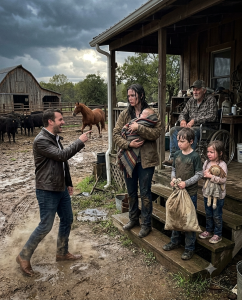
Amanda Venegas said the words while rainwater dripped from her dark hair and slid off the edge of the faded shawl wrapped around the baby in her arms. Her voice was steady, but only just. Beneath that steadiness was exhaustion so deep it had settled into her bones. She had walked too far, carried too much, and spent too many nights pretending not to be afraid in front of children who were already learning what fear looked like.
The old man in the wheelchair stared at her from beneath the wooden porch of San Isidro Ranch, and the silence around them tightened.
Before he could answer, another voice broke in.
“Are you seeing this?” Ernesto Saldívar scoffed, throwing one arm toward Amanda and the children like they were refuse that had washed up in his uncle’s yard. “I come here to talk about the future of this place, and some stranger appears with a rehearsed sob story.”
Amanda didn’t turn toward him.
She had already decided, from the first second she saw him, that he was the kind of man who mistook cruelty for intelligence.
The ranch was bigger than she had imagined. The porch stretched wide across the front of the house, its wood worn smooth by years of weather and work boots. The yard was hard-packed dirt, still damp from rain. Beyond it stood the corrals, the sheds, the fenced pastures, and a row of mesquite trees bent by old winds. Everything looked tired, but not dead. It looked like a place holding itself together out of habit.
Much like the man in the chair.
Rodrigo Saldívar was seventy-four years old. His hair was white, his face lined and stern, his left leg useless after a fall years earlier that had slowly stolen the rest of his mobility. People in town said he had become difficult. Some said bitter. Others said he had begun forgetting things. But when Amanda looked into his eyes, she saw none of the fog Ernesto had described.
She saw a man who had learned to listen before speaking.
Ernesto, on the other hand, spoke like he had already inherited everything in sight.
He wore city clothes too fine for the dust of the ranch, a pressed shirt under a tailored jacket, and shoes that looked offended by the mud. Under one arm he carried a leather folder. Amanda had noticed that immediately. Men carrying folders to sick old men rarely brought anything good.
“Uncle,” Ernesto said, turning back to Rodrigo with a smile that soured as soon as it appeared, “you can’t run this ranch by yourself. Everyone in town knows it. You need someone responsible handling your affairs.”
Rodrigo’s hands remained on the arms of his wheelchair.
“You mean you.”
Ernesto spread his hands as though modesty belonged to him. “I mean family.”
The word hung there. Family.
Amanda nearly laughed, but she had no strength to spare.
Her baby, Lencho, whimpered weakly against her chest. She shifted him and felt the heat of his fever through the shawl. Her son Abundio, only eight, dragged their sack of clothes a little closer to the porch and tried not to sway on his feet. Chabela, five, stood pressed to Amanda’s side, clutching a rag doll so soaked by the rain it looked drowned.
Rodrigo noticed the children before he answered anyone else.
“What happened to the baby?” he asked.
Amanda stepped closer. “He has a fever.”
Ernesto rolled his eyes. “This is absurd.”
Amanda ignored him and met Rodrigo’s gaze.
“You have no one to care for you, and my children have no grandfather. Please let us stay.”
Even Ernesto seemed surprised by the bluntness of it.
Then he laughed.
“What a line,” he said. “Did you practice that on the road? Don’t listen to her, Uncle. Women like this know exactly how to get in. First it’s pity. Then food. Then a bed. Then they start talking about rights.”
Abundio stiffened. Amanda felt it without looking. The boy had his father’s temper, which was a dangerous inheritance for a child in a hard world.
“I’m not asking for charity,” Amanda said. “I can cook. I can milk cows, clean stalls, keep accounts, and care for the sick. If I’m no use, I’ll leave.”
Rodrigo studied her. Then he looked at Lencho, whose face was flushed and damp. He looked at Abundio, too proud to beg. At Chabela, who had not spoken a word since entering the yard.
Then he looked past them, toward the corral, where an old chestnut horse with a graying mane pawed the earth in agitation.
Canelo.
Rosario’s horse.
The sight of him stirred a memory so quickly that Rodrigo almost resented it. His wife had been dead three years, and yet every now and then someone would move a certain way, or speak with a certain plainness, and grief would return with all its old authority.
Amanda did not sound like Rosario.
But she had that same unbearable honesty.
“Ernesto,” Rodrigo said, “leave.”
His nephew blinked. “What?”
“You heard me.”
“You’re choosing a stranger over me?”
Rodrigo’s expression didn’t shift. “You’re the one making me choose.”
For a moment Ernesto looked as if he might refuse. Amanda wondered whether men like him had ever once in their lives heard the word no without trying to break something afterward.
Finally, his face hardened. He slipped the folder tighter under his arm and took a step backward.
“You don’t understand what you’re doing.”
Rodrigo’s answer came low and precise. “I understand you better than you think.”
Ernesto’s eyes cut toward Amanda, and what she saw there made her skin tighten.
It wasn’t humiliation.
It was calculation.
Then he turned and strode back to his gray sedan. The tires spat mud and dust as he drove away, but before reaching the road he stopped just long enough to look back through the windshield.
Amanda had seen that kind of look before too.
A man promising himself he would come back prepared.
That night, Rodrigo gave them the back room, a narrow space once used by hired men during harvest and repair season. It smelled faintly of cedar, old blankets, and dust. To Amanda it felt like a palace.
She laid Lencho on one of the cots and nearly panicked when she touched his forehead again. He was hotter than before.
Rodrigo sent for a medicine box that had not been opened in months.
“Rosario always said you treat the child first,” he murmured, almost to himself. “Questions can wait.”
Amanda looked up at him, and for the first time since reaching the ranch, her control slipped.
Not because he had offered shelter.
Because he had offered mercy without making her crawl for it.
“Thank you,” she whispered.
“Don’t thank me yet,” he said. “You’ll earn your keep.”
“I intend to.”
He almost smiled.
By morning, San Isidro smelled different.
For years, breakfast in that house had been an afterthought. Coffee reheated until it turned bitter, bread turned hard, meals swallowed for function rather than comfort. But Amanda rose before dawn, tied back her hair, and worked with the quiet speed of someone who had spent years keeping families alive with very little.
She made coffee in a blackened pot, sweetened with piloncillo and cinnamon. She warmed beans, fried eggs, and pressed tortillas by hand. When Rodrigo took the first bite, his face didn’t change, but he kept eating long after he would normally have pushed the plate away.
Abundio asked where the broom was and cleaned half the stable before anyone thought to tell him not to. Chabela, after a long period of silence, wandered into the main room and discovered a wooden sewing box tucked away in a cabinet. Inside were spools of bright thread, small silver scissors, needles, buttons, and scraps of fabric Rosario had once saved. Chabela sat on the floor and stared at them with solemn delight.
As for Lencho, by midday his fever had finally begun to drop. He reached for Rodrigo’s beard with a sticky little hand and burst into a laugh so sudden and bright that even the old man startled.
For one fleeting day, the ranch remembered what family sounded like.
It unnerved Rodrigo more than he expected.
There had once been laughter here all the time. Rosario’s voice in the kitchen. Music from the radio. Men coming in and out during calving season. Neighbors stopping by. A table that was never empty. After she died, the ranch had not become silent all at once. Silence arrived in layers. First evenings. Then mornings. Then entire weeks with no voice in the house except his own.
Now there were children in the yard.
He should have felt imposed upon.
Instead, he felt the walls breathing again.
The trouble began before sundown.
Fortino, an old ranch hand who had worked with Rodrigo on and off for years, rode in from town looking pale.
“Don Rodrigo,” he said, removing his hat, “Ernesto’s been talking.”
Rodrigo’s eyes narrowed. “About what?”
“About the woman. He’s telling everyone she’s manipulating you. Saying she bewitched you somehow. Says she came to trick you into signing things.” Fortino hesitated. “He also says he’s bringing a lawyer. Maybe the police.”
Amanda, standing in the kitchen doorway with Lencho on her hip, went very still.
Rodrigo noticed.
Noticed the way fear crossed her face too quickly to hide.
He said nothing then, but later, after the children had eaten and the lamps were lit, he wheeled himself into the kitchen where Amanda was washing dishes.
“Who are you running from?”
She did not answer immediately.
Outside, the night insects had begun their steady chorus. The house felt small around the question.
“I didn’t ask whether you needed work,” Rodrigo said. “I asked who you’re running from.”
Amanda set down the plate in her hands.
“My husband died six months ago,” she said.
“How?”
She closed her eyes briefly. “They said it was a road accident.”
“They?”
She looked at him then. “Men who wanted something from him.”
Rodrigo waited.
“My husband did bookkeeping for a produce buyer in the next town. He wasn’t an important man. But one night he came home with papers he never should have seen. Land transfers. Debt claims. Names. He told me there were people taking properties from widows and old men who couldn’t defend themselves. Forged signatures. Bribes. Threats.” Her mouth tightened. “He said one name more than once.”
Rodrigo already knew it before she said it.
“Saldívar.”
She nodded.
The room seemed to lose warmth.
“Which Saldívar?” he asked.
“I don’t know at first,” Amanda said. “My husband tried to protect me by telling me less. Then he died. After that, men started asking whether he had left anything behind. Whether he told me where the papers were. Three nights ago one of them came to the room we were renting. He said hunger makes children persuasive.” Her voice almost broke then, but she forced it back into place. “So I took mine and left before dawn.”
Rodrigo sat very still.
He thought of Ernesto arriving with his leather folder and his urgency. He thought of all the times his nephew had pushed him to sign “temporary management” forms over the past year. He thought of rumors from town that he had ignored because old age taught men the danger of reacting to every whisper.
And for the first time, a darker possibility opened fully in his mind.
“What papers?” he asked.
Amanda hesitated.
“I don’t have them,” she said. “But my husband hid something before he died. A ledger page. He told Abundio where to find it if anything happened to him.”
Rodrigo looked toward the back room.
“Does the boy have it?”
Amanda nodded once.
That was when someone banged on the front door.
Not politely.
Not like a guest.
Fortino, who had stayed the night in case Ernesto caused trouble, crossed the room first and looked through the window.
Then he swore under his breath.
“There are three vehicles,” he said.
Rodrigo wheeled toward the front. Amanda followed, holding Lencho tighter. Abundio stepped out of the room with Chabela behind him, his face already drained.
The vehicles in the yard threw long beams of light across the porch.
Ernesto stepped out of the first one in a pressed coat, carrying the same leather folder. Beside him was a thin man in a suit, another wearing a badge, and behind them—
Amanda stopped breathing.
Because climbing out of the third truck was a man she recognized instantly.
Gaspar Ruiz.
The same man who had come to her rented room three nights earlier. The same man who had smiled while suggesting her children might suffer for her silence.
“He can’t be here,” Amanda whispered.
“You know him,” Rodrigo said.
“Yes.”
Gaspar saw her through the open doorway and smiled again. Even from that distance, she felt the menace in it.
Ernesto mounted the porch without waiting to be invited inside.
“Uncle,” he said smoothly, “I’m here to help you correct a serious mistake. This woman is a fraud, and I have witnesses willing to swear she entered this property under false pretenses.”
Rodrigo’s voice came out flat. “You brought witnesses awfully fast.”
“When a vulnerable old man is being exploited, responsible people act quickly.”
Amanda almost laughed at the audacity of it, but fear had her by the throat.
The man with the badge cleared his throat, suddenly less certain than his uniform suggested. “Sir, we only need to ask a few questions.”
“To whom?” Rodrigo asked.
Amanda felt Abundio touch the back of her skirt. She glanced down. The boy’s face was pale but determined.
He slipped a folded oilcloth packet into her free hand.
Her pulse slammed.
The ledger page.
He had brought it with him.
Gaspar’s eyes dropped to the motion, then snapped back to Amanda’s face.
He knew.
Everything changed in that second.
Rodrigo saw it too.
“What’s in your hand?” Ernesto asked sharply.
Amanda closed her fingers around the packet.
“Nothing that belongs to you.”
Gaspar took one step forward. “Ma’am, careful now. You don’t want to make this worse.”
“Worse for who?” Rodrigo asked.
Nobody answered.
The old man’s gaze moved from Ernesto to Gaspar, to the lawyer, to the badge, then back again. His face did not show anger. It showed something colder.
Certainty.
“Fortino,” he said quietly, “bring me the tin box from my study.”
Ernesto’s composure flickered. “What for?”
Rodrigo ignored him.
Fortino disappeared into the house and returned with a dented metal box and a ring of keys. Rodrigo unlocked it with deliberate slowness while everyone on the porch watched.
Inside were copies of deeds, tax receipts, notarized letters, and an envelope Amanda had never seen before.
Rodrigo removed the envelope and held it up.
“Two years ago,” he said, “my banker warned me someone might try to pressure me into signing over parts of this property. I was advised to document every visit, every request, every irregular offer. So I did.”
Ernesto’s face lost color.
Rodrigo continued, “Including the dates you came here, the papers you pushed at me, and the names you used to pressure hired hands into speaking against me.”
The lawyer beside Ernesto shifted backward.
The badge looked suddenly much less eager.
Gaspar took another step, but Fortino was already there, broad and solid between him and the doorway.
Amanda’s fingers trembled around the oilcloth packet. She opened it and pulled out the folded page her husband had hidden. Her eyes moved over the handwriting, the columns, the numbers, the names.
Then she found it.
Ernesto Saldívar. Payments routed through third parties. Properties flagged: widows, elderly, disputed heirs. Gaspar Ruiz listed beside collection actions.
Her stomach turned.
Rodrigo extended his hand. “Let me see it.”
Amanda gave him the page.
He read for less than ten seconds before lifting his eyes to Ernesto.
“Is this why he died?” Rodrigo asked.
No one moved.
The silence on the porch became unbearable.
Amanda had imagined this moment before—some version of it, some confrontation where the truth would finally be forced into daylight. But imagination had never captured how small evil could suddenly look when caught. Ernesto, who had filled the yard like a conquering man that first afternoon, now looked pinned in place by paper, memory, and the fact that his uncle was not as helpless as he had hoped.
“I want all of you off my property,” Rodrigo said.
The lawyer stepped back first. “I was not informed of any of this.”
“Of course you weren’t,” Rodrigo replied.
The man with the badge looked miserable. “Sir, this appears to be a civil matter with possible criminal implications. I’ll need to report—”
“Yes,” Rodrigo said. “You will.”
Gaspar tried one last move. “You’re all making assumptions.”
Amanda finally found her voice.
“No,” she said. “My husband died because he saw what you were doing. You threatened my children. And tonight you followed me here because you thought I came empty-handed.”
Gaspar stared at her, and for the first time she saw uncertainty break through his confidence.
Rodrigo turned to Fortino. “Call Tomás at the municipal office. Then call the newspaper in town. I want witnesses before anyone rewrites what happened here.”
That did it.
Ernesto exploded.
“This is my family’s land!” he shouted. “Mine! I’m the only one who knows how to save it. You were going to let it rot, old man, and hand it over to strangers and servants and beggars—”
Rodrigo’s voice cut across him like a blade.
“You were willing to steal from blood because you thought age made me weak. But what you never understood is that this ranch stopped belonging to family the day family forgot what loyalty was.”
Ernesto lunged as if he might grab the papers, but Fortino shoved him back down the steps. Gaspar swore and moved too, only to stop when the deputy finally stepped in front of him.
Within an hour, the yard that had once held only rain and strangers was full of lamps, voices, and witnesses. By midnight, Ernesto and Gaspar were both gone under official watch, not because justice worked swiftly—Amanda knew better than to romanticize that—but because too many people had now seen too much.
Truth did not always win quickly.
Sometimes it only needed enough eyes on it.
The days that followed were messy, public, and exhausting. Statements had to be made. Papers examined. Men who had once nodded politely at Ernesto in town suddenly claimed they had always distrusted him. Amanda said little unless asked directly. Rodrigo said less, but when he did speak, people listened.
The ledger page matched other records.
The forged transfer attempts were real.
The pressure campaign against vulnerable landowners was real.
And the “accident” that killed Amanda’s husband no longer looked like an accident at all.
Months later, San Isidro was still standing.
So was Amanda.
Rodrigo never called her his daughter, and she never called him father. That wasn’t the shape of what grew there. It was something stranger and steadier than names. He became the person her children ran to with scraped knees and stolen fruit and bedtime questions. She became the one who knew exactly how strong his coffee should be, when his hands hurt before he admitted it, and which memories of Rosario comforted him instead of cutting too deep.
Abundio learned ranch work from Fortino and bookkeeping from Amanda. Chabela sewed scraps of fabric into little animals using Rosario’s old thread. Lencho grew into the kind of child who believed he had always belonged there.
One evening, long after the scandal had faded into the kind of story towns tell with lowered voices, Rodrigo sat on the porch with Amanda while the children chased each other through the yard.
“You were wrong that first day,” he told her.
Amanda looked over. “About what?”
“You said your children had no grandfather.”
She smiled then, slow and tired and real.
In the pasture, Canelo lifted his head at the sound of laughter drifting across the fence line.
Rodrigo watched the children and added, “Turns out I had no one to care for me either. Not until you arrived.”
Amanda said nothing for a moment.
Then quietly, “Would Rosario have approved?”
Rodrigo looked out at the ranch his wife had once filled with warmth, at the house alive again with noise and argument and footsteps and small hands opening cabinets that had stayed shut too long.
“Yes,” he said. “She would have opened the door before I did.”
The strange thing about betrayal is that it always announces itself loudly in hindsight. The greed. The pressure. The rehearsed concern. The way some people circle the lonely and the grieving like vultures wearing family faces.
But kindness can arrive just as unexpectedly.
Sometimes in the shape of a widow in the rain.
Sometimes with children, fever, and nowhere left to go.
And sometimes the biggest red flag is not the stranger asking for shelter.
It is the relative who cannot bear to see the door opened.