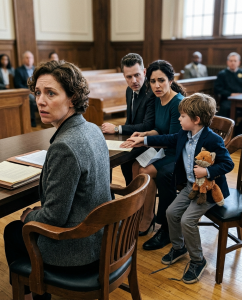
The mother at the custody hearing looked calm until her little boy slipped his hand into the other woman’s — and the courtroom realized the case wasn’t what anyone thought it was.
At first, it looked like the kind of moment family court feeds on.
A small boy choosing comfort from the wrong person.
A composed mother going pale while her ex-husband’s new partner received the easy affection she clearly didn’t.
It was the sort of image that could settle into a judge’s mind long after testimony ended. A child didn’t fake instinct, people liked to say. Children went where they felt safest.
That was exactly what made the moment so dangerous for Amelia Hart.
She had spent six months trying to survive the slow, polished dismantling of her reputation. None of Ryan’s accusations were dramatic enough to sound insane. He had been careful. He never called her unstable in so many words. He just described her as “intense.” Never claimed she neglected Noah. He only repeated, with sad reluctance, that her work often came first. Never said she was vindictive. He simply told people she “struggled to let go.”
Individually, those things sounded harmless.
Together, they built a woman no court wanted to trust.
Amelia knew how it looked. She knew her posture was too straight, her answers too clipped, her face too controlled. She had learned the hard way that if she cried, Ryan called her hysterical. If she got angry, he called her volatile. If she defended herself too hard, he called her obsessed.
So she had done the only thing left.
She had become still.
But stillness had a cost. People often mistook it for coldness.
That morning in court, she had already heard Ryan’s lawyer describe her as “high-functioning but emotionally rigid.” She had already watched him nod toward Amelia’s color-coded parenting binder like it was evidence of pathology instead of exhaustion. She had already listened to Ryan describe his own home as “a gentler environment” in a voice so mournful and measured it almost made Amelia laugh.
Almost.
Because she knew what gentle looked like with Ryan.
It looked like a hand against a doorframe just hard enough to make you jump.
It looked like a smile while lying.
It looked like saying cruel things in a soft tone so that if you repeated them later, you sounded dramatic.
It looked like making you question your own memory until defending yourself seemed irrational.
And lately, she had begun seeing traces of that same machinery at work in Noah.
The little pauses before answering questions.
The sudden worried glances after mentioning his father.
The strange adult phrases that didn’t belong in a six-year-old’s mouth.
Your work makes people lonely.
Sometimes mommies break homes.
Dad says not everybody tells the truth in court.
Every time Noah said one of those things, Amelia felt terror move under her skin.
But terror, unlike proof, couldn’t be submitted as evidence.
That was why she dreaded the hearing. Not because she thought she would lose immediately, but because she knew Ryan only needed to appear calmer than she did. He didn’t need the truth. He needed a cleaner performance.
Then Noah crossed the aisle and put his hand in Vanessa Cole’s.
Vanessa had been in Ryan’s life for eight months. Amelia knew the timeline because Ryan had moved with startling speed. The divorce wasn’t even final when Vanessa’s toothbrush appeared in the downstairs bathroom. Soon after came her shoes near the front door, her hair ties on the kitchen counter, her laugh in the background during drop-offs.
Amelia had expected resentment. What she had not expected was uncertainty.
Vanessa never behaved like someone openly hostile. She seemed cautious, even slightly uncomfortable around Amelia, as if she sensed tension she didn’t fully understand. Once, during a handoff, Amelia had caught Vanessa watching Ryan with a puzzled expression after he snapped too sharply at Noah for spilling juice. The look had vanished fast, but Amelia remembered it.
So when Noah took Vanessa’s hand in court, Amelia’s humiliation came mixed with something uglier.
Fear.
Because children offered themselves where they hoped to be heard.
And Noah had gone to Vanessa.
Not to Ryan. Never to Ryan.
That should have mattered immediately. Instead, for a few terrible minutes, it looked like the worst possible thing for Amelia’s case.
Until the stuffed fox fell.
Until the folded note slid out.
Until Vanessa opened it and the entire hearing tipped into another reality.
Amelia recognized the words instantly because she had written half of them herself.
Three nights earlier, Noah had stood at the kitchen counter in dinosaur pajamas while she packed his school lunch.
“How do you spell brave?” he had asked.
She smiled without looking up. “B-r-a-v-e.”
“How do you spell sorry?”
She had rattled them off one by one while slicing strawberries, distracted and tired and trying not to think about the hearing.
Brave.
Sorry.
Secret.
Mom.
Don’t leave.
She remembered pausing then, just for a second. “That’s a lot of serious words for school.”
Noah had shrugged too quickly. “It’s just writing.”
She should have asked more. She would blame herself for that for a long time.
Now Vanessa held the paper in her hand, white-faced, staring as if the room had suddenly grown teeth.
Ryan reached for it. She refused.
That was the first fracture.
The second came when Noah said, in that tiny shaking voice, “I wanted to ask if you knew my mommy wasn’t the one who leaves.”
The courtroom changed shape around those words.
Family court runs on procedure until a child says something no adult can package.
Then the truth starts leaking through the seams.
Ryan tried immediately to dismiss it. Noah was confused. He was overwhelmed. He’d been coached. Amelia expected that. What she didn’t expect was Vanessa’s reaction.
She crouched to Noah’s eye level with real horror on her face.
Not performative concern. Real horror.
When the judge asked to see the note, Vanessa handed it over, but not before glancing at the back and stopping short. Written beneath the copied spelling words, in Noah’s uneven block letters, was another message:
ask her why daddy says not to tell
The judge read it. His face hardened.
Ryan’s lawyer stood and began objecting to the “improvised questioning of a minor,” but the objection fell flat. Even he looked rattled now.
Then Noah said the next thing.
“He said if I loved Mommy too much, you wouldn’t stay either.”
Silence landed so hard it felt physical.
Amelia looked at Vanessa then and knew, with absolute certainty, that she had not known the full truth.
Because Vanessa’s expression wasn’t defensive.
It was devastated.
Ryan saw it too. “Vanessa,” he said, switching instantly to that coaxing voice Amelia used to mistake for tenderness, “you know how kids jumble things.”
But the mask had slipped already. It always did when control moved beyond his reach. The tension around his mouth had sharpened. His eyes had gone flat.
Noah noticed. He folded in on himself at once.
That was what convinced the judge more than anything else.
Not the note. Not the accusation. The flinch.
The social worker moved beside Noah. The bailiff took a half-step closer to Ryan. The hearing stopped being about custodial percentages and began drifting toward child welfare concerns.
Vanessa, perhaps only trying to return the note discreetly, picked up the stuffed fox again and felt something inside the torn seam.
She reached in and pulled out a tiny silver key taped to a receipt from a storage facility.
Ryan actually lunged forward before catching himself.
Too late again.
Vanessa unfolded the receipt. Unit number 214. Three monthly payments charged to Ryan’s card. On the back, in Noah’s writing: daddy put mommy boxes there. don’t tell.
For a moment Amelia couldn’t understand the words.
Then every missing thing from the past four months crashed together in her head.
The banker’s box of financial documents she could have sworn she packed after moving out. Noah’s preschool behavioral reports that vanished the same week Ryan accused her of “overreacting” to concerns. Copies of emails. Her personal journal. The notebook where she had written dates, incidents, and exact phrases Noah repeated after coming back from Ryan’s house.
She had searched everywhere.
Ryan had watched her search.
He had even helped once, standing in her apartment doorway with a sympathetic expression while she tore open hallway closets.
“You’re under so much pressure,” he had murmured. “You keep misplacing things and then blaming yourself. This isn’t healthy, Amelia.”
At the time, a part of her had believed him.
That was the thing about Ryan’s kind of manipulation. It worked best when paired with just enough kindness to make self-doubt feel reasonable.
The judge ordered an immediate recess and instructed both attorneys to approach.
Ryan began speaking rapidly, trying to explain the storage unit as harmless, administrative, misunderstood. Vanessa stepped away from him as if his voice itself had become dangerous.
“What’s in the unit?” she asked.
Ryan didn’t answer.
“Ryan,” she said again, louder now, “what is in the unit?”
“Private property,” he snapped.
There it was.
Not sadness. Not concern. Anger.
Clean and bright and impossible to mistake.
Vanessa’s face changed. Amelia watched the last of her uncertainty die.
The judge asked court security to remain present while he conferred with counsel. The social worker knelt beside Noah and gently asked if he felt safe with his father. Noah cried harder at that question than he had at any point all morning.
Amelia could not move.
She wanted to run to him. She wanted to hold him so tightly the whole world disappeared. But years of learning how Ryan used visible emotion against her kept her frozen in place until the social worker beckoned.
Only then did Amelia kneel beside her son.
Noah launched into her arms with the exhausted force of a child who had been waiting too long.
“I’m sorry,” he sobbed into her shoulder. “I’m sorry, Mommy, I was brave but I got scared.”
Amelia felt something break inside her, something old and hard she had been carrying since the marriage began.
“You were brave,” she whispered. “You were so brave.”
The judge issued an emergency temporary order before lunch.
Ryan’s parenting time was suspended pending investigation. The court authorized an immediate welfare review and granted Amelia temporary sole decision-making authority. It was not the final outcome, but it was enough to change the balance.
For the first time in months, Ryan did not leave the courthouse looking victorious.
He left furious.
Vanessa did not go with him.
Instead, she waited in the corridor while Amelia sat with the social worker and Noah in a small conference room. After several minutes, there was a soft knock. The social worker opened the door and looked to Amelia for permission.
Vanessa stood there stripped of courtroom composure. Her mascara had smudged. Her voice was low.
“I need to tell you something.”
Amelia should have wanted her gone. Instead she nodded.
Vanessa sat carefully, as if approaching a wound.
“There were things that didn’t make sense,” she said. “I told myself they were normal because divorce is messy. He always had an explanation. He said you exaggerated. He said Noah repeated things for attention. He said you wanted to punish him.” She swallowed. “A week ago, I found Ryan in the garage with one of your labeled storage bins open. He said he was sorting old tax records you’d abandoned. I believed him.”
Amelia closed her eyes.
Vanessa continued. “Two nights ago Noah asked me if I knew ‘the truth about his mom.’ I thought he meant the divorce. I asked Ryan later, and he laughed it off.” Her hands shook. “I should have pushed harder.”
Maybe she should have.
But Amelia had lived long enough with Ryan to know how easily doubt could be redirected inside his orbit. Vanessa had not built the trap. She had simply stepped into it.
“Why did Noah come to you?” Amelia asked quietly.
Vanessa’s eyes filled. “Because he needed to know if I was part of it.”
That answer hurt because it was true.
Children are frighteningly precise when identifying who might still be reachable.
With court authorization, Amelia’s attorney and a sheriff’s deputy accessed the storage unit that afternoon.
Inside were six banker’s boxes, two plastic bins, a file crate, and one sealed envelope.
Amelia stood just outside the unit door because suddenly her knees didn’t trust her. The deputy opened the nearest box.
Her handwriting.
Her folders.
Noah’s medical records.
Bank statements.
Preschool incident reports.
Printed emails.
The spiral notebook she had almost convinced herself she imagined.
And in the sealed envelope, photographs Ryan had taken of her apartment after the separation: laundry on the couch, dishes in the sink, toys on the floor. Curated fragments meant to support a future portrait of disorder.
There were also printouts of drafted statements. Notes in Ryan’s handwriting. Timelines. Talking points.
Use her late invoices.
Show pattern of disorganization.
Mention emotional outbursts.
Noah prefers calmer home.
On one page, written in the margin beside a list of Amelia’s supposed weaknesses, were four words that made the deputy go very quiet.
Need Vanessa credible and maternal.
Amelia stared at the line until the letters blurred.
Vanessa, when shown the page later, looked physically sick.
By evening, Ryan’s lawyer had withdrawn from representation.
By the end of the week, the court appointed a guardian ad litem for Noah and ordered a forensic evaluation. The storage contents were entered into the record. Ryan was instructed to have no unsupervised contact with Noah pending further review.
He still tried, of course.
He sent messages through attorneys claiming misunderstanding, mutual property confusion, emotional contamination by Amelia. He requested compassion. He hinted Vanessa had misinterpreted what she found because she was embarrassed about the relationship.
But something fundamental had shifted.
Once coercive behavior becomes visible to people outside the home, it loses some of its magic.
Vanessa gave a statement.
So did the social worker.
So did Noah’s therapist, who finally had a clearer framework for the child’s anxiety.
The months that followed were slow, expensive, and emotionally brutal. Recovery never arrives with courtroom music and a clean ending. It comes in paperwork, appointments, guarded handoffs that no longer happen, and children waking up from dreams they can’t explain.
Noah began to untangle the lies in pieces.
At first he asked practical questions.
“Did you leave Daddy first?”
“Did Daddy hide my drawings too?”
“Can people sound nice and still tell bad secrets?”
Later the questions got harder.
“Why would Daddy want me to think you left me?”
“Did I do something wrong when I listened?”
“Was Vanessa scared too?”
Amelia answered as honestly as a mother can without handing a child the full ugliness of his father.
“No, baby.”
“You did nothing wrong.”
“Some adults say unfair things when they want control.”
“Yes, I think she was scared too.”
That last answer mattered.
Because Vanessa did not disappear after the hearing.
She ended things with Ryan that same day. She cooperated fully with the investigation. She gave Amelia copies of texts she had once overlooked: messages where Ryan coached her on what to say about his “stable home,” reminders to mention Noah’s bond with her if anyone asked, warnings that Amelia would try to “manipulate female sympathy.”
Reading them was like watching the backstage mechanics of a lie.
Vanessa cried when she apologized, and Amelia believed she meant it. Belief did not erase the damage. It did not create instant trust. But it made honesty possible.
The final custody ruling came four months later.
Ryan was granted only professionally supervised visitation contingent on compliance with counseling, evaluation, and strict court conditions. Amelia received full primary custody and sole legal decision-making authority for the time being. The judge’s written order was blunt. Ryan had engaged in manipulative conduct detrimental to the child’s emotional well-being, including concealment of relevant records and attempts to distort the child’s perception of his mother.
Amelia read the order twice in her lawyer’s office, not because she doubted the words, but because after so long being told reality could be rearranged, she needed to see that sometimes it held.
That night, after takeout noodles eaten cross-legged on the couch, Noah fell asleep with the stuffed fox under his arm.
Amelia sat beside him in the dim bedroom light and looked at the little tear in the fox’s side where the key had been hidden.
Such a small place to carry so much fear.
Children do that all the time, she realized.
They hide unbearable things in soft places and hope the right person notices before it’s too late.
Weeks later, Vanessa dropped off a new stuffed fox she had bought to replace the damaged one. She left it on Amelia’s porch with a note.
He was trying to tell the truth the only way he could. I’m sorry I didn’t understand sooner.
Amelia kept the old fox anyway.
Not because she loved what it represented, but because it reminded her of the moment the story broke open.
The moment everyone in that courtroom stopped seeing a composed woman and an easygoing father and started seeing what had really happened.
A child had crossed a room, taken the hand of the wrong woman, and exposed the right lie.
And even now, long after the order was signed and the boxes were returned and the worst of the legal storm had passed, Amelia sometimes found herself replaying that instant.
Noah leaning into Vanessa.
The note falling free.
Ryan going white.
The truth, finally tired of being buried.
People still asked who the villain was.
Ryan, obviously.
But Amelia had come to think the deeper danger was something quieter: how easily control can be mistaken for calm, how often a mother’s restraint gets mistaken for coldness, how readily a charming man can borrow the language of concern and use it as a weapon.
She also thought about Vanessa sometimes.
About how close a person can stand to deception without seeing its full shape. About how expensive denial becomes when a child is the one paying for it.
And on the hardest days, when Noah asked one more question Amelia wished he never had to ask, she thought about bravery.
Not the dramatic kind.
The child-sized kind.
The kind that writes secret notes in crooked pencil.
The kind that hides a key in a stuffed toy.
The kind that slips a hand into someone else’s and says, without saying it outright, Please tell me whether you’re part of this too.
What Vanessa did next mattered.
What the judge did mattered.
What Amelia had survived mattered.
But the truth was, the whole case turned because a six-year-old decided he could not carry the lie one more day.
And that leaves its own uncomfortable question behind.
How many adults in that courtroom thought they were there to decide who the better parent was, only to realize a child had already done the bravest part for them?