When Uncle Ben died, the family behaved exactly the way grief sometimes exposes people.
Not with tears first, or stories, or even silence.
With claims.
The cabin was mentioned before the funeral flowers had started to wilt. The truck became a topic while casseroles still crowded the kitchen counters. Drawers were opened. Closets were checked. Small comments were made in low voices that weren’t low enough. Who had helped most. Who deserved what. Who had “always been promised” something no one had ever heard about until that exact moment.
Caroline stood inside all of it feeling like she was watching strangers wear the faces of people she had known her whole life.
Maybe she should not have been surprised. Her family had always found a way to turn tenderness into a contest. Whoever spoke loudest became right. Whoever demanded most became wounded if anyone resisted. Kindness was treated like weakness, patience like permission. Caroline had learned that early and survived it by becoming the one who didn’t fight over every inch of air in the room.
Uncle Ben had noticed that about her long before anyone else did.
He was not really her uncle by blood alone. After her mother died, he had become the one reliable person in the family—the one who showed up without needing applause for it. He did not talk much when others were around, but with Caroline he had a quiet steadiness that made the world feel less slippery. He taught her how to patch a screen door, how to sharpen a kitchen knife safely, how to check whether a fuse had blown, how to listen to a person’s tone instead of their performance.
And every winter, he fixed the old radio.
It sat on the kitchen shelf in his cabin, a heavy wooden thing with a scratched face and a dial that wandered unless it was coaxed into place. Caroline used to sit beside him wrapped in a blanket while snow feathered over the windows. He would twist one knob, tap the side once with his finger, then smile when a ribbon of static broke open into old country music. She loved watching the station arrive out of noise. He always let her turn the volume up the last little bit.
Those were the moments she remembered when the rest of the family only remembered objects.
At the reading of the will, Caroline sat quietly at the end of the table while her aunt dabbed dry eyes with a tissue that somehow never smeared her makeup. Her cousins leaned forward every time the lawyer paused, eager and tense. Her brother wore the solemn expression he always used when he wanted to look deeper than he was.
The cabin, everyone assumed, would become the center of the conversation.
Instead, the lawyer’s wording was cautious, almost annoyingly formal. Certain assets were listed. Certain possessions were left open to family agreement. There were references to personal effects, tools, furniture, vehicles, and other property “believed to be within the estate.”
Believed to be.
Caroline did not catch the significance then. Nobody did.
What they caught was opportunity.
By the time the meeting ended, her cousins were already discussing who would get the better bedroom in the cabin. Her aunt talked about the truck as if it had already been transferred into her name. Her brother announced he would take the fishing gear because “Ben would have wanted it used,” which almost made Caroline laugh. He had never once gone fishing with Uncle Ben and had complained openly for years that the smell of bait made him sick.
Then the lawyer pushed one last item across the table.
The old radio.
“It was specifically set aside,” he said.
Nobody wanted it.
One cousin actually laughed. “It doesn’t even work.”
Another glanced at Caroline, smirked, and said, “Perfect for you.”
The room gave a brief, cruel little ripple of amusement.
Caroline felt the sting, but she smiled anyway. She had learned that refusing to react often frustrated people more than tears ever could. She picked up the radio carefully, thanked the lawyer, and carried it out while the others stayed behind arguing over furniture placement and key copies.
The radio was heavier than she remembered.
At home, she set it on her kitchen table and stood looking at it for a long time. It still smelled faintly like dust and cedar, like Uncle Ben’s place in winter. She ran her thumb over a crack in the varnish and remembered him saying once, “If something’s worth keeping, it’s worth opening up before you throw it away.”
At the time he had been talking about a toaster.
Now, the words returned with strange force.
She turned the radio over. The back panel was slightly loose. Not broken—deliberately loosened. Uncle Ben was too precise for accidents like that. He hated stripped screws. He hated crooked shelves. If the panel sat wrong, it sat wrong for a reason.
Caroline found a screwdriver in her junk drawer and removed the screws one by one.
The panel lifted.
There were no wires where they should have been.
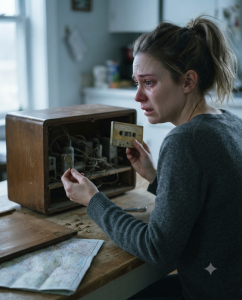
Instead, tucked into the hollow space inside the radio, wrapped carefully against the wood, were three things: a folded map, a small brass bank key, and a cassette tape wrapped in a strip of faded cloth.
For a moment, her brain simply stopped.
Then her pulse kicked so hard she had to sit down.
She picked up the tape first. In black marker, across the label, were two words in Uncle Ben’s hand.
For Carrie.
She stared at it until her vision blurred.
Caroline did not own anything that could play a cassette anymore. Most people she knew didn’t. But her neighbor, Mrs. Delaney, kept old things the way some people keep emergency supplies. Caroline took the tape and walked down the road in the dark, feeling the cold air against her face and the hard bank key pressed in her pocket like a second heartbeat.
Mrs. Delaney opened the door in slippers and listened without interrupting while Caroline awkwardly explained that she had found something inside an old radio. She disappeared into a closet and returned with a cassette player that looked nearly as old as the radio itself.
“Bring it back whenever,” she said. “And honey?”
Caroline looked up.
“Whatever’s on that tape, listen sitting down.”
Back home, Caroline set the player on the kitchen table. She inserted the cassette. Her finger hovered over the button for a second, suddenly afraid of what would happen after she pressed it—afraid the tape would be blank, or damaged, or full of some harmless message that meant she had imagined the importance of all this.
Then she hit play.
Static scratched through the room.
And then Uncle Ben’s voice arrived, low and worn and unmistakable.
“Carrie, if they gave you the radio, it means they still don’t listen.”
Caroline’s hand flew to her mouth.
He continued in the calm voice he used when he wanted someone to stop panicking and hear him all the way through. He said that if she had found the tape, then things had unfolded as he expected. The family would have rushed toward anything obvious. They would have measured value by appearance. They would have missed what mattered because they never listened long enough to hear the quiet parts.
Then his tone changed.
He told her the cabin had been purchased with money left by her mother before she died. Not borrowed money. Not shared family money. Her mother’s money, set aside with instructions that it be protected for Caroline. After her death, the situation became tangled by grief, legal delays, and pressure from relatives who viewed everything as communal when convenient and personal when profitable. Uncle Ben had stepped in, held the property in a way that kept it safe, paid what needed to be paid, and waited for Caroline to be old enough—and strong enough—to receive the truth.
He said he had wanted to tell her sooner.
He said he did not trust the people around her.
Caroline closed her eyes and listened through tears.
Uncle Ben went on. The truck, he said, had never belonged to the estate at all. It had been in a separate arrangement, one the family either misunderstood or pretended to misunderstand. The key, he explained, opened a safe deposit box containing documents, records, and instructions that would establish everything properly. Ownership. Source of funds. His legal intent. Her rights.
Then came the words that split her heart open.
“I’m sorry I had to hide this in a place they’d treat like junk,” he said. “But sometimes the only way to protect what matters is to put it where greedy people won’t bother looking.”
By the time the tape clicked off, Caroline was crying openly.
Not because she had suddenly inherited something valuable, though that part was enormous and real.
She cried because Uncle Ben had known. He had known how little the others thought of her. He had trusted that they would dismiss her, mock her, hand her the item they believed was worthless. He had used their cruelty as the lock on the truth.
She replayed the tape once, just to be sure she had not misunderstood.
Then she unfolded the map. It showed a simple route into town and an X drawn beside the local bank.
She did not answer the texts that began arriving. Her cousin asking whether she wanted “any of the kitchen stuff.” Her aunt announcing she would be by later for “Ben’s papers.” Her brother sending a message about dividing tools. They all spoke as if the shape of the future had already been decided.
Caroline hardly slept that night.
The next morning she was waiting outside the bank when the doors opened.
Inside, the air smelled faintly of paper and carpet cleaner. She approached the counter, placed the key down gently, and told the banker she needed help accessing a safe deposit box left to her by her late uncle. The banker examined the key, asked for identification, then led her through a series of quiet procedures that made the whole thing feel both ordinary and unreal.
Finally, she was shown into a small private room.
A metal box was placed on the table before her.
Caroline’s hands trembled as she lifted the lid.
Inside were neatly organized documents, each in labeled folders. Account statements. Purchase records. Tax receipts. Correspondence. A certified copy of a trust arrangement. Handwritten instructions from Uncle Ben. A letter from her mother’s attorney dated years earlier. And there, unmistakably, were records showing that the money used to buy the cabin had come from an account funded by Caroline’s mother’s estate and preserved specifically for Caroline’s benefit.
Caroline read every page twice.
The truck records were separate, just as Uncle Ben had said. It had been excluded from estate property under an earlier transfer. Her aunt had no claim through the will at all.
Then she found another envelope.
For Carrie only.
Her stomach tightened. She opened it.
Inside was a short letter from Uncle Ben and a notarized statement.
The letter warned her that the documents proved ownership, but the statement proved knowledge. If anyone challenged her, he wrote, she needed to understand that this had not been simple family confusion.
Caroline unfolded the statement.
What she read made her skin go cold.
Uncle Ben had documented conversations over several years. Dates. Locations. Specific names. He wrote that certain relatives had learned, directly from him, that the cabin funds came from Caroline’s mother. He recorded how they pressured him to “leave old money buried” and let the property pass informally after his death. One line hit her harder than all the rest: a relative had actually said Caroline would “take something sentimental and be thankful.”
Caroline stared at the page until the words blurred.
So they had known.
Maybe not everyone. Maybe not every detail. But enough. Enough to understand that the cabin was not theirs by right. Enough to choose silence anyway. Enough to count on Caroline being too gentle, too intimidated, too accustomed to less.
Her phone started buzzing on the table beside the documents.
Aunt Lydia.
Caroline let it ring.
Then a text from her cousin Mark: We need to talk before you do anything stupid.
Another from Aunt Lydia: Don’t create drama over paperwork you don’t understand.
Caroline gave a humorless little laugh at that. For the first time in years, their certainty no longer frightened her. It clarified everything.
The banker returned to check whether she needed assistance. Caroline looked up and, after a brief hesitation, asked for certified copies of all relevant documents. The banker nodded, professional and discreet, and carried the folders away.
While she waited, Caroline thought about every holiday where she had been talked over. Every decision made around her instead of with her. Every time her grief had been treated like a softer, less important thing than everyone else’s ambition. She thought about her mother, whose money had silently built the place the family now felt entitled to divide. She thought about Uncle Ben protecting those records year after year, carrying the burden until he couldn’t anymore.
And she thought about the radio.
How they had laughed when they gave it to her.
How casually cruelty can destroy itself.
With the certified copies in hand, Caroline left the bank and sat in her car without starting it. Her phone was still vibrating every few minutes. Voicemails were piling up. One cousin had shifted tactics and was now trying to sound warm. Her brother wanted to “clear up confusion.” Aunt Lydia had sent three messages in a row, each colder than the last.
Caroline called an attorney.
By afternoon, she was seated across from a woman with silver-framed glasses and the kind of expression that suggested she had spent years watching lies collapse under paperwork. Caroline laid out the tape, the map, the key, the documents, and finally the notarized statement.
The attorney read silently for several minutes.
Then she looked up and said, “You are in a far stronger position than they think.”
Caroline exhaled for what felt like the first time all day.
The attorney advised immediate protective steps. Formal notice. Temporary injunction regarding the cabin contents. Verified estate clarification. Preservation of records. A warning against unauthorized sale or transfer of disputed property. The words were dense and legal, but underneath them was a simple truth: Caroline did not have to beg. She did not have to negotiate from shame. She did not have to ask permission to hold what was already hers.
That evening, a courier delivered notices.
The reaction was immediate.
Her aunt called screaming. Her brother accused her of betrayal. One cousin insisted Uncle Ben must have been manipulated in old age, right up until the attorney mentioned the supporting documents and notarized statement. Then the story changed. Suddenly this was all a misunderstanding. A painful family mix-up. Nobody had meant anything by it.
But intention gets harder to fake when dates and signatures exist.
Within days, the locks on the cabin were legally secured. The truck transfer was challenged and reversed. Inventory was taken. Records were reviewed. The family’s confidence thinned into panic, then resentment, then silence. Caroline did not enjoy any of it the way some people might have. Vindication was real, but it was not light. It came braided with grief, with anger, with the ugly knowledge that people she had spent years trying to keep peace with had counted on her silence as part of their plan.
When she finally returned to the cabin with lawful possession recognized, she unlocked the door and stepped into a stillness that felt almost sacred.
The place smelled like pine wood, old coffee, and cold stone.
Nothing dramatic happened. No music rose. No hidden person appeared. It was just a room and then another room and another, all carrying the shape of Uncle Ben’s life. His boots by the back door. The mug with the chipped handle. The folded blanket near the chair where he used to sit. Caroline stood in the kitchen and cried harder there than she had at the bank, because now the truth was no longer abstract. It had a floor beneath her feet. A window she could touch. A table where she had once turned the radio dial while he smiled beside her.
On the highest shelf above the pantry, she found one last note tucked inside a coffee tin.
Knew you’d look eventually.
Inside, just a sentence.
Quiet doesn’t mean you don’t know who you are.
Caroline kept that note in her wallet.
Months later, after the legal dust had settled, she repaired the radio properly. A local technician helped preserve the hidden compartment before restoring the internal parts. The first time it crackled back to life in her own kitchen, Caroline stood there listening to an old country station drift through static, and for a second it felt like winter in Uncle Ben’s cabin again.
The family was never the same after that.
Some apologized badly. Some not at all. Some continued insisting the whole thing had been exaggerated, as though documented facts were simply rude opinions written on paper. Caroline stopped trying to make their version of her comfortable. She learned that distance can be a form of peace. She learned that being underestimated is painful, but it can also reveal exactly who people are when they think you won’t fight back.
And the strangest part was this: the broken radio they had mocked was the most honest inheritance of all.
Not because it led to the cabin, or the truck dispute, or the documents.
Because it proved Uncle Ben had seen her clearly.
In a family that talked over her, he had trusted her to listen. In a family that reached for surfaces, he had trusted her to look deeper. In a family that treated gratitude like obedience, he had left her the truth instead of a performance.
Some nights, Caroline still wondered which betrayal hurt more—the greed itself, or the confidence behind it. The certainty that she would smile, carry home something broken, and never think to open it.
They were wrong.
But not before revealing exactly who had been listening all along.