The storm came down over Cudillero with the kind of force people remembered for years.
Rain battered the cliffs and swallowed the road. Wind dragged branches across stone walls and shook the old farmhouses as if it wanted to pry them open. On the steep track leading to Doña Candelaria Villalba’s land, mud ran in dark ribbons, and the apple trees groaned like restless old men. Even the goats in the stable were uneasy, stamping and crying into the night.
Inside her house, Candelaria fed the fire and listened to the weather try to break the windows.
At seventy-two, she lived by rules.
No visitors after dark. No favors she hadn’t chosen. No stories from strangers. No trust offered too quickly, and none given twice.
The villagers called her hard, suspicious, impossible to please. They lowered their voices when they spoke of her, but not enough that she couldn’t hear. She had stopped caring years ago. People liked simple explanations. Bitter widow. Difficult old woman. Miserly landowner.
The truth was uglier, and therefore easier for everyone else to ignore.
Someone from her own family had once promised to care for her. That person had waited until grief made her weak, then taken money from the house, sold things that weren’t theirs, and left with the kind of betrayal that hollowed out more than a bank drawer. After that, Candelaria kept her world small and locked.
Her farm was enough. Seven hens. Three goats. A kitchen that held one cup, one plate, one chair by the table. The rest remained pushed back against the wall, dust gathering on their backs like a second life no one was allowed to touch. A gray cat named Olivo ruled the rooms with quiet arrogance. He slept where he pleased, judged everyone harshly, and was the only creature Candelaria spoke to without restraint.
That night, when three knocks landed on the door, Olivo raised his head at once.
Candelaria stared toward the entryway.
Nobody came to her house in weather like that unless they were desperate, foolish, or dangerous.
The knocking came again.
She took the oil lamp and crossed the hall. When she opened the door an inch, the wind slammed it wider with a burst of rain.
Outside stood an older man with a weather-beaten face and soaked clothes clinging to his body. A cloth bag hung from one shoulder. Beside him, half folded into his arm, was a young woman so pale she looked almost blue in the lamplight.
“I don’t ask anything for myself,” the man said. His voice shook, whether from cold or exhaustion Candelaria couldn’t tell. “Only shelter for my daughter. Let her warm herself for a little while. I’ll stay outside.”
The girl tried to lift her head. “We won’t trouble you. Just until the storm eases.”
Candelaria looked at them both and felt her instincts split in two.
One voice told her to shut the door now and protect what little peace she still had.
The other saw the daughter’s lips, the way the father tried to keep himself between her and the rain, and remembered too much.
“Names,” Candelaria said.
“Isidoro Almenara. She’s Nerea.”
“Where are you going?”
“Luarca. I was offered work on a farm there. But the road…” He glanced behind him at the black torrent of mud and water. “We couldn’t keep walking.”
Nerea coughed, a deep, tearing cough she tried and failed to hide.
Candelaria closed her eyes for one brief second.
“Only until morning,” she said. “You follow my rules. You don’t touch what isn’t yours. You leave when I say.”
Relief nearly buckled Isidoro where he stood. “Thank you.”
“Don’t thank me yet. Get inside.”
They crossed the threshold like people who knew the price of being turned away.
Candelaria found them towels. She laid more wood on the fire and put food on the table: bread, cheese, apples, coffee with milk. Halfway through slicing the bread, she noticed she had arranged three portions. The sight of three places on the table hit her with such force she almost swept two of them away.
Instead, she said nothing.
Nerea lowered herself into the chair carefully, moving with the stiffness of someone holding back pain. Isidoro sat only after she did. He watched her with constant, anxious attention, the way exhausted parents do after many nights without sleep.
Olivo slipped out from under a bench and went straight to Nerea.
“That’s unusual,” Candelaria murmured.
Nerea looked up. “What is?”
“He doesn’t like people.”
The cat rubbed against her ankles, purring as if he had made up his mind.
A tired smile touched Nerea’s mouth. “Maybe he only likes the pitiful ones.”
The smile became another cough. Isidoro flinched.
“You need a doctor,” he said under his breath.
“We need work,” Nerea answered, just as quietly.
Candelaria heard both.
Over supper she learned very little, and yet enough. They had left a place where there was no work and too much pride among relatives. They were traveling on promises, not guarantees. Nerea was ill but stubborn. Isidoro was poor but still tried to give her the larger half of everything on the table. When he slid part of his bread toward her, she waited until he looked away and pushed some back.
There was no performance in them. No polished misery. No manipulative story told for sympathy.
That almost made them more dangerous to her, because sincerity was harder to defend against than lies.
By morning, the storm had grown worse.
No one could have left safely, not over the high road and not toward the coast. So they stayed. One day became two. Two became three.
And in those three days, Candelaria’s house changed.
Isidoro repaired a loose fence board and patched a leak over the chicken shed using scrap she had meant to fix for months. He never asked to be paid and never acted as though his work purchased kindness. He simply noticed what needed doing.
Nerea, feverish though she was, insisted on helping indoors. She washed cups, swept the kitchen, folded blankets, and spoke to Olivo as if he were a proper gentleman with opinions worth hearing. Once Candelaria found her standing at the window with the cat in her arms, both of them watching the rain with the same solemn expression.
The sound of another woman in the house unsettled her.
Not because she disliked it.
Because some part of her had missed it so much.
On the second afternoon, Nerea found an old cracked blue bowl in the pantry and asked if she might use it for broth. Candelaria almost snapped that the bowl had belonged to someone else and was not for strangers. But when she looked at Nerea’s face, she saw no entitlement there, only care.
“Yes,” Candelaria said at last. “Use it.”
Nerea smiled. “Thank you.”
Such a small thing. Such an ordinary moment.
It left Candelaria shaken anyway.
In a village like theirs, ordinary peace was never allowed to grow undisturbed. The first threat came in polished boots.
Don Severiano Montalbán rode up to the gate just after noon on the third day. He owned neighboring land and had spent years trying to persuade, pressure, or annoy Candelaria into selling her farm. He masked greed in concern so often that some people had begun to mistake one for the other.
“I heard voices,” he said, glancing toward the house. “Thought perhaps you had company.”
“Perhaps I do.”
His eyes narrowed. “Strangers?”
“Travelers delayed by the storm.”
He leaned one elbow on the gate as though he had every right. “You should be careful. Desperate people are the first to smile and the quickest to steal.”
Candelaria stiffened. “You came all this way to insult guests under my roof?”
“I came to warn you. You live alone. It only takes one mistake.”
His gaze lingered on the windows too long.
Candelaria shut the gate in his face.
Yet his words stayed, because poison does not need to be believed to begin its work. It only needs to be heard.
That evening she returned from the village after selling eggs and trading for lamp oil. She carried the coins into her bedroom and opened the bottom drawer of the old dresser where she kept the little things she trusted nowhere else.
The photograph was there.
The silver medal was not.
For a moment she stopped breathing.
She touched the folded cloth where it should have rested, as if her fingers might somehow discover what her eyes had missed. Then she tore through the drawer. The photograph. The cloth packet of old letters. A hair ribbon faded almost white. No medal.
Her daughter’s medal.
The last object she owned that carried no bitterness.
The room blurred.
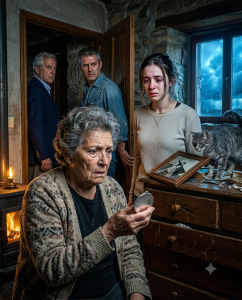
Behind her, Olivo let out a sharp cry. Candelaria turned and saw Nerea standing in the doorway with a damp rag in her hand.
“Is something wrong?”
The tenderness in the question landed at the worst possible time.
“Something is missing,” Candelaria said.
Nerea’s expression changed instantly. She understood at once.
“No.”
The single word was barely above a whisper.
Isidoro appeared behind her a second later, alert and tense. “What happened?”
“My silver medal is gone.”
He frowned, uncomprehending at first. Then he saw her face and understood the accusation. His own face drained of color.
“We haven’t taken anything.”
“You are the only people who have entered this house.”
Nerea’s hand trembled against the doorframe. “I did not steal from you.”
Candelaria hated the hurt in her voice. Hated it because it struck her as honest, and by then honesty only made the choice in front of her more painful.
“People say many things,” she replied coldly. “Experience teaches better.”
Isidoro drew himself upright. Shame and anger warred across his features, but he kept his voice measured. “Search our things.”
Candelaria did. She searched the cloth bag, the blankets, their coats, the corners where belongings might be hidden. She found spare stockings, a crust of hard bread, medicine leaves wrapped in paper, a comb missing teeth, and almost nothing else.
No medal.
That should have stopped the accusation.
Instead it deepened it. If the medal was gone and not in their things, then perhaps they had already hidden it. Perhaps they meant to retrieve it once they left. Suspicion, once inflamed, starts building its own evidence from air.
Nerea stood by the wall as Candelaria searched. She looked less angry than wounded, as though some fragile thing had finally cracked.
“I knew,” she said quietly when the search ended. “From the first night, I knew you were waiting for proof that kindness had been a mistake.”
Candelaria said nothing.
Isidoro helped Nerea sit near the fire. He put a blanket around her shoulders with hands that tried hard not to shake. “We will leave in the morning,” he said.
“It may still be dangerous,” Candelaria answered automatically.
He looked at her, and there was no gratitude left in his eyes now. Only restraint. “More dangerous than staying where my daughter is treated like a thief?”
The words hit exactly where they should have.
Before Candelaria could answer, a shadow crossed the doorway.
Severiano.
He stood there with the half-concerned expression men like him practiced in mirrors. “I heard raised voices. Is everything all right?”
Candelaria turned on him at once. “This is not your concern.”
But his gaze had already moved from her face to Nerea’s tears, to Isidoro’s rigid shoulders, to the open dresser drawer.
“So,” he said softly. “Something has gone missing.”
The satisfaction was subtle. Barely there.
Candelaria saw it too late.
He stepped farther inside, all false sympathy. “I warned you.”
Nerea stared at him as if seeing him clearly for the first time. Isidoro’s mouth tightened.
“Enough,” Candelaria snapped.
Yet Severiano stayed, because men who live off intrusion rarely recognize its limits.
The room sat in misery until Olivo leaped onto the dresser.
The cat landed with all four paws and knocked the old photograph frame sideways. It struck the wood, tilted, and fell face down with a crack. Behind it came a bright metallic sound.
Everyone turned.
Candelaria stepped forward, pulse hammering. She lifted the frame with trembling fingers.
Behind it, wedged between wood and the back panel, lay the missing silver medal.
No one spoke.
Rain battered the windows. The fire hissed. Somewhere in the stable, a goat cried out.
Nerea closed her eyes, and one tear slipped free before she could stop it.
Candelaria felt the blood drain from her face. The medal had not been taken. Perhaps she had left it against the frame. Perhaps it had slipped when she closed the drawer. It did not matter. What mattered was what she had done with her fear once it found a target.
“I…” The word died in her throat.
Isidoro pulled in a slow breath. He looked first at the medal, then at Nerea, then at Candelaria. His jaw was tight with held-back fury, but when he spoke, his voice was low.
“You searched my daughter.”
Shame struck deeper than any insult could have.
“Yes,” Candelaria whispered.
Nerea stood with effort, swaying slightly. “I told you.”
“I know.”
Candelaria had imagined many humiliations in life, but not this one: standing in her own room, the thing she valued most in one hand, while the value of her own judgment shattered around her.
Severiano cleared his throat. “Well. An unfortunate misunderstanding.”
Isidoro turned to look at him.
There was something in that gaze that changed the room.
“Strange,” he said slowly, “how quickly you returned for a misunderstanding.”
Severiano’s expression flickered. “I came because I heard trouble.”
“You came because you expected it.”
Candelaria’s breathing slowed. Her thoughts sharpened through the fog of guilt. He had appeared at the gate that morning with his warning already prepared. He had pushed suspicion into her house before the drawer was even opened. And now he had returned almost eagerly, as if he had been waiting nearby for the outcome.
Nerea looked at Severiano too. “He needed her to believe it.”
Severiano laughed, but there was strain in it now. “Believe what? That strangers can’t always be trusted?”
“No,” Nerea replied. “That she should stay afraid. That she should push everyone away.”
Candelaria’s eyes moved down to Severiano’s boots.
Mud clung to the sides, not the front path’s lighter clay but the darker wet earth from the side of the house, near the bedroom window and the outer wall. He had not come only by the gate.
A cold understanding slid into place.
“How long have you been circling this house like a vulture?” she asked.
His face changed. Not much. Just enough.
“You’re upset,” he said. “This is hardly the time—”
“What else have you taken from me over the years?”
The question fell like a stone.
Isidoro looked from one to the other, reading the history there. “He has been trying to buy the land.”
“For years,” Candelaria said.
“Land that is too much for one woman alone,” Severiano answered sharply, dropping the gentle mask. “I have made fair offers.”
“Fair?” Candelaria stepped closer. “You spread rumors that I’m losing my mind. You tell people I can’t manage this place. You come to my gate with warnings and your eyes on my windows.”
His mouth thinned.
Nerea put one hand to the back of a chair, steadying herself. “He wanted you to send us away in disgrace. Then he could point to this and say you were right to trust no one. Easier to corner someone when they believe everyone else is a threat.”
Severiano scoffed, but not convincingly.
Candelaria saw then that fear had made her useful to him. The lonelier she became, the easier she was to pressure. The more suspicious she appeared, the less anyone questioned who had helped deepen that suspicion.
“Get out,” she said.
He did not move.
“Get out of my house.”
Still he hesitated, and in that hesitation Candelaria found the old iron in herself that grief had never managed to kill.
She raised the silver medal, her daughter’s medal, and her voice came out strong enough to cut through storm and shame alike.
“You will leave now, Severiano, or I will walk into the village tonight and tell every living soul exactly how often you have entered this property under false concern. I will tell them what you said at the gate. I will tell them where the mud on your boots came from. And tomorrow I will have the boundary marked in front of witnesses. If you set one foot here again, it will not be me facing you alone.”
For the first time in years, Severiano looked uncertain.
Men like him relied on silence, not confrontation.
He stared at her, then at Isidoro, who had already squared himself between Severiano and the women without seeming to think about it. Nerea stood pale but unflinching. Olivo crouched on the dresser with his ears flat and eyes fixed.
At last Severiano backed toward the door.
“This is a mistake,” he muttered.
“No,” Candelaria said. “My mistake is standing in front of me already.”
He left without another word.
The house remained still for several seconds after the door closed. Rain pressed against the walls. Firelight moved across the broken frame on the floor.
Then Candelaria turned to Nerea.
She had apologized before in life, but never in a way that cost her pride. This one did.
“I was wrong,” she said. “Cruelly wrong.”
Nerea looked exhausted, hurt, and far too young in that moment. “Yes.”
Candelaria accepted the answer because she deserved nothing gentler.
She faced Isidoro next. “You offered me trust when I had earned none from you. I repaid it with suspicion.”
He exhaled slowly. “You repaid it with fear.”
The correction was merciful, and therefore harder to bear.
Candelaria nodded. “Stay until the roads clear. Not because I’m sorry. Though I am. Stay because your daughter should not be moved in this weather, and because this house has done enough harm for one week.”
Isidoro looked at Nerea. Nerea studied Candelaria for a long time, as though weighing whether repentance in an old woman was simply another form of self-protection.
Then she coughed into her sleeve, tired beyond ceremony, and said, “I don’t think I can make it to the gate, so for tonight you’re fortunate.”
It was a joke so dry that for one startled second no one moved.
Then, unexpectedly, Candelaria laughed.
It came rusty and unfamiliar, but real.
Isidoro’s shoulders loosened. Even Nerea’s mouth curved despite herself. The tension did not vanish, not all at once. Wounds do not close simply because truth arrives. But something else entered the room beside the hurt: the possibility that not everything broken must remain broken forever.
The storm weakened by morning.
By the next day, Nerea’s fever had eased enough that the color began returning to her face. Candelaria brewed broth, stronger tea, and a bitter herbal mixture her grandmother had once used for chest illness. Nerea made a face at the taste, and Candelaria informed her that health did not come flavored with honey. Isidoro laughed into his sleeve.
On the third clear day, they all went into the village together.
Candelaria did exactly what she had promised. In front of witnesses, she had the property boundaries reviewed and recorded. She spoke plainly, with names and dates, about Severiano’s repeated visits, the pressure to sell, the rumors he had spread. Others, hearing her speak openly for the first time, began to speak too. A widow from the lower lane said Severiano had once tried to frighten her about unpaid debts that did not exist. A shepherd admitted Severiano had asked too many questions about who came and went from Candelaria’s house. Piece by piece, the careful image he had built began to split.
He did not return to her gate after that.
As for the work in Luarca, it turned out the offer was still open. The estate owner, a cousin of one of Candelaria’s market contacts, needed someone steady and used to farm labor. Isidoro accepted. There was even a small outbuilding where he and Nerea could stay while she recovered enough to help with lighter tasks.
On the morning they were meant to leave, Candelaria packed bread, cheese, apples, dried herbs, and far too many eggs into a basket.
“This is excessive,” Isidoro said.
“This is practical,” she replied.
“It’s excessive,” Nerea murmured, smiling.
Candelaria ignored them both. Then she disappeared briefly into her bedroom and came back carrying the old cracked blue bowl wrapped in cloth.
Nerea blinked. “No, I can’t take that.”
“You can,” Candelaria said. “Someone should use it.”
Nerea accepted it carefully, as if receiving something larger than pottery.
At the doorway, Olivo wound himself around Nerea’s legs with such drama that she nearly missed her step.
“He’s trying to come with you,” Isidoro said.
“He is trying to steal my farewell,” Candelaria corrected, though her voice had softened.
Nerea looked at her. “Thank you. Even for the hard part.”
Candelaria understood. The hard part had not been the shelter. It had been the truth that followed. Sometimes mercy arrived dressed as humiliation, because that was the only shape pride would allow it to take.
Isidoro extended his hand. Candelaria looked at it for a second, then took it firmly.
“You gave us more than shelter,” he said.
She almost denied it, then chose honesty instead. “And you gave me back something I had nearly buried for good.”
When they finally walked down the path, the weather was clear enough that the sea could be seen again beyond the hills, silver under the light. Candelaria stood at the door until they disappeared from view.
That night, she went to the kitchen and, without thinking, pulled out two extra chairs from the wall before stopping herself.
She left them there.
Olivo jumped onto one and curled into a gray coil as if approving the decision.
Weeks later, a letter arrived from Luarca. Isidoro had steady work. Nerea was improving. She ended the note by saying the blue bowl had already become the most argued-over object in their small kitchen because her father claimed it made soup taste better than any other bowl in Spain.
Candelaria read the letter twice, then placed it in the bottom drawer of her dresser beside the old photograph and the silver medal.
The medal meant something different now.
For years she had treated it as proof of what she had lost. Now it also reminded her of what fear could turn her into if left unchallenged. More than that, it reminded her that the cruelest theft in a house is not always the stealing of an object.
Sometimes it is the slow theft of trust.
Sometimes it is a neighbor feeding your worst instincts until you no longer recognize yourself.
And sometimes the person who saves what remains of you is the one you almost turned away in the rain.
Who was right and who was wrong no longer felt like a simple question. Candelaria had been manipulated, yes. But she had also chosen suspicion when she could have chosen patience. Severiano had tried to steal her land. Fear had nearly helped him by stealing her judgment first.
In the end, the missing medal was found.
What took longer to recover was the part of her that still believed an open door could lead to anything but regret.
That, perhaps, was the real thing returned to her.