The donkey stopped first.
Not Celestina. Not the children. Not even the hope that had been fading mile by mile beneath the late afternoon sun.
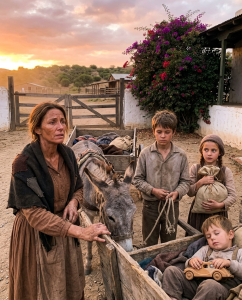
It was the donkey, stubborn and trembling, that planted its hooves in the dirt in front of the gate and refused to move another inch.
For one suspended second, Celestina stood beside the cart and simply breathed. Her hands ached from gripping the sideboards. Dust clung to the hem of her skirt. Her feet were swollen inside worn shoes, and every bone in her body felt scraped raw by the road. Behind her, three children waited in the silence that only hunger and exhaustion can create.
She lifted her eyes and read the wooden sign over the entrance.
El Refugio.
The Shelter.
The name nearly broke her.
For three days, she had walked with one thought hammered into her mind: do not stop, because if you stop, the children will see how scared you are. But now the donkey had made the choice for her. The animal’s flanks shuddered with effort. Its ribs showed through its hide. The cart behind it carried the last remains of her life—old clothes, blackened cooking pots, a blanket bundle, a broken stool leg she had not meant to keep, and three children who no longer asked where they were going because they had learned that not all mothers have answers.
Celestina climbed down and turned toward them.
Aurelio, thirteen, held the reins with a clenched jaw and eyes too old for his face. Since his father’s death, he had been trying to carry things no boy should carry. Her daughter Jacinta, nine, hugged a sack of clothes to her chest and watched everything in silence, as if speaking might make the little they had left vanish too. Mateo, only five, sat curled beside a dented pot, his small wooden toy car in his fist, staring at the ranch gate like it might either feed him or swallow him.
Celestina smoothed back her hair with dusty fingers. “Stay here,” she whispered.
She walked to the gate and knocked three times.
When the door opened, she saw a man framed by fading light. He was tall, broad, deeply tanned by work under the sun. His hands were rough, his shoulders heavy, his expression unreadable. He looked first at her face, then at the children, then at the donkey and the cart.
There are tragedies that explain themselves.
“Where are you coming from?” he asked.
“La Colorada.”
He let the words settle. “And your husband?”
“Dead.”
No decoration. No softness. No tears.
She had spent them all in private.
His gaze sharpened. “And the children?”
“Mine.”
He nodded once. “Why are you on the road?”
This time the answer burned.
“Because after I buried my husband, his family came with documents and told me the house and land were theirs. They said I could leave quietly or make trouble. So I took what I could carry, loaded the children into the cart, and walked.”
The man looked at the boy holding the reins. Aurelio stared back, refusing to lower his eyes. Then he looked at Jacinta, who edged behind the cart’s sideboard. Finally he looked at Mateo, who did not understand adult pride or legal theft, only the shape of danger.
“There are three,” the man said.
“There are three,” Celestina answered, her voice steady even as shame rose hot in her throat. “And none of them are a burden. The boy knows fieldwork. The girl helps in the kitchen. The little one learns fast. I can cook for you, clean for you, work in your house… just accept me with my children.”
The man did not answer right away.
The sun dipped lower. The donkey snorted and dropped its head. Somewhere behind the house a chicken made a sharp complaint before settling for the evening.
At last he stepped aside and opened the gate.
“For tonight,” he said.
Celestina almost staggered with relief.
Not because the problem was solved. It was not. They still had no guarantee of tomorrow. But for one night, her children would not sleep on the ground.
That mattered enough to feel like grace.
The man’s name was Steven.
The ranch was modest but solid, cleaner than prosperous places she had seen abandoned by neglect. Whitewashed walls. A swept porch. A wide corridor cooled by shade. Red bougainvillea climbed one post near an empty rocking chair. The house felt cared for, but lonely, as if someone once loved every corner of it and someone else had been trying to preserve that love by force of habit alone.
Celestina noticed details because details were survival. The kitchen was organized but rarely used. The sink was scrubbed clean, but the bread tin was nearly empty. Boots by the door were repaired more than once. A shelf held medicines, all for one person.
This was a house where only one adult had been living for a long time.
The children ate that night with the shaky hunger of those trying not to seem desperate. Steven watched without intrusion. He gave them beans, cheese, and whatever bread was left. When Mateo nearly fell asleep at the table, Jacinta rested a hand on her brother’s shoulder and guided him to the room Steven had offered them.
Celestina thanked him, though gratitude tasted strange when mixed with humiliation.
She did not sleep.
Near dawn, while her children lay scattered in deep, exhausted silence, she rose and found the kitchen. Work was the one thing still fully hers. She lit the stove, sorted what ingredients he had, and cooked black beans, hot tortillas, and coffee strong enough to cut through sorrow.
When Steven entered, he stopped at the doorway.
“You didn’t need to do that.”
“You gave us shelter,” she said. “I don’t know how to receive without earning.”
He ate in silence. Then, looking into his cup, he asked, “Your son really knows ranch work?”
Celestina met his eyes. “I’m not trying to place him in your hands. I’m telling you the truth. His father taught him before he died.”
After breakfast, Steven showed them the property.
There were twelve head of cattle, four horses, a neglected kitchen garden, and a chicken coop barely holding together. Fences needed mending. Tools needed organizing. The pump handle squealed with rust. But there was life in the land. It had not given up.
Celestina walked the garden rows, crouched, crumbled soil between her fingers, tested the coop door, and studied the hens.
“The chicken coop can be fixed in twelve days,” she said. “The garden will produce in less than a month if it’s cleared, watered, and planted properly. But people have to let me work.”
A shadow of a smile touched Steven’s mouth.
Within days, everyone fell into rhythm.
Aurelio worked beside Steven in the fields and around the stock pens. The boy listened carefully, learned quickly, and did twice the labor expected of him because gratitude had settled into him like a commandment. Jacinta swept, shelled beans, washed dishes, and slowly returned to herself by naming every hen she encountered. Mateo discovered corners of the yard to conquer, from the water trough to the barn steps, and once laughter returned to him, it changed the whole sound of the place.
So did Celestina.
She repaired the kitchen garden row by row, raised seedlings in tin cans, patched feed sacks, boiled herbs against insects, restored order to shelves and storerooms, and turned meals into something warm enough to make even silence feel less severe. She did not hover, did not pry, did not ask for promises. She worked.
Steven noticed everything.
He noticed how she mended without complaining, how she measured flour by touch and knew when rain was coming by the movement of birds, how the children obeyed her not from fear but from trust. He noticed Aurelio’s determination, Jacinta’s gentleness, Mateo’s sudden devotion to a stray gray barn cat. He noticed, too, that the ranch felt less like a mausoleum.
And that frightened him.
Because it had once been alive in another way.
One night Celestina heard him crying.
It was past midnight. She had risen for water and paused in the hallway when she heard the sound from behind a locked door at the far end. Not loud sobbing. Just a rough, broken breath and the kind of muffled grief that belongs to people who have practiced suffering alone.
The next day, while folding laundry, she found a photograph tucked beside a clean shirt. A woman stood smiling in front of the bougainvillea, one hand on the porch rail, sunlight in her hair.
Steven gently took it from her. “Her name was Rosario.”
He said the name like he was afraid it might disappear if spoken too quickly.
Later, piecing together what little he allowed, Celestina learned that Rosario had been his wife. She had planted the flowers, kept the ranch books, named the place El Refugio, and died of a fever that turned dangerous too quickly and too far from proper medical help. Since then, Steven had stayed on as if devotion alone could hold a life in place.
The locked room had been hers.
Celestina never asked to enter it.
Then the horsemen came.
It was just after noon, when heat pressed against the yard and the chickens had taken shelter in strips of shade. Two men rode up to the gate and remained mounted, which told Celestina enough before they even spoke. Men who bring respect dismount. Men who come to claim, threaten, or inspect from above stay in the saddle.
“We’re looking for Steven,” one of them said.
Steven came from the barn and recognized them immediately. Celestina saw it in the way his shoulders stiffened. The men were Rosario’s relatives—cousins, as it turned out—who had rarely visited while Rosario was alive and not once offered help after she died.
They moved away from the porch to speak privately, but privacy means little on an open ranch. Celestina could not hear every word, only fragments carried by the wind.
“…legal right…”
“…Rosario’s property…”
“…thirty days…”
When Steven returned, he looked like a man who had been struck somewhere no one could see.
“They say the ranch belonged to Rosario before we married,” he said at last. “They claim the property should pass to her blood relatives. They gave me one month to leave.”
Aurelio stopped cold beside the well. Jacinta held the cat tighter. Mateo looked from one adult face to another, the air itself seeming to tell him danger had arrived.
Steven sat down on the porch step as though his legs no longer trusted him. “I should have seen this coming,” he muttered. “Rosario handled the papers. I never cared who was named where. The place was ours. That was enough for me.”
Celestina felt something cold move through her.
She knew this script. She knew the polished certainty of people who came with claims after death, when grief had made the living slow and vulnerable. She had watched it happen to herself.
“Show me the papers,” she said.
Steven looked up. “What?”
“The deeds. The tax receipts. Anything with names.”
He gave a bitter laugh. “It won’t matter.”
“It mattered when they stole my home,” she said. “Paper can be twisted. It can also expose the people twisting it.”
That evening, after the children were fed, Steven unlocked the room at the end of the hall.
Rosario’s room had been preserved like a held breath. Dresses hung in order. A comb rested on the dresser beside a ribbon. A shawl was folded over a chair. On the bedside table sat a Bible, a rosary, and a dried sprig of bougainvillea pressed between its pages.
From a wooden chest, Steven lifted bundles of documents tied with string. Celestina spread them across the table and lit the lamp higher. Aurelio stood beside her, reading the parts he could. Names. Dates. Boundaries. Transfer statements. Receipts for taxes Rosario had paid in her own hand.
Then Celestina saw a document older than the rest.
At the bottom was a name she had never heard.
Tomasa Villarreal.
“Who was she?” Celestina asked.
Steven frowned. “Rosario’s godmother. Why?”
Celestina read again. The ranch had not passed directly to Rosario from her parents, as the cousins claimed. It had first been left to Tomasa, who later transferred use and stewardship under specific terms. There was also a letter, tucked between receipts, written in Rosario’s careful script and addressed to a local attorney in town. In it, Rosario referred to a final filing she intended to complete after the harvest—one that would secure Steven’s right to remain on the land if anything happened to her.
“Did she ever go through with this?” Celestina asked.
“I don’t know.”
“Do you know the attorney?”
“Señor Barrera. In San Miguel. Old man with a limp.”
Celestina folded the letter with sudden purpose. “Then tomorrow we go to San Miguel.”
Steven hesitated. “And if the filing was never completed?”
“Then we find out what was completed,” she said. “Because men who lie that confidently usually expect no one to challenge them.”
Before sunrise, Celestina and Steven rode out in the wagon, leaving Aurelio in charge with strict instructions. The road to San Miguel jolted every bruise in her body, but her mind stayed sharp. She had been powerless once. She would not be powerless twice if stubbornness could prevent it.
Attorney Barrera was old indeed, sharp-eyed, and deeply offended by deceit before they had even finished explaining.
He searched through ledgers and cabinet drawers until he found copies of filed notices, wills, and a signed addendum from two years before Rosario died. The final filing had been completed.
Not only that—it was devastating to the cousins’ claim.
The ranch had been placed into a survivorship arrangement protecting Steven’s right to remain on the property for life. After his death, if there were no children from the marriage, the land would pass not to Rosario’s cousins but to a charitable parish trust that supported widows and orphaned children from surrounding ranches.
Rosario had written it that way herself.
Barrera adjusted his spectacles and tapped the paper. “She told me her cousins only loved what could be sold. She wanted the ranch to remain a refuge. That was her word, I remember. Refugio.”
Steven sat very still.
Celestina watched the realization move through him—grief, gratitude, shock, and something like being loved across death.
“Then why did they come so certain?” he asked.
Barrera’s mouth tightened. “Because they likely hoped you had no documents and no appetite for a fight.”
They returned home with certified copies, a formal letter, and instructions for filing a protective notice with the local authorities. But the cousins were not done. Two days later they came back, smug as before, only to find Steven waiting on the porch with Celestina beside him, Barrera’s letter in hand, and the local deputy standing near the gate.
Steven’s voice did not shake as he read the legal terms aloud.
For the first time, the cousins’ confidence cracked.
One demanded to see the papers. The other accused Barrera of favoritism. Celestina stepped forward before either could reclaim ground.
“You counted on grief to make him surrender,” she said. “You counted on loneliness. On ignorance. On the idea that decent people don’t fight back. You chose the wrong house.”
The deputy, who had heard enough family land scandals to fill a graveyard, suggested the men leave before they transformed a civil fraud into a criminal complaint.
They left.
But not before one cousin spat toward the dust and muttered that Rosario had always been foolishly sentimental.
Steven went white with anger. Celestina touched his arm once, and that was enough. The horsemen rode away smaller than they had arrived.
That night, the ranch felt altered. Not lighter, exactly. Some victories don’t erase sorrow. But something had settled into place.
Later, when the children were asleep, Steven opened Rosario’s room again. This time he did not stand in the doorway like a trespasser. He crossed inside, touched the shawl on the chair, and sat on the edge of the bed. Celestina remained near the door until he spoke.
“She never told me the details,” he said softly. “She only said she wanted this place to do some good if she left before me. I thought she was talking about crops, neighbors, helping where we could. I didn’t know she had protected me like this.”
Celestina looked around the room, at the preserved tenderness of an interrupted life.
“She knew who her relatives were,” she said. “And she knew who you were.”
He laughed once, brokenly. “She would have liked you.”
“No,” Celestina said. “She would have judged my garden rows and told me I planted the peppers too close.”
That earned the first real laugh she had heard from him.
Over the following weeks, the ranch changed in ways neither grief nor fear could stop. Barrera helped finalize new protections. Steven, guided by Rosario’s wishes, formally designated part of the ranch income for a small fund that would support widows in emergency need. Celestina kept the household and gardens running so efficiently that even the deputy joked the place had become too organized to qualify as a ranch.
Aurelio grew stronger and steadier. Jacinta filled the porch with potted herbs and named two new cats despite Steven’s objections. Mateo forgot what it felt like to be afraid of sleeping under a roof that might disappear by morning.
And slowly, without anyone announcing it, El Refugio became what its name had always promised.
Not a monument to loss.
A living shelter.
Months later, on an evening washed gold by sunset, Steven sat in the rocking chair beneath the bougainvillea while the children chased each other across the yard. Celestina was sorting beans in a shallow tray, and the wind carried the smell of warm earth and wood smoke.
“I owe you this place,” Steven said.
She did not look up. “No. Rosario saved it. I just recognized the kind of people trying to steal it.”
He was quiet a moment. “You saved more than the place.”
This time she did look at him.
There are sentences that do not ask for immediate answers because both people hearing them know they belong to a longer road. Celestina had not come seeking a man. Steven had not opened his gate seeking a new family. Life had pushed them together through hunger, grief, and the hard labor of staying decent when cruelty would have been easier.
But affection had begun anyway, quietly, in the spaces where trust lives before love dares to.
On the wall behind them, evening light touched Rosario’s photograph, now displayed openly in the hall instead of hidden away. The locked room was no longer locked. Jacinta sometimes placed fresh flowers there. Mateo had once asked if Rosario was the angel who sent them to the gate, and no one had known how to answer him.
Maybe she was.
Maybe refuge is built that way—by the dead who planned ahead, by the living who refuse to surrender, by strangers who become necessary to one another before they ever become family.
People later told the story in different ways. Some said a widow arrived with three children and saved a ranch. Others said a grieving man opened a gate and saved a family. The truth was less tidy and more human.
They saved each other.
And even then, questions lingered the way all honest stories do. Who had been more wrong—the relatives who tried to steal from the vulnerable, or the loved ones who fail to prepare those they leave behind? What was the biggest warning sign—that greed waited until mourning to strike, or that good people so often think love itself is enough protection against the world? And if you had stood at that gate, tired, proud, and desperate, or on that porch, grieving and suspicious, would you have made the same choice?
Some homes are inherited.
Some are defended.
And some become real only after everyone inside them has already learned what it means to lose one.