When Mave Holloway walked into the orphanage in Harland Creek, the woman behind the desk thought grief had finally broken her.
That much was obvious from the way Mrs. Aldridge lifted her spectacles, stared hard at the young widow’s swollen belly, then down at the thin coat that could not hide the poverty of the rest of her. Mave had snow on her hem, red hands, and a tired face that still somehow managed to look stubborn.
She also had one dollar.
That was all.
A single coin in her pocket, six weeks before childbirth, with winter closing over the frontier and debt pressing at her door hard enough to splinter anyone weaker.
Mrs. Aldridge did not bother to soften her disbelief.
“You’re asking to take in children,” she said. “In your condition.”
“I know my condition.”
“With respect, Mrs. Holloway, your condition is exactly why this makes no sense.”
Mave stood there in the cold office and let the words settle. None of them were new. Since Thomas died four months earlier, everyone in Harland Creek had developed opinions about what she ought to do. Sell the ranch. Move into town. Ask the church for charity. Give up the cattle. Give up the baby. Give up, in general.
The only thing she had not heard from anyone was faith.
She had stopped waiting for it.
“I need help,” Mave said finally. “Not pity.”
Mrs. Aldridge folded her hands. “You need money.”
Mave pulled the dollar from her pocket and set it on the desk.
“Then this is what I’m spending.”
The matron blinked at the coin, almost offended by it.
“That won’t even buy bread.”
“Then I won’t buy bread.”
The orphanage was crowded with children no one in town wanted. Not because they were wicked. Because they were hungry, thin, wary, and old enough to know when they were unwanted.
In the back room sat the two who had caught Mave’s eye the moment she entered.
A boy and a girl.
The boy was nearly a man already, sixteen with shoulders shaped by labor, not comfort. His face was too controlled for his age. It was the face of someone who had spent too much time measuring danger before speaking. The girl beside him was small and still, with dark braids and solemn eyes that flickered up only when she thought no one was looking.
“Colton Reed,” Mrs. Aldridge said stiffly. “And his sister, Elsie.”
Mave sat across from them and told them the truth.
She told them the ranch was barely standing. The cattle were lean. Firewood was low. The east fence was damaged, the barn door hung crooked, and creditors had begun circling the property with the patience of men who enjoyed collecting from the desperate.
She did not offer kindness dressed as fantasy.
“Some days there won’t be enough food,” she said. “Most days there will be too much work. But if you come with me, you eat at my table. Not after me. Not in the kitchen. At my table.”
Colton studied her so intently it made Mrs. Aldridge uncomfortable.
“And when your baby comes?” he asked.
Mave answered at once. “Then four of us will be cold instead of three.”
It was Elsie who asked the question that changed something in the room.
“Would you take both of us?”
Mave looked at her. Really looked at her. At the way the child held herself as though she had learned that being quiet was safer than being noticed.
“I didn’t come for half a heart,” Mave said.
Mrs. Aldridge tried one last time to interfere. She warned Mave that Colton had a temper when cornered. That he questioned authority. That he had once gone without supper because he had defended a younger boy from punishment. She said Elsie spoke so little most people found it unsettling.
Mave signed the paper anyway.
As they were leaving, Colton saw the dollar on the receipt.
“That was all your money?”
“Yes.”
“And you used it on us?”
Mave pulled her gloves on with stiff fingers. “No. I invested it.”
He went quiet after that.
The ride home was miserable, the kind of cold that seemed to reach past skin and settle in the bones. Elsie rode wrapped in a blanket, staring out at pine trees heavy with snow. Colton sat beside Mave, not close enough to crowd her, but near enough to study the horse, the sky, the wheels, the path. He watched everything.
Mave noticed.
He was the sort of boy who expected trouble and planned for it before anyone else had admitted it was coming.
When they reached Holloway Ranch, the place looked exactly like what it was: a property one hard season away from ruin.
The chimney smoked weakly. The barn leaned. The fence gaped open on the eastern side. The yard had the lonely look of a home that had been holding itself together for the sake of one person and one person only, and that person was tired.
Mave braced herself for their disappointment.
“That’s what there is,” she said.
Colton climbed down and stared at the barn. “That door gets fixed tomorrow.”
“Dinner first,” Mave replied.
“The door first. Snow gets in tonight, you’ll lose feed.”
She turned toward him, stubbornness flaring hotter than fatigue. “Dinner first.”
He held her eyes, then nodded once.
Inside, they ate corn mush with the last strip of salted pork. Elsie finished every bite. Colton glanced around the kitchen with sharp, practical attention, taking in the flour sack, the woodpile, the loose hinge on the back door, the cracked pane by the sink.
Not judging.
Assessing.
When Mave showed them the small bedroom, Elsie touched a folded blanket with disbelief.
“Is this real?”
“As long as you’re here, yes.”
Colton stayed in the doorway. “People promise things when they need something.”
Mave looked straight back at him. “Then watch me tomorrow.”
That night the wind rattled the house. Sometime before dawn, Mave woke to whispering in the hall.
She rose carefully, one hand beneath her belly, and moved toward the sound.
“Don’t say anything about the jacket,” Colton whispered.
“But it’s the same one,” Elsie said. “The one he wore.”
“I know.”
“What if she knows?”
“Then we’ll see if she throws us out.”
Mave froze.
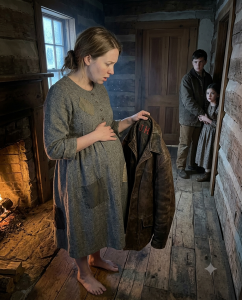
By the fireplace hung Thomas’s old winter coat. She had left it there since his death, unable to pack it away. It still smelled faintly of smoke and cedar and the cold plains where he had spent most of his life working cattle before she met him.
Mave stepped into the hall. The children turned so fast it was almost painful to watch.
“Who wore it?” she asked.
No one answered.
She took the coat down herself and turned the collar back. On the inside seam, nearly erased by time, were letters she had never noticed.
T.R.
Not T.H.
Her stomach tightened so sharply she had to grip the table.
“Tell me,” she said. “Now.”
Colton’s face hardened with old memory. “Our father wore that coat.”
Mave felt the room shift beneath her.
Thomas had told her once, when they first married, that he had lived under different names on the trail because ranch hands and cowboys often drifted, started over, rode where work called them. She had never pressed him for details. In those days she was too relieved to have found a steady man with kind hands and quiet habits, a man who fixed broken gates before sunrise and never once mocked her for inheriting a failing ranch.
She had loved the man in front of her. She had not imagined another life behind him.
Colton reached into the coat lining and found a section where the stitches were beginning to split. He tugged once and pulled out a folded paper hidden inside.
“I think he was running from what happened the night our mother died,” he said.
The paper was a letter.
It was addressed in Thomas’s unmistakable hand.
To whoever finds this, if I have not lived to speak it plain.
Mave sat down before her knees gave out.
The children stood close enough to hear every word.
Thomas—who had once been Thomas Reed—wrote that years before Harland Creek, he had worked cattle in Wyoming and married a woman named Nora Reed. They had two children: Colton and Elsie. Then came a brutal winter, a trail contract gone wrong, and a partner named Wade Barlow who cheated hands out of wages and laid claim to land that did not belong to him. Thomas had fought him. Nora had begged him to leave the outfit before it turned deadly.
He was too late.
One night, while Thomas was away bringing in horses before a storm, Barlow and two hired men came to the Reed cabin looking for a metal lockbox Thomas kept hidden beneath the floorboards—a box containing proof that 160 acres along Willow Creek had been lawfully purchased in Thomas Reed’s name, along with a bank draft and the deed to a small cattle brand he had been building slowly for his family.
Nora tried to stop them.
During the struggle, a lantern was knocked over. Fire spread through the cabin. By the time Thomas returned, the house was burning and the neighbors swore Nora and the children had been inside.
The bodies were never properly found. The storm, the fire, and the confusion turned the whole scene into ash and rumor. Barlow insisted there had been nothing left to save. He also told Thomas the law would blame him for the fight that had led to the fire.
Thomas believed his family was dead.
He nearly killed Barlow that same week.
Instead, beaten half senseless by Barlow’s men and warned he would hang if he stayed, he fled under another name. Thomas Holloway.
For years, he carried the guilt of surviving when Nora had not. The letter said he had tried more than once to learn the truth, but every trail went cold. Eventually he wandered south, worked cattle, and one spring arrived in Harland Creek, where he met Mave.
“I did not tell my wife because I was a coward where my grief was concerned,” the letter read. “I thought the dead were buried and I feared my old enemies might follow my name if I stirred it again. If I was wrong, and if Colton and Elsie lived, then everything I own is theirs as much as any child I have after.”
Mave read that last line twice.
Colton’s face had gone pale, but his voice remained hard. “So he just started over?”
Mave folded the letter carefully. “No,” she said. “He survived badly.”
It did not excuse everything. It did not remove the ache. But she could hear Thomas in the words—the man who went quiet whenever smoke drifted on winter air, the man who woke from sleep breathing like he had been running, the man who once stood at the window during a storm and said, almost to himself, Some things get taken before you can turn around.
Elsie sat on the edge of a chair, small fingers pressed to her lips. “He thought we died?”
Colton looked away. “That’s convenient.”
Maybe it was. Maybe it wasn’t. Mave had no luxury for deciding fast.
What mattered more was the line about the land.
The lockbox.
The deed.
If it still existed, it could save all of them.
By afternoon, the children had told her their side. After the fire, a ranch wife passing through had found them huddled in a root cellar behind the cabin where Nora had hidden them. Nora never came back. The woman took them to a church mission. From there they were moved twice, then finally sent to Harland Creek. Colton never forgot their father’s coat, or the way Nora used to say that if anything happened, there was paper hidden somewhere that proved the future belonged to them, not to men like Wade Barlow.
Mave decided before sundown.
They would go to Willow Creek.
The trip took two days in bitter weather and strained every bit of strength Mave had left. Twice Colton told her they should turn back. Twice she refused. By the time they reached the ruined cabin site described in the letter, the sky had gone silver with snow.
Nothing remained of the old house except a blackened stone chimney, a collapsed root cellar, and a stand of cottonwoods bending over the creek.
Colton found the floorline first.
Then Elsie found a rusted hinge under the drifts.
At last Mave, kneeling painfully in the frozen dirt, felt the edge of a metal box trapped beneath a flat stone.
They hauled it out together.
Inside were the deed, the bank draft, and a second letter—this one older, from Nora to Thomas, written before the fire. It warned him that Barlow had learned about the land and meant to steal it. She begged him to leave the cattle outfit and come home for good. At the bottom, in a hurried line, she had written: If anything happens to me, make sure our babies know they were loved before all this fear.
Colton read that line and turned away so quickly Mave pretended not to notice the tears.
But the hardest part still waited.
Wade Barlow was alive.
He had grown older and richer on stolen reputation, and when Mave presented the deed to the county office, his name surfaced immediately. He now claimed half the grazing corridor near Willow Creek through a chain of fraud that only held if Thomas Reed had truly died without issue.
Colton wanted to confront him with his fists.
Mave chose the law first.
She brought the letters, the deed, and the children to the county judge. Mrs. Aldridge, to Mave’s surprise, agreed to testify that the siblings had arrived years earlier under the Reed name. A former mission worker confirmed the transfer records. An aging blacksmith remembered Thomas Reed’s custom-branded coat and swore Barlow had once tried to buy it off him after the fire, as if desperate to erase traces.
At the hearing, Barlow smiled like a man long accustomed to winning.
Then he saw Colton.
For a second, something like fear broke through.
It was enough.
Under questioning, his story shifted. Then shifted again. By the time the judge pressed him on the forged land transfer, Barlow’s confidence had cracked. He admitted he had gone to the Reed cabin that night to force Thomas to sign over the property. He admitted Nora fought him. He insisted he never meant for the lantern to fall.
No one in the room believed the tremor in his voice was remorse.
The judge voided Barlow’s claim on the land. The deed passed to the legal heirs of Thomas Reed: Colton and Elsie, with provisions protecting the unborn child Thomas had with Mave. The bank draft, though old, was honored in part after a long argument at the bank in Cheyenne, enough to settle the worst of Mave’s debt and buy seed, lumber, and two healthy milk cows.
A week later, labor came early.
Snow lashed the windows while Mave gripped the bedframe and fought pain that felt big enough to split her in two. Elsie held a cloth basin with trembling hands. Mrs. Aldridge, who had traveled out after hearing the weather had turned, muttered practical instructions with an authority no one dared challenge. Colton waited outside the door with his back against the wall, pacing holes into the floorboards.
Near dawn, the baby cried.
A girl.
Mave named her Nora.
When Mrs. Aldridge placed the child in her arms, Mave looked up and found Colton in the doorway. He stood there awkwardly, eyes red, shoulders squared as if he was bracing for one more loss and did not know what to do when none came.
“Do you want to hold your sister?” Mave asked.
He didn’t answer at first.
Then he crossed the room as carefully as a man approaching something holy.
Spring came late but honest. The east fence was rebuilt. The barn door hung straight. Calves survived. Elsie began talking more, slowly at first, then with sudden bursts that made the house feel larger. Colton still carried anger, but it no longer seemed aimed at everyone. Sometimes it was just grief with a stronger spine.
One evening, standing by the pasture, he asked Mave, “Why didn’t you send us back when you found out?”
Mave shifted baby Nora higher on her hip. “Because by then,” she said, “you were already mine.”
He looked away, but not before she saw what that cost him.
The town, of course, had opinions. Some called Mave foolish for taking in trouble when she had barely survived on her own. Others called her blessed, as though providence looked prettier after the hard part was over. Mave ignored them all.
The truth was less tidy.
Thomas had lied by omission. He had carried guilt into a second marriage and left too much unsaid. He had also loved deeply, worked hard, and died before he could repair what he broke. None of those truths canceled the others.
Maybe that was the ugliest part of real life.
The dead were not always saints or monsters. Sometimes they were just people who made one terrible choice, then ran out of time to explain it.
On warm evenings, when the light turned the fields gold and the baby slept against her shoulder, Mave would sometimes watch Colton fixing tack by the barn while Elsie laughed nearby and wonder which wound mattered more—the years Thomas lost with his children, or the years they lost believing he had chosen not to come back.
She never found an answer that felt complete.
But she knew this much:
A woman had walked into an orphanage with one dollar and no sensible future.
What she brought home was not a burden.
It was the truth.
And in the end, that truth fed every one of them better than pity ever could.