When Hortensia Zabaleta heard the pounding at her door, her first instinct was not fear.
It was fury.
The storm had been building since late afternoon, rolling over the hills in black layers until the ranch seemed swallowed by a sky too heavy to hold itself up. By nightfall the wind had started driving rain against the house in slanted sheets, rattling the shutters and hammering the tin roof hard enough to make the walls groan. Hortensia had already checked the locks twice, fed the fire, and set her shotgun within reach.
She had lived alone too long to ignore a storm or a stranger.
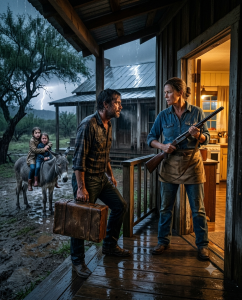
So when the knock came again—three hard blows, then silence—she lifted the shotgun and went to the door without a lantern, letting the lightning do the work of showing her what waited outside.
A man stood at the edge of the porch, drenched to the bone. Beyond him, under the twisted branches of the mesquite tree, a gray donkey strained under the weight of two little girls clinging to each other for warmth.
The man’s shirt was plastered to his skin. Mud climbed his boots to the knee. A battered suitcase hung from one hand, as though he had been carrying it too long to remember he could put it down. He looked exhausted enough to collapse, but he was still standing.
The girls looked worse.
The older one sat upright by force of will alone, her arms wrapped around the younger child’s waist. The younger had her face buried in her sister’s shoulder. Neither of them was crying.
That was what stopped Hortensia.
Rain could make anyone miserable. Hunger could hollow out a face. But children who sat in a storm without tears had seen something deeper than weather.
She did not lower the shotgun.
“I don’t keep money here,” she called over the rain. “And I don’t feed every stranger who comes by with a story.”
The man swallowed before answering. “I’m not here for money, ma’am. I’m only asking for shelter for my daughters until the storm passes. I’ll sleep outside.”
Those words hit her in a place she hated anyone reaching.
Not because they were dramatic. Because they were plain.
No performance. No bargaining. No flattery. Just a father offering himself to the cold as long as his daughters could be dry.
Hortensia tightened her grip on the gun and studied him under another flash of lightning.
“What’s your name?”
“Ezequiel Palomino.”
“And them?”
“Virtudes and Perpetua.”
As if summoned by the naming, thunder cracked so close the whole house shook. The gray donkey jerked beneath the girls. At the same moment the younger one coughed—a small, weak sound that somehow cut through the storm sharper than thunder had.
That decided it.
“The girls come in,” Hortensia said. “You too. But hear me well, Ezequiel Palomino. Nobody lies in my house. Nobody steals. Nobody touches what isn’t theirs. And nobody talks to me as if I need a man to think for me.”
He dipped his head once. “Understood.”
That answer, more than any apology or explanation, kept the door open.
Inside, warmth met them slowly. Hortensia’s kitchen had never been pretty, but it was solid—thick walls, a blackened stove, shelves worn smooth by years of use, and a fire that had outlasted most people’s interest in her. The room smelled of smoke, stale coffee, and the kind of silence that settles into a home when there has been only one heartbeat living in it for too many years.
She handed two towels to the older girl.
“Dry your sister.”
The child nodded and obeyed without wasting a motion. She was perhaps eight, though her face held none of the softness that should have belonged to that age. Her little hands moved quickly, efficiently, as she rubbed the younger girl’s hair and cheeks dry. The younger one—Perpetua, Ezequiel had said—stared around the room with wide, guarded eyes.
“Have you eaten?” Hortensia asked.
Virtudes looked toward her father, then down.
“Yesterday.”
That one word changed the room.
Ezequiel closed his eyes, shame rising visibly across his face. Hortensia turned away before he could say anything. She did not believe in making people thank her for survival. She opened the pot of beans, set tortillas to warm, and shaved off slices of dry cheese.
“Then tonight you eat.”
When Ezequiel returned from settling the donkey in the shed, his hands were red with cold. Hortensia pointed him toward the back room where some of her dead father’s clothes were still stacked in a chest no one had touched in years.
“I don’t want to impose,” he said.
“You’ll impose more if you die in my house before daylight.”
To her surprise, the older girl smiled.
Barely. Just enough to show she still knew how.
That tiny smile disturbed Hortensia more than the pleading had. It told her how little kindness those children were used to receiving.
They ate in silence.
Perpetua ate with both hands, taking careful bites as if the food might be snatched away. Virtudes broke her tortilla and pushed the larger half toward her sister. Hortensia pretended not to notice. Some gestures were too sacred to stare at.
Later, when the dishes were cleaned and the house darkened, Hortensia lay awake in the chair by the fire, pretending she was only listening to the wind.
From the back room she heard Perpetua murmur in her sleep.
“Mom…”
Then came the scrape of the cot as Ezequiel rose.
“I’m here, little one,” he whispered. “I’m here.”
His voice was steady, but there was something torn inside it, something held together by effort alone. Hortensia kept her eyes on the fire and said nothing.
She had shut that house against other people’s pain sixteen years earlier.
Pain had entered anyway.
Morning came washed clean and gray. The storm had blown east, leaving the ranch slick with mud and the air smelling of wet earth and mesquite bark. Hortensia had already decided the family would leave as soon as the road allowed it. She had not spent sixteen years protecting her peace just to let strangers settle into it.
Then she opened the door.
Ezequiel was at the fence, repairing a section the storm had knocked loose. He had found wire and tools without touching anything he should not, and he worked with the quiet competence of a man trying to repay space with labor. Near the basin, Virtudes was washing breakfast plates. On the ground beside the steps, Perpetua sat cross-legged before Canelo, a mean-tempered striped tomcat who had scratched every human hand that ever reached for him.
Perpetua held out one finger.
The cat leaned into it.
Hortensia actually stopped walking.
“He’s soft,” Perpetua whispered, as if sharing a secret.
“What did you say?” Hortensia asked.
The little girl looked up. “His name is Canelo.”
It was the first time she had spoken without burying her face in someone else’s shoulder.
Something inside Hortensia shifted.
She disliked that too.
Shifts led to openings. Openings led to loss.
Before she could say anything, she saw a riderless figure approaching on foot through the mud: Aurelio Temístocles Vargas, hat tipped back, boots filthy, smile ready. No one in three neighboring valleys knew more about other people’s business than Aurelio, and no one enjoyed it more.
He reached the gate and stopped there, letting his gaze travel across the yard. Ezequiel at the fence. The girls by the steps. The donkey under the shed. The open kitchen door.
“Well now,” Aurelio said. “Looks like your house isn’t so empty after all.”
Hortensia crossed the yard before he could say another word. “State your business.”
Aurelio looked delighted by her tone. “Can’t a neighbor check after a storm?”
“No.”
His smile widened. “Then I suppose I came because I recognized your guest.”
Those words changed Ezequiel’s posture instantly. His shoulders locked. Virtudes, though still only a child, went still in a way that was practiced. Perpetua looked from one adult to the next with frightened confusion.
Hortensia saw all of it.
“You know him?” she asked.
Aurelio rested his arms on the fence. “Know of him. Enough to think a woman alone ought to be careful.”
Ezequiel set down his tools. “Girls,” he said quietly. “Get your things.”
Perpetua stood. “No.”
The force in that little word stunned everyone.
Aurelio laughed under his breath. “You see? Even they know running is getting old.”
Hortensia turned sharply. “Nobody leaves my property because a man like you enjoys hearing himself talk.”
Then she looked at Ezequiel. “Inside. All of you.”
Aurelio called after them, “Ask him why his wife is dead.”
The kitchen went cold despite the heat from the stove.
Perpetua clung to Virtudes. Ezequiel remained standing near the door, as though he had not yet decided whether to bolt or confess. Hortensia leaned the shotgun against the table within reach and folded her arms.
“Talk.”
Ezequiel said nothing.
Hortensia’s patience hardened. “You asked for shelter under my roof. You got it. Now you tell me whether I’ve brought danger into my home.”
Virtudes looked at her father, not with confusion but with dread. That look said more than any rumor could.
Finally Ezequiel spoke. “My wife’s name was Jacinta.”
He said the name the way some men touch a wound to prove it still hurts.
“She worked washing clothes in San Gerardo. Sometimes in kitchens. Sometimes sewing. Whatever paid. Three weeks ago she came home different. Quiet. Watching the road. She wouldn’t say much the first day. The second day she told me she had heard something while delivering mended shirts to the old customs office.”
He stopped, jaw tightening.
“She heard two men talking in a locked room. One of them was a local official. The other… one of the men who moves contraband through the hills. She heard names. Payments. Routes. She heard them mention a fire that was set on purpose to cover missing ledgers. And she heard one name she knew too well.”
“Aurelio?” Hortensia asked.
Ezequiel looked up. “Not just Aurelio. Men above him. Men who smile in daylight and bury people at night.”
Hortensia’s expression did not change, but her pulse did.
“Why tell you?” she asked.
“Because one of the shirts she was mending belonged to Aurelio. She knew his voice. Once she recognized it, she panicked. She came home and told me we should leave. I told her we needed proof before abandoning everything. That was my mistake.”
Virtudes had gone pale.
Perpetua pressed closer against her sister and whispered, “Papa…”
Ezequiel continued, each word heavier than the last. “The next evening Jacinta was found in the ravine below the old mill. They said she slipped. Everyone said it quickly, like the story had been prepared before the body cooled. But she had bruises on both wrists. Dirt under her nails. And before she left the house that last morning, she wrote down one place on a scrap of paper and tucked it into my shirt.”
He reached into the lining of his coat and pulled out a folded, weather-damaged piece of paper.
Hortensia took it.
Only a few words were still legible.
Hortensia Zabaleta. North ranch. She’ll hate you, but she won’t sell children.
For the first time in many years, Hortensia felt her throat tighten.
“Jacinta knew me?” she asked.
“Not personally,” Ezequiel said. “But people know stories. They know you live alone. They know men don’t stay here long. They know you don’t bend when others do. She said no one would expect us to come to the one woman who never lets anyone stay.”
A humorless breath escaped Hortensia. Trust her reputation to become a refuge.
Aurelio’s voice sounded from outside the kitchen window.
“You should be careful with stories, Hortensia. Some of them bring trouble.”
He had not left. Of course he had not.
Hortensia walked to the window and looked out. He still stood at the fence, but he was no longer smiling. Two riders had appeared on the road behind him, distant but coming nearer through the drying mud.
Trouble had arrived faster than truth.
She turned back. “How long have they been following you?”
“Since Jacinta died,” Ezequiel said. “I think they hoped I knew what she heard. Maybe they thought she left me names. Evidence. Something valuable. We kept moving. Every time someone recognized us, we moved again.”
“And the girls?”
At that, his face cracked.
“They learned not to ask questions in public. Not to cry where men could hear. Not to say their mother’s name where it might anger the wrong person.”
Hortensia looked at Virtudes. The child met her eyes with terrifying steadiness.
“My sister cries in her sleep,” Virtudes said. “I don’t let her cry when people are around.”
No child should have known to say that.
Something old and bitter inside Hortensia rose then—not fear, not exactly, but memory. Sixteen years earlier, when she had been newly widowed herself, men had arrived with smiling mouths and easy offers. Advice. Protection. Help with the ranch. What they wanted was land, decisions, control. When she refused, they called her impossible. When that failed, they called her dangerous. She learned quickly that a woman alone survived by becoming harder than anyone liked.
That hardness had kept her alive.
But looking at those girls, she understood something else.
Hardness was one thing. Abandonment was another.
Outside, hoofbeats drew closer.
Hortensia lifted the shotgun and broke it open to check the shells. Click. Snap. Closed.
Perpetua stared. “Are they bad men?”
Hortensia met the child’s eyes. “Bad enough.”
Ezequiel stepped forward. “I’ll take the girls out the back.”
“No.” Hortensia’s answer was immediate.
“You don’t owe us this.”
“I know exactly what I owe. And it isn’t to men who hunt children because a woman overheard the wrong truth.”
A pulse of silence went through the room.
Then Hortensia started giving orders.
“Virtudes, take your sister to the root cellar. Stay there until I call your name myself.”
Virtudes hesitated. “What about Papa?”
“He follows after he bars the rear door.”
The girl nodded once and led Perpetua away.
Hortensia looked at Ezequiel. “Do you know how to fire a rifle?”
“Yes.”
“There’s one above the pantry. Use it only if someone gets inside.”
“You trust me that much?”
“No,” she said. “I trust the look in your daughters’ faces.”
That hit him harder than any accusation.
By the time Aurelio reached the porch with the two riders behind him, the ranch house had changed. The doors were barred. The front window was cracked open just enough for the shotgun barrel. Ezequiel stood out of sight by the hallway. The girls were hidden belowground with jars of peaches and sacks of flour and the old smell of potatoes.
Aurelio stepped onto the porch and raised both hands as if he had come peacefully.
“Hortensia,” he called. “Don’t be foolish. We only want to ask him some questions.”
She answered through the door. “Then ask them from the road.”
One of the riders—a thick-necked man with a scar near his ear—spat into the mud. “That widower has something that doesn’t belong to him.”
Hortensia’s voice stayed calm. “Then come back with a warrant and a priest to hear your lies.”
Aurelio’s patience thinned. “You’re protecting a man you don’t know.”
“No,” she said. “I’m protecting two girls you do know.”
That landed.
Silence outside. Breathing inside.
Then Aurelio tried another angle. “His wife meddled in things above her station. That’s not our fault.”
Hortensia’s hand tightened on the shotgun. “So you admit there were things to meddle in.”
She heard him curse under his breath.
Inside the hallway, Ezequiel whispered, “He’ll try to circle the house.”
“He can try.”
And he did. The scarred man moved off the porch, boots sloshing through mud toward the side yard. Hortensia fired once into the water trough beside him. The explosion sent water and splinters everywhere. The man stumbled back with a shout.
“My next shot won’t miss on purpose,” Hortensia said.
No one moved for several long seconds.
Then, unexpectedly, the second rider wheeled his horse halfway around and muttered something to Aurelio. Even from inside, Hortensia could hear fear creeping into the man’s voice. The ranch woman’s reputation had apparently traveled farther than the storm.
Aurelio understood he was losing the balance.
So he played his final card.
“He doesn’t have proof,” Aurelio shouted. “Do you hear me, Ezequiel? Jacinta died for nothing. No one will believe you.”
From the hallway came Ezequiel’s answer, stronger than Hortensia had yet heard it.
“She didn’t die for nothing.”
He stepped into view holding not only the rifle, but a cloth bundle. He set it on the table, unwrapped it, and revealed a small ledger wrapped in oilskin.
Hortensia stared. “What is that?”
“Jacinta’s proof,” he said. “She hid it inside our donkey’s saddle padding. I didn’t find it until last night.”
Outside, Aurelio went silent.
That silence was confession enough.
Ezequiel opened the ledger. Names. Dates. Payments. Deliveries. Bribes tied to the customs office and several outlying ranch routes. Aurelio’s name appeared again and again. So did names higher than his.
Hortensia laughed once, sharp and unbelieving. “All this time you were carrying the thing they killed her for on the back of that poor animal?”
Ezequiel’s eyes filled, but he did not look away. “She trusted I would find it before they did.”
Outside, Aurelio stepped off the porch. “Burn the house,” he snapped.
He never finished the order.
A voice behind him cut through the yard like a blade.
“No one burns anything.”
Sheriff Mateo Barragán rode in from the east trail with four deputies behind him. Mud sprayed from the horses’ legs as they surrounded the gate. One deputy already had a pistol drawn. Another dismounted and seized the scarred rider before he could run.
Aurelio spun around, white-faced. “Sheriff, this is a misunderstanding—”
Mateo did not let him finish. “I was at the crossing when a child came riding bareback on a gray donkey screaming that bad men were at Hortensia’s house.”
All eyes turned.
From the side of the barn, Canelo the cat emerged first—then Perpetua behind him, filthy to the knees, chin lifted stubbornly.
Virtudes was right behind her, out of breath and furious. “I told her to stay hidden.”
Perpetua pointed at Aurelio. “That man has the lying face.”
For one stunned second no one spoke.
Then even Sheriff Mateo let out a rough breath that might have been a laugh.
The ledger did the rest.
Within an hour Aurelio and both riders were bound, disarmed, and taken away. Mateo read enough by the kitchen table to understand that the matter had already grown beyond one ranch and one dead woman. He promised the names in the book would go to the provincial authorities before sunset and that copies would be made immediately.
Aurelio shouted threats all the way to the road.
No one listened.
By evening the ranch was quiet again, though not the same quiet as before. This one felt stunned, as if the house itself had watched a fever break.
Perpetua fell asleep sitting up, one hand tangled in Canelo’s fur. Virtudes finally cried only after her sister was asleep, doing it silently, shoulders shaking, face pressed into Hortensia’s apron because she seemed too young suddenly to know where else to put all that fear. Hortensia held her without speaking.
Ezequiel stood outside at sunset beside the gray donkey, one hand resting on its neck. When Hortensia joined him, he said, “I never meant to bring this to your door.”
She looked out across the wet fields glowing copper under the last light. “You didn’t bring it. Men like that always think every door belongs to them eventually.”
He nodded.
After a while he asked, “When the road dries… should we go?”
Hortensia took longer than necessary to answer.
The old instinct was still there. Protect the house. Protect the solitude. Return everything to how it had been.
But how it had been was a kitchen with one cup, one plate, one set of footsteps, one life narrowed so tightly around survival it had mistaken emptiness for peace.
She looked back through the open window.
Perpetua was asleep at the table. Virtudes had curled beside the stove. Canelo lay between them as if he had always been theirs. The house, for the first time in sixteen years, no longer smelled only of smoke and memory.
“No,” Hortensia said at last. “Not yet.”
Ezequiel turned to her in surprise.
“The fence still needs finishing,” she added. “And the donkey needs feeding properly. And those girls need a place where they can forget to listen for men on the road.”
He understood what she could not quite say.
His eyes filled, but he did not thank her too much. That, more than anything, made her believe he might deserve to stay.
Weeks later, when word spread that arrests had reached all the way into San Gerardo and the customs office was under investigation, people began repeating the story of the widow, the widower, the two girls, and the ledger hidden in a donkey saddle. Some told it badly. Some told it with embellishments. In every version, Hortensia sounded fiercer than she thought she was and Perpetua sounded bolder than any five-year-old had a right to be.
Only a few people understood the truest part.
A house can close itself against pain for years and still not become safe.
Sometimes safety arrives disguised as inconvenience. As muddy boots on the porch. As hungry children in borrowed towels. As a plea spoken so softly it would be easy to refuse.
Sometimes the biggest red flag is not the stranger asking for help, but the familiar smile that appears too quickly once help is given.
And sometimes forgiveness is not the question at all.
The real question is whether a person who has suffered enough can still choose not to become cruel.
That night, in the middle of the storm, Hortensia Zabaleta opened the door with a shotgun in her hands and every reason to say no.
What saved them all may have been that she hated fear just a little more than she hated letting someone in.