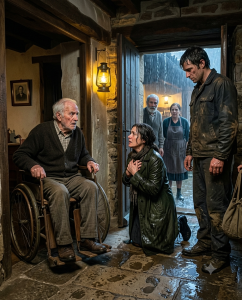
“You’re alone… my son will work for you. Please let us stay.”
Those were the words that entered Don Aurelio Valcárcel’s house on a night of pounding rain, only hours after his own blood had stood in that same home and told him he was a useless old man.
The contrast would have been enough to break a weaker person.
But Don Aurelio had not survived a lifetime of labor, grief, and stubborn love by being weak.
Even in old age, even seated in a wheelchair after an accident had stolen the strength of his legs, there was something in him that still refused to bend when bending meant surrender.
That afternoon, Ramiro had come dressed like success and spoken like a vulture.
He had parked his sleek dark car in front of the old Valcárcel house as though he already owned the gravel beneath it. He had walked in without waiting to be invited, kissed no one, greeted no one properly, and gone straight to the matter that had clearly been feeding his ambition for months.
The farm.
The land.
The house with its cracked beams, old portraits, and years of memory soaked into the walls.
Ramiro had once been a boy running through those same rooms, stealing apples from the kitchen, hiding behind flour sacks, laughing as he dodged the cows in the lower field. Aurelio had loved him then. Not as a son, exactly, but as the closest thing left to one. He had taught him how to approach a frightened animal, how to close a gate correctly, how to respect a field even when it looked empty.
But time had done what time often does: it had revealed character.
And character, once fully grown, does not look back kindly just because someone helped raise it.
“You can’t go on like this,” Ramiro had said that afternoon, standing over Aurelio’s chair with the confidence of a man who believed age itself was an argument. “This place is dying. You’re alone. You can’t manage it. Sign the papers and let someone capable take over.”
Someone capable.
Someone with blood.
He had said that too, as if Aurelio were some temporary inconvenience standing between Ramiro and what was naturally his.
Don Celso Aranda, who had worked the Valcárcel land for decades, had gone still in the doorway. Nuria, his wife, had kept herself busy in the kitchen because she knew if she looked too long at Ramiro, she might say something impossible to take back.
Aurelio had simply stared at him.
He had aged, yes. His hair had gone silver. His body had betrayed him in places. His hands shook when the weather turned. But his mind was clear, and his memory clearer still.
He remembered every calf born in winter, every patch of land Elvira had insisted could still bloom, every debt paid late but honestly, every hand offered shelter under that roof when storms made strangers of decent people.
“As long as I breathe,” he had replied, “this house is not for sale.”
Ramiro had laughed then, a thin, ugly sound.
“Then you’ll die surrounded by cows and dust.”
He left after that, but his contempt did not.
It lingered.
By evening the sky had turned iron-gray, and rain came down in sheets over the hills outside Cangas de Onís. The wind rattled shutters and moaned under the eaves. Aurelio sat by the front window longer than usual, staring out over the courtyard where puddles formed in the stone dips he knew by heart.
The house felt larger on nights like that.
Too much silence. Too many doors closed because there was no one left to sleep behind them.
Elvira had been gone three years, and grief had changed shape but never disappeared. At first it had been sharp and unbearable. Then it became quiet and constant. A chair not moved. A shawl folded away. A rosebush neglected because touching it meant admitting whose hands had once cared for it.
Ramiro thought Aurelio feared death.
He was wrong.
What Aurelio feared was emptiness.
He feared becoming the last witness to a life no one else remembered correctly.
That was when the knock came.
Not loud. Not timid either. The knock of someone with no choice left but dignity.
Celso took a lantern and opened the door.
On the threshold stood a woman and a man, both soaked through, both trying not to look desperate.
The woman spoke first. “Forgive the hour.”
She called herself Amalia Sifuentes. The young man beside her was her son, Gael.
Up close, their exhaustion showed more clearly. Amalia’s scarf clung damply to her temples. Her shoes were worn down at the edges. She held herself straight, but only through force of will. Gael looked strong in the way working men do—no show to it, no vanity, just long arms, tired shoulders, and hands cut by labor.
“We are not asking for alms,” Amalia said after Celso let them step just inside the door. “My son will work. He will work from sunrise to dark. We only ask for a roof.”
Aurelio looked at them from the hallway.
He saw the rainwater on the floorboards where they stood. He saw Gael’s split knuckles. He saw the way the young man remained half a step behind his mother, not because he was weak, but because he understood her pride and would not trample it.
“Where are you from?” Aurelio asked.
“From a place that no longer had room for us,” Amalia answered.
Her husband had died six months earlier after a fall from a construction scaffold in Oviedo. The compensation promised by the contractor never fully came. A cousin had let them stay for a while, then changed his mind when money ran thin. They sold what they could. They moved from one temporary room to another, each one smaller and colder than the last, until even pity began to cost people too much.
“Five villages,” she said quietly. “Five doors closed. Some were polite. Some were not. But the answer was the same.”
“And why here?” Aurelio asked.
At that, Amalia hesitated.
“Because someone at the market said the Valcárcel house used to be the kind of place where people were still treated like human beings.”
The words struck him harder than Ramiro’s insult had.
Nuria turned away to hide tears.
Celso looked down.
Aurelio heard Elvira then as plainly as if she had been standing beside him: A house without compassion rots, even if the walls still stand.
“Come in,” he said.
That was all.
No long speech. No conditions first. No performance of generosity.
Just: “Come in.”
Nuria put coffee on immediately. Celso brought dry blankets. Gael thanked both of them with the embarrassment of a man who hates receiving what he cannot yet repay. Amalia accepted the cup with shaking fingers but did not cry until she thought no one was looking.
That night they were given a small room near the back staircase. It had once belonged to a visiting aunt who had liked to complain about the cold. Amalia called it beautiful.
Before dawn, Gael was already awake.
Celso found him in the courtyard trying to figure out where the stable tools were kept without disturbing anyone. That alone earned a flicker of respect.
“Ever worked cattle?” Celso asked.
“A little,” Gael said. “Mostly day labor. Fences. hauling. Basic livestock care.”
“Basic gets corrected fast around here.”
Gael nodded. “Then correct me.”
And so Celso did.
The first week was hard. Gael was strong, but farm work punished muscles differently. He learned the rhythm of milking times, feed schedules, medical signs, mud conditions, weather patterns, and the unspoken rules of a place where animals and land noticed laziness faster than people did.
He made mistakes and owned them.
When two calves slipped through an improperly latched side gate, Gael sprinted after them through the yard, one nearly knocking him flat before Celso helped corner them near the stacked woodpile. Mud covered both men to the knees.
“My mistake,” Gael said, breathing hard.
Celso expected excuses. A loose hinge. A bad latch. Rain. Distraction.
Instead he got honesty.
That mattered.
Inside the house, Amalia transformed things so quietly that the changes seemed at first like tricks of light.
The kitchen regained order. Windows were opened. Linens were aired. The stale smell in two closed rooms disappeared. She polished wood without overdoing it, folded blankets the way older women do when they were taught to respect even worn fabric, and never once asked which objects were valuable.
Then she found Elvira’s garden.
It sat half forgotten behind the side wall, sheltered from the strongest wind. The roses had thinned. Weeds had started their patient takeover. Broken branches lay where no one had wanted to touch them.
Amalia stood there for a long time before doing anything.
When Aurelio wheeled himself out and saw her kneeling beside the rosebushes, clearing leaves by hand, the image hit him with such force that he gripped the arms of his chair.
“Elvira planted those,” he said.
Amalia looked up. “Then she planted them with love.”
“She hated seeing them neglected.”
Amalia brushed damp soil from her fingers. “Then let’s not neglect them.”
She said it simply, but the words entered the house like warmth.
Days passed. Then weeks.
Gael learned quickly. He listened more than he spoke. He had a calm way with animals, especially nervous ones. He was careful with tools and respectful with the older workers. He asked questions not to impress, but to understand. Celso began trusting him with harder jobs. Nuria began setting aside larger portions at dinner without commenting on it. Even the dogs stopped barking when he approached.
As for Amalia, she became woven into the house’s rhythm with such grace that no one could say when she stopped feeling like a guest.
Aurelio noticed all of it.
He noticed the house had sound again. Not noise. Life.
A door opening early. Boots crossing stone. Firewood being stacked. Nuria laughing. Celso swearing under his breath at a stubborn hinge. Amalia humming in the kitchen when she thought she was alone.
And for the first time since Elvira’s death, Aurelio sometimes stayed at the dinner table after the meal had ended, not because he had anything urgent to say, but because getting up meant returning to silence.
One evening, Gael asked him about the herd’s history.
Not the market value. Not the acreage. The history.
Which cow line was oldest? Which field flooded first in spring? Why did Celso insist on checking the northern fence twice before heavy rain? Which horse had belonged to Elvira?
The questions disarmed him.
People who wanted to take a place usually asked what it was worth.
People who wanted to belong asked how it became what it was.
So when Ramiro returned and found Amalia and Gael at the dinner table, something changed in the house at once.
He entered like a man expecting obedience and instead found a room that had already moved on without asking his permission.
“Who are these strangers?” he demanded. “And why are they sleeping under my family’s roof?”
“My family’s roof.”
The arrogance of it turned the air hard.
Aurelio met his gaze. “They are here because I invited them.”
Ramiro stared from one face to the next. Celso’s expression was unreadable. Nuria looked openly disgusted. Gael had risen halfway from his chair, restrained only by Amalia’s hand on his sleeve.
Ramiro laughed, but there was strain in it now.
“So this is what it’s come to? You replace blood with beggars?”
“Careful,” Aurelio said.
For the first time, Ramiro truly looked at the room and realized he no longer controlled its mood by simply walking into it. The old dynamics had shifted. He was not the favored heir sweeping in to save a decaying property. He was an intruder in a home that had begun, somehow, to heal without him.
Then Aurelio saw it.
Ramiro’s eyes flicked toward the hallway cabinet.
Not toward Amalia. Not toward Gael. Not even toward Aurelio.
Toward the locked walnut cabinet beside the study door where old farm ledgers, deeds, and family papers were kept.
That was why he had returned.
Not jealousy. Not outrage.
Fear.
Aurelio’s mind moved quickly. In the weeks since Ramiro’s first visit, he had gone through several drawers and found odd discrepancies in a few financial notes—small missing sums, copied keys returned to the wrong hook, a signature on an old supply order that didn’t look quite right. At the time he had thought memory might be playing tricks on him.
Now he wasn’t so sure.
Ramiro took one step toward the cabinet. Gael stood fully.
“Sit down,” Ramiro said sharply.
Gael didn’t move.
“It wasn’t a suggestion,” Ramiro snapped.
“And this isn’t your house,” Aurelio replied.
Silence crashed into the room.
Ramiro turned on him, face tightening. “You think these people care about you? They see an old man, a farm, and a chance.”
Aurelio almost smiled.
That was the first thing Ramiro had said all evening that revealed more about himself than anyone else.
“Funny,” Aurelio said. “I was beginning to think the same of you.”
Ramiro’s composure cracked.
What came out next was too quick to stop. He accused. He mocked. He claimed he was the only one who understood what had to be done. He insisted the property was collapsing, that taxes were behind, that Aurelio was no longer fit to manage anything, that a transfer now would prevent embarrassment later.
But the more he spoke, the more one detail betrayed him.
He knew too much.
Not about the house in general—about specific financial pressures, notice dates, and figures Aurelio had never personally discussed with him.
Celso heard it too. So did Nuria.
“Who told you about the tax notice?” Aurelio asked quietly.
Ramiro stopped.
No one breathed.
The notice had arrived only four days earlier. Celso had collected the mail. Aurelio had read it in his study and locked it away. He had spoken of it to no one but Nuria, and only in passing.
Ramiro recovered too fast. “People talk.”
“Not that fast,” Aurelio said.
The room changed.
Ramiro’s anger sharpened into something uglier. “You don’t know what you’re doing.”
“No,” Aurelio said. “But I know when a man returns for papers, not for family.”
Ramiro lunged for the cabinet key hanging from the sideboard.
He never reached it.
Gael moved first—not with violence, but with speed. He caught Ramiro’s wrist and stopped him cold. The two men stood face to face, one fueled by entitlement, the other by restraint stretched to its limit.
“Let go of me,” Ramiro hissed.
“When you step back,” Gael said.
It might have turned ugly then, but Aurelio spoke before it could.
“Celso. Bring me the blue ledger from the study.”
Ramiro went pale.
That was all Aurelio needed.
Celso disappeared and returned with the old account book—worn leather, blue spine, pages full of entries written over years in Aurelio’s careful hand. Tucked inside was an envelope.
Aurelio had found it the previous week and said nothing because he had wanted certainty before accusation.
Inside were copied withdrawal slips, supplier invoices, and one forged authorization form giving preliminary access to a restricted line of credit under the farm’s name. The signature was a decent imitation of Aurelio’s. Decent, but not good enough. The bank manager had flagged it and sent quiet notice, assuming confusion, not fraud.
Aurelio had waited.
Now Ramiro had explained the rest himself.
“You forged my name,” Aurelio said.
Ramiro said nothing.
Nuria sat down slowly, hand at her chest.
Celso looked at Ramiro with a disgust so deep it almost resembled pity.
“It wasn’t stealing,” Ramiro said at last, and that choice of defense told everyone more than denial could have. “I was protecting the future. You don’t understand what this place costs. What it’s worth.”
“What it’s worth?” Aurelio’s voice rose for the first time. “You were ready to strip it before I was buried.”
Ramiro’s eyes flashed. “Because you’d let it die! You and your memories and your dead wife and this museum of a farm—”
The crack of Aurelio’s hand against the table silenced him.
Every person in the room froze.
“Do not speak of Elvira,” Aurelio said, trembling now with fury, “when you have never understood one decent thing she stood for.”
Ramiro looked around and finally saw the truth.
He was alone.
Not because they had chosen strangers over blood.
Because he had emptied blood of all meaning.
He jerked his arm free from Gael and backed toward the door. His face had gone colorless, but pride still held his chin up.
“You’ll regret this,” he said.
“Perhaps,” Aurelio answered. “But not as much as you’ll regret coming back tonight.”
The next morning, Aurelio and Celso drove to town—Celso driving, Aurelio beside him with the blue ledger on his lap. They met the bank manager, confirmed the forged documents, revoked every standing access point, changed legal protections on the property, and contacted a lawyer who had known Elvira well enough not to waste time pretending this was a misunderstanding.
Ramiro was not arrested that day. Aurelio chose not to begin there.
First, he cut him out completely.
Every paper Ramiro had hoped to touch was locked behind walls he would never open. Every assumption he had made about inheritance vanished. Every imagined path into the farm closed.
Weeks later, a formal letter arrived through the lawyer. Ramiro wanted reconciliation. He blamed debt. Panic. Pressure. Wrong judgment. He never once wrote the word sorry in a way that sounded like sorrow rather than strategy.
Aurelio read the letter once and burned it in the kitchen stove.
Spring came slowly that year.
The roses revived first.
Then the pasture greened.
Gael took on more responsibility in the fields. Celso, who trusted slowly and permanently, began consulting him instead of merely instructing him. Amalia restored room after room with patient hands. Nuria started leaving her gossip unfinished just to hear Amalia’s quieter observations, which were usually sharper anyway.
One evening, under a pale gold sky, Aurelio asked Gael to wheel him out to Elvira’s garden.
They sat there for a while without speaking.
Finally Aurelio said, “Do you know why I let you stay?”
Gael looked uncomfortable. “Because you are kinder than most.”
“No,” Aurelio said. “Because you came asking what you could give before asking what you could take.”
Gael had no answer to that.
Aurelio watched the rosebushes shift in the breeze. “This place doesn’t need owners as much as it needs caretakers.”
Later that summer, he put legal changes in motion—not impulsively, not sentimentally, but carefully. The farm would remain protected. Celso and Nuria would be secure as long as they lived. Amalia would never again face a road with nowhere to sleep. And Gael, if he wished to remain, would not remain as hired muscle drifting from season to season, but as a man with standing, responsibility, and a future tied to the land he had helped restore.
No one announced it dramatically.
That was not Aurelio’s way.
But by autumn, everyone in the valley understood that the Valcárcel house had not been saved by inheritance.
It had been saved by character.
As for Ramiro, people heard things. Failed ventures. Debts. Restlessness. Doors that did not open as easily as before. Aurelio never asked for details. Some endings punish themselves well enough.
On a cold evening months later, Aurelio sat again at the dinner table while wind moved softly against the windows. The house no longer felt hollow. It felt inhabited in the truest sense—not by bodies alone, but by purpose.
Amalia brought bread. Nuria poured stew. Celso argued about fencing. Gael came in smelling of hay and weather. Someone laughed. Someone answered back. The old beams held the sound and gave it back warmly.
Aurelio looked once toward Elvira’s portrait.
He did not speak aloud.
He didn’t have to.
Some griefs never leave, but sometimes life, stubborn and undeserved, enters beside them and sits down at the same table.
And maybe that was the hardest truth in all of it.
The man who shared Aurelio’s blood tried to strip him of dignity, his home, and the memory of everything that place had stood for.
The widow with nothing and the son in muddy boots gave it back.
So who was right? The nephew who claimed inheritance by name, or the strangers who honored the house better than family ever did? What was the true red flag—poverty at the door, or ambition wearing polished shoes? And if someone had looked at Ramiro sooner, really looked, would they have seen the hunger in him before it turned into betrayal?
Aurelio never answered those questions for anyone else.
But each morning, when Gael crossed the yard before sunrise and Amalia opened the kitchen shutters to let in the light, the house answered for him.
[AI_IMAGE_TEXT_PROMPT]