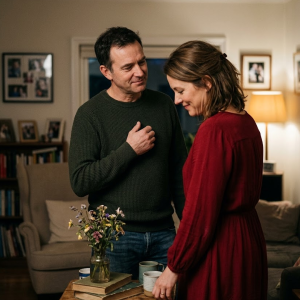
She walked up to that microphone in front of four hundred people, reached into her pocket — and the envelope was gone.
But I’m getting ahead of myself. Let me tell you about Loretta Vance.
—
Loretta had been singing in the First Covenant choir since she was nineteen years old. She met Gerald there. Married him there. Watched her children get baptized there. That church was not just a building to her — it was the architecture of her entire life.
And the organ was the heart of it.
Installed in 1954. Hand-carved walnut casing. One hundred and twelve pipes, some of them taller than Gerald himself. The whole congregation had fundraised for that restoration back in 2009. Bake sales. Pledge drives. A Christmas concert that packed the pews three nights running.
Loretta had personally organized every single one of those events.
She kept the receipts, too. But nobody knew that yet.
—
When the divorce came through in 2021, it was quiet. Gerald had been choir director for thirty-one years. Everybody loved Gerald. Nobody quite knew what to say to Loretta, so mostly they said nothing. She kept showing up to Sunday service. Kept sitting in the fourth pew, left side, where she’d always sat.
She kept her cardigan buttoned, and she kept her hands folded in her lap.
Except sometimes, when someone would sit down close to her or reach over to share a hymnal, you’d notice her do this small, quick thing — she’d press her hand to her left side, just below her collarbone, like she was checking that something was still there.
A few people noticed. Nobody asked.
—
What nobody knew — what Gerald certainly didn’t know — was that three weeks before the divorce was finalized, he had filed paperwork with the county claiming the pipe organ as personal property. His family, he argued, had made a “primary contribution” to the restoration.
The church board, bless their hearts, had not read the fine print.
By the time anyone understood what had happened, the organ was already on a truck headed to Nashville. Sold to a collector for forty-six thousand dollars.
The Sunday it went silent, Loretta sat in her pew and did not cry. She just reached into her cardigan, touched whatever was in that pocket, and stared straight ahead at the empty loft.
Then she went home and started making a list.
—
For eighteen months, Loretta was quieter than anyone had ever seen her.
She drove to the county records office four times. She made calls to the original organ restoration company in Cincinnati. She visited the elderly widow of the deacon who had chaired the 1954 installation committee. She requested documents from the church’s own archive that nobody had touched in thirty years.
And the whole time, she carried that envelope.
Yellowed. Water-stained at one corner, like it had been stored somewhere damp for a very long time. Every time it got close to leaving her possession, she’d tuck it back into the left pocket of whichever cardigan she was wearing that day.
Her daughter asked about it once.
Loretta just smiled and said, “It’s an old letter. It’ll keep.”
—
The retirement gala was Gerald’s idea, naturally.
Thirty-one years of service. A plaque. Dinner at the Riverside Event Center, the nicest venue in three counties. Four hundred guests, including the mayor, the bishop, and half the congregation that had watched Loretta eat her pride every Sunday for eighteen months.
She was on the guest list. Of course she was. To leave her off would have looked petty.
Gerald had made a mistake in underestimating how much Loretta understood about appearances.
She wore her navy dress, the one with the fitted waist. Her hair was done. She arrived early, found her table, and set her purse down with the calm of a woman who has been planning something for a very long time.
When the program started, she sat perfectly still.
When Gerald’s colleagues stood up to toast him — charming Gerald, dedicated Gerald, the man who gave this community thirty-one years of music — she applauded with everyone else.
She pressed her hand to her pocket once. Just once.
Then, during the open tribute portion of the evening, she stood up.
The room went politely quiet. People smiled. Of course Loretta would want to say a few words. Whatever had happened between them, she had always been gracious.
She smoothed the front of her navy dress.
She walked to the podium.
She adjusted the microphone.
And she said, clearly, into the silence:
“Before Gerald accepts this honor, I’d like to share something he once wrote — in his own handwriting — about exactly who really paid for that organ.”
She reached into her pocket.
Her face didn’t change.
But her hand — her hand slowed down.
And then stopped.
The envelope was gone.
—
Four hundred people were looking at her.
The mayor was looking at her. The bishop was looking at her. Gerald, sitting at the head table with his plaque already unwrapped, was looking at her with an expression she had not seen on his face in thirty-two years of marriage.
He looked afraid.
Loretta stood at that microphone for three full seconds without speaking. Later, people would describe it differently. Some said she looked stricken. Some said she looked confused. One woman at table eleven would tell her sister that night that Loretta had looked, just for a moment, like she might sit back down and let the whole thing go.
But that woman had not spent eighteen months watching Loretta Vance.
What happened in those three seconds was this: Loretta ran through the evening in her mind. She had arrived early. She had set her purse down. She had gone to the ladies’ room once, around seven-fifteen, and she had checked the pocket before she left the table and again when she came back. She had pressed her hand to it when they toasted Gerald the first time, and the second time, and the envelope had been there, right there, its familiar soft edges against her palm.
She had not left the table again.
Which meant the envelope had not walked away on its own.
She looked at Gerald.
His jaw was set. His hands were flat on the white tablecloth in front of him, very still, the way a man holds his hands when he is trying to look calm and is not calm at all.
And there, just to his left — nearly hidden under the edge of his plaque, which he had slid a few inches to the right at some point during the evening — was a faint, familiar yellow corner.
He had walked past her table.
She remembered it now. Midway through the dinner. He had come to her table to say something gracious to the people sitting with her, the way a host does, and he had bent down and kissed her cheek, the way a grateful ex-husband might, and she had let him because she understood appearances too.
She had not felt his hand.
But she felt it now.
Loretta Vance looked at her ex-husband of thirty-one years across a room of four hundred people, and she smiled.
Not the small, folded smile she had been wearing for eighteen months. Something older than that. Something that reached her eyes.
She turned back to the microphone.
“It appears,” she said, pleasantly, “that Gerald has already found what I was looking for.”
A confused murmur moved through the room.
“Which makes sense,” she continued, “because his name is on it too.”
She let that sit for a moment.
“Gerald, would you like to bring it up? Or shall I come to you?”
—
He did not move.
She had expected that.
What she had not expected — what nobody in that room had expected — was Gerald’s sister Patricia, sitting two seats down from him, who reached across the table, picked up the envelope from under the plaque, and held it out toward the aisle.
“Oh for heaven’s sake,” Patricia said, loud enough to carry. “Just give it to her, Gerald. I told you fifteen years ago this was going to come back around.”
The room went completely, perfectly silent.
Gerald looked at his sister. His sister looked back at him with the flat patience of a woman who has been right about something for a very long time and is not enjoying it.
Loretta walked down from the podium. She walked to the head table. She took the envelope from Patricia’s hand, looked Patricia in the eye, and said, quietly, “Thank you.”
“Don’t thank me,” Patricia said. “Just read it.”
—
She read it.
Not all of it — it was four pages, handwritten, and the room did not have that kind of patience. But she read the parts that mattered. She had memorized them anyway.
The letter was dated March 1974. It was written by Gerald’s father, Hector Vance, to the church board of First Covenant, declining a request that his family be formally credited for funding the original organ installation.
In his own handwriting — looping, careful cursive, the kind men of that generation used for important things — Hector had written that the organ belonged to the congregation and always had. That any suggestion his family had contributed more than any other member was, in his word, unseemly. That a house of worship was not a place for one family’s name to stand above another’s.
He had also, in the third paragraph, itemized the actual largest contributors to the 1954 installation. The Deacon’s Widow Fund. The Ladies’ Auxiliary. And, at the top of the list, a family named Chambers.
Loretta’s maiden name was Chambers.
Her grandmother had given four hundred dollars in 1954, which was, in 1954, a significant portion of a school teacher’s yearly salary.
Her grandmother had never mentioned it to anyone.
Loretta had found the letter in a box of her grandmother’s papers, six months after the organ went to Nashville, while cleaning out a storage unit in Decatur.
—
She did not deliver a speech. She did not accuse Gerald of anything, not directly, not there. She simply read the relevant passages aloud, held the letter up so the bishop could see the date, and said that she was submitting a formal copy to the county records office on Monday, along with the restoration contribution records she had gathered from 2009, which showed — clearly, publicly, in signed pledge cards — that the Vance family’s contribution to that restoration had been eleven hundred dollars.
The total raised had been sixty-two thousand.
She thanked everyone for coming. She said she hoped Gerald enjoyed his plaque. She said she wished him well, and she meant it, because she was done.
Then she walked back to her table, picked up her purse, and left the Riverside Event Center before the dessert course.
—
What happened after is not a simple story and I won’t pretend it is.
The collector in Nashville, when presented with documentation establishing the organ as congregational property improperly transferred, agreed to negotiate. Gerald’s attorney made arguments. The church board, finally reading the fine print they had missed two years earlier, retained their own counsel.
It took eleven more months.
But on a Tuesday in October, a moving truck pulled up to First Covenant Church. The walnut casing came through the side door first, then the pipes, one hundred and twelve of them, wrapped in moving blankets and carried by four men who did not know what they were carrying or how long it had been gone.
Loretta was not there when it arrived. She had choir rehearsal that evening.
She was there on Sunday.
She sat in the fourth pew, left side. Her cardigan pocket was empty. She had left the envelope with the church archivist, properly catalogued, where it would not get lost again.
When the organist — a young woman named Deb who had never heard the instrument before that week — played the first chord of the processional, Loretta felt it move through the pew and up through her spine the way it always had.
She did not press her hand to her chest.
She folded her hands in her lap and looked straight ahead at the loft, where the walnut casing gleamed under the light, and the pipes stood in their rows, taller than Gerald had ever been.
And she sang.