I’ve been retired for eleven years, but I still can’t sleep through a Montana thunderstorm.
Something about the sound of rain on a tin roof pulls me straight back to my route. Thirty-two years of walking that stretch of Highway 2, rain or shine, frost or mud. My knees remember every mile.
So when I heard the thunder roll in last Tuesday afternoon, I was already on my porch with my coffee before the first fat drops hit the dirt.
That’s when I saw her.
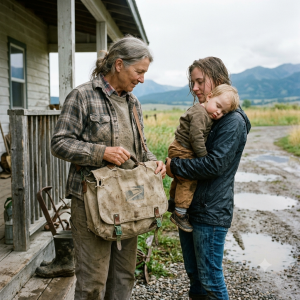
A young woman, maybe twenty-five, coming up the gravel drive with a toddler on her hip and her head ducked low against the wind. She was soaked through — thin jacket, canvas sneakers, hair plastered flat. The little one had his face pressed into her neck like a baby bird.
And slung over her shoulder, bumping against her hip with every step, was a USPS canvas mail satchel.
Not a new one. Not a replica you’d buy at an antique store.
Old. Worn. The kind with the brass buckle gone green and the strap stitched twice where it had torn. The kind that had seen weather.
My weather.
I stood up before I even thought about it.
“You two get up here right now,” I called out. “I’ve got a dry porch and hot coffee and neither one of us is going to feel good about you standing in that rain.”
She hesitated — the way women do when they’ve been taught to be careful about kindness from strangers. I understood that. I didn’t push.
“My name’s Dottie,” I said. “I’m seventy-one years old and my biggest threat is overcooking the coffee. Please come sit down.”
That got a small, tired smile out of her.
Her name was Lacey. The little boy was Micah, two and a half, with his daddy’s eyes — she said that unprompted, quickly, the way you mention someone who isn’t there anymore. I didn’t ask.
I brought out the good mugs. Heated up some milk for Micah and found half a sleeve of animal crackers in the back of the pantry. He sat on my porch swing like he owned it, feet dangling, perfectly content.
But Lacey never set down the bag.
Not when she took off her wet jacket. Not when she wrapped both hands around her mug. Not when Micah climbed into her lap and fell half-asleep against her collarbone.
The bag stayed. Strap looped around her wrist. Resting in her lap under the sleeping boy like something she was protecting — or something that was protecting her.
I noticed her watching me look at it once.
“Old habit,” she said, and I let it go.
We talked about the storm. About Micah’s favorite dinosaur — a triceratops he called “Tops.” About how the creek behind my property floods every spring but I keep coming back anyway because the land has my name in it now, same as I have its mud in mine.
She laughed at that. A real one.
But twice — twice — when Micah reached toward the bag with his small, curious hands, Lacey gently caught his wrist and redirected him. Calm. Practiced. Like she’d done it a hundred times.
Like whatever was inside was not for little hands.
Like whatever was inside mattered more than almost anything.
The storm went on for nearly three hours. We went through the whole pot of coffee. I dug out a spare blanket for Micah when he finally went all the way under. Lacey sat very still in the rocker, watching the rain come down in silver sheets off the mountains, and I could see something in her face — not sadness exactly. More like someone who had been carrying a long distance and could finally, just for a moment, put one foot still.
I didn’t ask about the bag again.
Some things you wait for.
Around four o’clock, the rain softened. The sky went from charcoal to pale gray to something almost gentle. Lacey looked up like she recognized a signal.
She folded the blanket. Settled Micah on her hip. Pulled on her still-damp jacket.
I walked her to the porch steps and told her she was welcome back anytime, and that the offer of coffee had no expiration date, and I meant every word.
She nodded. Looked down at the bag.
And then she lifted the strap from her shoulder, and she held it out.
She set it — gently, carefully, like it was made of something fragile — into my two hands.
I looked up at her.
Her eyes were steady. Certain. Like she’d been rehearsing this moment for a long time.
“He told me,” she said, “that if I ever got lost, I should find the lady who carried this.”
She paused.
“And he said you’d know exactly what’s inside.”
I stood there on my own porch in the clearing Montana afternoon, holding a bag I hadn’t seen in over a decade, feeling something move through my chest that I didn’t have a name for yet.
I looked at her face.
And I realized I did know.
The bag had belonged to Gary Pellman.
Gary had been my substitute carrier for six of my thirty-two years. Tall kid, originally from Billings, with a gap between his front teeth and a laugh you could hear from two blocks over. He started at twenty-two and within a year he knew the route better than I did. Knew which dogs were all bark, which porches were slick in the frost, which elderly residents needed a knock and a check-in instead of just a mailbox drop.
He was good at the work because he understood that the work was never really about the mail.
He had a daughter he’d mention sometimes — just in passing, the way proud fathers do when they’re trying not to make it a whole thing. She was with her mother, things hadn’t worked out, but he sent money every week and drove down twice a month and coached her T-ball team when he could get there.
Her name was Lacey.
I looked at this young woman standing on my porch steps with her sleeping son and her still-damp jacket and her steady, certain eyes, and the arithmetic of it settled into me quietly, the way important things often do. Not like a crash. Like something coming to rest.
“Gary’s your father,” I said.
She nodded once. “He passed fourteen months ago. Heart attack. He was fifty-one.”
I had not known that. You lose track, after you retire. The world keeps moving on the route and you’re no longer part of its daily rhythm. I felt the loss of him land in me freshly, the way grief works when it arrives late — no less real for the delay.
“I’m so sorry,” I said. And then, because it was true: “He was one of the finest people I ever worked alongside.”
Lacey looked out toward the mountains for a moment. Collected herself. When she looked back her eyes were wet but her voice was even.
“He talked about you a lot. Dottie on Highway 2. Said you were the one who taught him that the route was a relationship, not a job. That he carried that with him every day.”
I didn’t trust myself to speak for a moment, so I just held the bag a little tighter.
“After he died,” she went on, “I got into some trouble. Nothing — ” she stopped, glanced at Micah’s sleeping face, chose her words. “Nothing serious. But I was in a bad place and I made some choices that left me and Micah without a lot of options. I’ve been trying to get to my aunt’s place in Whitefish. She said we could stay.”
Whitefish was still sixty miles north.
“I found the bag in a box of his things my grandma mailed me. There was a note inside, in his handwriting. Said if I ever found myself lost in Montana — he meant that literally, he knew me — I should look for Dottie Marsh, rural route off Highway 2, the one with the tin roof and the creek that floods. Said you’d know what to do.”
She almost smiled at that last part. Almost.
I looked down at the bag. The brass buckle, gone to green. The stitched strap. I ran my thumb along the seam and remembered exactly when it had torn — February, maybe 2003, a Tuesday, a load heavier than usual because of a mail-order seed catalog that had gone to every address on the route. Gary had laughed and said he needed a packhorse, not a mail bag.
I undid the buckle.
Inside, wrapped in a doubled-over bread bag to keep it dry, was a bundle of letters bound with a rubber band that had long since lost its give, a small spiral notebook, and a photograph.
The photograph was of Gary and a little girl, maybe five years old, on the steps of what looked like a county park shelter. He was crouched down to her level with both arms around her and that gap-toothed grin going full power. The little girl had her arms flung wide open, laughing at whatever he’d just said. Pure joy in both their faces. Pure, uncomplicated joy.
On the back, in Gary’s handwriting: Lacey and me, Havre, July 4th. Best day.
I turned it face-up and held it out to her.
She took one look and pressed her free hand over her mouth.
We stood there in the clearing afternoon light for a moment, neither of us saying anything, while Micah slept on her shoulder and the creek murmured down in the hollow and the last of the storm moved east toward the plains.
The letters were ones she had written him over the years — grade school, middle school, a few from high school. Every single one he’d kept. The notebook was his. Short entries, not quite a journal, more like observations. Things he’d noticed on the route. An old woman who kept a single rose blooming in a coffee can on her step all the way into October. A kid who left a hand-drawn thank-you card in the mailbox after Gary returned a lost dog that had followed him halfway down the block. Small mercies. Daily evidence that people were, on balance, trying.
The last entry was dated about three months before he died.
It said: Lacey’s boy walked today. Micah. She sent a video. Watched it six times. Some things you just have to write down so you don’t forget you were this happy.
I closed the notebook.
I told Lacey she was staying for supper. I told her I had a spare room that was clean and warm and not being used by anything except some cardboard boxes that had needed reorganizing for two years and could wait another night. I told her that in the morning, if she’d let me, I’d drive her and Micah to Whitefish myself, because sixty miles was nothing in a truck and everything on foot with a toddler and a canvas bag.
She started to say she couldn’t impose.
I gave her the same look I used to give Gary when he tried to carry more than was sensible just to prove he could.
She stopped.
We had soup and toast and Micah woke up from his nap entirely renewed, a different small person than the one who’d fallen asleep — bold and curious and intent on investigating every corner of my kitchen. He found the cabinet with the pots and I let him be. Some noise is the right kind.
After he went to bed in the spare room, Lacey and I sat at my kitchen table for a long time. She told me about Gary — things I hadn’t known, years I hadn’t seen. How he’d gotten into birdwatching in his forties. How he’d taught himself to make tamales from a library book and never quite gotten the masa right but made them every Christmas anyway. How at the end he’d told her that the best work he’d ever done was the mail route, not because of the mail, but because of the paying attention. Because of showing up.
I told her things too. About the route. About the February blizzard of 1998 when we’d done the whole stretch together and found old Herschel Abbot frozen on his back step, alive but barely, and gotten him inside and stayed until his daughter arrived from town. About the way the light comes across the highline in late September in a way I’ve never been able to describe to anyone who hasn’t seen it. About how retirement is mostly good and sometimes very quiet in the wrong way.
She listened the way her father used to listen. Fully. Like what you were saying was the thing that mattered most right then.
Around eleven she said she ought to sleep. She stood up and started to take the bag with her and then she stopped and set it back on the table, facing me. Like she was leaving it in good hands for the night.
I drove them to Whitefish the next morning. Her aunt, a small fierce woman named Brenda, came out to the truck before I’d even shifted into park and had Micah off Lacey’s lap before anyone had said hello. The kind of welcome that doesn’t need an announcement.
Lacey hugged me at the curb. A long, real one. The kind you feel in your shoulders.
She pulled back and looked at me and said, “He was right about you.”
I told her to call me when they got settled. She said she would.
She has. Twice now. Micah has apparently entered a phase where he calls every animal, regardless of species, “Tops.” The triceratops won the naming rights and is not giving them up.
I’ve been thinking about Gary all week. About what he did — keeping that bag, writing that note, trusting that the thread between his daughter and a retired mail carrier on Highway 2 would hold across years and distance and whatever trouble might come. It’s an enormous act of faith disguised as a small practical instruction.
If you ever get lost, find the lady who carried this.
He knew the route was a relationship. He knew that relationships, tended right, outlast the work that built them. He knew his daughter might need someone with mud in her boots and a pot of coffee always ready and a spare room that could wait.
He knew me.
I’ve been putting off reorganizing those boxes in the spare room for two years. Last night I finally started on them.
It felt like the right time to make some space.