She almost didn’t stop.
Marvene Hollis had been driving the same stretch of I-90 for forty years, and the Powder River Truck Stop was just a place to use the restroom and grab a coffee before the last hour home to Billings.
But something made her look through the window.
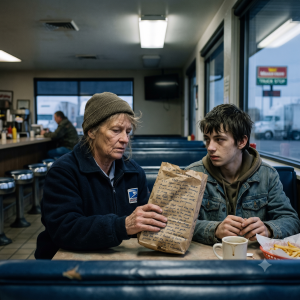
A boy. Maybe sixteen. Sitting alone in the far corner booth, thin jacket, no food in front of him. Just a pile of ketchup packets he was tearing open one by one, dragging his finger through them like that was supper.
Marvene was inside before she even made the decision.
She’d spent thirty-one years as a mail carrier in rural Montana. She knew lonely. She knew the particular stillness of a person trying very hard not to be seen.
She sat down across from him.
He flinched like she’d thrown something.
“I’m getting the meatloaf,” she said, like they’d already been talking. “The pie here is decent if you like cherry. You like cherry?”
He stared at her. Dark eyes. A bruise, old and yellowing, along his jaw she pretended not to notice.
“Sure,” he finally said.
She ordered for both of them without making a thing of it. When the food came, he ate like he was trying not to cry. She talked about nothing — the weather coming in, a pronghorn she’d almost hit on Route 12, the way the sky turns that particular shade of purple before snow.
And the whole time, she noticed the bag.
A paper lunch bag, the ordinary brown kind. Worn soft as cloth at the folds. Covered — absolutely covered — in handwriting. Neat, careful cursive, line after line, looping around all four sides and across the bottom.
Every few minutes, the boy would take it out of his jacket pocket, smooth it flat against the table with both palms, the way you’d press a letter from someone you loved. Then he’d fold it back along the same creases, gentle as a prayer, and tuck it away again.
He did it three times during the meal.
Marvene watched but didn’t ask.
The fourth time he took it out, she saw his hands were shaking.
“You don’t have to tell me anything,” she said quietly. “But I’m a good listener if you want to.”
He shook his head. Looked out the window at the parking lot.
Then, without looking at her, he said, “It’s the only thing I kept.”
She waited.
“From my grandma’s house. Before they cleared it out.” He smoothed the bag again. “She used to write on everything. Grocery bags, napkins, envelopes. Everybody said she was just — ” he stopped. “They said she was odd. But she wrote like every word mattered.”
Marvene felt something shift in her chest. Something old.
“Where was your grandma’s house?” she asked. Her voice came out careful. Measured.
He named a road. A rural route number. A little community outside of Broadus that barely had a post office anymore.
Marvene set down her coffee cup.
She’d carried mail on that route.
For thirty-one years, she had driven that road in every kind of weather God ever invented. She knew every mailbox, every fence post, every dog that would chase her truck on Tuesdays for reasons she never understood.
“What was her name?” Marvene asked.
He told her.
The room went very quiet, or maybe that was just something happening inside Marvene’s own head.
Because she remembered that name. She remembered that mailbox specifically — the one with the hand-painted bluebird that got faded and then repainted and then faded again. She remembered that sometimes, when the box was empty both ways for too long, she’d wondered about the woman inside that little house.
She’d wondered if anyone was writing to her.
“Can I see it?” Marvene asked. “The bag?”
He hesitated. Then he slid it across the table.
She turned it toward the diner light, tipping it to read the cursive running along the side.
And her breath stopped.
Because she knew this handwriting.
Not because she’d seen it on letters coming in to that bluebird mailbox.
She knew it because she had watched it leave.
Thirty-one years of a woman standing at that mailbox, sometimes in slippers, sometimes in the cold, sliding letters out and sliding them in. Marvene had assumed they were going to family. To friends. To somebody, somewhere, who was writing back.
She had carried this handwriting across half of southeastern Montana.
She had held it in her hands hundreds of times.
But the writing on this worn paper bag — these careful, looping words the boy treasured like scripture — this wasn’t the grandmother’s handwriting.
Marvene turned the bag over slowly.
She looked at the date written in the corner.
She looked at the return address.
And her hand began to shake, because the handwriting wasn’t the boy’s.
It wasn’t his grandmother’s.
It was hers.
From thirty-one years of letters she had delivered.
Letters she never once knew had gone unanswered.
She sat with that for a long moment. The diner noise went on around her — the short-order bell, a trucker laughing at the counter, the weather channel murmuring from a TV mounted too high on the wall. None of it touched her.
She read the words on the bag slowly. Her own handwriting, all right. She could see the particular way she crossed her sevens, the slight leftward lean she’d never been able to train out of herself.
But the words.
She didn’t remember writing them. That was the thing. You carry enough mail, enough years, the details bleed together. But these words — whoever had written them had written them to a child. Patient and clear and very kind.
She read a line near the top fold. Then another. Then she understood.
These weren’t letters she had written. They were letters she had delivered. Letters that had passed through her hands without her ever knowing what was inside them. The return address was hers only in the sense that it was the post office’s address — the Broadus station where she’d worked before they consolidated routes, the same one she’d sorted mail out of every morning for decades.
She turned the bag again and found the date.
June 1998.
The summer Marvene’s second route was extended east, out past the Powder River breaks. She remembered 1998. There had been a drought and she’d worried about a family on the far end of the route, an elderly woman who hadn’t put her flag up in two weeks. She had actually gotten out of her truck and knocked on the door that time. The woman had been fine — embarrassed, even, and a little pleased.
She looked up at the boy.
“Who sent this to your grandmother?” she asked. She kept her voice even. “The original letter, I mean. The one she saved the bag from.”
He blinked. He’d expected a different kind of reaction — she could see that. Something dramatic, maybe, or disbelief.
“Her sister,” he said. “My great-aunt Patrice. She lived in Billings. They wrote to each other every week for like forty years.”
Marvene let out a breath she hadn’t known she was holding.
Of course.
Not her handwriting. Patrice’s handwriting. Some woman in Billings whose cursive leaned the same particular leftward way Marvene’s did, who crossed her sevens like a European because someone had taught her to, who had written to her sister out on that lonesome eastern stretch every single week for forty years.
Marvene had carried those letters. Hundreds of them. She had slid them into that bluebird mailbox and driven on without a thought, the way you do, the way you have to when you’re covering a hundred and sixty miles of rural route and the work doesn’t stop for sentiment.
She had been, without knowing it, the thread between two sisters.
Every week. Forty years.
She set the bag down on the table very gently.
“Your grandmother’s name was Della,” she said. It wasn’t a question.
The boy stared at her. “How did you know that?”
“Handwritten name on the box. Little bluebird painted on the side. I painted that bird back on for her once, did you know that? Must have been 2003, 2004 maybe. The winter had faded it almost all the way off. I had a little kit of exterior paint in the truck — don’t ask me why, it’s just one of those things you accumulate. I touched it up one morning when I had a few extra minutes. Never knocked on the door. Just did it and left.”
The boy’s mouth was open.
“She talked about that,” he said slowly. “She talked about that her whole life. She thought it was my grandfather’s ghost.”
Marvene laughed. It surprised her — a real laugh, the kind that comes up from somewhere unexpected. She hadn’t laughed like that in a while.
“Well,” she said, “I can tell you it wasn’t a ghost. Just a mail carrier with a hobby kit and too much feeling for a mailbox.”
The boy looked down at the bag. He ran his thumb along one of the creases. “Grandma Della died in February,” he said. “And Aunt Patrice died last fall. That’s — that’s why the letters stopped.” He paused. “I didn’t know Aunt Patrice. We weren’t in contact with that side. But I found this bag when we were cleaning out the house. In a coffee can. With about three hundred other letters she’d kept, bundled up with baling twine.”
“What happened to the rest of them?” Marvene asked.
His face did something complicated. “My mom’s boyfriend said they were junk. He threw them out before I could get back to the house.” He was quiet a moment. “I got there in time to grab this one.”
Marvene nodded slowly. She understood what kind of situation she was looking at now. The thin jacket. The bruise. The ketchup packets. Getting back to the house implied he hadn’t been allowed to stay there.
She didn’t push on any of that. Not yet.
“Where are you headed?” she asked.
“Billings,” he said. “I’ve got an aunt there. Different aunt — my mom’s sister. She said I could come.” He looked down. “I don’t know her very well.”
“Anybody know you’re on your way?”
He nodded. “I texted her. She’s expecting me.”
Marvene pulled a napkin from the dispenser and wrote her name and number on it. She pushed it across the table.
“I live in Billings,” she said. “Been there forty-some years. I know people.” She tapped the napkin. “You get there and something isn’t right, you call me. Not tomorrow, not when you’ve thought about it. That night.”
He looked at the napkin. Then at her. Trying to figure out if she was real.
Most people, she knew, stopped offering about two steps before she was willing to.
“Why are you being so nice to me?” he asked.
She considered the question. She’d been asked variations of it over the years and she never had a very satisfying answer, but she tried anyway.
“I spent thirty-one years making sure the things people needed to say to each other actually got there,” she said. “Letters from sisters. Birthday cards. Checks from people who owed other people money. Medical results. Notices of things ending and things beginning. I knew that the only thing keeping some of those people connected to the world was whatever was in my truck on a given Tuesday.” She looked at him steadily. “You’re connected to the world whether you know it or not. Sometimes somebody just needs to be the one to show up and remind you.”
He didn’t say anything. His eyes were bright.
She paid the check over his protest. She walked him out to the parking lot and found out his aunt’s address, which turned out to be six blocks from her own house, a fact that made him laugh for the first time — a short, rusty sound, like something that hadn’t been used in a while.
His name was Cody. She found that out in the parking lot. Cody Ray, seventeen in March, and he had been sleeping in a friend’s truck for four days before he started walking the highway.
She drove him to Billings herself.
The aunt — a small, nervous woman named Gretchen who met them at the door in a bathrobe and then cried for a solid three minutes — was real. The room was real. There was food in the kitchen. There was a dog who immediately climbed on Cody and stayed there.
Marvene drove home through the first light snow of the season, the kind that doesn’t stick, just drifts across the headlights and disappears.
She thought about Della, out on that rural route, going to the mailbox every week for forty years to collect the one reliable thing. She thought about Patrice in Billings, writing every week, trusting that the words would get there.
She thought about all the things she had carried without knowing what they meant.
That was three years ago.
Cody finished high school in Billings. He’s at community college now, studying to be an EMT. He still texts Marvene on holidays and sometimes for no reason at all. Last spring he brought her a cutting from a bluebird he’d been painting — on an old coffee can, just like the one his grandmother had kept, practicing the shape until he felt like he had it right.
He put it on her porch while she was out. Left a note underneath in careful, deliberate cursive.
She keeps it on the windowsill above the kitchen sink, where she can see it every morning.
She almost didn’t stop.
She’s glad she did.