Every Tuesday morning for four months, Dottie Callahan drove her old Subaru down a dirt road she had no business being on.
She’d found the mailbox by accident.
Last October, she’d taken a wrong turn off Route 12 — the kind of wrong turn that happens when you’re 67 and your mind is half on a podcast and half on whether you turned the stove off. The mailbox sat at the end of a rutted lane, leaning like it was tired. Rusted. Cracked clean down one side.
But someone had tied a piece of red yarn around the post.
Dottie noticed things like that. Thirty-one years as a school librarian will do that to you.
She didn’t think much of it until she saw the child.
Just a flash, really. A small figure in the tree line at the far end of the lane. Maybe eight, nine years old. Standing still as a deer. Gone before Dottie could even lift her hand to wave.
She went home. She thought about it for three days.
Then she put a paperback in that mailbox.
Nothing fancy. A copy of Charlotte’s Web she had two of. She left it spine-up so the rain wouldn’t wreck it, and she drove away telling herself she was probably being foolish.
It was gone the next Tuesday.
So she left another one.
The One and Only Ivan. Then Hatchet. Then Island of the Blue Dolphins. Every single one disappeared within the week.
She started finding something in return.
Tucked between the pages of each book she left — wait, no. Tucked between the pages of each book that came back. Because that’s what started happening around week three. She’d open the mailbox and find the previous book sitting there, returned neat as you please.
And always, always, pressed flat between pages 46 and 47 — a wildflower.
The first one was a blue flax blossom, barely bigger than Dottie’s thumbnail.
The second was a pale yellow biscuitroot.
The third was something she had to look up: a shooting star wildflower, deep pink, shaped like a little comet.
Always page 47. Never any other page.
Dottie began to press them herself, in the pages of her old field guide. She started driving slower down Route 12, watching the tree line. She mentioned the flowers to her friend Barb at Tuesday morning coffee, and Barb said, “Dottie, you’ve got yourself a little pen pal,” and they both laughed.
But Dottie didn’t laugh as much as Barb did.
Because she’d started to notice something. The books were always returned with the spine bent back at the same spot. The same passage, every time, in a different book. As if small hands kept returning to one particular kind of moment — always the part where the child in the story realizes they are not as alone as they thought.
She left The Secret Garden in March.
She left A Long Walk to Water in April.
Each one came back with a pressed flower on page 47. Each one bent open to a moment of unexpected kindness.
And then, last Tuesday, Dottie opened the mailbox and felt her breath catch.
The returned book — Julie of the Wolves — had something she hadn’t seen before.
A folded piece of paper tucked inside the front cover. Not a flower. Not this time.
A note.
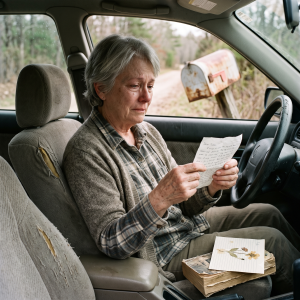
Her hands were shaking a little as she unfolded it in the front seat of her Subaru, the engine still running, Montana wind rocking the car just slightly.
The note started in one handwriting. Small, careful, the letters shaped with the particular effort of a child who is still learning to make them behave.
Thank you for the books. I read every one. My favorite part is always when someone helps without being asked.
Dottie sat with that for a long moment.
Then her eyes moved to the second half of the note.
Different handwriting entirely.
Older. Steadier. But something in it — a tremble at the end of certain letters — that made Dottie think of someone writing through tears, or through great effort, or through something she couldn’t yet name.
And what that second handwriting said was this:
My daughter Wren has read your books by flashlight, by firelight, and twice by the light of her phone when I didn’t know she was still awake. She asks me every Wednesday morning if it’s Tuesday yet. I don’t know who you are. I don’t know why you started leaving them. But I have been very sick this winter, and there were days I couldn’t get out of bed, and she needed somewhere to go that wasn’t inside this house watching me be sick. Those books gave her somewhere to go. I want you to know that. You gave my child whole other worlds to live in when this one got too heavy. Thank you doesn’t feel like enough. But it’s what I have.
The signature was a single name: Cecelia.
Dottie read it twice. Then she folded it very carefully along its original creases and held it in both hands in her lap and looked out at the lane and the tree line and the low April sky going silver over the mountains.
She sat there for a good while.
Then she drove home and she did not tell Barb. Not yet. Some things need to be carried alone for a little while before you share the weight of them.
That night she sat at her kitchen table with a yellow legal pad and she wrote back.
She didn’t try to say anything grand. Dottie had been a librarian long enough to know that the right response to a book lover isn’t a speech — it’s another book. But she was also 67 years old and a widow of nine years and she knew what it meant to be the one left managing everything while someone you loved got small and tired. She wrote to Cecelia the way she’d have wanted someone to write to her back in the winter of 2015, when her husband Ray was in and out of the hospital and the house felt like it was holding its breath.
She wrote: I found your mailbox by accident but I don’t think there are very many accidents in this life, not really. She wrote: I know what it is to be the one holding everything together. She wrote: I would very much like to bring groceries on Tuesdays if that is all right with you. You don’t have to answer this note. I’ll bring them either way and leave them in the mailbox and you don’t owe me a thing.
She tucked the note into the front cover of From the Mixed-Up Files of Mrs. Basil E. Frankweiler, which she had always felt was exactly the right book for a child who needed to believe that ordinary places could hold extraordinary secrets.
She left it Tuesday morning.
Wednesday, her phone rang. A number she didn’t recognize.
The voice on the other end was quiet. A little roughed up around the edges, the way voices get when someone has been coughing a lot, or crying, or both.
“This is Cecelia Marsh,” the voice said. “Wren’s mom.” A pause. “The mailbox.”
“I know,” Dottie said. “I’m so glad you called.”
There was a long breath on the other end. “Nobody brings groceries to people they don’t know.”
“I do,” Dottie said. “I used to be a librarian. We’re a little pushy about things we think are important.”
Cecelia laughed at that. It was a short laugh, surprised out of her, the kind that sounds like it hasn’t been used in a while. Then she got quiet again. “She read the whole new book last night. She told me this morning it was the best one yet.”
“It’ll hold up,” Dottie said. “I’ve given it to a lot of children over the years. It never lets them down.”
The following Tuesday, Dottie turned down the lane for the first time since October with more than a book in the car. She had two paper grocery bags in the back seat. Nothing elaborate. Soup she’d made herself, a good bread, eggs, a bag of apples, some cheddar, a thing of orange juice, two kinds of crackers, and a small bar of dark chocolate she’d slipped in at the last minute because she felt it was important.
And she had, tucked under her arm, a box of twelve paperbacks she’d spent part of the week selecting with the focused care she used to give to building a school library’s collection. Books for a child who loved animals and survival and solitude and unexpected kindness. Books for when you’re eight or nine and the world has gotten bigger than it should be. Books for the long rest of the summer, and for whatever came after.
The house at the end of the lane was small and old and tidy in the way that things are tidy when someone is working very hard to keep them that way. There was a vegetable garden along the south side, just turned over. A pair of rubber boots by the door, adult size and child size, side by side.
Dottie sat in the car for a moment.
Then the screen door opened.
Wren came out first.
She was small for her age, with dark hair pulled back in a braid that was coming loose on one side. She was wearing a sweatshirt with a wolf on it, which Dottie noted and approved of. She stood on the porch steps and looked at Dottie with large, serious eyes and did not wave.
Neither did Dottie. She just nodded.
Wren nodded back.
Cecelia came to the door a moment later, one hand on the doorframe. She was thinner than she should have been, and there was a tiredness behind her eyes that Dottie recognized. But she was standing. She was upright. And she was looking at Dottie with an expression that was equal parts wariness and something that wanted very badly to not be wariness.
“You actually came,” Cecelia said.
“I told you I would,” Dottie said.
She got out of the car. She retrieved the grocery bags and the box of books.
Wren came down the steps and stopped a few feet away and looked at the box.
“Are those all for me?” she asked. Her voice was low and careful.
“Every one,” Dottie said.
Wren looked up at her. “Why page 47?”
Dottie paused. She hadn’t expected that question. “What do you mean?”
“You always left the books open to page 47. The first few times I thought it was an accident. Then I checked and it was always the same page.” Wren pushed her loose braid back over her shoulder. “So why?”
Dottie looked at her for a moment. Then she smiled.
“Your turn,” she said. “Why did you always press the flowers between pages 46 and 47?”
Wren’s serious expression shifted. Something moved across her face — surprise, and then a little glow of pleasure at being understood. “Because in all the books,” she said slowly, “something important always seemed to happen around there. At the beginning. Before the kid knows yet that it’s going to be okay.” She paused. “I wanted to mark it. So I’d remember where the good part was about to start.”
Dottie stood there in the April wind with two bags of groceries and a box of twelve books and looked at this child and felt something move through her chest that she didn’t have a precise word for. It was the feeling she’d had sometimes at the end of a very good book, but also the feeling she’d had in the hospital with Ray, and also something else — something that was specifically about standing in a Montana dooryard in spring and being 67 and still, still being surprised by the world.
“That,” Dottie said, “is exactly right.”
She left that afternoon having stayed for soup and most of a pot of tea. Cecelia had lupus — had been managing it for years, had gone through a brutal flare last fall that had knocked her flat from October through February. She was better now. Not all the way. But better.
Wren had sat at the kitchen table the whole time with The Witch of Blackbird Pond open in front of her, not exactly reading and not exactly listening to the adults, occupying that precise child-space in between.
Before Dottie left, Wren walked her to her car.
“Will you keep coming on Tuesdays?” she asked.
“If you’ll keep leaving me flowers,” Dottie said.
Wren thought about this seriously. “What if I can’t find one some weeks?”
“Then you leave whatever you find,” Dottie said. “That’s the rule with gifts. You leave what you have.”
Wren nodded. That seemed to satisfy her.
It is a Tuesday morning in late May now. Dottie has driven this road seventeen times since October. She knows where the ruts are. She knows where the lane bends and the meadow opens up and the mountains come into view all at once, sudden and enormous and indifferent in the way that beautiful things sometimes are.
She knows which tree Wren likes to read in. She knows how Cecelia takes her tea. She knows that Wren has a particular passion for books about animals making their way in hard landscapes, and that she reads fast but remembers everything, and that she has opinions about endings and isn’t shy about sharing them.
Last week the returned book had a pressed flower on page 47, same as always. A wild prairie rose, just opening. The deepest pink Dottie had ever seen.
And written in the margin beside it — small, careful, still learning to make the letters behave — just two words.
Found you.
Dottie had pressed it into her field guide with the others. Blue flax, biscuitroot, shooting star, prairie rose. All of them lined up in the order they were given, each one marking the place where the good part was about to start.
She turns down the lane now and the Subaru finds its way without her having to think much about it. There’s a book on the passenger seat. There are groceries in the back.
The mailbox leans at the end of the lane, still rusted, still cracked down one side.
But someone has replaced the red yarn with a fresh piece.
Brighter than the last one.
Dottie pulls up and stops the car and sits there a moment in the Montana morning, engine running, windows down, listening to the meadowlarks.
Then she gets out and goes to see what’s been left for her.