The first time Elisa Arroyo decided to die, she did it quietly.
There was no dramatic note, no last plea, no desperate cry to heaven. Just a dusty road in Jalisco, a dry wind scraping over the earth, and three dark belladonna berries trembling in her hand.
She had walked so far that morning she could no longer feel the blisters on her feet. Her skirt was torn from cactus thorns. Dirt clung to her fingers and to the sweat drying on her neck. Her stomach had been empty for so long that hunger had moved past pain and turned into numbness. That frightened her most. Even her body had stopped protesting.
She lifted the berries toward her mouth.
She thought of Julián.
Eight months had passed since they laid him into the ground in a village cemetery where the crosses leaned crooked and the wind swept dry flowers over the graves like discarded promises. He had not died old. He had not died peacefully. A fever had taken him fast, and by the time the priest had finished praying, Elisa still hadn’t understood how a man who had filled every corner of her life could vanish so completely.
For a few days after the burial, grief had been soft with shock. Then it turned cruel.
Doña Ramona, Julián’s mother, arrived dressed in widow’s black, though she wore it with the confidence of someone who had come to collect, not mourn. She brought a notary, two lawyers, and the kind of smile that never reached the eyes.
“The house was in my son’s name,” she had said, smoothing her gloves while Elisa stood in the doorway trying to understand why legal papers were being opened before the candles from the novena had burned out. “And the debts attached to it must be settled.”
“Elisa lived there with him for nine years,” one neighbor had dared to say.
Ramona turned as if swatting away a fly. “That changes nothing.”
Then, with terrible calm, she looked Elisa up and down and delivered the blow she had probably wanted to say for years.
“A widow that big, that slow, and that useless should be grateful for anything she’s given.”
Elisa had never forgotten the expression on the notary’s face. Not pity. Not outrage. Embarrassment. As if cruelty became acceptable as long as it wore respectable clothing.
Within days, the house was gone. The bank took the furniture. The kitchen table where Julián used to sit with his coffee disappeared into a wagon. The bed where he had reached for her in the dark belonged to strangers. She was left with a single suitcase, a few pots, and the kind of humiliation that follows a person louder than footsteps.
Then began the search for work.
She tried everything. Boarding houses, kitchens, bakeries, private homes, ranches. She stood in doorways and introduced herself. She spoke of experience, of long hours, of recipes and discipline, of how to stretch meat for twenty mouths and how to keep coffee hot before dawn. Most never let her finish. Their eyes slid over her body first, and that was enough.
One woman at a bakery had laughed outright. “The customers won’t want to see you in the front.”
A ranch owner’s wife had folded her arms and said, “You look too tired for this kind of work.”
A cook at a fonda had muttered to another, not quietly enough, “She’d eat the profit.”
Each rejection added weight to her chest until it felt impossible to breathe.
By the third week, she had stopped defending herself. By the fourth, she had stopped imagining a future.
That was how she ended up at the edge of the road with poison in her hand.
She never swallowed it.
A hard strike hit her wrist, sending the berries flying into the dirt. Elisa cried out and dropped to her knees, scrambling for them with desperate fingers, but a worn leather boot crushed them before she could.
“You had no right!” she shouted, her voice torn raw.
“Maybe not.”
The voice was deep, rough, and steady.
“But I wasn’t about to watch you die right in front of me.”
Elisa looked up through a blur of tears and saw a man standing over her with a weathered hat pulled low, a faded denim shirt open at the throat, and shoulders shaped by years of hard labor. The sun had carved lines around his eyes, but those eyes were what struck her most—gray, watchful, and heavy with the kind of knowledge people only gain by surviving disappointment again and again.
“My name is Mateo Aguilar,” he said. “And unless I’m mistaken, you haven’t eaten.”
She wanted to hate him for interfering. She wanted to scream. Instead her body betrayed her with silence.
“You don’t know anything about me,” she whispered.
He crouched, not close enough to frighten her, but close enough that she could see he was not mocking her.
“I know you’re alone,” he said. “I know you’re hungry. And I know someone worked very hard to make you believe your life had no value.”
No one had put it that way before. Not even Elisa herself. Hearing it said aloud split something open inside her.
“My husband died,” she said, staring at the road. “Then his mother came with papers and took my home. The bank took what was left. I’ve asked for work everywhere. No one cares what I can do. They look at me and decide who I am.”
Mateo waited.
Then he asked only one question.
“Can you cook?”
Elisa laughed bitterly. “For nine years I ran the kitchen in a guesthouse. I fed laborers, musicians, truck drivers, priests, drunks, families, and men who could complain through a miracle. None of them complained about my food.”
“Then come with me,” Mateo said. “I need a cook.”
She frowned. “You don’t even know me.”
“I know what I need,” he replied. “My kitchen is failing, my ranch hands are angry, and I’m tired of bad coffee. I’ll pay wages, room, and meals. That’s not pity. It’s work.”
“I don’t want charity.”
He stood and tipped his head toward the road ahead. “Good. Neither do I.”
Rancho La Noria sat outside Tepatitlán among dry hills, agave rows, and broad fields browned by heat. It was large enough to suggest old prosperity, but tired enough to show trouble. Fences sagged in places. One barn roof had been patched with mismatched tin. The main house was sturdy but worn. Men moved around the yard with the tense efficiency of people who were working too hard for too little reward.
The kitchen was even worse.
When Elisa stepped inside, the smell nearly drove her back out. Burned grease, old coffee, spoiled meat, damp flour, and stale smoke sat in the air like punishment. Pots blackened by neglect crowded the counters. A sack of grain had split in one corner. The wood stove was cracked. Flies claimed the windowsill.
“God help us,” Elisa muttered before she could stop herself.
A young ranch hand standing nearby gave a nervous half-smile. “You must be the new cook. I’m Tomás.”
Before she could answer, another man approached. Older. Hard-eyed. Thick mustache. Arms crossed as if defiance were his natural posture.
“This her?” he asked Mateo. “This is what we’ve got?”
Mateo’s tone stayed level. “This is Doña Elisa. And nobody here insults the person who hasn’t fed them yet.”
The man said nothing more, but the look on his face made clear he had not surrendered his opinion. Mateo later introduced him as Pedro, the foreman.
Elisa tied back her sleeves, took one slow breath, and got to work.
The world made sense to her in kitchens. It always had. Grief could rage outside. Debt could knock at the door. People could judge and sneer and strip a life to the bone. But inside a kitchen there were rules. Heat transformed. Salt corrected. Time rewarded patience. Hunger could be answered.
“Water,” she said to Tomás. “Dry wood. Eggs. Onions if there are any. Bacon. Beans.”
He blinked at her sudden command, then hurried off.
She scrubbed surfaces with furious determination, washed blackened pots, sorted what remained usable from what had rotted, and rebuilt order out of ruin. Her hands moved faster than they had in weeks. By late afternoon, the kitchen had changed character entirely. Fire snapped in the stove. Beans simmered low with bacon. She whisked eggs with chopped onion and chiles. Tortilla dough rested beneath a cloth. Coffee darkened in a clay pot with cinnamon and piloncillo.
Pedro reappeared, drawn by the smell, though he pretended otherwise.
“With respect,” he said, leaning against the doorframe, “you don’t look like somebody who’s gone hungry.”
Tomás stiffened. Mateo, who had just stepped inside, said nothing. He watched Elisa.
She flattened a ball of masa with calm, steady hands and looked Pedro straight in the face.
“At six o’clock,” she said, “taste my food. Then decide whether your mouth is for judging or only for eating.”
Tomás choked on a laugh and immediately tried to hide it.
When the men sat down to supper, suspicion filled the room before the food did. Elisa had seen it before. Working men who’d been disappointed too many times learned to brace themselves.
Then they tasted.
Silence took over.
One by one, spoons scraped bowls. Tortillas vanished. Coffee cups were refilled. No one looked up because no one wanted to lose even one second of eating.
Finally, Tomás lowered his spoon and said softly, “This tastes like home.”
Pedro, who had eaten two extra tortillas while pretending indifference, cleared his throat. “It’s good.”
Mateo stood near the doorway, arms folded, watching Elisa with a quiet expression she did not know how to read. Gratitude, maybe. Relief. Something gentler than either.
For a moment, warmth spread through her chest. Not happiness. Not yet. But the possibility of becoming necessary again.
The moment did not last.
Tomás came back from outside pale and breathing fast. “Doña Elisa,” he said, glancing at Mateo before speaking, “the fence on the south pasture didn’t collapse.”
Mateo’s face hardened. “What are you talking about?”
“It was cut,” Tomás said. “Clean through.”
Pedro swore under his breath.
Mateo set down his cup. “Again?”
That single word changed the air in the room.
Again.
Elisa looked from one man to another. “This has happened before?”
No one answered immediately. Finally Tomás said, “We’ve lost cattle twice. Feed has gone missing. Tools too. Every time something breaks, people call it bad luck.”
Pedro snapped, “Because sometimes bad luck is exactly what it is.”
Mateo did not argue, but his jaw tightened.
Before anyone could say more, hoofbeats thundered into the yard. A rider burst from the darkness shouting, “Boss! Fire in the north pasture! Someone turned the cattle loose!”
The room exploded into motion.
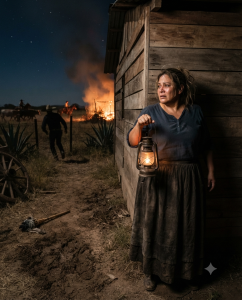
Chairs slammed back. Men grabbed hats, ropes, buckets. Mateo was outside before the echo died. Elisa rushed to the kitchen doorway and saw the horizon lit orange. Flames licked up from the dry pasture in hungry tongues. Smoke rolled across the night. Cattle bawled in panic, a terrible sound that seemed almost human.
But in that chaos, Elisa noticed something strange.
A figure moved behind the grain shed.
Not toward the fire. Away from it.
There was purpose in the movement. Secrecy.
She grabbed a lantern from a hook and ran around the side of the kitchen before she could talk herself out of it. The yard behind the shed was darker, shielded from the main blaze, but smoke drifted through in thin, choking ribbons. She lifted the lantern higher.
The smell hit her first.
Kerosene.
Fresh, sharp, unmistakable.
Her pulse began to pound. Near a wagon wheel she found a rag blackened on one end and wet on the other. A torch. Dropped or hidden in a hurry.
Then she saw footprints in the dirt. Not the heavy prints of men charging to fight the fire. These were more careful. One heel dug deeper than the other, as if the person had carried extra weight. Elisa crouched to see better, then froze as two voices drifted from the far side of the shed.
“You said it would stay in the dry grass,” one hissed.
“It was supposed to,” the other snapped. “How was I supposed to know they’d all still be awake?”
Elisa pressed herself against the wood, barely daring to breathe.
The first voice again, angry now: “If Mateo sees the books—”
“We’ll handle Mateo,” the second interrupted. “But if you lose your nerve now, we’re both finished.”
Books.
That word stayed with her.
When the men moved away, Elisa circled carefully and caught only the briefest glimpse of one disappearing into the dark. Not enough to see the face. Enough to see the build. Enough to know one of them walked with a slight drag in the left foot.
She carried the rag back toward the house, hidden in her apron.
The fire took half the north pasture before they contained it. One calf died. Two horses were injured. By the time the men returned, smoke covered them like another layer of skin. Mateo looked exhausted and furious, but also grimly unsurprised. That bothered Elisa more than the fire itself.
“You expected this,” she said quietly when they were alone in the kitchen.
Mateo washed soot from his hands in a basin. “I expected trouble. Not tonight.”
“Someone set that fire.”
His eyes lifted to hers. “Did you see who?”
“No. But I found this.” She unfolded the rag.
Mateo stared at it for a long moment. Then he looked toward the pantry, where ledgers and keys hung behind a locked cabinet.
The next morning Elisa rose before dawn and made coffee strong enough to wake the dead. The men were raw from the night’s work, quiet with anger. Pedro barked orders in the yard, but Elisa noticed it then—the slight drag in his left foot when he turned sharply.
She said nothing.
Instead she watched.
Over the next three days, she learned more by keeping her mouth shut than she ever could have by asking questions. Tomás was loyal but nervous. He had seen too much and understood too little. Pedro controlled nearly everything on the operational side of the ranch—supplies, repairs, schedules, hired labor. Mateo trusted him because Pedro had been there since Mateo’s father ran La Noria.
There was also César, the bookkeeper, who came from town twice a week to manage invoices and debt records. Thin, polished, too clean for ranch life, with fingers that looked more suited to cards than numbers. He smiled too quickly and never held eye contact long.
On Thursday afternoon Elisa was carrying lunch to Mateo when she heard raised voices from his office.
“I asked for the payment receipts from February,” Mateo said.
“You already saw them,” César replied.
“I saw copies.”
“That’s all I keep.”
“That’s not what you said last month.”
Elisa stopped outside the half-open door. She couldn’t see them, but she heard the scrape of a chair.
“You’re under pressure,” César said in a soothing tone that made her skin crawl. “After the drought and the cattle loss, of course the numbers look worse.”
Mateo’s answer came low and dangerous. “Are you telling me my own ranch is collapsing by coincidence?”
Silence.
Then César said, “I’m saying not every problem is betrayal.”
Elisa stepped away before she could be caught listening, but the sentence followed her all day.
That evening she checked the pantry cabinet while putting away flour and coffee. The key ring was there. So were the ledgers. But one book—the fuel and supply account—had fresh dust marks around it, as if it had been removed and returned in haste.
She waited until midnight.
The house slept lightly after the fire. Men rolled in their bunks, horses stomped in the stable, and every creak felt louder than normal. Elisa took a candle and the pantry key she had copied in dough earlier that day. Her hands shook as she unlocked the cabinet.
The ledgers smelled of leather and old paper. She found the fuel account and opened it across the table.
She wasn’t a trained accountant, but kitchens teach arithmetic better than schools ever do. She knew quantities. She knew waste. She knew when numbers lied.
Kerosene purchases had doubled in four months.
Feed orders had been billed but not fully delivered.
Fence repair wire had been paid for three separate times.
And at the bottom of several pages was César’s neat signature—alongside initials authorizing release from ranch stock.
P.A.
Pedro Aguilar? No. Pedro’s last name was Ledesma.
P.A.
Elisa turned another page, then another, until the realization hit her hard enough to make her grip the table.
P.A. was not Pedro.
It was Patricio Aguilar.
Mateo’s younger brother.
She had seen his name only once, on a framed photograph in the hallway. A handsome man with Mateo’s eyes and a smile too charming to trust.
The next morning, Patricio arrived.
He came on a chestnut horse, dressed better than anyone working the ranch had a right to dress, with polished boots, a pressed shirt, and the lazy confidence of someone who believed rules were for other people. He dismounted grinning and embraced Mateo as if he brought nothing but good news.
“El hermano perdido returns,” he joked.
Mateo’s face did not soften. “You could have sent word.”
“I was nearby.”
“Since when?”
Patricio spread his hands. “Since family still has the right to visit.”
From the kitchen doorway, Elisa watched the exchange and felt the skin rise on her arms. Patricio’s left foot dragged almost imperceptibly when he turned.
At lunch he flirted with everyone and insulted no one directly. That made him more dangerous, not less. He praised the food extravagantly, called Elisa a miracle, and laughed with the men as if he had earned his place among them.
But when Mateo stepped out to deal with a supplier, Patricio leaned on the kitchen table and lowered his voice.
“You’re new,” he said.
Elisa kept kneading dough. “That’s usually what new means.”
His smile sharpened. “Then here’s some advice. Don’t involve yourself in ranch matters that don’t concern you.”
She met his gaze. “Feeding the men concerns me. Fires concern me too.”
For the first time, his smile cracked.
That night Elisa took the ledgers to Mateo.
She expected anger, denial, maybe even accusation. Instead she found him sitting alone on the back steps, staring at the blackened edge of the north pasture under moonlight.
He looked older than he had on the road.
Without a word, she handed him the open ledger and pointed to the entries. Mateo read in silence. Then read again.
When he reached the signatures, all the color left his face.
“No,” he said quietly.
Elisa did not answer.
“He wouldn’t,” Mateo insisted, though there was less certainty in it now. “Patricio is reckless. Lazy. He gambles. But this—”
“Two men argued behind the grain shed the night of the fire,” Elisa said. “One said, ‘If Mateo sees the books.’ The other said, ‘We’ll handle Mateo.’ I found the torch. I smelled the kerosene. And your brother drags his left foot.”
Mateo shut the ledger hard enough to make the steps shake.
The confrontation happened the following afternoon in the main barn.
Mateo sent everyone else away except Pedro, Tomás, César, Patricio, and Elisa. Light slashed through the slats in the walls, striping the hay in gold and shadow. Horses shifted in their stalls as if they could feel the tension.
Mateo held up the ledgers. “Explain these.”
César went pale instantly.
Patricio did not. He smiled, which was worse.
“There are irregularities,” Mateo said. “Fuel. Feed. repairs. Missing stock. Fences cut. Fires set. Explain.”
César began stammering. “I—I only recorded what I was given—”
“By whom?”
César’s eyes darted toward Patricio.
Patricio let out a slow breath and said, “You always did love dramatics, brother.”
Mateo took one step forward. “Did you burn my land?”
Patricio’s smile vanished. “Your land?”
The words landed like a slap.
“El rancho should have been split,” Patricio said, voice rising. “Father favored you because you worked like a mule and made everyone else feel small. But half of this should have been mine.”
“So you steal from me?”
“You were already losing it,” Patricio fired back. “I just moved things along.”
Tomás looked sick. Pedro swore softly. César backed away as if distance might erase his part in it.
Mateo’s hands curled into fists. “You killed a calf. You could have killed men.”
Patricio laughed once, harsh and bitter. “Please. A little fire, a little panic, some ruined numbers, and the bank would finish what I started. Then you’d be forced to sell. And guess who was ready to buy through a third party?”
For one long second, nobody moved.
Then Mateo crossed the space between them.
Pedro caught him before the first punch landed full force, but not before Patricio stumbled back into a hay bale with blood on his lip and hatred in his eyes.
“You self-righteous fool,” Patricio spat. “You think you’re better than everyone because you rescue stray women off the road and feed your workers like saints.”
Elisa felt every head turn.
Mateo’s face changed.
It was no longer just fury. It was clarity.
“Get off my ranch,” he said.
Patricio wiped his mouth and smiled again, but now it looked broken. “You’ll regret this.”
“No,” Mateo said. “You will.”
Pedro stepped forward then, and in a voice heavy with disgust, said, “I’ve worked this land thirty years. Your father would die twice seeing what you did.”
César tried to slip away, but Tomás blocked the door.
By evening, Mateo had turned both men over to the authorities in town with the ledgers, the false invoices, and César’s written confession. César folded first. Men like him always do when charm stops working. He admitted Patricio had been siphoning supplies, staging losses, and using controlled sabotage to worsen the ranch’s debt until forced sale became inevitable.
The fire had been meant as pressure.
Nothing more.
That was the part Elisa found hardest to forgive. To some men, ruin was just arithmetic.
The weeks afterward were not easy, but they were clean.
Pedro changed toward Elisa in small, stubborn ways. He never apologized directly—that would have required a personality transplant—but one morning he left the best eggs from the henhouse outside her kitchen door, and another time he told a supplier, “Nobody talks nonsense about Doña Elisa in my hearing.” Coming from him, it was practically poetry.
Tomás became her shadow and willing helper. Under Elisa’s eye, the kitchen turned into the steady heart of La Noria. Men worked harder because they ate better. Accounts balanced because Mateo checked every figure himself. Trust, once broken, returned like rain after drought—slowly, unevenly, but real.
As for Mateo, he thanked Elisa twice.
The first time was in front of everyone, formal and clear. “You saved this ranch.”
The second time was weeks later, at dusk, when the sky turned copper over the repaired north pasture.
They stood by the fence watching the cattle settle. The scorched earth had already begun to green in stubborn patches.
“You saved me first,” Elisa said.
Mateo shook his head. “I stopped you on a road.”
“You gave me work.”
“I gave you a kitchen.”
She looked at him then, at the man who had seen hunger before shape, pain before appearance, value before despair.
“You gave me back a reason to stay alive,” she said.
He had no answer for that. Or maybe he did, but some truths sit too deeply in the chest to come out cleanly.
Months later, when people from nearby towns spoke of La Noria, they spoke differently. They spoke of a ranch that nearly burned from within and survived. They spoke of a cook whose food could silence a table and whose eyes missed nothing. They spoke of Mateo Aguilar with more caution and more respect. And when cruel people remembered the woman who had once been called too big, too slow, too useless, they had to say those words much more quietly—because now they sounded ridiculous even to them.
As for Doña Ramona, she sent one message through a neighbor asking whether Elisa had “landed somewhere decent.”
Elisa sent back only four words.
“Better than I lost.”
That night she laughed for the first time in a way that did not hurt.
Some wounds never fully disappear. Some humiliations leave marks long after justice arrives. Elisa still remembered the road, the berries, the feeling of having no place left in the world. Mateo still carried the betrayal of his own blood like an old fracture that aches before rain. But La Noria stood. The fields grew back. The fire had revealed what rot was hidden underneath, and once that rot was dragged into the light, healing became possible.
Maybe that was the part no one talked about enough: the ugliest betrayals do not always destroy a life. Sometimes they expose exactly who deserves to remain in it.
And if there was one question that lingered after everything was over, it was this—what causes more damage in the end: the enemy who attacks openly, or the family member who smiles while striking the match?
