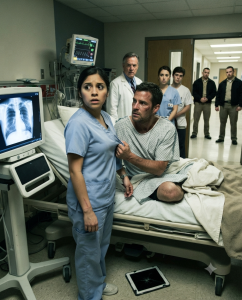
When Lucía Ríos started her job at the Naval Specialty Hospital in southern Mexico City, she learned almost immediately that competence and kindness did not protect anyone from cruelty.
Sometimes they made it worse.
She had been there less than three weeks, which was long enough for everyone to know her name but not long enough to care whether she kept it. She was quiet, careful, and painfully polite. She did not gossip at the nurses’ station. She did not flirt with the residents. She did not laugh loudly enough or speak sharply enough or carry herself with the practiced hardness people in that hospital mistook for strength.
So they treated her like an easy target.
That morning, the target came with a chart.
Marisol, the senior nurse on shift, dropped the file in front of Lucía and said with a smile that wasn’t a smile at all, “Room 12. Iván Salcedo. Former naval commando. Deaf after an explosion, partial leg amputation, hostile with staff. He doesn’t let anyone touch him. We thought you two might be a perfect match.”
Tomás, one of the residents, lifted his phone and snorted. “This should be educational.”
Lucía reached for the chart without answering. Mockery was easier to survive when you refused to feed it.
The chart told her more than the staff had. Fever. Elevated pulse. Right-sided rib pain. Progressive breathing difficulty after prosthetic mobility training. Bilateral profound hearing loss. Left below-knee amputation.
And then, over and over, in aggressive red handwriting: difficult patient.
Lucía hated labels like that. Too often, they said more about the failures of the medical team than the person in the bed.
She walked to Room 12 feeling their attention on her like hands between her shoulder blades.
Inside, Iván Salcedo was exactly what no one outside the room had understood.
Not unstable. Not violent. Not irrational.
He was alert.
He sat upright with his back against the wall, not the pillow, giving himself sightlines to the door, window, oxygen port, and instrument tray. His broken communication tablet lay near the bed in pieces. The orderlies posted near him looked wary, but he looked prepared.
For danger, not drama.
Lucía paused at the door and tapped the frame twice.
His gaze snapped to her hands immediately.
That was enough for her to dismiss the orderlies and step inside alone.
Then she did the one thing none of them expected.
She signed.
My name is Lucía. I’m your nurse. I won’t touch you without permission.
Iván stared at her, then responded so quickly it was obvious he hadn’t expected to be understood.
Who taught you?
Lucía hesitated only a fraction of a second. “Someone who knew how to listen,” she signed back.
It was true, though not complete.
Years earlier, before nursing school and before the name Lucía Ríos, she had lived another life that had required silence, observation, and languages no transcript could capture. Officially, that life no longer existed. The people from it believed she was dead, and she had worked very hard to stay that way.
But some skills never really left the body.
Iván’s eyes narrowed, not trusting her yet, but willing to test her.
No residents, he signed. No Castañeda. No sedatives.
She agreed with the calm confidence of someone who had already decided she would not let this man be dismissed into panic and restraint because people around him were lazy.
When she took his vitals, the numbers troubled her immediately. His blood pressure was elevated. His pulse was racing. His breathing was too fast, too shallow. He guarded the right side of his chest with unconscious protectiveness. When she auscultated his lungs, breath sounds on the right were diminished.
“You need urgent review,” she signed.
He gave her a hard, humorless look. “The doctor said anxiety.”
“The doctor is wrong.”
That was when everything changed.
Instead of standard sign language, Iván switched to a stripped-down tactical system—coded movements, compact and military, designed for silent operations. Pain worsening. Breathing failing. Internal problem.
Lucía understood every sign.
And in understanding, she revealed herself.
Iván saw it. Then his gaze dropped to the faint scar on her left wrist beneath her watch. His face lost a little color, the way it does when memory arrives before belief.
He signed one word.
Sparrow.
Lucía stepped back so sharply her hip struck the metal trolley.
“No,” she signed. “Sparrow is dead.”
“Then let her stay dead.”
Before she could say another word, the door opened. Marisol swept in with Tomás behind her, still filming with predatory amusement. Lucía moved into the hall and requested Dr. Arturo Castañeda immediately.
He arrived annoyed, listened to her report with visible impatience, and made his diagnosis from the doorway.
“Anxiety. Nebulizer. Sedate if agitated.”
Lucía stared at him. “You do not sedate someone who can’t breathe.”
His expression hardened. “You do not tell me how to practice medicine.”
Inside the room, the monitor dropped.
The oxygen saturation hit 88.
Then 84.
Iván’s fingers tightened around the sheet as his lips began to gray. Lucía hit rapid response. Castañeda moved as if to cancel the alarm, but Iván caught his wrist. Instantly.
Even half-compromised, he moved with trained efficiency.
Lucía signed one command. “Let him go.”
He obeyed her at once.
The response team rushed in. Portable imaging confirmed what Lucía had feared: a tension pneumothorax. Air trapped in the pleural space was collapsing Iván’s right lung and shifting pressure dangerously. It was no anxiety attack. It was life-threatening.
“He needs needle decompression now,” Lucía said.
Castañeda, suddenly aware that his negligence was visible to witnesses, snapped, “If you touch him, you’re fired.”
Iván gripped Lucía’s sleeve and pressed a signal against her palm.
You.
There are moments in medicine when protocol, hierarchy, fear, and consequence all condense into a single irreversible second. Lucía knew exactly what would happen if she obeyed the wrong person.
So she obeyed the right one.
“Patient consent is given,” she said, loud enough for the room to hear.
She prepped the site, located the intercostal space, and inserted the catheter.
For a beat nothing happened.
Then trapped air burst out in a sharp hiss.
Iván inhaled like a drowning man reaching air.
The monitor climbed.
Around them, the room went silent.
No one mocked her then. No one filmed. No one smiled.
Iván looked at her with a strange mixture of gratitude and dread and signed slowly, with deliberate clarity.
“If they found me, they found you too.”
Lucía felt the floor tilt under her.
She did not have time to answer. A woman from administration appeared in the doorway with two men who were not normal hospital security. Their clothes were correct enough to pass. Their posture was not. One carried himself like an ex-soldier trying very hard not to look like one. The other surveyed the room too carefully, measuring exits, not policies.
Castañeda muttered, “Keep them apart this time.”
Lucía heard him.
So did Iván.
Everything in her body went cold.
The older of the two men stepped into the room. “Nurse Ríos, administration needs a statement.”
Iván slammed the rail hard enough to make everyone jump. He signed rapidly: No statements. No isolation. No scans alone.
Lucía understood at once. He wasn’t warning her about paperwork. He was warning her about containment.
The older man reached for her elbow. Reflexively, she turned—and saw a mark beneath Castañeda’s cuff where his sleeve had shifted.
A tiny burn scar in the shape of a half-ring.
Memory hit her so hard she nearly lost balance.
A dark corridor. Wet concrete. The smell of diesel and salt. Men speaking in clipped whispers. A metal door. Her own hands bound in front of her. Someone grabbing her wrist. Someone saying, “The asset is compromised. Sparrow knows the route.”
And a man with a half-ring burn scar at his wrist shoving her toward an exit while alarms began to scream.
“You run now,” he had hissed. “If they catch you, they erase us both.”
Lucía blinked and the hospital room returned.
Castañeda saw from her face that she remembered something.
That was enough to frighten him.
“Take her to administration,” he said too quickly.
Iván moved despite the pain, planting his good leg on the floor and reaching for Lucía as the older operative stepped forward. The younger one drew back instinctively, creating the smallest opening near the door.
Lucía used it.
Not by running.
By asking the one question no one in the room wanted spoken aloud.
“Who signed the transfer order that brought Iván here?”
It was such a precise question that everyone froze. The administrator frowned. Tomás lowered his phone. Marisol looked truly lost now.
Lucía pointed to the chart. “He’s a former naval special operations patient with complex trauma, bilateral deafness, and a high-risk respiratory complication. Why was he transferred from a secured veterans’ unit to a civilian-facing specialty ward under Dr. Castañeda’s supervision?”
No one answered.
She turned to Iván. “Why were you moved?”
He met her eyes and signed three words.
To draw you out.
The room changed.
Suddenly every earlier cruelty looked different. The taunts, the setup, the eagerness to send Lucía into that room, Castañeda’s refusal to examine Iván, the fake confidence about sedation—it all stopped looking like arrogance and started looking like stage management.
Lucía wasn’t assigned to Room 12 because they expected her to fail.
She was assigned because someone suspected she would recognize him.
Tomás, pale now, glanced at the phone in his hand. “I didn’t know,” he whispered, mostly to himself.
Marisol backed away from the bed. “What is this?”
No one answered her either.
Lucía’s mind raced through what she knew—and what she had spent years refusing to know. Sparrow had been a field translator and communications asset attached unofficially to a joint operation no report ever acknowledged. The mission had ended in betrayal. An extraction route had been sold. Several operatives died. Officially, Sparrow was killed in the collapse that followed.
Except Sparrow had not died.
She had escaped, badly injured, with help from one insider whose name she had never learned.
She had disappeared, changed identities, and built a small life out of routine and discipline and silence.
Now Iván was here. Alive. Deaf. Injured. Moved like bait.
And Castañeda knew the codename.
Which meant Arturo Castañeda was not just a doctor with a dangerous ego.
He had been there.
Lucía looked at him fully for the first time.
“You were in Veracruz,” she said.
He laughed once, thin and false. “You’re confused.”
Iván signed, “He was not field. He was medical clearance.”
The administrator turned sharply. “Doctor?”
Castañeda’s control fractured. “This is absurd. She’s unstable, he’s hypoxic, and all of you are indulging—”
Lucía cut him off. “You signed off on men who should have been grounded. You cleared a transport route that was already compromised. And when it failed, you buried the surviving asset under a death report.”
The younger operative took a subtle step away from Castañeda.
That told Lucía plenty.
The administrator’s face changed from annoyance to alarm. “Is any of this documented?”
Iván gave a grim little smile and reached beneath the mattress. Everyone tensed—then he pulled out not a weapon, but a cracked waterproof drive attached to an old chain.
“I kept one thing,” he signed.
He held it out to Lucía, not the others.
Castañeda lunged.
He barely took two steps before the older operative intercepted him and twisted his arm behind his back with professional efficiency. The movement was so practiced that it answered more questions than any speech could.
Castañeda shouted, “You have no idea what’s on that drive!”
Lucía took it from Iván.
The chain felt familiar in her hand. She had worn one like it once.
Tomás, now shaking, said, “My phone recorded everything from when she challenged the sedation order.”
For the first time all day, he sounded useful.
The administrator snapped into action. “Seal this floor. No one leaves. Call legal. Call military oversight. Now.”
Castañeda struggled. “You’re making a catastrophic mistake.”
“No,” Lucía said, surprising herself with how calm she sounded. “I think the catastrophic mistake was bringing both witnesses into the same room.”
The drive was encrypted, but not in a way Lucía had forgotten. The old access pattern came back to her fingers before she had time to question it. She plugged it into the portable workstation at the nurses’ station while the floor dissolved into frightened silence around her.
Files opened.
Patient clearances.
Communications logs.
Altered casualty reports.
Audio transcripts.
Transfer approvals.
And one video.
The timestamp was from the night Sparrow supposedly died.
The footage was unstable, shot in low light, but the faces were clear enough.
Iván, younger, shouting silent orders no one in the recording could hear later.
Men moving through a coastal corridor.
Panic.
Gunfire in the distance.
A woman being shoved toward an emergency exit.
Lucía.
Then Castañeda appeared in frame—not as a doctor receiving the wounded, but as a facilitator inside the operation. He was arguing with another man over evacuation priorities. One phrase, captured by the body camera’s microphone, cut through the static with horrifying clarity.
“Forget Sparrow. Mark her dead and close the breach.”
The station went still.
Marisol covered her mouth.
Tomás looked ill.
The administrator turned toward Castañeda as if seeing a stranger.
But the worst part came next.
The second half of the video showed something Lucía had never known. The man who had shoved her toward escape—the one with the half-ring scar—had not been protecting Castañeda. He had been defying him. He had bought Lucía time by sending the false death notice himself. Moments later, he was shot from behind while trying to reach Iván.
Lucía stared at the screen, throat burning.
All these years she had lived with fragments, with fear, with the certainty that survival had cost too many names. Now the truth was sharper and more terrible: someone had chosen to save her, and someone else had profited from her disappearance.
The older operative holding Castañeda looked at the footage and quietly tightened his grip.
“I wondered why Herrera vanished from every file,” he said.
So that had been the rescuer’s name.
Herrera.
Castañeda went pale. Truly pale this time, stripped of performance. “You don’t understand the pressure we were under.”
Iván signed with brutal steadiness, and Lucía translated aloud.
“He says pressure doesn’t rewrite murder.”
Legal arrived. Then oversight. Then men with credentials too high-ranking and too careful to be improvising. Castañeda was taken off the floor in restraints, still trying to frame his decisions as operational necessity, as triage, as chain-of-command reality.
No one listened.
Tomás surrendered the phone recording. Marisol gave a statement through tears, insisting she had thought the cruelty on the floor was just cruelty, not part of something larger. Lucía believed her, mostly. Small cruelties thrive in places where bigger ones are already being hidden.
Iván was moved at last—but this time under proper care, proper monitoring, and a team that communicated with him directly instead of about him. His lung reinflated over the next days. His oxygen normalized. His pain eased. He remained guarded, but the hard distrust in his face loosened when people asked permission before touching him and waited for the answer.
Lucía visited after her shifts, sometimes to check on his wound care, sometimes only to stand in the doorway and sign a few quiet questions.
One evening, after the official statements were over and the hallway outside his new room had gone dark and still, she asked him the question she had avoided since the first day.
“Why didn’t you expose me the second you recognized me?”
Iván watched her for a long moment before answering.
“Because dead was the only safe thing you ever had.”
She looked down at the scar on her wrist.
“And now?”
He gave a small shrug. “Now they know you lived. So live on purpose.”
A week later, military oversight issued a formal inquiry. Several old files were reopened. The Veracruz operation was reclassified pending criminal review. The name of Herrera, once erased, returned to the record. It did not bring him back, but it ended the lie that had buried him beside Lucía.
As for Lucía, she was offered leave, protection, counseling, transfer options, and the usual bureaucratic language institutions use when they suddenly discover a person has a history too dangerous to ignore.
She declined the transfer.
Maybe that surprised people. Maybe they expected her to disappear again.
But for the first time in years, disappearing no longer felt like safety. It felt like surrendering the truth to the same machinery that had nearly crushed both of them.
She stayed.
Not because the hospital had earned her loyalty. It hadn’t.
She stayed because patients like Iván were called difficult every day by people too impatient to see fear, pain, history, and intelligence inside the behavior they found inconvenient. She stayed because she had once been turned into a ghost by people who thought silence was the same thing as control. She stayed because surviving under a false death had kept her alive, but it had never let her be whole.
Months later, after the floor had changed leadership and mandatory communication protocols were rewritten, Lucía found herself standing again at the nurses’ station where Marisol had once handed her Room 12 like a joke.
Everything looked the same.
Nothing was.
A new nurse, timid and overdressed in fresh scrubs, hovered uncertainly with a chart in her hands. Lucía saw the fear immediately. Saw the way the others might circle if no one interrupted the pattern.
So she walked over, took the chart gently, and said, “You don’t have to prove yourself by letting people throw you to the wolves.”
The younger woman blinked in surprise. “How did you know?”
Lucía smiled faintly. “Because someone tried it on me.”
Later that night, she visited Iván before leaving. He had a new tablet, an adjusted prosthetic plan, and a sarcasm sharp enough to prove he was healing.
At the door, she signed, “You still call me Sparrow in your head, don’t you?”
He almost smiled. “Only when you’re about to do something reckless.”
She laughed then—quietly, but without apology.
As she walked out, she thought of Herrera, of the years lost, of the lies finally dragged into fluorescent light. She thought of Castañeda in custody, of files reopened, of names restored. She thought of the thin line between protection and erasure, between obedience and guilt, between surviving and actually returning to your own life.
The hardest truth was not that villains had hidden behind authority.
It was that so many decent people had accepted easy labels, easy judgments, easy silence.
Aggressive.
Uncooperative.
Difficult.
Those words had almost killed a man.
And a dead woman answering to Lucía Ríos had almost let them bury the truth forever.
Maybe that was the real red flag all along: not the patient who fought being touched, but the system that got angry whenever someone asked why.
