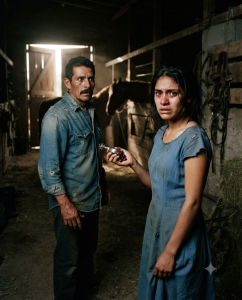
By the time the municipal police pushed their way into the market at Ures, the damage had already been done.
Not the theft. Not even the shouting.
The true damage was the circle.
It had formed around a kneeling young woman in the dust, and once a circle like that closed in a town like Ures, it became harder to break than bone. Vendors leaned over their counters to watch. Children stood on tiptoe between adults’ elbows. Men who had stolen from widows with signed papers and polished smiles now shook their heads over two missing bread rolls as if civilization itself were collapsing.
At the center of it all was Mariana Reyes.
She was twenty-four and looked older in the way hunger ages a person unevenly. Her shoulder showed through a tear in her faded dress. Her wrist was red where the butcher had seized her. Her mouth was dry, but her chin was lifted. Against her chest she held an old cloth sack with both arms, not protectively, but desperately, as if the world could take one more thing from her if she loosened her grip for even a second.
Don Ramiro, owner of the butcher stall, stood over her with a leather belt wrapped around his fist.
“She stole from me,” he barked to anyone willing to listen. “Bread today, meat tomorrow, and then what? You let one thief walk and soon the whole market rots.”
Some nodded because nodding was easier than thinking.
Others watched with the ugly fascination of people relieved that public humiliation had chosen someone else for the day.
Mariana said nothing. She had already learned one of the oldest lessons of poverty: the hungrier you are, the less human people allow you to be.
Then a voice came from the edge of the square.
“Let her go.”
The crowd shifted. A man stepped between the stalls without hurry but with the kind of certainty that made people move anyway. He was broad-shouldered, sun-browned, and carried himself like someone used to animals more than people. There were lines at the corners of his eyes, a pale scar across his left hand, and silence clung to him the way dust clung to boots on ranch roads.
Julián Álvarez rarely entered town unless he had to.
That alone made everyone stare.
“What she took, I’ll pay for,” he said.
Ramiro turned, belt still raised. “She robbed my counter, Julián.”
Julián set five hundred pesos on the butcher block. “That covers the bread.”
Ramiro’s nostrils flared. “And the rest?”
Julián looked at the crowd, then back at him. “That’s for the shame you charged on top of it.”
The square went still.
Ramiro’s face darkened, but he released Mariana’s wrist. In a small town, there were many kinds of power. Ramiro had one kind. Julián had another. Ramiro knew he could beat a hungry woman in public and still sleep that night. He also knew that crossing a man like Julián in front of witnesses might cost him more than pride.
Mariana rose slowly.
She did not thank him.
That was the first thing Julián noticed. Not because he expected gratitude, but because everyone else in that square would have. Her silence told him more than tears ever could.
He removed his denim jacket and held it out. “Take it.”
She studied him with those dark, unwavering eyes.
“Why?”
“Because the sun doesn’t ask who deserves shade.”
Something flickered across her face then—not softness, but attention. As if she were placing his voice somewhere old inside her memory.
The whispers began before they reached the edge of the plaza.
A drifter. A liar. A girl asking about burned land in the Valley of the Mesquites. Trouble. Ghosts. Old things better left alone.
Julián ignored it all, though his heartbeat had changed the moment he first saw her. He had recognized her before she ever looked at him properly. Not the thinness. Not the torn dress. The eyes.
Twelve years earlier, during a week he had tried and failed to erase from his life, he had fallen half-conscious beside an abandoned well after taking a knife slash meant for someone else. Fever had dragged him close to death. When he woke, there had been a little girl with black braids crouched beside him, lifting water to his mouth with shaking hands and shouting for help until her voice broke.
He never forgot those eyes.
He had not expected to see them again in a market square with a butcher’s belt hanging over them.
The road to his ranch unrolled through dust and mesquite scrub beneath the fading light. Neither of them spoke much. A few times Julián looked sideways at Mariana, wondering what had reduced her to stealing bread. A few times he caught her glancing toward him with a scrutiny so direct it unsettled him.
At the ranch, he offered her the stable, a blanket, water, and a place to remain unnoticed until dawn.
“You always bring strangers home?” she asked.
“You’re not a stranger,” he said before he could stop himself.
She did not look surprised.
Only confirmed.
That was the moment unease moved from the back of his mind into his chest.
Night came fast. Horses shifted in their stalls. Wind rubbed the dry yard. Julián sat on the porch with a tin cup of coffee gone cold, telling himself he had done one decent thing and should leave it there.
Then he saw light in the stable.
A thin seam of gold through rough boards.
He moved closer and heard Mariana speaking softly—not to him, not to anyone present, but as if to the dead.
When he peered through the crack, she had the cloth sack open in her lap. Inside were not stolen goods, not food, not money. She held a cluster of glossy red seeds, old but vivid enough to glow in lamplight.
Then she whispered, “The Álvarez men were there too.”
Julián felt the world shift under him.
He entered the stable.
Mariana looked up as if she had expected him at that exact moment. The seeds lay in her palm. “My mother sewed these into her hem,” she said. “For protection.”
Julián’s mouth went dry. He remembered red flashes in black smoke. He remembered trying not to see.
“What are you doing here?” he asked.
“Looking for the truth.”
She said it without drama. That made it worse.
Word by word, the story emerged. She had spent years collecting scraps from drunks, old women, land records, and frightened men who talked too much after mezcal. Her family had lived in the Valley of the Mesquites until one night their home burned. People later called it an accident, then a land dispute, then a tragedy no one could explain. But children remember what adults hope fire can erase.
Men on horseback.
Road blocked.
Shouting.
Smoke.
An Álvarez name carried on the wind.
“I saw your scar that night,” Mariana said, pointing to his left hand. “I never forgot it.”
Julián closed his fist.
He had been there. That much was true.
But truth had never been simple, and the Valley had swallowed simple men long before it swallowed Mariana’s family.
Years earlier, the land in the valley had become valuable after surveyors discovered a spring beneath a stretch of exhausted ground. Ownership was messy. Papers vanished. New papers appeared. Men who had never touched a shovel began arriving in clean boots. The Reyes family refused to leave. So did two other families. Threats followed. Then bribes. Then one night, horses.
Julián had ridden with them, but not for the reason Mariana believed.
Back then he was younger and stupid enough to think loyalty was a virtue by itself. Ramiro had been his friend, almost a brother, older and louder and always certain. When Ramiro told him they were only going to scare squatters off land that legally belonged elsewhere, Julián believed him. He drank with him. Rode with him. Asked too few questions.
By the time they reached the valley house, the truth was already moving.
There had been cans of kerosene.
There had been armed men.
There had been orders, not warnings.
Julián understood too late.
He had tried to stop it. He could still remember grabbing a lantern from one man’s hand and taking a knife slash across his own. He remembered dragging at a gate while flames leaped the roofline. He remembered a child’s scream from inside. He remembered Ramiro shouting over the horses, “Leave it! It’s done!”
Then the roof collapsed.
What Julián did not know that night—what he learned only later from whispers—was that not everyone died. One child escaped through the back as the house gave way. A little girl vanished into brush and smoke before anyone could catch her.
Mariana.
Now she stood in his stable, alive and burning in a different way.
He told her enough to make her face change and not enough to absolve himself.
“I was there,” he admitted. “But I did not set the fire.”
“You rode with them.”
“Yes.”
“You knew the men.”
“Yes.”
“You left.”
The last word landed hardest because it was the one he could never outrun.
“Yes,” he said.
Mariana laughed once, a broken sound. “Then what difference do the rest of your words make?”
She reached back into the sack and unfolded another bundle. A silver spur dropped into her palm.
Its edge was blackened from old heat.
Engraved on the side were the initials J.A.
Julián stared at it and felt dread before thought.
“I found this where my house burned,” Mariana said. “I carried it for months. I told myself I would look into the face of the man whose name was stamped into my family’s ashes before I decided whether he deserved to live.”
Julián did not move.
He knew that spur.
But he also knew something Mariana didn’t.
He turned it over, looking at the deep scratch across one letter, and memory struck with a different, sharper clarity. He had lost that spur two days before the fire while breaking a bay stallion near the river. Ramiro had found it, laughed, and tucked it into his own pocket, saying he would return it when Julián learned to stop throwing pieces of himself across the countryside.
He never returned it.
Julián looked at Mariana. “This wasn’t on my boot that night.”
She went still.
“It was taken from me before the fire.”
“By whom?”
He drew breath to answer, but hoofbeats sounded outside.
The horses erupted.
Julián killed the lamp and pulled Mariana behind stacked feed barrels. Moonlight stretched under the stable door as a man dismounted with maddening calm.
“Well?” a familiar voice called. “You going to invite me in, Julián?”
Mariana trembled beside him.
The door opened.
Boots crossed the threshold.
“I saw her in town,” the man said. “Didn’t think you’d be stupid enough to bring her here.”
Even before the moon caught his face, Mariana recognized the voice. Memory had stored it in the same place as heat and terror.
Don Ramiro.
The butcher from the market smiled into the dark as if entering a room he owned.
“Twelve years,” he said softly. “And still the dead don’t stay buried.”
Julián rose with an iron hook in his hand.
Mariana stood too, silver spur clenched like a blade.
Ramiro’s expression changed only slightly when he saw her. Not guilt. Not sorrow. Annoyance. The kind a man shows when a problem he buried returns covered in dust.
“Girl,” he said, almost kindly, “you should’ve stayed gone.”
Mariana stepped into the moonlight. “Did you burn my house?”
Ramiro sighed through his nose. “Your family had chances.”
That answer, with all its smug, bloodless cruelty, told her more than any confession could have.
Julián moved between them. “Leave.”
Ramiro laughed. “You always were weak at the finish.”
Weak.
That word reached back through twelve years of rot. Julián saw himself younger, angrier, stupid enough to trust a man because that man spoke like certainty itself. He also saw the bodies left in certainty’s wake.
“You used my spur,” Julián said.
Ramiro shrugged. “It fit the story.”
Mariana stared between them, horror dawning in layers. “He framed you.”
“No,” Julián said, eyes fixed on Ramiro. “He used me first.”
Ramiro’s smile thinned. “You rode with us. Don’t rewrite your sins now.”
“I rode to threaten. You came to kill.”
“And yet they died all the same.”
The stable seemed to shrink around those words.
Mariana’s voice shook. “Why?”
“For land,” Ramiro said, as if speaking to a child. “For water beneath it. For men in Hermosillo who pay well when obstacles disappear. Your father refused every offer. Pride is expensive.”
“And my mother?”
A shadow moved across Ramiro’s face, but not remorse. “She saw too much.”
The horses pounded the stalls in terror. Somewhere outside, wind rattled the dry mesquite branches. Mariana looked as if the world had cracked open and shown her machinery she had never wanted to see.
Julián stepped forward. “You’re finished.”
Ramiro’s hand moved toward the knife at his belt.
Mariana saw it first.
“Julián!”
Too late to retreat, too late to bargain. Ramiro lunged. Julián caught his wrist; the knife flashed silver between them. They slammed against a post hard enough to shake loose old dust from the rafters. Mariana grabbed a shovel and struck Ramiro’s shoulder. He cursed, twisted, and drove Julián backward toward an empty stall.
For a terrible second it looked like twelve years would repeat themselves—another fire of violence, another failure, another survivor forced to watch.
Then Julián trapped Ramiro’s knife arm against the stall gate and drove the iron hook down across his hand. The knife fell. Mariana kicked it away. Ramiro swung at Julián with his free fist, but years of cruelty had made him arrogant, not quick. Julián hit him once in the mouth, once in the throat, and finally drove him to the floor.
When the police arrived—summoned by a ranch hand from the neighboring property who had heard the horses screaming—Ramiro was on his knees with his own belt binding his wrists.
That detail spread through town by sunrise.
By noon, so did the rest.
Mariana gave her statement first. Julián gave his after. Then, faced with testimony, the recovered spur, old land transfers, and one terrified former rider who realized Ramiro would no longer protect anyone, the story that Ures had buried for twelve years began to crawl back into daylight.
The Valley fire had been no accident.
The land had been taken through fraud after the deaths.
Three men had ridden there knowingly.
One had planned it.
One had obeyed.
One had tried too late to stop what obedience had unleashed.
Ramiro went to prison.
The officials investigating the land scheme reopened records no one expected to see again. Some property changed hands. Some money disappeared. Some powerful names never faced what they deserved. That, too, was part of the truth.
As for Julián, his confession did not free him. It merely made his guilt public. In Ures, some said he was as monstrous as Ramiro because he rode with him at all. Others said a man who tried to stop murder should not be condemned beside the man who ordered it. Most agreed on only one thing: silence had protected evil far longer than violence ever could.
Mariana did not forgive him quickly.
In the first months after the trial, she stayed nowhere for long. She visited the valley often. She stood where her house had been and let the emptiness answer her in whatever language emptiness uses. Julián never followed her there unless she asked, and for a long time she never did.
But she also did not disappear.
With legal help from a priest in a neighboring town and one stubborn attorney who hated land thieves on principle, Mariana fought to reclaim a portion of the property that had belonged to her family. Not all of it could be recovered. Too much had been sold and resold. Too many signatures had layered over blood. Still, a small piece returned to her.
On it stood nothing but stones, dry brush, and memory.
It was enough to begin.
Months later, on a morning washed pale with winter light, Mariana went to Julián’s ranch carrying a tin box. Inside were the red seeds, the blackened silver spur, and a photograph salvaged from records in town—a picture of her mother smiling beside the old house before the fire.
She placed the spur on his table.
“I don’t forgive what you did,” she said.
Julián nodded once. He had never expected otherwise.
“But I know now what belongs to you and what belongs to him.”
He looked at her then, really looked, and saw not the child from the well, not the woman from the market, but the person who had somehow survived enough to separate guilt from evil without confusing one for the other.
“That doesn’t save me,” he said.
“No,” Mariana replied. “It doesn’t.”
She slid the tin box closed. “But telling the truth saved what was left of me.”
In the spring, they rode together to the Valley of the Mesquites. Wild grass had begun to push through the earth in thin green lines after unexpected rain. Mariana scattered the red seeds where the doorway had once stood. Not because she believed in old protections anymore, but because grief sometimes needs a gesture more than a certainty.
Julián watched from a distance.
She turned to him when she was done. “My mother used to say evil counts what it takes. Goodness counts what it returns.”
He had no answer for that.
Maybe there wasn’t one.
They did not become family. They did not become something easy enough to name. What existed between them was rougher and more honest: a shared wound, one inflicted, one carried, both dragged into light at last.
People in town still argued about them. Some thought Mariana should have hated him forever. Some thought Julián deserved prison alongside Ramiro. Some thought survival itself gave no one the right to judge another person’s failures under fire.
But years later, when people told the story of the market in Ures, they never started with the bread.
They started with the circle.
With a town ready to watch a hungry woman be broken over two rolls.
And with the moment one man stepped forward and said no—not because he was innocent, not because he was noble, but because somewhere inside the wreckage of what he had failed to do before, he recognized one last chance to stop evil from wearing the face of order.
Whether that redeemed him was a question different people answered differently.
Mariana’s answer was the only one that ever mattered.
When asked once, long after, whether Julián Álvarez was the man who destroyed her life, she said, “No. He was the man who stood beside the one who did, and that is its own kind of sin.”
Then she waited a moment and added, “But he was also the man who finally named him.”
For some people, that was not enough.
For others, it was the beginning of justice.
Maybe both were true.
Maybe the biggest red flag had never been Ramiro’s cruelty, obvious and loud, but the way an entire town found it easier to call hunger a crime than to question the respectable men who profited from ashes. Maybe forgiveness was never the point. Maybe the point was that truth arrived late, scarred, and imperfect—and arrived anyway.
And maybe that is why the story lingered.
Not because of the fire.
Not because of the theft.
But because in the end, the person everyone tried to shame for stealing bread was the one who forced a town to look at what had really been stolen all along.
