Efraín sold his grandfather’s diner on the same night doctors told him his son would not make it through the next day without emergency surgery.
He had known desperation before. He had known overdue bills, spoiled deliveries, broken refrigerators, rent hikes, and the kind of exhaustion that made a man stare at a pot of beans as if one more boil might somehow solve his life. But this was different. This was not a business problem. This was not something he could outwork.
This was his son lying in intensive care, ribs crushed, internal bleeding worsening by the hour, while every person in a white coat spoke the language of urgency with professional calm and cold numbers.
The amount required by morning was more money than Efraín had ever had in his hands at one time.
So he sold the only thing that had ever felt larger than himself.
La Mesa de Don Nacho sat on a modest street in Santa María la Ribera, squeezed between a locksmith and a pharmacy with a flickering sign. It had never been famous, but in its best years it had been known. Office clerks came for the stews. Taxi drivers came for the tortillas. Construction workers came for the early soup and the coffee strong enough to hit the chest before the tongue.
It had belonged first to his grandfather, Don Nacho, a man who believed food was not simply sold. It was offered. Served. Given a kind of dignity that reflected back on the one receiving it.
“Food is served with respect, or it is not served at all,” he used to say.
As a boy, Efraín heard that sentence so often it became part of the walls.
He also watched the harder parts. He watched his father balancing costs in a notebook, stretching supplies through slow weeks, patching the same freezer twice instead of buying a new one. He saw that kindness did not make business easier. He understood very young that principles had a price.
Still, he held onto them.
For years he defended the diner almost as if it were a relative too old and stubborn to survive alone. Even when newer cafés began taking over the neighborhood, even when younger customers preferred places with polished menus and imported names for things his family had cooked for generations, he stayed. He replaced what he could, repaired what he could not replace, and pretended each bad month was temporary.
It rarely was.
His sister Teresa thought he was a fool.
She had always been practical, efficient, and offended by sentiment. If a chair broke, she wanted the cheapest replacement. If a customer could not pay, she wanted them gone before others noticed. If Efraín talked about tradition, she talked about profit margins. As the years grew tighter, she repeated the same accusation more openly.
“This place is sinking because you inherited your grandfather’s heart and none of his timing.”
He never knew if that was meant as an insult.
Twenty years before the sale, when the diner still had a chance and his body still recovered from fourteen-hour shifts, Efraín began noticing a young couple sitting across the street beside the shutter of a closed auto parts store. At first he assumed they were waiting for someone. Then he saw them again the next day. And again.
They never begged. That was what stayed with him.
The man carried himself with visible strain, but also pride. The woman looked exhausted in the deep, quiet way that said fatigue had become normal. They watched the diner almost every evening, not greedily, not even hopefully. More like people allowing themselves one small look at warmth before night.
One evening, after the last customers had left, Efraín packed two portions of pork in green sauce, rice, beans, and tortillas. He crossed the street before he could talk himself out of it.
The young man stood halfway as if preparing either to defend himself or apologize.
“No, sir,” he said quickly. “We don’t want trouble.”
“It isn’t trouble,” Efraín replied. “It’s hot food.”
The woman accepted the bag with both hands.
“We can’t pay you.”
“Then pay me by staying alive.”
Her eyes filled so suddenly she had to look down.
Their names, he learned later, were Mateo and Luz.
From then on, whenever he saw them there, he set aside two meals. He never made an announcement of it. He never called attention to them. Sometimes he walked the food over himself. Sometimes he sent a young helper with instructions to leave it and come back. Sometimes he tucked a note into the napkin.
God go with you.
Hold on.
Tomorrow matters too.
It cost him little. It cost him arguments.
Teresa was relentless. “You are not running a church kitchen,” she hissed one night after catching him pack extra tortillas. “This is why we never get ahead.”
“My grandfather said one plate never made anyone poor.”
“And what did that wisdom buy him? A funeral paid in installments.”
Efraín kept helping them anyway.
What struck him most was the couple’s restraint. They never took more than what was offered. They never started arriving early. They never spun dramatic stories for sympathy. They ate neatly, quietly, with a formality that made their situation even more painful to witness. There was something unmistakable in the way Luz broke tortillas in halves and offered Mateo the larger piece every time. Something in the way Mateo always waited until she took the first bite.
They had known a table once. That much was clear.
Then, without warning, they vanished.
Efraín packed two meals the next day from habit and caught himself looking across the street every few minutes. By the end of the week he felt absurdly abandoned by people he barely knew. He asked around. No one knew where they had gone. In a city that swallowed the vulnerable every day, disappearance had no ceremony.
Years passed.
His father died. Then his mother. Teresa became even sharper, as though grief had calcified whatever softness she might once have had. Julián grew up, sturdy and quiet, and eventually took work as a truck driver because it paid better than the diner ever could. Mariana entered the family with quick opinions and little patience for the old business. She did not hate Efraín, exactly, but she viewed him the way many practical people view idealists during a crisis: as dangerous.
Then came the accident.
Julián’s truck overturned on the highway near Querétaro in the wet dark before dawn. By the time Efraín reached the hospital, his son was already in intensive care. There were forms to sign, procedures to authorize, and costs to confront. The doctors did not promise survival even with surgery. Without it, they said, there was no real chance at all.
Efraín sold his pickup first. Then the chain from Julián’s baptism. Then old kitchen equipment he had once sworn never to part with. He borrowed from suppliers and regular customers. It was not enough.
Selling the diner felt like carving his name off his own chest.
But he did it.
Several buyers appeared within days. One wanted to replace the place with luxury apartments. Another asked if the old framed photo of Don Nacho could be removed before final inspection because it “cheapened the atmosphere.” Efraín listened to each one and felt his stomach harden. Teresa urged him to stop hesitating.
“The dead will not save your son,” she said.
“No,” he answered finally, “but the living might.”
She looked at him as if he had said something childish.
That evening, as he sat at the counter with the sale papers spread before him, the bell above the door rang.
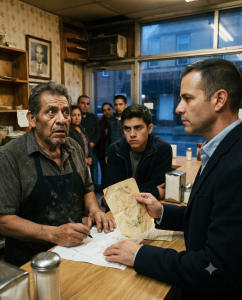
A man in a white shirt and dark blue jacket entered with a younger man at his side. The older one looked around not like a buyer measuring profit, but like someone entering a memory that had refused to fade. He touched the counter. Studied the kitchen pass-through. Stared at Don Nacho’s photo. Then he turned and looked out toward the sidewalk across the street.
Something shifted in his expression. Recognition, grief, gratitude—Efraín could not tell.
“I accept your price,” the man said.
Teresa almost clapped.
The buyer moved through the paperwork quickly, but when Efraín picked up the pen, the man asked in a low voice, “Don Efraín, do you really not remember me?”
It took a second.
The face had changed with health, age, dignity, and success. But the eyes had not.
“Mateo?” Efraín said.
The man smiled, and for an instant the twenty-year gap collapsed. “Yes.”
Efraín stood so abruptly the chair scraped the floor.
Teresa stared from one to the other, confused and irritated. Mariana looked impatient, as though the reunion were an obstacle to something urgent. But Efraín hardly saw them. He could only stare at the man who had once sat hungry on the curb with a woman named Luz and accepted food as if it were the last thing preserving their humanity.
Mateo reached into his jacket and removed a yellowed diner napkin, unfolded so carefully it was clear it had survived many years of being protected.
Efraín recognized his own handwriting at once.
God go with you.
Below it was another line, written later in different ink.
When we can stand again, we will come back for you.
Efraín read it twice before looking up.
“My wife wrote that,” Mateo said. “She wrote it the day we left.”
“Left where?”
“The city. Almost life itself.”
He drew in a breath and motioned to the young man beside him. “This is my son, Daniel.”
The boy—no, the young man—extended his hand with striking seriousness. “It is an honor to meet you, sir.”
The honor in his voice made Teresa shift uncomfortably.
Mateo began to tell the story.
Twenty years earlier, he and Luz had arrived in Mexico City after a string of disasters that sounded almost fictional in their cruelty. Mateo had been cheated out of wages at a factory job up north. Then he was injured. Then the room they rented was lost when they fell behind. Luz was pregnant then, though only a few weeks, and trying to hide how sick and weak she felt because she knew Mateo blamed himself for everything.
They slept in shelters when they could. In bus terminals when they could not. Mateo searched for work during the day and returned empty-handed often enough that he stopped describing his failures out loud. One afternoon, after being turned away from another loading job, he and Luz sat across from the diner because the smell of real food drifting through the street was almost easier than walking.
Then Efraín crossed with two hot meals.
“We were at the point,” Mateo said, “where kindness had started to feel suspicious. That is why I told you we didn’t want trouble. I thought there had to be a price hidden somewhere.”
Luz had kept the first napkin. Then the second. Then every one after that.
“You fed us for weeks,” Mateo said. “Maybe longer. I lost count because those days all looked alike. But my wife counted. She counted every meal because every meal meant one more night we did not have to decide which one of us would pretend not to be hungry.”
Daniel stood very still, listening as if he had heard the story many times and still felt it in the same place each time.
“What happened after you disappeared?” Efraín asked softly.
Mateo looked down for a moment before answering. “A priest from a shelter connected us with a couple leaving for Puebla. They knew of a farm that needed hands. We went because we had no choice. Luz got sicker on the way and we feared the baby was gone. But he wasn’t.” He put a hand on Daniel’s shoulder. “He was stronger than we were.”
In Puebla, Mateo worked fields, then loading docks, then a warehouse. He learned inventory systems, taught himself bookkeeping at night, and eventually became foreman. Years later, when the warehouse owner retired, Mateo took a risk no sensible man would have taken unless he remembered hunger too clearly to waste opportunity. He borrowed, partnered, failed once, restarted, and built a regional food distribution company.
“Luz used to say it all began with two plates of stew,” he said.
Teresa finally found her voice. “That is very touching,” she said sharply, “but his son is dying tonight. If you are buying, then buy.”
Daniel turned toward her, and there was nothing rude in his face, only disappointment so direct it stung. “My father knows that,” he said. “That is why we came.”
Mateo pulled another envelope from his jacket and laid it next to the sale contract.
“This is enough to cover Julián’s surgery in full,” he said.
The room went silent.
Mariana stepped forward first. “What?”
“I spoke to the hospital after we confirmed the details,” Mateo said. “The deposit can be transferred immediately.”
Efraín stared, unable to process the words. “No,” he said automatically. “I can’t take that.”
Mateo’s expression changed. Not offended. Almost hurt. “You can. Years ago you gave without asking what came back. Let me do the same.”
Teresa scoffed. “Nothing comes free.”
Mateo looked at her calmly. “No. It doesn’t. That’s exactly why I know what his kindness cost.”
Efraín’s eyes burned. He sat down because his knees no longer trusted him. “Why would you do all this?”
Mateo did not answer right away. Instead he unfolded the old napkin again and touched the writing with one finger.
“Because my wife is gone,” he said.
The words landed like a dropped glass.
“Cancer,” he continued, voice roughening. “Three years now. Before she died, she made me promise something. She said if I ever found the man from that diner, I had to make sure he never suffered the kind of helplessness we felt when no one would look at us. She said debts of dignity are not paid with thanks. They are paid by protecting someone when it is their turn to fall.”
Daniel swallowed hard, eyes fixed ahead.
Efraín thought of the woman across the street holding foil-wrapped food against her chest as if it were sacred. He had not even known she was carrying a child then. He had not known she would save napkins. He had not known a kindness small enough to fit into a paper bag could survive two decades and come back wearing a suit.
“I was ready to buy the diner,” Mateo said, “because I wanted to keep anyone from tearing it down. I still will, if that is what you want. But not like this. Not as a man taking from you while you bleed.”
Mariana looked from the envelope to the contract, torn between fear and greed and shame. Teresa folded her arms harder, but said nothing. Something in the room had shifted beyond her reach.
“What are you saying?” Efraín asked.
“I’m saying your son gets his surgery tonight. I cover it. No sale required.” Mateo paused. “And if the diner is willing, I would like to invest in restoring it. Not erasing it. Restoring it. New equipment, repaired structure, proper accounts, and a community meal program in your grandfather’s name.”
Efraín covered his mouth with his hand.
Daniel spoke then, quietly but firmly. “My mother used to tell me people survive because someone decides they matter before there is proof. She said you did that for them. I’d like to help do it here.”
For the first time that long night, Mariana began to cry. Not loudly. Just one sharp break in her composure, as if the entire ugly logic of the last few days had suddenly become unbearable. “I’m sorry,” she whispered, though it was unclear whether she meant to Efraín, to Julián, or to herself.
Teresa, however, could not bear the moral direction of the moment. “This is madness,” she snapped. “You’d trust a stranger with—”
“He stopped being a stranger twenty years ago,” Efraín said.
It was the first hard thing he had said all evening, and everyone heard it.
Within an hour, Mateo’s people transferred the hospital deposit. Efraín received the confirmation on Mariana’s phone because his own was too old to load the message properly. She showed him the screen with shaking hands. Paid. Surgery cleared.
He cried then, not delicately, not with the controlled tears of a proud man, but with the collapse of someone who had been bracing against catastrophe for too long.
The operation lasted through the night.
Mateo and Daniel waited with them in the hospital corridor. Mateo bought coffee no one drank. Daniel sat beside Efraín without forcing conversation. At one point, near dawn, Efraín asked him what his mother had been like.
Daniel smiled through wet eyes. “She was the kind of person who thanked doors after people held them open.”
When the surgeon finally came out, everyone stood.
Julián would live.
The recovery would be long. There were complications still to watch. But he would live.
Mariana fell against the wall sobbing in relief. Efraín closed his eyes and whispered his grandfather’s old line, though he could not have explained why. Perhaps because respect had fed more than hunger after all. Perhaps because that had always been the deeper lesson.
The weeks that followed changed more than one life.
Mateo refused any repayment plan. “Your repayment already happened,” he told Efraín. “You just didn’t know it yet.” Instead they drew up a different agreement. Mateo would fund renovations through his company. The diner would remain in Efraín’s family name. Daniel, who had studied business and operations, would help modernize the back end without touching the soul of the place. The sign outside would stay. Don Nacho’s photo would stay. The menu would stay, except for a few additions Mariana suggested that Efraín, surprisingly, approved.
Even Teresa changed, though not all at once and not gracefully.
The first time she saw the new plaque near the entrance, she stood in front of it for a long time without speaking.
La Mesa de Don Nacho
Food is served with respect, or it is not served at all
Community Meal Fund in honor of Luz and Mateo
After a while she asked Efraín, “Do you think one plate really changes that much?”
He looked at the lunch rush, at Daniel helping carry boxes through the back, at Julián moving slowly but alive with a brace still hidden under his shirt, at Mariana wrapping extra meals for the evening outreach table they now kept by the door.
“Yes,” he said. “I think sometimes one plate waits twenty years to answer.”
Teresa nodded once and turned away before he could read her face.
The diner reopened fully three months later.
The first night, when the crowd finally thinned and the griddle cooled, Efraín stepped outside. Across the street, the old curb still sat beneath the repaired shutter of the auto parts shop. For a moment he imagined Mateo and Luz there again—young, exhausted, ashamed of needing what they had not yet been offered.
He wondered how many people had passed them without seeing them. How close any life can come to breaking because dignity is expensive when you are poor. He also wondered how many families destroy themselves believing generosity is a loss instead of an investment no ledger knows how to measure.
Inside, laughter rose from one of the tables.
Efraín turned back toward the warm light of the diner and felt the strange aftershock of surviving enough years to watch a small act return larger than grief. He had nearly lost his son. He had nearly lost his grandfather’s legacy. In the end, both were saved by the very thing others had mocked him for giving away.
And if there was one question that still stayed with him after all of it, it was not whether kindness matters.
It was whether most people only call someone foolish because they are afraid of discovering what they themselves would not have done.
