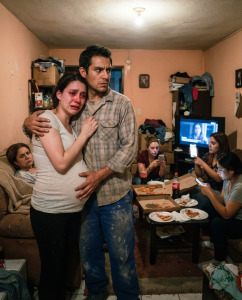
At 10:17 p.m., Nicolás unlocked the apartment door and walked into a smell so stale and heavy it made him stop in the entryway.
Cold pizza. Flat soda. Grease. Sauce dried into paper plates. The sour, lived-in odor of people who had eaten well and left the mess for someone else.
For a second he stood there with his backpack hanging from one shoulder, too tired to process what he was seeing. His entire body ached. He had just come from the industrial park in Tultitlán after a twelve-hour shift at a warehouse owned by NorteLogística. All day he had loaded and moved boxes until his palms burned. Then he had spent the long trip home packed into public transport, sweating through traffic and delay after delay, telling himself he only needed to make it a little farther.
Home. Shower. Food. Mariana.
That had been the order in his mind all evening.
Especially Mariana.
His wife was eight months pregnant, and lately he lived for the small moments he got with her. The way she leaned back against him when she was exhausted. The way she smiled when the baby kicked. The way she still asked him how his day went, even on days when she was the one carrying a whole human being and could barely sleep.
He wanted to get home, warm up whatever they had left, and place his hand on her belly until he felt his son move. That was the one thing that still made the days feel worth it.
Instead, he opened the door and found the apartment looking wrecked.
His mother, Teresa, was stretched under a blanket on the biggest couch like she owned it. His sisters were spread out around her. Brenda was lifting her chin for selfies with the new phone Nicolás was still paying off in installments. Karla was laughing at videos on the television. Lidia was scrolling through a delivery app, still complaining about the pizza they had already devoured.
Boxes were open on the table. Crumbs were ground into the couch. Cups and napkins littered the floor.
No one cleaned.
No one even looked embarrassed.
Nicolás felt that familiar fatigue settle behind his ribs—the kind that had nothing to do with labor and everything to do with carrying too much for too long.
After his father died, things had shifted so gradually he had barely noticed it at first. His mother needed help with medication. One sister was behind on rent. Another had debt. Another had nowhere to stay “temporarily.” Temporary became weeks. Weeks became months. Then every bill quietly became his responsibility.
He told himself it was family.
He told himself men endured.
He told himself it would settle down once the baby came.
But lately, even before that night, a thought had started creeping in when he lay awake beside Mariana: Why does saving everyone always feel like burying us?
He dropped his backpack near the door.
“Where’s Mariana?”
Brenda didn’t even stop adjusting the camera angle on her face. “Kitchen, I think.”
Karla laughed. “Washing up.”
Teresa sighed heavily, already offended by something nobody had said. “Your wife is too sensitive, Nicolás. I asked her for the smallest help and she looked like she wanted to collapse. Honestly, these modern girls act like pregnancy is a disease.”
Something tightened in his jaw.
He walked toward the kitchen without replying.
He heard water running before he reached the doorway.
Then he saw Mariana.
She was barefoot on the cold tile. Her swollen stomach nearly touched the edge of the sink. One hand scrubbed a greasy pan. The other pressed into the small of her back. Her shoulders were shaking. Her face was pale in that bad way, not tired but drained. Her lips looked dry. Her eyes were swollen.
And she was crying so quietly he knew it wasn’t the first time.
“Mariana.”
She flinched, wiped her cheek with her wet sleeve, and turned fast enough to pretend she wasn’t falling apart.
“You’re home,” she said. “I’ll heat your dinner right now. I just need to finish these.”
The sentence broke in the middle.
Nicolás crossed the kitchen in two steps, took the sponge from her hand, and shut off the faucet.
“That’s enough.”
Her gaze flicked toward the living room. Fear moved across her face before she could hide it.
“Please, don’t start anything,” she whispered. “I can finish. I don’t want problems with your mom.”
He stared at her.
Not because of what she said. Because of how quickly she said it. Like she had practiced shrinking. Like she had learned that surviving the evening meant calming everyone else before they turned on her again.
“You’re shaking,” he said.
“I’m okay.”
“No, you’re not.”
“Nico, really, I—”
He touched her face gently and lifted it until she met his eyes.
“Look at me.”
She tried. She truly tried.
Then all the strength went out of her.
She folded into his chest and sobbed with her whole body, muffling the sound like she was ashamed of needing comfort. Nicolás held her tighter and felt a wave of dread roll through him.
This wasn’t one insult.
This wasn’t one cruel comment.
This was sustained.
“Talk to me,” he said quietly.
She clutched his shirt harder. “Your mom says I’m a burden. Your sisters say you work yourself to death while I pretend to be sick. They say I trapped you with the baby. That I’m lazy. That I’m dramatic. I kept thinking if I helped more, maybe they’d accept me.”
He felt sick.
“How long?”
She lowered her eyes. “About two months.”
Two months.
Two full months while he worked overtime, picked up extra shifts, and came home too tired to notice the pattern hiding in plain sight. Two months of trusting the people he had been raised to protect. Two months of leaving his wife in the apartment with women who had decided kindness was weakness and pregnancy was an inconvenience.
And then Mariana let out a sound that cut right through him.
She bent over sharply, both hands gripping her belly. A plate slid from the rack and smashed across the floor.
Nicolás caught her before her knees hit the tile.
“Mariana.”
She was breathing in short bursts now, trying not to panic.
“How long between them?”
“I don’t know,” she whispered. “They started earlier.”
His heart slammed once.
“Earlier?”
“I didn’t want to call you. You were working. I thought maybe they’d stop if I finished cleaning.”
He looked at the dishes. The mess. The broken plate. Her swollen feet on cold tile.
And from the living room, he heard laughter.
Not concern.
Not footsteps.
Laughter.
He slipped one arm under her knees and lifted her. She was trembling in his arms, her face pressed against his shoulder, trying not to cry out.
The living room finally went quiet when he walked in carrying her.
Teresa looked up first, annoyed before she was curious.
“What is this?”
“She’s having contractions,” Nicolás said.
Lidia rolled her eyes. “So? That doesn’t mean the world stops.”
Brenda smirked. “She always has perfect timing.”
Karla leaned back with her arms crossed. “Honestly, she was doing fine a minute ago.”
Nicolás looked at them, and in that moment he saw everything differently. Not as his mother and sisters. Not as people he had obligations to because blood said so. He saw four adults sitting in a home they barely contributed to, eating food he paid for, using electricity he paid for, wearing comfort on their faces while his pregnant wife had been used like unpaid labor.
Teresa clicked her tongue. “You spoil her too much. That’s the problem. A little housework won’t kill her.”
Mariana’s fingers dug into his shirt with another contraction.
Nicolás went very still.
When he spoke, his voice was calm in a way that made all four women finally pay attention.
“If my wife ever washes one more plate for you, cries one more tear because of this house, or spends one more night being humiliated by any of you, you’re all out before sunrise.”
No one moved.
The television kept shouting nonsense into the silence.
Teresa sat up slowly. “Excuse me?”
“You heard me.”
Her expression changed from disbelief to outrage. “You would throw your own mother out for that girl?”
Nicolás held her stare. “No. For what you did to her.”
Lidia stood up. “You’re being manipulated.”
He barked out a humorless laugh. “Manipulated? She’s in pain and none of you even stood up.”
Karla shook her head. “She uses that pregnancy.”
And as if the sentence itself had triggered fate, Mariana cried out again, this time loud enough that even Brenda lost the smug look on her face.
Still Teresa did not soften.
Instead she said, cold and sharp, “Women know how to use tears when they want control.”
Something in Nicolás settled right there.
Not rage. Decision.
He took out his phone and ordered a car to the nearest hospital.
Then he looked at all of them and said, “When I come back, I want this apartment empty.”
Brenda shot to her feet. “You can’t be serious.”
“Oh, I am.”
Teresa stood now too, shaking with anger. “After everything I did for you?”
He almost laughed again, but there was nothing funny left in him.
“What did you do for me?” he asked. “Teach me guilt? Train me to confuse obedience with love? Make my wife serve the people I’m already paying to keep alive?”
Her mouth opened, then shut.
For the first time in years, she had no immediate answer.
Mariana trembled in his arms. “Nico,” she whispered, “please…”
He looked down at her. Even now, even while in pain, she was worried about the fallout. About being blamed. About becoming the reason everything cracked.
He leaned his forehead briefly against hers. “You are not the problem.”
The rideshare notification flashed.
He turned toward the door.
That was when Teresa snapped, “If you walk out that door choosing her over us, don’t come back begging when she leaves you the same way all selfish women do.”
He stopped.
The room went so quiet no one breathed.
Then Nicolás turned around slowly and asked the question that changed all their faces at once.
“What do you mean, the same way?”
Teresa realized too late she had said too much.
Brenda looked away.
Lidia suddenly found the floor fascinating.
Karla swallowed.
Nicolás felt a chill move through him. “What are you talking about?”
Teresa recovered first, or tried to. “Nothing. I meant—”
“No,” he said. “You meant something.”
Mariana shifted weakly in his arms, confused and hurting, and Nicolás’s mind began connecting things he had ignored before. The way Teresa had always compared Mariana to someone else. The bitterness in her voice whenever happiness entered the apartment. The private talks that stopped when he walked in. The look on Brenda’s face right now—guilty, not angry.
The baby moved suddenly against Mariana’s belly, a jolt under Nicolás’s arm, and with it came another contraction that bent her almost double.
That ended the conversation.
He got her downstairs, into the car, and to the hospital with adrenaline doing what sleep and food no longer could. The triage nurse took one look at Mariana and rushed them inside. Nicolás stayed with her through the next hour, counting breaths, wiping tears, answering questions. The contractions were real, but her body was also dehydrated, overworked, and under severe stress. They managed to slow the labor. The baby was not coming that night.
The doctor was kind but blunt.
“She should not be under physical or emotional strain,” he said. “At all. If this continues, next time we may not be able to stop it.”
Nicolás thanked him, then sat beside Mariana’s bed and stared at the floor.
She reached for his hand. “I’m sorry.”
That word broke him more than anything else had.
He looked at her in disbelief. “For what?”
“For causing this. For your family. For making you choose.”
He gripped her hand harder. “Listen to me carefully. You did not cause this. You survived it. Those are not the same thing.”
Tears slid down her face again, but this time she didn’t hide them.
He stayed with her until she fell asleep.
Then, sometime after 3:00 a.m., he went back to the apartment.
He expected yelling. Resistance. More drama.
He found his sisters stuffing their things into bags.
Teresa sat on the couch in rigid silence.
Apparently, once he left, the possibility that he really meant it had finally become real.
He stood in the center of the room and said, “You have one hour.”
Teresa looked up slowly. “So this is how you repay your mother.”
“This is how I protect my wife.”
Brenda muttered, “You’re throwing away your family.”
Nicolás shook his head. “No. I’m finally seeing who already threw me away.”
Lidia tried one last time. “You don’t understand the whole story.”
“Then tell it.”
Nobody spoke.
He waited.
Finally, Karla exhaled and said, “Mom hated Mariana before you even got engaged.”
Teresa whipped toward her. “Be quiet.”
But Karla was crying now, whether from fear or shame he couldn’t tell.
“She found out Dad had someone else for years,” Karla said. “A second woman. Mom became obsessed with the idea that all relationships were lies. When you met Mariana and actually looked happy, she said it wouldn’t last. She said no woman stays loyal unless she needs something. Then when Mariana got pregnant, Mom said that proved it—she was securing herself.”
Nicolás felt as if the room tilted.
He looked at Teresa. “So you punished her for a betrayal she never committed.”
Teresa’s eyes filled with furious tears. “You don’t know what it’s like to be made a fool.”
“No,” Nicolás said. “But Mariana does.”
That landed.
For one second, Teresa’s face cracked—not into remorse exactly, but into recognition. Then pride hardened over it again.
He did not argue further.
By dawn, they were gone.
A week later, Nicolás moved Mariana into a smaller place near her aunt, a cramped apartment with peeling paint and barely enough space for a crib. But it was quiet. No shouting. No dirty dishes waiting like a threat. No judgment in every room.
When their son arrived three weeks later, Nicolás held him and understood with unbearable clarity how easily cycles pass from one generation to the next when no one dares to break them.
Teresa sent messages at first. Angry ones. Then wounded ones. Then long paragraphs about sacrifice and motherhood and disrespect. Nicolás read them all and answered only once:
You are my mother, but you are not entitled to hurt my wife. That ends here.
Months later, he allowed a supervised visit.
Teresa walked in smaller than he remembered. Older too. She looked at the baby, then at Mariana, and for the first time there was no poison in her face. Only something more complicated. Loss, maybe. Regret, maybe. Or just the shock of discovering that control is not the same thing as love.
She said very quietly, “He has your eyes.”
Mariana nodded but said nothing.
The visit was short.
After Teresa left, Nicolás stood by the window holding his son while Mariana folded tiny clothes beside the bed. Their new place was humble, unfinished, imperfect.
But it was peaceful.
And peace, he had learned, was worth more than duty to people who fed on your silence.
Sometimes he still thought about that night at 10:17 p.m.—the smell of cold pizza, the sound of running water, the sight of Mariana crying over a sink while in labor. He would always regret not seeing sooner what was happening under his own roof.
But he also knew the truth now.
The biggest red flag had never been the mess in the apartment.
It had been how easily everyone expected the kindest person in the room to carry it.
And the hardest lesson was this: some families believe forgiveness is automatic because they share your blood. But blood means very little the moment you have to choose between protecting the people who raised you and protecting the person who trusted you enough to build a future with you.
That night, Nicolás finally chose right.
Not because it was easy.
Because by then, anything else would have been unforgivable.
