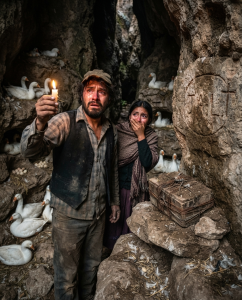
The day Santiago Madero decided he might have to sell his 11 geese to keep his wife from starving, the birds marched in a straight line to a rock wall in the Sierra de Arteaga and disappeared into the mountain.
Not over it.
Not around it.
Into it.
For a moment he honestly thought hunger had finally started playing tricks on him.
The wind was bitter that afternoon, the kind that slid under clothes and settled in your bones. Santiago stood on the north slope with his jaw clenched, one hand still half raised from where he had been about to throw a pebble to redirect the birds. He watched the last white body slip behind a cluster of twisted sabino trees and vanish. Then there was nothing.
No flapping. No startled noise. No sign of a path.
Just rock and silence.
His breath came out in a thin cloud. His hands were raw from chopping frozen wood and patching fence with wire too old to trust. His stomach had been half-empty for so many weeks that the ache no longer came in waves. It had become part of him, like the cold.
Back at the adobe shack, Elena would be counting what remained of the corn. Again. She did it every evening now, though she tried not to let him see.
The thought of returning with no answer made something twist inside him.
He took two careful steps toward the wall, but before he could search further, Elena’s voice came from behind him.
“Well?”
He turned. She had followed more quietly than he had expected, her shawl tight around her shoulders, her dark braid tucked beneath it to keep the wind from pulling it loose. Her face was tired, thinner than it had been in summer, but her eyes were still sharp.
“They vanished,” he said.
She glanced at the rock face. “Birds don’t vanish.”
“These did.”
She walked past him, crouched near the sabinos, and pushed aside the lower branches. For several seconds she said nothing. Then she held out a hand without looking back.
“Come here.”
Santiago knelt beside her and felt it immediately.
Warm air was breathing out of a narrow crack in the stone.
Both of them stared.
The opening was little more than a hidden seam in the mountain, concealed by roots and shadow. It was too narrow to notice from even a few steps away. Santiago put his hand farther in. The heat was steady and dry, impossible in weather like this.
Then came a low honk from inside.
The geese.
Alive. Calm. Not trapped. Not panicked.
Elena crossed herself almost absently. “That’s wrong.”
“Or useful.”
She gave him a look. “Useful things can still be dangerous.”
That was true. They knew that better than most.
They had come to that ranch outside Arteaga with an optimism that now seemed almost embarrassing. They were going to turn stubborn land into a future. Plant walnut trees. Raise birds. Save enough to repair the house properly. Maybe, if things improved, have children before too many years passed.
Instead, the first hard frost blackened the young planting. Hail smashed part of the roof. The mule went half-lame. Prices rose at the market. Every plan shrank to survival.
The worst part wasn’t the work or the weather.
It was the humiliation.
Santiago’s older brother Rogelio had made sure of that.
Rogelio had always known how to talk in a way that made every sentence feel like a hand on the back of your neck. He had inherited their father’s height, their father’s confidence, and, as Santiago had learned too late, none of their father’s restraint. When he came to the ranch that September, he didn’t arrive to help. He arrived to watch.
He looked over the broken roof, the cracked water barrel, the patchy field, and the mule tied in the yard.
“I told you,” he said with a laugh. “This land swallows more than it gives.”
Santiago had wanted to hit him. Elena had spared him that mistake by stepping forward first.
She said nothing to Rogelio. Just looked at him until his grin thinned and he finally turned away.
Later that night, Santiago had apologized for his brother.
Elena shook her head. “Don’t apologize for a man who enjoys hunger when it belongs to someone else.”
She had always seen people too clearly.
It was Elena, too, who had insisted on buying the geese eight months earlier in Saltillo. They had almost no cash left after supplies, and Santiago thought she had gone mad when she pointed to the loud, white birds at the market.
“Geese?” he asked. “Now?”
“They give eggs,” she said. “They make noise when strangers come. And they keep a lonely place from feeling dead.”
“Or they eat the last money we have.”
She faced him with that bright, stubborn calm of hers. “Then let them earn it.”
So he gave in.
And somehow the birds had become part of the rhythm of the ranch. Loud, messy, impossible to ignore. Elena talked to them while hauling water. They followed her around the yard like self-important old women. More than once their furious honking had warned them when coyotes passed too close after dark.
Now those same geese were disappearing every afternoon and returning clean, fed, and strangely content.
He had followed them three days in a row and lost them every time. On the fourth, Elena came with him and they found the crack.
But Elena was right. Going in at dusk would have been foolish.
So they returned to the shack to wait until morning.
That night was the kind of cold that made the walls creak. They ate watery beans and two tortillas each. The stove smoked. Wind hammered the door. At one point the mule made a restless sound outside and all 11 geese erupted in noise, then abruptly went silent.
Elena set down her cup.
“What if there’s an animal in there?” she asked.
“The geese wouldn’t enter a den willingly.”
“What if it’s not a den?”
He looked at her. She looked back.
Neither of them said Rogelio’s name, but it was there between them.
Rogelio knew that land better than he pretended. Their father had owned it before dividing what little he had between his sons. Everyone said Santiago got the poorer section because he was softer, easier to persuade, less likely to fight. Rogelio had accepted the better water access and the flatter fields with no complaint at all. Too little complaint, Santiago now thought.
Had he known something?
Had their father?
The next morning, Santiago took three tallow candles, a rope, and Elena’s rosary. He squeezed sideways into the crack while Elena held the candle at the entrance. Stone scraped skin from his shoulder. For a terrifying second his chest caught and he thought he would suffocate wedged inside the mountain like an animal in a trap.
Then the passage opened.
He stumbled into a chamber so large the candlelight couldn’t reach the far edge at first. The air was warm, almost gentle. The rock glowed amber and gold under the flame. The smell was dry feathers, dust, and something mineral, old as the mountain itself.
And everywhere he looked, there were eggs.
Nested in hollows in the stone.
Lined across ledges.
Clustered in natural shelves as if the chamber had been waiting years to become a sanctuary.
The geese stood above them on the terraces of rock, necks lifted, watchful but completely at ease.
Elena came through behind him and stopped dead.
“Mother of God.”
Neither of them moved for several seconds. Hunger changes how a person sees. To another eye, it might have been a strange natural wonder. To them, it was food. Weeks of food. Maybe months if managed carefully. Enough to sell some. Enough to breathe.
Then Santiago lifted the candle higher and the feeling changed.
Carved into the wall was a set of initials.
E.M.
The letters were rough but unmistakable.
Below them was a date from thirty years earlier.
Their father’s initials. Their father’s hand.
Santiago stepped closer until the wax nearly dripped onto his fingers. He remembered those letters from old tools, from a chest in his mother’s room, from a branding iron handle his brother kept after the funeral.
His father had stood in this exact chamber.
He had found it.
And told no one.
Or not no one.
“Elena,” Santiago whispered.
She was staring at the base of the wall. Half hidden under dust and feathers lay a wooden box wrapped in rusted wire.
He knelt beside it, but Elena touched his wrist before he could open it.
“Look,” she said.
At first he saw nothing unusual. Then his eyes adjusted.
Boot prints.
Old, but not ancient. Not thirty years old. A few recent disturbances in the dust near the box and back toward a darker side passage he had not noticed at first.
Someone else had been there.
Someone human.
A pulse started hammering behind his eyes.
He thought of Rogelio laughing in the doorway. Rogelio dismissing the north slope as useless. Rogelio urging him more than once to sell the place before it ruined him.
Not because it was worthless.
Because it wasn’t.
Santiago twisted the rusted wire free. The wood creaked when he lifted the lid.
Inside were papers wrapped in cloth, a leather pouch, and a small stack of folded pages tied with faded string. On top lay an oilskin packet with a name written across it in their father’s hand.
Rogelio.
Santiago felt heat rise through him so fast it made him dizzy.
Elena looked from the packet to his face. “Open it.”
He did.
Inside was a letter, yellowed but still legible.
Rogelio, it began. If you are reading this, I either trusted you too much or not enough.
Santiago read the line twice.
Below it, in careful handwriting, their father explained that years earlier he had found the thermal chamber by accident after tracking wounded game. He realized the warmth made it a perfect winter shelter for birds and a place where eggs could survive the cold. But that was not the true value.
A narrow spring ran beneath the chamber.
Hidden.
Protected from freeze.
Enough water, if carefully brought out, to keep livestock alive through winter and irrigate a small orchard uphill.
His father had feared neighbors would seize it if word spread. He had also feared that if both sons knew too early, they would tear each other apart over the best way to use it. So he had shown the entrance only to Rogelio, the older one, and ordered him to wait until the time was right to tell Santiago.
Santiago lowered the page. His hand shook so hard the candle flame trembled.
Elena said nothing.
There was more.
Their father’s writing changed lower down, as if the pen had pressed harder.
If greed reaches you before love does, then this secret will destroy what I hoped it would save.
Santiago swallowed and kept reading.
There were rough maps in the box. Notes about clearing a safer passage. A count of winter temperatures. And in another folded paper, something that made Elena cover her mouth.
A deed correction.
Their father had intended to revise the property lines before he died. The hidden chamber and the spring below it belonged to Santiago’s section, not Rogelio’s. But the paperwork had never been filed after the old man fell sick.
Rogelio had known.
Known for years.
Known the chamber sat on Santiago’s land.
Known there was warmth, water, and survival hidden inside the mountain.
And still he had come to the ranch to laugh.
Santiago went so still that Elena became frightened. Rage in him was rare. When it came, it had nowhere easy to go.
“What did he gain?” she asked softly.
Santiago looked back through the papers. Another answer arrived quickly and ugly.
Several receipts. Names of buyers from town. Small private sales over the past winters. Eggs. Birds. Even delivery notes marked with initials Santiago recognized as Rogelio’s.
Rogelio had been using the chamber in secret.
Taking eggs.
Selling what the mountain gave.
And keeping his younger brother starving within walking distance of it.
The geese outside erupted in alarm.
This time there was no mistaking it.
Not the contented noise of birds in shelter. Warning cries. Sharp and violent.
Santiago blew out one candle at once. Elena covered the box. Together they listened.
Steps in the brush.
Slow. Careful. Familiar.
Someone who knew exactly where the crack was hidden.
Santiago moved toward the entrance and peered through the narrow passage just in time to see a shadow stop outside.
Rogelio’s voice floated in, low and irritated.
“I know you’re in there.”
Elena’s fingers tightened on Santiago’s arm. He could feel her pulse through the wool of her sleeve.
Rogelio spoke again. “You should’ve sold those birds when I told you.”
That, more than anything, snapped the last doubt.
The geese had led them here because they had found what Rogelio had been taking. Warmth. Shelter. A place to lay in safety. The birds had returned to a secret their owner had been denied.
Santiago turned back into the chamber. On one side passage, partly blocked by fallen rock, he could hear the faint sound of water moving below. Real water. Hidden life under a dead winter ranch.
Elena leaned close. “We can’t let him take this.”
“He already has.”
“No,” she said, and there was steel in her voice now. “He borrowed it from silence. That isn’t the same as owning it.”
Rogelio began pushing at the entrance brush.
Santiago looked at the box, the letter, the maps, the deed note. Then at the eggs. Then at Elena.
A year earlier he might have retreated. Argued later. Tried to keep peace. Let family remain family, even in injustice.
Hunger had burned that weakness out of him.
He handed Elena the papers. “Take these to the back passage. Find where the water runs. If there’s another way out, use it.”
“And you?”
He picked up the remaining candle and stood straighter than he had in months.
“I’m done being the brother he counts on to step aside.”
She stared at him for a long second, then nodded. Before leaving, she pressed the rosary into his palm. “Don’t waste your anger. Use it.”
Rogelio forced his shoulders into the crack and entered with a grunt, one hand protecting his candle from the draft.
When he saw Santiago standing in the chamber, his expression changed only for an instant. Surprise. Then annoyance. Then the familiar, poisonous confidence returned.
“Well,” Rogelio said, glancing around as though he had stumbled into a room he rented. “So you finally found it.”
Santiago said nothing.
Rogelio looked at the open box. The missing wire. The papers gone from the top.
“You opened things that weren’t yours.”
Santiago laughed once. It was not a pleasant sound. “That’s rich.”
Rogelio’s mouth tightened. “Father left this to me to manage.”
“He left instructions for you to tell me.”
“He left instructions for a world that didn’t exist anymore.” Rogelio stepped farther in, eyes flicking toward the side passage where Elena had vanished, then back. “You wouldn’t have known what to do with this place.”
“I would’ve fed my wife.”
Rogelio shrugged, as if that were sentimental nonsense. “You were always soft.”
Santiago moved before he fully decided to. He shoved Rogelio hard against the wall beside the carved initials. The older man’s candle dropped and went out. For one hot second they stood chest to chest in the dim chamber, breathing hard.
“Soft?” Santiago said. “You watched us starve.”
Rogelio didn’t deny it. That was the worst part.
Instead he hissed, “You think surviving is the same as being cruel? Father trusted me because I understand what men do when they smell profit.”
“Profit?” Santiago said. “This was water. Food. A future.”
“And now you have one, thanks to me keeping it hidden.”
Santiago almost struck him then. But footsteps sounded in the side passage. Elena returned, cheeks flushed, eyes bright.
“There’s another opening lower down,” she said. “And the spring is real. Stronger than a trickle.”
Rogelio’s face changed. For the first time, true fear.
He lunged for the papers in her hand.
One of the geese swept down from the rock shelf with a scream and slammed into his shoulder. Then another. And another. Rogelio threw his arms up, cursing, stumbling backward under a furious storm of wings and beaks. In any other moment it might have been absurd. Here, in the gold light of the chamber, with the birds attacking the one man who had robbed their keepers, it felt like judgment.
He slipped on loose feathers and crashed against the wall. The old stone above the side passage shuddered. A shelf of rock cracked and dropped in a shower of dust, blocking part of the way back toward the main entrance.
“Move!” Elena shouted.
Santiago grabbed the box while Elena clutched the papers. They rushed toward the lower passage as Rogelio fought to free himself from the falling debris and screaming birds.
The hidden tunnel was narrow but passable. It sloped downward, warm at first, then damp. Soon they could hear the spring clearly, running under stone with a clean, living sound Santiago had almost forgotten existed. A little farther on, the passage opened into a sheltered ravine beyond the ridge.
They emerged in cold daylight, gasping.
For a long moment neither spoke.
Then Elena started laughing. Not because anything was funny, but because they were alive, carrying proof, standing above a hidden source of water and warmth while the man who had kept them desperate was trapped on the wrong side of his own greed.
They did not go back to the shack first.
They went straight to town.
The notary was old, suspicious, and slow, but the papers got his full attention. The deed correction was unfinished, yet clear. The receipts with Rogelio’s marks established use. The father’s letter did the rest. By sundown, two local officials were riding back with Santiago and Elena to inspect the chamber and record the spring.
Rogelio had made it out by then, filthy and wild-eyed, but his confidence was gone. He tried to talk over everyone at once. Claimed the papers were misunderstood. Claimed he had protected the place for the family. Claimed Santiago was ungrateful.
No one listened for long.
Not with the chamber sitting on Santiago’s side of the line.
Not with the receipts.
Not with the water.
Over the following months, everything changed more slowly than in stories and more quickly than Santiago had believed possible. The spring was carefully channeled. The passage was reinforced. The eggs were collected with care, enough to keep the geese returning without stripping the chamber bare. The mule gained weight. The roof was repaired. The first walnut saplings that had seemed doomed were replaced and, with water, finally took hold.
Rogelio stayed away for a while after town turned against him. In places like that, a man can survive being called harsh. He cannot easily survive being called the kind of brother who lets family starve while selling hidden plenty behind their backs.
One evening in early spring, Santiago stood outside the shack and watched Elena scatter feed to the geese. They moved around her in a white, noisy circle, proud as ever. The air no longer smelled of desperation. It smelled of damp soil and fresh-cut wood.
Elena glanced at him. “What?”
He shook his head.
“I was just thinking,” he said, “we almost sold them.”
She smiled without looking up. “That would’ve been your bad idea, not mine.”
He laughed, really laughed, and the sound startled him.
Later, after sunset, he went alone to the chamber. He stood beneath his father’s initials and placed a hand on the carved stone. For years he had believed the worst thing a man could inherit was hardship. He knew better now.
Sometimes the worst thing is a silence passed down like wisdom.
And sometimes salvation arrives loud, stubborn, and feathered, honking at your door until you are humble enough to follow it.
When people in town later told the story, they argued over the biggest red flag. Was it the brother who mocked poverty too eagerly? The father who trusted secrecy more than truth? Or Santiago himself, for taking so long to see that some men do not hide things because they are protecting you, but because your suffering serves them?
Santiago never answered that question out loud.
But every winter after that, when the geese marched toward the mountain and returned at dusk, fed and calm and watchful, he remembered exactly how close he had come to losing everything before he understood who had really been starving him.
