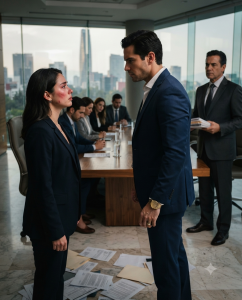
The slap landed so hard that for a moment, no one in the boardroom seemed able to breathe.
The sound cracked across marble, glass, and polished walnut with a violence that did not belong in a room built for strategy, signatures, and carefully rehearsed ambition. One second, Ana Lucía Ortega was standing beside the conference table with a stack of revised merger documents in her arms. The next, her face had snapped to the side, her body had lost balance, and three hundred pages were flying out of her hands like startled birds.
The papers scattered across the boardroom floor of Grupo Romano’s headquarters on Paseo de la Reforma.
No one moved to help her.
Twenty-three executives stayed in their leather chairs. Six foreign investors stared in frozen disbelief. Four corporate attorneys looked everywhere except at the woman who had just been humiliated in front of all of them.
Ana Lucía caught herself against the edge of the table before she could fall. Her cheek burned. Her shoulder throbbed where it had struck the wood. But the pain wasn’t what stunned her most.
It was how easy Rodrigo Sandoval had made it look.
He lowered his hand with chilling calm, adjusted the cuff of his navy suit, and glanced around the room as if he expected everyone present to understand that this was unfortunate, yes, but still somehow his right. His gold watch flashed under the overhead lights.
“Look at yourself, Ana Lucía,” he said, his voice smooth and polished. “Did you really think someone like you could become my wife?”
Her lips parted, but no words came out.
On her finger, the engagement ring he had placed there eight months earlier trembled with her hand. She barely had time to curl her fingers around it before Rodrigo stepped closer, grabbed her wrist, stripped the ring off, and tossed it under the table.
“My mother was right,” he went on. “Two years pretending I wasn’t embarrassed to introduce you. Two years listening to people ask why I was with a chubby assistant who just got lucky.”
A few heads lowered. Someone near the middle of the table shifted in discomfort. One of the attorneys, a woman old enough to know better, pressed her mouth into a line and looked down at her notes as if reading could excuse silence.
Ana Lucía didn’t cry.
Not yet.
That was the part of her Rodrigo had never understood. He had mistaken restraint for weakness because he had only ever respected noise. He had no idea what it had cost her to stay composed through years of smiling through slights, fixing his mistakes in private, and letting him collect praise built on her invisible labor.
She had organized the entire board meeting. She had coordinated schedules across three time zones. She had reviewed every annex of the merger package. Most importantly, she had stayed awake until nearly five in the morning correcting seventeen errors in the final contract—seventeen mistakes that Legal had missed and Finance had almost signed off on. The merger was the largest acquisition Grupo Romano had pursued in fifteen years, and the papers now spread across the floor would have exposed the company to serious financial risk if she had not caught the problems first.
Rodrigo knew that.
He had thanked her for it at two in the morning.
He had kissed her forehead in the office and promised, “Once this closes, everything changes for us.”
Now, in front of everyone who mattered to him, he was acting as though she had been a burden all along.
“You’re not wife material,” he said again, this time louder. “I stayed because I felt sorry for you.”
The words hit harder than the slap.
Not because Ana Lucía believed him, but because part of her suddenly feared those had been his real thoughts all along. The late nights. The hidden phone screen. His mother’s cool smile at family dinners. The way he always introduced her by title before name, and sometimes not at all. Details she had spent two years explaining away now rearranged themselves into something uglier.
Then the room changed.
The shift was so subtle at first that she almost missed it. Several people at the table were no longer watching Rodrigo.
They were watching the man at the head of the room.
Damián Romano had not spoken once during the entire scene.
He sat with a black pen in his hand, finishing the last page of the merger agreement as though he had not just seen one of his senior associates strike a woman inside his boardroom. To an outsider, that composure might have looked like indifference. To those who knew him well, it meant something else: he was deciding how much damage should be done, and to whom.
At forty-five, Damián carried power differently than Rodrigo did. Rodrigo performed power. He wore it loudly—designer suits, aggressive handshakes, expensive clubs, the kind of smile men use when they think money exempts them from consequence. Damián, by contrast, moved with the ease of someone who did not need to advertise what he could do. His dark hair was combed back neatly. His expression was calm. His suits were impeccable but unremarkable. He rarely raised his voice, never repeated himself, and had a reputation in business circles for finishing conflicts long before others realized they had started.
Officially, he was president of Grupo Romano, a logistics empire with interests across shipping, fuel distribution, agricultural supply chains, and cold storage ports.
Unofficially, people said he understood how this country truly moved.
When he finished signing, he capped the pen, closed the folder, and looked up.
The room fell into a colder silence than before.
Near the wall, Mateo Salas—Damián’s head of security—lifted one hand to the concealed earpiece beneath his collar. He did not speak. He just waited.
Rodrigo, arrogant enough to confuse silence for permission, cleared his throat. “Mr. Romano, I apologize for the spectacle,” he said lightly. “It’s a personal matter. Human Resources can reassign Miss Ortega.”
Damián stood.
The legs of his chair skimmed softly over marble. He stepped away from his place at the head of the table.
Not toward Rodrigo.
Toward the papers on the floor.
He bent down and began collecting them one by one.
For several long seconds, no one in the room understood what they were seeing. The president of Grupo Romano—the man foreign partners treated with careful respect and domestic rivals avoided provoking—was kneeling on marble to gather documents no one else had bothered to pick up.
One page near an executive’s loafer.
Another near the investor’s briefcase.
Another under the table, where Rodrigo had thrown the engagement ring.
Damián noticed the ring, paused only a fraction of a second, and picked up the page beside it first.
When the stack was complete, he squared the edges with precise fingers and turned to Ana Lucía. His face gave nothing away as he placed the papers back into her hands.
“You corrected these contracts,” he said.
Her throat tightened. “Yes, sir.”
“You found seventeen errors Legal missed.”
She stared at him. “You knew?”
“I know who protects my company when nobody is looking.”
That was the moment the tears came.
Not wild sobbing. Not collapse. Just one tear, then another, slipping down a cheek already reddening from Rodrigo’s hand. The recognition hurt because it was the first real acknowledgment she had received all day—perhaps all year.
Damián turned toward Rodrigo.
“Repeat what you said.”
Rodrigo laughed, but the sound had changed. “I said she isn’t wife material.”
Damián held his gaze. “Again.”
Every person in the room became painfully still.
Rodrigo swallowed. “She’s not wife material.”
Damián gave one small nod and said, “Mateo.”
“Yes, boss.”
“Erase him.”
Mateo touched his earpiece. “Black protocol.”
Rodrigo barked a short, disbelieving laugh. “What is that supposed to mean?”
His phone vibrated before anyone answered.
He glanced down, irritated, then answered with a sharp, “What?”
His expression collapsed.
“What do you mean my accounts are frozen?”
Another call came in before the first had fully ended. He answered that one too, his voice rising.
“Removed? On what authority?”
A third call. Then a fourth.
His private investment firm had voted him out as managing partner.
His access to a members-only golf club in Bosques had been suspended permanently.
The management company overseeing his penthouse in Polanco informed him that the residence title was under legal review and his service staff contracts had been transferred.
Then his driver called to say he had been reassigned.
Rodrigo’s skin went gray.
“This is illegal,” he said, breathing harder now.
Damián looked at him without blinking. “No. It’s expensive.”
The line hit the room like a second blow.
Rodrigo took a step forward, outrage finally overwhelming his disbelief. “Who the hell do you think you are?”
For the first time that day, Damián smiled.
It was not a smile of pleasure. It was a smile of memory—of understanding exactly which systems he owned, exactly which loyalties had just shifted, exactly how naïve Rodrigo had been to think one title and a family name made him secure.
“I’m the reason food, medicine, and fuel keep moving across this country without anyone asking who keeps the routes open.”
The words were quiet.
That made them more frightening.
Mateo’s earpiece crackled. He listened, then inclined his head. “It’s done.”
Rodrigo looked down at his phone once more.
A final message lit the screen.
Access revoked.
Not delayed. Not under investigation. Gone.
The room understood then that this was no temporary punishment. Damián was not humiliating Rodrigo for show. He was removing him from the map.
Ana Lucía felt a chill pass through her that had nothing to do with the over-conditioned room. She had worked at Grupo Romano long enough to know rumors. Ports. Routes. Emergency clearances. Calls answered by ministers and labor leaders alike. She had always told herself most of it was exaggeration—the myth that naturally grows around rich men who keep their private lives locked tight.
But as Rodrigo stood there unraveling under the weight of a few quiet orders, she realized the rumors had actually been the smaller version of the truth.
Then her own phone vibrated.
Still shaking, she looked down.
A secure location pin had appeared on her screen.
No sender name.
No message.
Just coordinates.
Near the Port of Veracruz.
She looked up at Damián. He was already watching her.
Rodrigo saw the direction of her gaze and whatever remained of his composure snapped.
“What did he send you?” he demanded.
Ana Lucía didn’t answer.
Damián returned to his chair with the same calm he had shown all morning. “You spent two years believing his lies,” he said. “You deserve to see the one thing he never wanted you near.”
Rodrigo’s face blanched. “Don’t.”
The single word transformed the atmosphere more effectively than shouting could have. Men like Rodrigo feared losing money, status, comfort. But this was fear of exposure.
Ana Lucía opened the location pin. Her pulse quickened. The map zoomed in on a private dock, one she had never seen listed in any official internal route schedule. Attached to the pin was an encrypted file.
“What’s in Veracruz?” she asked, her voice rough.
Rodrigo stared at her as though the answer itself could kill whatever chance he had left. “You don’t know what you’re walking into.”
Damián said, “No. He’s worried you finally will.”
She tapped the file.
A thumbnail appeared.
Dark water. Cargo containers. A timestamp from three months earlier. And Rodrigo, standing on a secluded dock close to midnight beside two men whose faces she didn’t recognize but whose body language screamed secrecy. One of them was handing him a folder. Another was guarding a container with no visible company markings.
Ana Lucía’s stomach turned.
Rodrigo had always insisted he avoided port operations. He said he preferred finance, acquisitions, strategy. He complained about inspections, schedules, shipping delays. He had told her more than once that Veracruz bored him.
Now there he was, hidden in the dark on a private dock tied to a location he had never once mentioned.
She opened the next file.
Bank transfers.
Shell entities.
Payments routed through companies with names so generic they were clearly designed never to be remembered.
A shipment manifest appeared next, partially redacted, but not enough to hide one detail: the contents declared publicly did not match the internal inventory.
Ana Lucía looked up so quickly her chair almost tipped.
“What is this?”
Rodrigo lunged forward. “Stop reading.”
Mateo moved instantly, intercepting him with a grip that looked controlled only because it was effortless. Rodrigo struggled once, then froze when Mateo tightened his hold just enough to make resistance useless.
The boardroom had gone beyond scandal now. This was no longer about an abusive fiancé. No longer about personal cruelty. This was fraud at minimum. Perhaps smuggling. Perhaps something worse.
One of the foreign investors muttered a curse under his breath. An attorney shut her laptop. Another executive reached for water with a visibly shaking hand.
Damián remained seated.
“Keep going,” he told her.
The final folder contained photographs and signed authorizations. In one, Rodrigo was standing beside a refrigerated container with an intermediary linked to a supplier that Grupo Romano had blacklisted years earlier for document tampering. In another, the same container appeared on a route that should never have passed through the private dock listed in the coordinates.
Then Ana Lucía found the page that made everything click.
Her own name.
A draft memorandum, unsigned but clearly prepared for future use, falsely assigning operational oversight of the Veracruz irregularities to her department.
She stared at it, unable to process what she was seeing.
Rodrigo had not only lied to her.
He had been preparing to sacrifice her.
If the false routing, the shell transfers, or the container discrepancies were discovered, the paper trail would have been adjusted to point toward an administrative failure under Ana Lucía Ortega. The “assistant who got lucky” was good enough to build the work, fix the damage, and serve as the fall person if anyone started asking questions.
A stunned sound escaped her before she could stop it.
Rodrigo heard it and closed his eyes for one fatal second.
That was all the confirmation she needed.
“You were going to blame me,” she said.
He opened his mouth. Nothing came out.
“You were going to use me,” she said again, louder now, the room hearing every word, “and when it collapsed, you were going to let them bury me with it.”
“Ana—”
“Don’t.” Her voice broke this time, not from weakness but from the force of finally seeing the full shape of what he was.
For two years she had mistaken calculated convenience for love.
She remembered every moment differently now. The sudden gifts after long absences. The pressure to sign internal summaries he told her were routine. The times he insisted she send files from her login “just this once.” The way he always wanted her close to the work but far from the credit. Even the proposal now looked grotesque in hindsight—not a promise, but a collar.
Damián let the silence stand long enough for Rodrigo’s mask to finish falling away.
Then he spoke to the room, not loudly, but with the clarity of a final order. “Counsel will remain. Everyone else may leave.”
Chairs moved at once.
Investors gathered their things without meeting anyone’s eyes. Executives exited in controlled haste, pretending dignity on their way out. No one spoke to Rodrigo. No one comforted him. The room emptied with shocking speed until only Damián, Mateo, two attorneys, Ana Lucía, and Rodrigo remained.
Damián slid a folder across the table toward the attorneys. “You will coordinate with federal authorities through the channels already prepared. The private dock, the shell corporations, the falsified routing, and the attempted internal liability transfer all go in. Nothing is delayed.”
One attorney nodded. The other looked pale but determined.
Rodrigo stared. “You set this up.”
Damián’s expression did not change. “I confirmed it.”
“You were watching me?”
“For months.”
The answer seemed to hollow Rodrigo out. He sank into a chair, less like a powerful man brought down and more like a spoiled one suddenly discovering that consequences were real.
Damián turned to Ana Lucía. “I did not intervene earlier because I needed the full chain. If I had moved too soon, he would have buried the evidence and replaced the route by morning.”
She looked at him, eyes wet again, trying to reconcile gratitude with anger. “And I had to stand there and take that?”
The question hung in the air.
Damián did not hide from it. “No,” he said. “For that, I was late.”
It was the first imperfect thing she had heard him say.
And because it was honest, she believed it.
Rodrigo let out a bitter laugh from the chair. “So what now? You hand me over and pretend you’re a hero?”
“No,” Damián said. “I remove a liability.”
The cruelty of the answer matched Rodrigo’s own language so precisely that even Rodrigo seemed to feel the symmetry.
By evening, authorities had seized access to the Veracruz dock. The shell companies linked to the transfers were flagged. Two men in the photographs were detained before dawn. Rodrigo’s devices were confiscated. His board positions vanished one by one. Calls that once connected instantly now went unanswered. The people who had crowded close when he looked successful disappeared as soon as protecting him became inconvenient.
Ana Lucía gave her statement that night.
She did it with a bruise on her cheek and a steadiness she did not know she still possessed.
Every document she had saved. Every inconsistency she had quietly corrected. Every rushed request from Rodrigo that had felt wrong at the time but now made sense in a far darker pattern. The attorneys listened carefully. Damián said very little.
When it was over, they stood together outside a private conference room overlooking the city. Reforma glittered below them. Traffic moved like a living river of white and red.
Ana Lucía folded her arms around herself. “Did you know about the engagement?”
“Yes.”
“And you still let me stay near him.”
“I watched the company,” Damián said. Then after a pause: “I should have watched you more carefully.”
She turned to look at him.
There was no flirtation in his tone. No attempt to soften the night into something easier. Just accountability delivered in the same plain way he gave orders.
“I don’t need saving,” she said.
“I know,” he replied. “That’s why I sent you the truth.”
She looked back out at the city.
By the next week, Rodrigo Sandoval was no longer a rising star in business columns. He was a cautionary headline, then a legal case, then a name people used more quietly than before. The penthouse was tied up. The memberships were gone. Former allies denied knowing details. His mother issued a statement through a family office claiming shock and disappointment. No one believed she had known nothing.
Ana Lucía was offered a transfer, a promotion, and a settlement package from multiple departments that suddenly understood her value.
She accepted only one thing immediately: a new title that reflected the work she had already been doing.
Director of Contract Risk and Compliance.
It was not charity. It was correction.
Weeks later, she visited Veracruz.
Not the private dock. That site was sealed and under investigation. She stood instead near the public port at sunrise, watching cranes lift containers against a pink-gold sky. The air smelled of salt, diesel, and heat waking up. Men shouted over machinery. Ships waited offshore like patient verdicts.
She thought about how close she had come to losing everything for a man who had confused love with ownership.
She thought about the ring under the boardroom table.
She had left it there.
Some things did not deserve retrieval.
When her phone buzzed, she glanced down and saw a short message from Damián.
You were never the weak one in that room.
She stared at the screen for a long moment before slipping the phone back into her bag.
The bruise on her cheek had faded by then. The lesson had not.
People would probably tell the story later in ways that made it simpler than it was. They would say the powerful boss defended the humiliated woman. They would talk about the slap, the boardroom, the frozen accounts, the dramatic collapse. They would turn it into a clean story about justice arriving on time.
But Ana Lucía knew better.
Justice had been late.
Silence had been expensive.
And the biggest red flag had not been the slap itself, but every smaller cruelty she had been taught to excuse before that moment ever happened.
Still, there was one truth she carried from the wreckage that none of them could rewrite:
The man who tried to erase her was the one who vanished.
