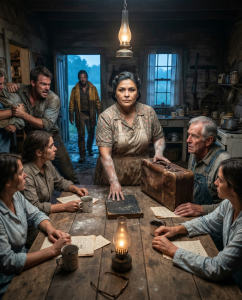
They laughed when the overweight cook walked into the ranch kitchen with flour on her sleeves and a suitcase older than most of the men at the table.
The laughter had a familiar shape to it. Maribel knew that kind of laughter well. It started in the eyes before it reached the mouth. It passed quickly from one person to another, not because anything was truly funny, but because cruelty liked company. By the time she crossed the kitchen threshold, the men seated at the long pine table had already decided who she was.
Too heavy. Too old-fashioned. Too quiet. Harmless.
The foreman made sure to turn that judgment into theater.
“Don’t let her near the stove,” he said, loud enough for the room to hear. “She’ll take up the whole kitchen before breakfast is done.”
A few men barked into their coffee. One slapped the table. Another looked away, embarrassed but not embarrassed enough to say anything. The ranch owner’s youngest son, leaning in the doorway in a clean shirt he probably hadn’t washed himself in years, smirked as if the joke reflected well on him.
Maribel said nothing.
She walked to the pantry door, set down her suitcase, removed her coat, rolled back sleeves dusted in flour, and asked one calm question.
“Where do you keep the yeast?”
That unsettled them more than offense would have. People liked the bullied to flinch. They liked outrage because it confirmed power. Indifference made them feel unseen.
The owner’s wife had hired Maribel for thirty days. That was the official arrangement. The ranch needed someone in the kitchen while the household prepared for a county inspection and managed a difficult month of calving, accounting, and family tensions. The explanation sounded ordinary enough. The truth, as Maribel already suspected, rarely announced itself so politely.
The Velez ranch had once been the pride of the county. Arturo Velez built it from scrubland and stubbornness, turning dry acreage into thriving pasture and teaching his children to speak of work as though it were a kind of prayer. But age had softened his body before it softened his authority, and power had begun to slide into the cracks between his sons, his daughter, and the men who managed the place in his name.
By the time Maribel arrived, the ranch was still standing, but not steadily.
The eldest son, Ramon, had his father’s temper but not his patience. He believed every problem could be solved by confrontation, and every disagreement was a challenge to his judgment. The younger son, Esteban, had charm where Ramon had force, but charm had spoiled into arrogance. He wore polished boots, spoke too quickly, and treated labor as something that happened around him. Their sister, Elena, was the only one who still looked at the numbers, though even she seemed exhausted from trying to convince the men around her that figures mattered.
Then there was the foreman, Gil Mercer.
Gil had been on the ranch long enough to speak with the authority of history and the entitlement of habit. He gave orders as if they were favors. He answered questions as if they were insults. Men obeyed him because Arturo had once trusted him, and because in places like that, loud confidence often stood in for character.
Maribel saw all of this in the first two days.
She saw more because no one bothered to hide it from the cook.
The kitchen sat at the center of the main house like a listening post disguised as labor. Every argument passed through it eventually. Men came in for coffee angry and left angrier. Women lowered voices in the doorway and assumed the kneading woman nearby had no interest in family business. Even the workers from the barns treated the room like neutral ground, which meant they brought worry in with their dust and carelessness out with their empty plates.
Maribel listened.
She learned the ranch books no longer matched the cash on hand. She learned feed costs had climbed faster than they should have. She learned a county inspector was due at the end of the month to review sanitation, stock health, and water quality—an inspection that mattered deeply because the ranch was already under financial strain. A poor report could trigger more scrutiny. More scrutiny could expose debts. Debts could invite the bank.
The family spoke of money the way others spoke of storms: not as possibility, but as something already gathering.
The youngest son made no effort to disguise his contempt.
At dinner on her first evening, after refusing the roast she prepared and loudly taking bread instead, he said, “I don’t trust a woman who looks like she needs two chairs.”
The room went still.
Elena looked furious. Arturo, seated at the head of the table beneath the weight of his own fatigue, closed his eyes briefly as if he had no strength left for shame.
Maribel set down the serving spoon and replied, “Then it’s fortunate the food only needs one plate.”
For half a second, Ramon choked on a laugh before catching himself. Esteban flushed. Gil glared. Arturo opened his eyes and studied her with sudden interest.
After that, the insults became less direct. Not kinder—just more cautious.
And while they adjusted to her, Maribel began to notice the ranch was sick in ways no physician could fix.
The first thing she caught was the missing feed.
A kitchen ran on quantities, substitutions, waste, and timing. Maribel had long ago learned that scarcity told the truth even when people did not. The pantry records, meal counts, and supply habits taught her quickly what each week should consume. That same sense pulled her toward the feed inventory. A stable boy mentioned there had been another urgent order. Later she heard Ramon complain about costs. Still later, she carried stale bread toward the outer sheds and saw the latest delivery stacked along the wall.
The count was wrong.
Not catastrophically wrong. That would have been too obvious. Two sacks here. Three there. A steady leak instead of a dramatic theft.
She said nothing. She only remembered.
A few mornings later, carrying vegetable peelings out behind the kitchen, she noticed tire tracks near the storage barn. Narrow tires, unfamiliar tread, pulled in after dark and backed out with care. Not ranch trucks. Not delivery wagons. Someone had been visiting the property and avoiding notice.
That same week, several heifers fell ill.
The men argued over causes. Heat. Bad forage. Mud in the troughs. Elena thought the pattern didn’t make sense. Gil snapped that cattle got sick and women got nervous and both things were natural. Tomas Creed, Gil’s assistant, hovered near every conversation. He was quick with explanations, quicker with blame, and strangely eager in every emergency.
Maribel began watching him.
Tomas had the face of a man who wanted to look forgettable and failed because he tried too hard. He spoke deferentially upward and sharply downward. He was always first to reach trouble and somehow never the source of suspicion. He collected samples, fetched tools, checked gates, counted stock, delivered messages. The usefulness was excessive. Men who truly worked usually had no time to advertise it.
One evening Luz, the kitchen maid, found Maribel standing in the doorway of the feed room after supper.
“What are you doing?” Luz asked.
Maribel looked over the shelves, the scuffed floor, the uneven placement of the remaining sacks.
“Looking for patterns.”
Luz smiled uncertainly. “In here?”
“In rooms where theft happens,” Maribel said, “patterns are all anyone leaves behind.”
Luz never forgot that answer.
Days passed. Tension thickened. Arturo came downstairs less often, but when he did, the family performed normalcy too carefully. Ramon spoke about repairs. Esteban made jokes no one enjoyed. Elena carried ledgers under one arm and frustration under the other. Gil moved through the ranch with the confidence of a man who believed no one beneath him mattered.
Then Maribel found the hidden book.
It happened in the dry pantry, behind two flour barrels that did not sit correctly against the wall. The left barrel listed slightly forward, as though something behind it kept it from resting flat. She moved it an inch and saw the oilcloth bundle tucked into shadow.
Inside was an old ledger.
At first glance, it looked like decades of rough agricultural accounting—deliveries, quantities, initials, side notes. But Maribel had spent enough years around numbers and men to know when disorder had been staged. The entries were inconsistent in a very precise way. There were feed purchases not reflected in the office books. Chemical withdrawals logged without corresponding treatment records. Small quantities of medicine repeatedly moved. Dates that aligned too neatly with each cluster of cattle illness.
And on several pages, initials beside key entries: T.C.
Tomas Creed.
On another page, written in a tighter, sharper hand, were notations that made Maribel’s pulse slow instead of race. Slow meant focus. Focus meant danger was real.
By the time she wrapped the ledger and hid it under her apron, she no longer doubted that the ranch was being undermined from inside.
What she did not yet know was how far up the rot went.
The county inspection was scheduled for dawn two days later.
The house worked late the night before. Lamps burned in three rooms at once. Men crossed the yard carrying papers, lanterns, and irritation. Maribel baked in silence while arguments drifted through the walls. Ramon wanted the barns checked again. Elena insisted the water logs were incomplete. Esteban complained that panic made them look guilty. Gil said inspectors mostly cared whether people acted confident.
That line alone told Maribel more than he intended.
Close to midnight, a ranch hand burst through the back door, breathless.
“There’s something wrong with the water.”
Everything broke at once.
Boots pounded across the yard. Lanterns flared. Men shouted over one another. At the main tank, the smell was unmistakably wrong—chemical, bitter, not strong but enough to tell any sensible person not to drink it. Someone yelled that one of the dogs had gotten sick. Another swore the trough by the east fence smelled the same.
The county inspector would arrive in a matter of hours.
If the water tested contaminated, the ranch’s standing would collapse. Contracts could be frozen. Cattle sales delayed. The bank, already circling, might tighten immediately. In one blow, the place could be pushed from vulnerable to doomed.
Ramon demanded to know who had touched the tank. Esteban accused neighboring ranchers. Gil shouted for order while ensuring none existed. The workers began blaming one another so fast that no individual accusation had time to become useful.
Then Gil saw Maribel approaching from the house.
“You,” he barked. “Stay in the kitchen where you belong.”
The old formula. Put the woman back in the room assigned to her. Restore hierarchy. Silence inconvenience.
Maribel met his eyes only briefly.
Then she walked past him.
For a second, Gil was too shocked to move. When he recovered, he stormed after her with the family behind him. They expected rebellion of the emotional kind—a protest, tears, dramatic offense. What they found instead was discipline.
Maribel entered the dining room, crossed to the long table, and laid the old ledger at its center.
No speech. No performance.
Just evidence.
“What is this?” Ramon demanded.
“The reason your feed keeps disappearing,” Maribel said.
Arturo had come in behind the others, one hand braced on his cane. He looked from Maribel to the book and said a single word.
“Read.”
Elena opened it first. Within moments her face sharpened. Ramon leaned in, then Arturo. Esteban, suspicious and impatient, snatched pages forward. Gil stepped closer, too close, and Arturo slapped his hand away with surprising force.
The room changed as the entries connected.
Stolen feed. Unlogged chemicals. forged purchase notes. Dates tied to every unexplained sickness in the herd. Deliveries that never reached the main barn. And tucked into later pages, side notes referencing an outside buyer prepared to make an offer if the ranch’s value crashed after inspection failure.
Tomas Creed had been standing near the doorway.
No one noticed him backing away until Maribel said, “Check his truck.”
Every head turned.
Tomas ran.
He made it only as far as the veranda. Two ranch hands tackled him into the dirt. Gil started shouting that the initials meant nothing, that anyone could fake a ledger, that people were losing their minds in the middle of a crisis. But his outrage came too quickly. Too defensively.
Maribel looked at him with cool certainty.
“Then open the truck.”
The keys were found in Tomas’s pocket. Under a canvas in the truck bed lay feed sacks branded with the ranch mark, containers of unlogged chemicals, and a metal cash box. Inside the box were partial contracts prepared by an outside buyer waiting to purchase land once the ranch was weakened enough to sell cheap.
One document carried a witness signature.
Gil Mercer’s.
Nobody spoke for several seconds. The night noises outside seemed impossibly loud.
Ramon turned on Gil with murder in his eyes. Elena whispered, “You did this to us?” Arturo did not speak at all. He simply looked old in a new way, the kind of old that arrived when betrayal crossed from suspicion into proof.
By dawn, the truth was clear.
Tomas and Gil had been stealing feed for months, weakening cattle with carefully controlled contamination, manipulating records, and setting the ranch up to fail the county inspection. Their plan was simple and vicious. Drive down value. Amplify debt. Force the family into a desperate sale. Profit from the collapse.
The poisoned tank was meant to be the final push.
The ranch had not been suffering bad luck. It had been bled deliberately.
And the person who stopped it was the woman they had mocked before breakfast on her first day.
Arturo turned to her when the shouting quieted.
“Who are you?” he asked.
It was the right question, finally asked too late.
Because Maribel had done more than any temporary cook should have known how to do. She had seen patterns in inventory, behavior, access, timing, and books. She had moved with the patience of someone who had not merely stumbled into corruption, but recognized its design.
Maribel placed one hand on her battered old suitcase.
“There’s more,” she said.
The room, already strained by scandal, seemed to tighten further. Gil and Tomas were being held at the hall. The dawn outside was turning silver. Maribel opened the suitcase and removed a folded document preserved between layers of cloth.
Arturo stared at the paper before she even unfolded it. Something in his expression broke loose into dread.
When she placed it beside the ledger, Elena leaned in first. It was an estate transfer document dated twenty-one years earlier, shortly after Arturo’s wife had died. The signature approving a key shift in control over part of the ranch holdings belonged not to Arturo, but to the person who had handled the family’s affairs in the chaotic aftermath of grief. Someone trusted. Someone never questioned.
Ramon whispered that person’s name in disbelief.
Arturo gripped the table so hard his knuckles whitened.
“I was told those papers were settled,” he said.
“They were buried,” Maribel answered. “Not settled.”
Her voice no longer sounded like a cook’s voice in a rich family’s house. It carried history.
Before anyone could press further, the front door opened.
A man stepped inside with mud on his boots, a weathered face, and the look of someone walking into a graveyard he had once escaped. Arturo’s cane slipped against the floor.
“I saw your grave,” Arturo said hoarsely.
“No,” the man replied. “You saw what they wanted you to see.”
The room recoiled from him as from an apparition. Gil stopped struggling. Tomas went still. Whatever fear theft had caused, this caused more.
Maribel turned toward the man, and for the first time since arriving, emotion crossed her face without disguise.
“You came,” she said.
“I had to,” he answered.
The man was Mateo Salazar, once the ranch’s legal steward and Arturo’s oldest friend. Twenty-one years earlier, after Arturo’s wife died in a riding accident, Mateo had vanished under a cloud of rumor, then supposedly died before he could return. His disappearance had helped cement decisions made in the confusion that followed—control of accounts transferred, records consolidated, certain names removed, certain questions buried.
Including the question of a child.
Maribel unfolded the second page of the document. There, in faded ink, was a notation crossed out so aggressively it nearly tore the paper. A beneficiary name erased from record.
Maribel’s full name.
Elena looked from the page to Maribel as realization formed slowly, painfully. Arturo did not speak because he already knew before he could bear to know.
Maribel was not merely a cook.
She was his daughter’s child.
Years earlier, Arturo’s daughter Isabel had died under circumstances the family accepted because grief left them vulnerable and because someone they trusted had directed their attention elsewhere. The child connected to that branch of the family had been declared lost to distant relatives, then removed from succession records through fraudulent legal handling. With Mateo forced out and presumed dead, the alteration stood unchallenged.
The same network of greed that now tried to destroy the ranch had roots deep in that older betrayal.
Gil had not built the corruption alone. He had inherited its shelter.
Mateo spoke quietly, each word landing like a hammer.
“When Isabel died, they used the confusion. Papers moved fast. I objected. I was warned off. Then I disappeared before I could bring proof back.”
Arturo looked destroyed. “All these years…”
Maribel’s eyes did not leave his. “All these years, someone counted on you never looking where it hurt most.”
No one rushed to forgiveness. No one could. The room was too full of theft, humiliation, grief, and the raw shame of what had been overlooked. Ramon wanted names. Elena wanted every document brought out. Esteban, for once, had nothing reckless to say. The sun rose fully at the windows, exposing dust, exhaustion, and truth in equal measure.
The county inspector arrived an hour later to find a ranch in uproar, a contaminated water tank isolated before wider damage, stolen supplies recovered, and internal sabotage already documented. Elena met him with records. Ramon met him with fury redirected into cooperation. Arturo met him seated, pale but lucid, beside the woman everyone had mocked.
The inspection was difficult but not fatal.
Because the contamination had been caught quickly, because the evidence showed deliberate tampering rather than sustained neglect, and because the family—forced at last into honesty—opened everything for review, the ranch survived. Barely, but honestly.
Gil and Tomas were arrested. The outside buyer vanished into lawyers and subpoenas. Old records were reopened. Property documents were examined line by line. Mateo gave testimony. So did Maribel. Some truths took weeks to untangle. Others took only one look at a forged signature and a witness statement.
The legal restoration took months.
The emotional one never fully arrived.
Arturo asked Maribel to stay. At first she refused. Then she agreed to remain long enough to oversee the kitchen through the season while the household stabilized. It amused Elena privately that the family now deferred to the woman they had once treated as background furniture. Ramon learned to knock before entering her kitchen. Esteban never again made a joke about chairs. Luz watched all of it with quiet satisfaction.
One afternoon, long after the arrests, Arturo came into the kitchen alone. Maribel was rolling dough. Sunlight lit the flour on her sleeves, almost exactly as it had the first day she arrived.
“I should have known,” he said.
Maribel kept working. “You should have looked.”
He accepted that.
After a long silence, he asked, “Will you ever forgive me?”
She considered him, then the window, then her hands.
“Forgiveness isn’t the first thing people earn after the truth,” she said. “Sometimes they earn the chance to live with it.”
Arturo nodded, and for an old man who had built a ranch with certainty, that answer was harder than anger.
In time, the property records were corrected. Maribel’s name was restored where it had been erased. She claimed only what she believed was rightfully tied to her mother and refused the rest until every worker owed wages had been paid and every damaged account repaired. That decision changed how even the skeptical men spoke of her. Not because generosity redeemed her to them, but because principle terrified people who had none.
The ranch recovered slowly. Reputation returned in pieces. The water tank was replaced. Inventory controls tightened. Elena took charge of the books openly and permanently. Ramon learned that force without attention invited ruin. Esteban learned, perhaps for the first time in his life, that dignity was not inherited.
And Maribel?
Maribel remained impossible to reduce.
Some still called her the cook, but not with mockery. She fed the people who had once underestimated her and watched them learn the cost of it. She moved through the kitchen as she always had—steady, observant, unhurried. Yet now every person in the house understood that behind her silence there had once been investigation, history, and restraint powerful enough to save them all.
In the end, what lingered most was not the theft, though that had nearly destroyed the ranch. It was not even the revelation of inheritance and buried bloodlines. It was the terrible simplicity of the thing: a family had laughed at the only person paying attention.
Maybe that was the real warning hidden in everything that happened there. The loudest people had demanded authority. The proudest people had assumed they knew who mattered. The woman covered in flour, carrying a battered suitcase, had seen more than all of them because she never needed to prove she belonged before she began noticing what was wrong.
Some said Arturo was a victim of betrayal. Others said he was also guilty of trusting comfort over truth. Some thought Maribel should have forgiven more quickly. Others thought she gave far more grace than anyone had earned.
But nearly everyone agreed on one thing.
The day she walked into that kitchen, they thought they were looking at someone easy to dismiss.
What they were really seeing was the moment the ranch stopped dying.
