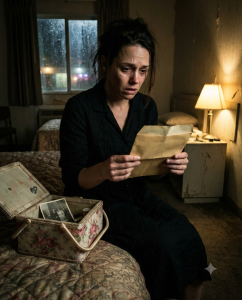
Clara was still wearing the black dress from her mother’s funeral when her brother told her she had twenty-four hours to leave the house.
He did not raise his voice. He did not pound a fist on the table. He didn’t need to. The gentleness in his tone made the moment uglier, because it sounded practiced, as though he had spent the morning rehearsing how to sound reasonable while taking everything from her.
“You know Mom wanted me to have it,” he said, sliding a folder across the kitchen table. “You never understood money. You never had a real career. This is for the best.”
For several seconds, Clara only stared at him.
The kitchen window over the sink was still fogged from the rain outside. A clean saucepan sat upside down on the drying rack. Her mother’s blue ceramic mug, the one with the cracked handle no one else was allowed to use, still stood on the counter where Clara had left it the day before the funeral. Nothing in the room looked different, and yet everything had already changed.
Their aunt Margo sat near the end of the table with both hands twisted tightly together. She didn’t speak. She didn’t look at Clara. Beside her was a lawyer Clara barely recognized, a narrow-faced man with silver glasses and a voice that sounded like paper being folded.
“The transfer has been recorded,” he said, glancing at the folder as though the words inside it mattered more than the person sitting across from him. “The property is no longer yours to occupy. I understand this is difficult, but legally—”
“Legally?” Clara repeated.
It was the first word she had spoken since sitting down.
She looked from the lawyer to her brother Daniel, then to Aunt Margo, waiting for someone—anyone—to say this had all been rushed, misunderstood, mishandled by grief. But Daniel just leaned back in his chair with the look he always wore when he thought he was being the adult in the room.
“Don’t make this uglier than it has to be,” he said. “Mom made her choice.”
Clara felt something hard and hollow open in her chest.
For eight months, while their mother declined room by room, breath by breath, Daniel had barely been present. Clara had canceled work, stopped taking clients, and moved back into the house full-time. She cooked every meal their mother could keep down. She learned how to sort pills into tiny plastic trays by day and changed soaked sheets at night. She helped her mother sit up, lie down, bathe, dress, breathe through pain, and endure the humiliations sickness brings long before death does.
Daniel came twice.
The first time, he wrinkled his nose and asked why the place smelled like medicine. The second time, he stayed less than forty minutes, spent most of it pacing in the hall with his phone pressed to his ear, and asked on the way out whether hospice “wouldn’t just be easier.”
Clara had not forgotten that.
But she had never imagined he would stand in the kitchen the morning after the funeral and tell her she no longer belonged in the home she had kept running with her own hands.
She opened the folder.
The top page was a copy of a will. Beneath it was a property transfer document. There were initials, seals, signatures, legal phrasing dense enough to make the page feel impenetrable. Clara’s eyes moved over the words without fully taking them in. All she could process was the conclusion printed beneath them.
Primary residence transferred to Daniel Mercer.
Her mouth went dry.
“This isn’t right,” she said quietly.
Daniel gave a little sigh, as though she were being slow on purpose.
“Mom worried about you,” he said. “You always lived month to month. Sewing jobs, alterations, costumes—whatever came along. She knew you’d run this place into the ground.”
Clara looked at him then with a disbelief so complete it almost felt calm.
She had turned that “whatever came along” into the money that paid for groceries when insurance stopped covering what her mother needed. She had sold custom work late into the night to cover co-pays, gas, equipment rentals, medications, things Daniel said he would help with and never did. She had never once asked their mother to choose between them.
Daniel, apparently, had.
Aunt Margo finally spoke, but not to defend Clara.
“Maybe it’s better not to drag this out,” she murmured.
Clara turned to her. “You knew?”
Aunt Margo’s face tightened. “I knew your mother had changed some paperwork.”
“That’s not what I asked.”
Still, Margo’s eyes stayed on the table.
That silence told Clara everything.
There are betrayals that arrive with shouting and slammed doors. And then there are the quiet ones, the ones carried on lowered eyes and careful wording, the ones that ask the wounded person to behave politely while being erased. Clara felt that kind settling around her now.
She rose from the table because if she stayed seated, she thought she might stop breathing.
Daniel stood too. “You can collect your personal things. I’m giving you until tomorrow afternoon.”
Clara stared at him. “Tomorrow?”
“I’m trying to be fair.”
She almost laughed then. Fair. The word was obscene in his mouth.
Instead, she walked upstairs.
Her mother’s bedroom door was half open. The room still held the shape of long illness: the adjustable bed rails, the stack of folded towels, the tray table, the bottles of lotion and medicine cups, the chair where Clara had slept so many nights her back no longer knew how to relax in a real bed. On the dresser sat the last bouquet from a neighbor, already browning at the edges.
Clara moved automatically. She packed two dresses, shoes, undergarments, toiletries, her charger, a sweater, and the book she had been trying to finish for four months. Then she stopped at the side of the bed and knelt.
Underneath was the sewing basket.
It had belonged to her mother for as long as Clara could remember. The basket appeared in every chapter of her childhood: patching scraped-knee jeans, hemming a recital dress at midnight, replacing buttons before church, rescuing stuffed animals after “surgery.” When Clara started sewing professionally, her mother gave advice with that basket at her feet like it was part of her body.
Clara reached under and pulled it out.
The lid was covered in faded roses. One corner was rubbed raw from years of use. The metal latch stuck unless you pressed it twice.
She held it for a second longer than necessary.
Then she took it downstairs.
Daniel saw it and smirked.
“Taking trash now?”
Clara did not answer.
She took her bag, the basket, and the house key from her pocket. For half a second she thought about setting the key on the table, then decided not to give him even that gesture. She left it in the bowl by the door, where her mother used to drop grocery coupons and spare change.
By the time she reached her car, the front door had already shut behind her.
The motel she found that evening sat on the edge of town near the highway, all buzzing neon and wet pavement. The room smelled aggressively of bleach, but underneath it lingered mildew and old cigarettes. Rain tapped against the window. Somewhere down the walkway, a couple argued in low, angry voices before a door slammed.
Clara sat on the bed in the dark.
Her body was beyond exhaustion now. It had crossed into that emptied-out state where grief feels less like crying and more like floating outside yourself, watching somebody else’s life fold inward. She still wore the black dress from the funeral. She had not eaten since noon. Her phone held two missed calls from unknown numbers and one text from Daniel: Let’s keep this civil.
She turned the phone facedown.
Then she opened the sewing basket.
At first, there was nothing strange about what she saw. Her mother’s silver thimble. A spool of cream thread. A tomato-shaped pin cushion with two bent pins still stuck in it. Small scissors with worn handles. And a faded photograph of Clara at twelve standing in a homemade costume, grinning while her mother crouched beside her, one hand at the hemline.
The picture hit her so hard she had to look away.
She put it down carefully and brushed her fingers along the inside of the basket.
Something snagged at her fingertip.
She frowned, leaned closer, and lifted the basket under the flickering lamp. The floral lining along one edge had been stitched shut by hand. Not neatly either. The stitches were tiny but hurried, as though done by someone trying not to be noticed.
Clara’s pulse quickened.
She fetched the small scissors and slipped one blade under the thread. A few snips later, a hidden pocket loosened. From inside it slid a sealed envelope, yellowed slightly at the corners.
On the front, in shaky handwriting, were five words.
For Clara, when they lie.
Clara went completely still.
She knew that handwriting. Even weakened by illness, even dragged by pain, it was her mother’s. The “C” in Clara still curled too far at the bottom. The “y” in they dipped sharply below the line. There was no mistaking it.
When they lie.
Not if.
A cold clarity moved through her.
Her mother had known.
Not only that—she had expected this exact moment.
Clara tore the envelope open with trembling fingers and unfolded the letter inside. Tucked behind it was a second set of papers: a legal document, notarized, bearing a later date than anything Daniel had shown that morning.
She read the letter first.
My sweet girl, it began. If you’re reading this, they did exactly what I feared.
The room seemed to narrow around her.
The letter was not confused or sentimental in the way Clara had half-feared it might be. It was steady. Precise. Her mother wrote that she had overheard Daniel asking questions in the hallway months earlier—questions about timing, transfers, signatures, what could be done “if capacity became an issue.” She wrote that she said nothing at first because she needed to be certain. Then she heard him again, this time with Aunt Margo, speaking as though the house was already his and Clara was simply a problem to be managed.
That was when she contacted another lawyer privately.
She wrote that Clara was the one who had cared for her, protected her dignity, and stood beside her when illness stripped everything else away. She wrote that Daniel had mistaken absence for innocence and politeness for entitlement. She wrote that she changed her will and the property documents accordingly, then hid copies where only Clara would think to look.
If you are reading this in my bedroom, she wrote, then thank God I was wrong.
If you are reading this somewhere else, then he moved faster than I feared.
The notarized document left no room for confusion. The house, all personal effects within it, and the remainder of her savings were left to Clara. There was also a handwritten note from the attorney, clipped to the last page.
Ms. Mercer instructed me to await contact from her daughter. If there is any dispute regarding subsequent paperwork, call immediately.
A number was written beneath.
Clara read everything twice, then a third time. She checked the dates. The signatures. The notary stamp. It was real. Not hopeful. Not symbolic. Real.
She began to cry then—not the hot, dramatic kind, but a breaking-open grief that had been held together by duty for so long it no longer knew how to fall apart gently. She cried for her mother, for the months of care, for the humiliation of that kitchen scene, and for the fact that even dying, her mother had been forced to protect her daughter from family.
The next morning Clara was outside the attorney’s office before it opened.
His name was Martin Hale. He was in his sixties, compact, neat, with the kind of face that did not waste expression. When she handed him the envelope and explained what had happened, he invited her in without interrupting once. Then he read the papers in complete silence.
When he looked up, something in his eyes had sharpened.
“When did your brother present his documents?” he asked.
“Yesterday. Right after the funeral.”
“And he had you removed from the property?”
“He said I had twenty-four hours. I left that night.”
Hale leaned back slowly.
“This instrument,” he said, tapping the newer will, “is valid on its face and executed months after the document he apparently relied upon. The property transfer attached to this set also supersedes the earlier one.” He paused. “Which means either your brother was relying on paperwork he knew had been revoked… or someone helped him conceal the later filing.”
Clara sat very still. “My aunt was there.”
He nodded once, unsurprised. “Do you know who his lawyer was?”
She gave the name from the folder.
Hale’s jaw tightened the smallest amount. “I know him. He is careful when it suits him.”
For the first time since the funeral, Clara felt something stronger than shock.
Anger.
Not wild anger. Not useless anger. The kind that straightens your spine and steadies your hands.
“What do we do?”
Hale picked up the phone.
“First,” he said, “we stop your brother from taking one more step inside that house as if it belongs to him.”
By noon, Daniel had received notice that the ownership of the home and the estate were under immediate legal challenge supported by a later, facially controlling testamentary package and property transfer. By three, Hale had filed an emergency motion to prevent sale, transfer, or removal of estate assets pending review. By evening, Clara was back in the passenger seat of Hale’s car as they pulled up outside her mother’s house.
Daniel’s car was in the driveway.
So was Aunt Margo’s.
“They’re inside,” Clara whispered.
Hale turned off the engine. “Good.”
Rainwater still glistened on the walkway. The porch light was on, even though it was not yet dark. Clara’s pulse pounded in her throat as they went up the steps. Hale rang the bell once and then again.
Daniel opened the door looking irritated, then briefly confused.
That confusion vanished when he saw Clara.
His expression hardened. “You can’t just come here.”
“She can,” Hale said. “And unless you enjoy speaking under oath about document suppression, I suggest you let us in.”
For the first time Clara saw something crack in her brother’s composure.
Only a little. But enough.
He stepped aside.
Inside, the house looked wrong already. Drawer contents sat stacked in boxes. The hall closet door was open. The silver tea service that had always lived in the dining room was missing from the sideboard. Aunt Margo stood near the living room archway holding a bundle of framed photographs against her chest as if she had every right to carry them out.
Clara stared at her. “You’re packing?”
Margo set the frames down too quickly. “We were only protecting valuables.”
“From who?” Clara asked. “The daughter who lived here?”
Daniel shut the door behind them with more force than necessary. “This is ridiculous. Mom signed everything over to me.”
Hale held up the later documents. “No. Your mother executed a superseding will and transfer package six months ago. She also left written instructions anticipating precisely this scenario.”
The color changed in Daniel’s face so fast it was almost shocking. Not pale exactly. Exposed.
“That’s impossible,” he said.
“Interesting choice of word,” Hale replied. “Most innocent people say mistaken.”
Aunt Margo sank onto the arm of the sofa.
Daniel laughed, too quickly, too loudly. “You think a hidden letter proves something? You think this changes anything? Maybe Clara forged it. She was alone with Mom for months.”
The accusation hit the room and hung there.
Clara felt it like a slap—but Hale was already prepared.
“The notarization, execution witnesses, and filing record will all be examined,” he said. “Which is why I’m more interested in how you managed to appear with outdated papers the morning after the funeral and attempt to remove the lawful beneficiary before she had time to locate the current ones.”
Daniel said nothing.
Hale continued, voice even colder now. “Also of interest is whether items removed from this house today were taken under a knowingly false claim of ownership.”
Aunt Margo’s eyes filled at once. “Daniel said it was settled.”
Daniel turned on her. “Don’t start.”
That was the moment Clara understood the whole shape of it. Not every detail, but enough. Daniel had counted on speed. On shock. On Clara being too tired, too heartbroken, too financially strained to fight. Aunt Margo had helped because helping him felt easier than opposing him. The lawyer at the table had perhaps chosen not to ask the wrong questions. They had all assumed Clara would leave with one bag and never return.
They had been right about the bag.
Wrong about everything else.
Hale asked Daniel directly whether he had knowledge of the later testamentary documents. Daniel denied it. Hale asked whether he had been informed of meetings between their mother and another attorney. Daniel denied that too. Then Hale asked why, if he believed himself the rightful owner, he had waited until immediately after the funeral to present paperwork and remove Clara rather than raising the matter while his mother was alive.
Daniel’s silence answered better than words.
Aunt Margo began crying in earnest. “I told you we should wait,” she said to him. “I told you not to push her out that day.”
Daniel swung toward her, stunned. “Are you serious?”
Clara watched them both and felt something inside her settle.
There would be court filings. Affidavits. Questions. Maybe consequences larger than humiliation. Hale later told her that whether Daniel’s actions rose to fraud would depend on what could be proved about his knowledge and intent, and whether the other lawyer had actually seen the superseding record before appearing at the house. But one thing no longer depended on anyone’s interpretation.
The house was not Daniel’s.
It was hers.
That night, after Hale arranged for a locksmith and documented the condition of the rooms, Clara stood alone in the kitchen again. The same table. The same blue mug. The same low hum from the refrigerator. Yet now the room felt altered by revelation. Not healed. Not safe. But true.
She went upstairs to her mother’s room and sat on the chair beside the bed.
On the pillow was a slight hollow where no head would rest again. The grief of that nearly bent her in half.
She took out the letter and read it one more time.
Near the end, in smaller handwriting, her mother had written: You were never the weak one in this family. They only hoped you would keep confusing kindness for surrender.
Clara pressed the page to her lips.
Weeks later, Daniel stopped calling her by name in legal correspondence and began using “my client’s sister.” Aunt Margo sent two messages, one apologetic and one self-protective. The first said she had never wanted things to go so far. The second said she hadn’t known what Daniel intended. Clara believed neither fully, though she believed Margo’s guilt was real.
The town, of course, learned pieces of the story. Towns always do. Some people said Daniel had only made an honest mistake. Others said no one empties drawers and rushes a grieving woman out of her home by honest mistake. Clara did not argue with either group. She no longer needed anyone else to certify what she had lived through.
She changed the locks. She rehung the curtains in the kitchen. She put the silver tea service back where it belonged. She kept the sewing basket on the shelf beside her worktable, not hidden anymore.
Sometimes she still woke at night expecting to hear her mother call from upstairs.
Sometimes she sat in the quiet and replayed that moment at the motel when the envelope slid into her hand, as if the dead had reached across one last betrayal to steady the living.
Daniel had thought the story ended when he pushed her out the front door.
He had been so certain, so composed, so ready to erase the months Clara gave and the love their mother had seen clearly to the very end.
What undid him in the end was not rage, not revenge, not even luck.
It was a woman he underestimated, a truth he failed to find, and five trembling words sewn into the lining of an old basket.
For Clara, when they lie.
And maybe that was the part that lingered longest after everything was settled—not the legal victory, not the humiliation Daniel brought on himself, not even the reclaimed house.
It was the question that remained in the quiet afterward:
How early had he started waiting for their mother to die, and how much would Clara have lost if her mother hadn’t known exactly who her children really were?
