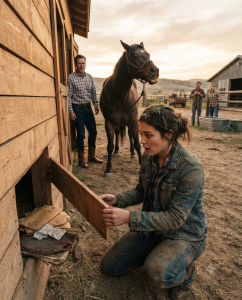
The horse refused to enter the new stable.
That was how it started, though later everyone on the ranch would remember it differently. Some would say the mare sensed danger. Some would swear animals always know when guilt is nearby. One man, ashamed of how quickly he had joined the accusations, would quietly admit he thought the horse sounded less frightened than furious.
Sarah only knew that Midnight had never screamed like that before.
The new stable sat at the edge of the ranch yard, its boards still bright where the sun hit them. Caleb Turner had made a show of building it almost as soon as he arrived, calling the old stalls outdated, unsafe, and inefficient. He liked using words that made him sound necessary. He also liked speaking loudly enough for everyone to hear.
That afternoon, the whole yard had become an audience.
Midnight planted her hooves so hard in the dirt that the veins in her neck stood out like cords. One ranch hand tugged her lead rope. Another clicked his tongue and tried to coax her. A third smacked his hat against his leg and muttered that the mare was acting demon-struck. Midnight answered all of them with the same piercing cry and a violent toss of her head that sent dust spinning through the fading light.
Sarah held the lead rope loosely and watched the horse’s eyes.
They weren’t wild in the way frightened animals usually are. Midnight wasn’t trying to run. She wasn’t trying to bolt for open pasture or jerk free from the crowd pressing around her.
She was looking at one spot.
The far wall.
“She spoiled that animal,” Caleb snapped. “Just like she spoiled everything else.”
The words cracked across the yard. Conversations stopped. Boots shifted in the dirt. Sarah felt every pair of eyes turn toward her at once.
Caleb stood near the stable entrance holding a folded document between two fingers as though he was afraid the paper itself might stain him. He looked clean in a way no real rancher ever did. His boots gleamed. His shirt still held its crisp lines despite the heat. There wasn’t enough dust on him to prove he had done anything harder that day than accuse someone.
Sarah said nothing.
There was no point.
By then, Caleb had already poisoned the air against her. He had arrived just days after his uncle’s funeral with legal authority, a calm voice, and a talent for sounding offended on behalf of the ranch. He told everyone he was there to protect what his uncle had built. He talked about modernization, accountability, efficiency. He carried clipboards around and frowned at old habits he did not understand.
At first, Sarah tried to give him room. The ranch had never been hers. She knew that. She knew better than anyone what it meant to survive on work that belonged to somebody else.
Still, she had been part of that place for eleven years.
She came to the ranch at sixteen because there were nights home did not feel survivable. Her father had never been cruel in the sober daylight, only careless, but whiskey made him unpredictable and rent money disappear. There were weeks when Sarah went to school hungry and then rode her bike to the Turner ranch because the smell of hay and leather felt steadier than the apartment she slept in.
Old Mr. Turner noticed everything without asking questions. He noticed when she started staying later. He noticed when she flinched at loud male voices. He noticed when she began arriving before dawn because it was easier than waiting for her father to wake.
He put her to work.
Nothing soft or ceremonial. Real work. Feed buckets. Stall mucking. Fence repairs. Saddle cleaning. Birth watches in the spring. Ice chopping in winter. Summer days so hot her shirt stuck to her spine before breakfast.
She loved it anyway.
The ranch gave her routine, and routine turned into trust. Mr. Turner trusted her with the inventory shed, then the supply orders, then cash deposits on busy market weeks when there was too much movement for him to drive into town himself. She learned the horses by breath and footfall. She knew which colt would nip, which gelding hated thunder, which mare needed a softer hand after foaling season.
Midnight had always been hers in the way one soul can attach itself to another without paperwork or permission. A dark mare with sharp ears and a mind too quick for most riders, Midnight tolerated plenty of people but listened only to Sarah and Mr. Turner. The old man used to laugh and say the horse judged character better than any preacher alive.
When he got sick, Sarah ran half the ranch while pretending not to.
She managed the hired hands, brought his medication with breakfast, balanced the feed accounts, and kept every late-night panic to herself. Caleb visited only twice during those months, both times in expensive jackets and both times leaving before supper. He spoke to his uncle politely, but Sarah noticed the strain under it. The old man, tired and thinner each week, never seemed relaxed around him.
One evening Sarah carried tea to the house and stopped outside the study when she heard raised voices.
“You will not take over before I’m gone,” Mr. Turner said.
Caleb answered in a low tone she couldn’t make out. Sarah started to step away, embarrassed, but then the old man spoke again, louder. “The books do not lie.”
There was a long silence after that.
When Caleb came out minutes later, his expression was smooth, but his eyes slid past Sarah like she wasn’t worth noticing. He got in his truck and left without saying goodnight.
Mr. Turner died two weeks later.
Everything after that moved like a storm front.
Funeral. Lawyers. A reading of documents nobody on the ranch fully understood. Caleb returned for good, carrying authority and grief in equal performance. He praised his uncle in front of outsiders, then criticized every system the old man had used once the guests were gone.
Within days he had started reviewing the finances.
Within a week he announced discrepancies.
Small amounts. Clever amounts. The kind that would seem harmless alone and devastating together. Missing deposit portions. Vendor payments that didn’t match invoices. Gaps spread over enough months to suggest someone patient and trusted.
“Someone with access,” Caleb said one morning, tapping the paper in his hand. “Someone no one would suspect.”
By the time he said Sarah’s name, he had already built the case in people’s minds.
She could see the relief on some faces. People like having a culprit. It saves them the discomfort of uncertainty. A few workers looked shocked. One or two looked ashamed. But nobody asked the questions Sarah wanted asked. Why hadn’t Mr. Turner confronted her? Why had the evidence surfaced only after Caleb arrived? Why were there no sheriff’s records, no bank complaints, no warnings before now?
Caleb enjoyed questions only when he could answer them himself.
By noon that day, everyone believed him.
By sunset, he told Sarah to pack her things and leave the tack room by dark.
“Be grateful I’m keeping this internal,” he said. “My uncle was too kind to you, and look how you repaid him.”
That was the first moment she almost spoke. Not to defend herself, but because dragging Mr. Turner’s name into the lie felt obscene. Still, she swallowed it. She had nothing in her hands but her own word, and against a signed document and inheritance papers, her word weighed nothing.
Then Midnight refused the stable.
At first, Caleb rolled his eyes. He said the mare was acting up because Sarah had made her soft. But the more the horse screamed, the more his irritation sharpened into something less controlled.
“Get her inside,” he barked.
Two workers tried. Midnight lashed backward, then froze again, staring past them. Another man fetched a blindfold. The mare nearly knocked him over. Sarah felt the lead rope vibrate with tension and laid a hand against Midnight’s neck.
The horse’s skin was hot and trembling.
“What is it?” Sarah whispered.
Midnight’s ears cut forward toward the far wall.
Sarah followed her gaze.
From a distance, nothing looked wrong. New stable. Clean lumber. Fresh hinges. Caleb’s pride and joy. But once Sarah started paying attention, the details began to shift. One section of the back wall was lighter than the rest. The grain didn’t line up cleanly. The nails looked older than the wood, dark with oxidation, as if they had been reused.
A memory flickered.
Mr. Turner in the yard, months earlier, watching Caleb supervise the construction. Midnight had gone uneasy then too, sidestepping near the back of the site while Caleb argued with a carpenter. Sarah hadn’t thought much of it at the time. Horses noticed noise, strangers, changes in smell.
Now her stomach tightened.
“It’s a horse,” Caleb snapped when someone muttered that something felt off. “Not a witness.”
The sentence dropped into the yard like a stone.
Sarah looked at him sharply. Caleb seemed to realize too late how it sounded. A faint sheen of sweat had appeared on his forehead. His hand kept brushing his thigh, an anxious movement he was trying to disguise.
Sarah handed Midnight’s rope to one of the younger ranch hands. “Hold her,” she said.
“Sarah—” the boy began.
But she was already moving.
She skirted the side of the stable, boots crunching over dry gravel. Nobody stopped her. At first, they didn’t understand what she was doing. Then Caleb did.
“Leave that alone,” he called.
Sarah kept going.
The far wall looked worse up close. One plank sat crooked enough to catch the eye once you knew where to look. Along the bottom edge was a narrow dark seam. Sarah crouched and pressed her fingers flat against it.
The sound behind the board was unmistakable.
Hollow.
Her pulse leaped. She slipped her fingers beneath the edge and tugged. The first nail held stubbornly, then gave with a shriek that made several people in the yard jump. She pried harder, feeling wood splinter under her palm, and the second nail came loose.
By then, workers had abandoned the horse and gathered behind her.
Caleb strode forward. “I said leave it.”
Sarah yanked the plank free.
A small cavity opened in the wall, deep enough to hide a box. No box remained there now, only loose items shoved into the back as if someone had concealed them fast and planned to retrieve them later.
Sarah reached inside.
She pulled out three sealed cash envelopes coated with dust. Then a torn bank receipt. Then a ledger wrapped in an old feed sack.
For a second nobody breathed.
The ledger had been missing for nearly a month.
Caleb had used that fact against her too. Missing records, he said, were exactly what guilty people relied on. Without them, no one could trace the theft cleanly. He had looked almost triumphant when he said it, as though the absence of proof was proof enough.
Sarah unwrapped the book with shaking hands. It opened to pages dense with Mr. Turner’s tight, slanted handwriting. Dates. Deposit tallies. Feed orders. Notes scribbled in the margins where he tracked money the way some men tracked weather patterns.
Then Sarah found the entries that changed everything.
Small withdrawals flagged with question marks. Transfers initialed by Caleb. A notation about temporary authority during illness. Another note two weeks later, more forceful: Deposit short again. Caleb claims clerical issue. Verify.
Tucked inside the back cover was the other half of the bank receipt.
Sarah pressed the two torn pieces together. Perfect match.
One of the hands leaned over her shoulder. “Jesus,” he murmured.
Another took the ledger carefully and scanned the pages. His expression hardened with every line. “These deposits never cleared,” he said. “They were logged, but the account didn’t receive them.”
Caleb stepped forward. “That proves nothing. Books can be altered.”
The older man holding the ledger turned a page. “Not by your uncle’s hand they can’t.”
Silence spread outward from that sentence.
Sarah raised her eyes to Caleb.
She saw it then, the thing she would remember more clearly than the papers, the receipts, even the hidden wall. His face changed before he could stop it. The practiced anger dropped away. The confidence slipped. What appeared in its place was naked panic.
He knew.
Everyone around him saw that he knew.
He recovered fast, but not fast enough. “She planted this,” he said. “She had access to the stable.”
“Built last week,” one of the workers said flatly. “By your crew.”
Another added, “And you’re the one who kept pushing that horse in there.”
Caleb looked around as if stunned to find the room had changed sides while he was still speaking. “You’re all making a mistake.”
“Maybe,” said Harlan, the oldest ranch hand, stepping between Caleb and Sarah, “but it won’t be the first one today.”
Harlan took the ledger from Sarah and flipped deeper into the pages. His brow drew down. “There’s more.”
A folded sheet slid out and landed at his boots.
He bent, picked it up, and read silently. Whatever was on it drained the last color from his face. “This is dated three days before Mr. Turner died.”
“What is it?” Sarah asked.
Harlan hesitated, then handed it to her.
It was a draft letter, unfinished and unsigned, addressed to an attorney in town. In it, Mr. Turner stated he intended to remove Caleb from any financial authority pending investigation into missing ranch funds. He mentioned concerns over intimidation. He mentioned hidden records in case anything happened before the matter could be resolved.
Sarah read the line twice because it felt impossible to see the words and still understand them.
In case anything happened.
She looked up slowly.
Caleb had stopped speaking. His eyes were fixed on the letter in her hand with the stillness of a man who has realized the worst piece of evidence has surfaced.
“Call the sheriff,” Harlan said.
That broke Caleb’s freeze. He turned fast and headed for the yard gate, but two ranch hands moved without being asked and blocked him. Not violently, just firmly, men who had worked beside each other too long to need discussion.
“You don’t get to walk off,” one said.
Caleb’s voice rose. “Move.”
“No.”
Midnight, still thirty feet away, went quiet.
Sarah became aware of everything at once—the heat trapped in the stable boards, the smell of hay, the roughness of the ledger cover against her palm, the humiliation of the whole day beginning to tilt into something else. Not triumph. Nothing that clean. More like grief with its mask ripped off.
Because the truth did not only free her.
It meant Mr. Turner had known he was being betrayed near the end of his life. It meant he had hidden evidence because he no longer trusted the man who shared his blood. It meant Sarah had been accused using the very gaps his uncle had tried to preserve long enough to expose.
The sheriff arrived just before full dark.
He knew the family. He knew Harlan. He listened without interrupting while the evidence was laid out on the hood of a truck under a work light. The envelopes. The matching receipts. The ledger. The draft letter. Caleb tried twice to interrupt and once to laugh it off, but each attempt sounded weaker than the last.
The sheriff turned to Sarah. “You found all this?”
She glanced toward Midnight. “She did.”
Nobody smiled at that. Not because it sounded foolish, but because too many people had seen the horse’s reaction with their own eyes.
The sheriff questioned Caleb separately, then again in front of Harlan and two others. His story changed twice in ten minutes. First he said he had never seen the ledger. Then he claimed his uncle had hidden it because Sarah threatened him. Then he said the envelopes were probably old operating cash and none of this was criminal.
The sheriff wrote everything down.
Before he left with Caleb in the back of the patrol truck, he asked one last question. “Why hide the records in the stable wall?”
No one answered immediately.
Then Harlan looked at the new boards, at the hollow cavity, at the horse still standing rigid and watchful in the yard.
“Because whoever hid them knew the wrong man would come back for them,” he said. “And maybe because he trusted that something on this ranch would remember.”
The days that followed were uglier than justice stories usually admit.
There were statements to give. Bank records to untangle. Lawyers and probate documents and whispers around town from people who suddenly claimed they never believed Caleb to begin with. Sarah received apologies too late to be comforting. Some were sincere. Some were attempts to repair reputations.
She accepted none of them easily.
Trust doesn’t return just because facts do.
But the sheriff’s investigation confirmed what the ledger suggested. Caleb had been siphoning money in small amounts while his uncle was ill, counting on confusion and delayed oversight to cover him. When Mr. Turner began documenting irregularities, Caleb tried to locate the records. He never found them before the funeral. Once he inherited temporary control, he redirected suspicion toward Sarah, expecting the missing ledger to keep the accusation standing long enough for him to settle the estate and disappear the rest.
He had not counted on Midnight.
Or on Sarah noticing the nails.
A month later, once legal dust began settling, the attorney handling Mr. Turner’s estate called Sarah to the house. She stood awkwardly in the study where she had once overheard that argument, hat in hand, unsure why she had been asked there.
The attorney slid a paper toward her.
Mr. Turner had amended his will shortly before his death. The ranch would not go to Caleb. It would pass into a trust managed by long-serving staff, with Sarah named as the on-site operations lead and future co-manager if she chose to stay.
She stared at the paper so long the attorney finally said, “He trusted you.”
Sarah laughed once, but it broke in the middle and turned into tears she had not planned to let anybody see.
Outside, Midnight was tied to the porch rail. When Sarah stepped out and pressed her forehead against the mare’s face, the horse exhaled warm air against her cheek and nudged her shoulder like she was annoyed by all the emotion.
The new stable stayed standing, but Sarah had the false section of wall removed entirely. She never covered the cavity back up. For a while she left it open as a reminder—not of Caleb, but of how close truth had come to being buried under fresh lumber and loud confidence.
People around town told the story in different ways after that. They said the horse saved her. They said greed always reveals itself. They said the old owner had one final plan. All of those things were partly true.
But Sarah knew the ugliest truth was simpler.
Everyone had doubted her because it was easy.
Everyone had believed Caleb because he wore authority like it belonged to him.
And in the end, the first soul on that ranch to refuse the lie hadn’t been a person at all.
Sometimes, when the evening light hit the yard just right, Sarah would catch herself looking toward the stable wall and thinking about the moment Caleb’s face changed. That unguarded flash of guilt. That split second when power vanished and truth stepped into the open.
She still wasn’t sure what hurt more: that he stole from a dying man, or that so many people were ready to let Sarah carry the blame without asking a single harder question.
Maybe that was the real warning.
Not the hidden cash. Not the forged story. Not even the nephew who came in polished boots and tried to bury evidence behind new boards.
Maybe the biggest red flag was how quickly decent people chose the easiest version of events.
And maybe that was why the memory stayed.
Not because a horse exposed a thief.
But because an animal showed a whole yard full of humans exactly what loyalty was supposed to look like.
