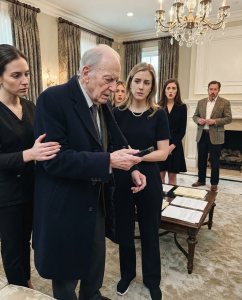
They hired Naomi as a caregiver because nobody else wanted the job.
That was what the agency told her over the phone in a voice that tried to sound casual and failed. The pay was unusually high. The family was “particular.” The patient was “difficult.” The previous caregivers had not been a good fit.
Naomi had heard every version of that sentence before. Difficult could mean proud. It could mean frightened. It could mean grieving, in pain, humiliated by dependence, or simply tired of being handled by strangers. Wealthy families loved to flatten complicated suffering into one convenient word.
Still, when she arrived at the Voss estate just after sunset and saw the place for the first time, even she understood why people had walked away.
The mansion rose behind iron gates and clipped hedges like a private museum. The windows glowed gold against the evening sky. The fountain in front was lit from below. Two cars worth more than Naomi’s lifetime earnings sat in the circular drive. Everything was polished, symmetrical, expensive.
And cold.
A maid took her coat. A butler avoided eye contact. Somewhere deeper inside the house, a man was shouting so violently the sound seemed to rattle the frames on the walls.
“That will be Mr. Voss,” the butler said, as if announcing weather.
Naomi was led through hallways lined with art and old portraits to a sitting room where the family waited. Three adult children, all elegant in different ways, rose to greet her. The oldest daughter, Celeste, wore a cream blouse and a watch that flashed when she moved her wrist. Her smile was perfect and dead. The middle son, Adrian, looked like he belonged on the cover of a finance magazine. The youngest, Lucian, had charm so polished it might as well have been lacquered on.
They thanked Naomi for coming as though she were doing charity work for people who owned half the city.
“He’s not himself,” Celeste said. “Please don’t take anything personally.”
“He accuses everyone of stealing,” Adrian added. “Jewelry, papers, medication. Whatever idea happens to enter his head.”
Lucian gave a small apologetic laugh. “We’ve learned not to engage.”
Then the family doctor entered, smooth and immaculate, with silver hair and a voice made for expensive waiting rooms. He reviewed the medication schedule. Sedatives for agitation. Sleep support. Pain management. Blood pressure control. A few other items listed with confident precision.
Naomi listened.
Then she was taken upstairs.
The old millionaire was in a large bedroom overlooking the south lawn. Elias Voss had once been a force, that was obvious even through illness. His face still had the severe architecture of command. But sickness had eaten at him. He was thin, pale, and coiled tight with anger. The first thing he did when Naomi stepped through the doorway was throw a glass toward the doorframe.
It shattered.
“Out,” he barked. “Out before you start lying to me too.”
Naomi took in the spilled water, the trembling hand, the tray of untouched medicine, and the fury that looked half-performed and half-earned.
Instead of leaving, she grabbed a towel from the washstand and knelt to clean the floor.
“Do you take your tea plain?” she asked.
He stared at her.
His eyes were sharp despite the fog around them. Suspicious. Defensive. Exhausted.
“Who sent you?”
“The agency.”
“That’s not what I asked.”
She wrung out the towel. “Your family hired me.”
He gave a harsh little laugh. “Then you’re already in danger.”
That first week, he was nearly impossible. He snapped at her for adjusting his blanket. He demanded she leave, then rang for her moments later. He accused the night staff of moving things. He insisted a painting had been shifted by half an inch and refused to sleep until it was straightened. Twice he refused medication so stubbornly that the doctor had to be called. Once he slapped a spoon out of Naomi’s hand so hard it struck the carpet and splattered broth across her shoes.
She did not quit.
There was something beneath the rage that would not let her dismiss him. Not because he was rich. Not because the house was full of whispers. Because she had seen real confusion before. She had seen minds unravel. Elias’s anger did not feel random. It felt aimed. It felt like a man drowning while everyone around him insisted the water wasn’t real.
On the fourth night, she discovered the crying.
The mansion after midnight became a different place. The downstairs laughter was gone. Doors closed. Pipes clicked softly in the walls. Somewhere far off a clock marked the hour.
Naomi was charting medication times at the desk outside Elias’s room when she heard a sound so faint she almost missed it. A broken inhale. Then another. Then the unmistakable sound of someone trying and failing to cry quietly.
She stood and went in.
The room was dim except for a lamp near the window. Elias lay turned toward the wall, shoulders shaking.
Naomi did not say, Are you all right? There are questions so useless they border on cruelty.
She walked to the bedside, pulled the chair close, and sat down.
Several minutes passed before he spoke.
“They moved the painting,” he whispered.
Naomi looked at the large landscape on the opposite wall. Storm clouds over a sea cliff. Heavy gilt frame. Slightly crooked.
“I noticed.”
“It hides the lock.”
She turned back to him. “What lock?”
His mouth tightened. “You’ll tell them.”
“No.”
He finally looked at her, measuring.
That was how it began. Not trust exactly. More like a pause in hostilities. A crack small enough for truth to begin leaking through.
Over the next several days, Naomi learned him in pieces. He liked strong black tea with one sugar cube and hated anyone fussing over him. He loathed pity more than pain. He could be cruel when frightened and frightening when humiliated. But sometimes, usually when the house was quiet and his medication had worn down to whatever clarity it allowed him, he spoke with startling lucidity.
He told her about a locked room no one used anymore.
About a red notebook.
About a stack of papers placed before him at night when he was too sedated to focus.
About the pills.
“Not mine,” he muttered one rainy afternoon while Naomi changed the dressing on a tear in his skin. “Bottle’s mine. Inside isn’t.”
Naomi glanced at the tray. “What do you mean?”
“They swap them when they think I’m asleep.”
The sensible thing would have been to write it down as paranoia and move on. She knew that. Families with too much money and too much tension often turned illness into chaos. Accusations multiplied. Memories twisted. Fear wore many disguises.
But then she noticed the timing.
Every morning medication pass was done under supervision. Every night dose arrived on a tray prepared out of sight. On certain evenings Elias became so heavily sedated that he could barely keep his eyes open long enough to drink water. Yet the prescribed amounts, according to the chart, should not have flattened him that completely.
She began to count.
She watched the blue tablets in particular. She watched which nurse carried them, who handled the tray first, whether the doctor happened to visit on nights when Elias seemed most incapacitated. The pattern that formed was not neat, but it was enough to disturb her.
When she raised her concern downstairs, the response was immediate and polished.
Celeste folded her arms and smiled as if indulging a child. “Our father has spent months accusing people of poisoning him.”
Adrian said, “He also accused the gardener of wiretapping the roses.”
Lucian laughed softly. “You’ll drive yourself mad if you start chasing all of it.”
The doctor’s expression cooled. “You are not qualified to interpret pharmacological effects.”
The lawyer was worse. He had come that afternoon with a leather portfolio and an air of administrative purity. He waited until the others left, then said, “You are employed to provide care, not commentary. Be careful not to confuse proximity with authority.”
Naomi understood the warning.
Stay useful. Stay quiet. Stay in your place.
She went upstairs angrier than she had been in years.
That night, Elias did not shout at her. He only watched as she straightened his blanket.
“They told you I’m mad,” he said.
“They told me a lot of things.”
He gave a tired, bitter smile. “Which part do you believe?”
Naomi considered lying. Instead she said, “I believe someone wants me to stop asking questions.”
For the first time, he looked almost relieved.
The next morning she examined the painting while changing the flowers. He had not imagined it. Behind the frame, fitted almost invisibly into the wood paneling, was a narrow door with a brass keyhole painted around so skillfully it vanished unless you were looking for it. Locked.
That same day, the housekeeper—a woman named Marta who had served the family longer than any of the children had been adults—lingered while collecting linens. Her hands trembled slightly.
“You should be careful,” Marta murmured.
“Of what?”
Marta glanced toward the hall. “Of noticing too much.”
Before Naomi could ask more, footsteps approached and Marta was gone.
By the third week, the atmosphere in the house changed. The family became attentive in a way that felt more dangerous than neglect. They spent longer in Elias’s room. They spoke near him in soothing tones that never reached their eyes. They asked Naomi whether he was sleeping enough, whether he seemed confused, whether he had mentioned papers or meetings or signatures.
One evening Celeste stopped Naomi in the hall.
“You’re very devoted,” she said. “That’s admirable. But sometimes compassion can blur boundaries.”
Naomi held her gaze. “Sometimes concern is just concern.”
Celeste’s smile thinned. “My father is not a reliable narrator.”
The sentence stayed with Naomi long after the conversation ended.
That night Elias gripped her wrist with surprising strength.
“Will reading,” he whispered. “Help me stand.”
“When?”
“Soon.” His breath caught. “Get my coat. Blue one. Wardrobe. Don’t let them take it.”
“What’s in the coat?”
Before he could answer, the bedroom door opened. The doctor entered with Adrian behind him.
Elias changed instantly. His eyes dulled. His hand loosened. He slumped back into the pillows with such convincing frailty Naomi might have doubted everything if she had not felt the force in his grip a second earlier.
Later, once he slept, she checked the wardrobe.
The blue coat was old, thick, and heavy. It hung among tailored jackets too fine to wear in bed, yet it smelled as if it had been used recently. Naomi ran her fingers through the lining and paused at a seam near the inside breast. Something stiff was hidden there.
She did not remove it. She only confirmed it was real, then put the coat back exactly as she had found it.
The will reading was scheduled for the next day.
By noon the west sitting room had been arranged like a private tribunal. Curtains were drawn halfway against the glare. The lawyer sat at a central table with papers aligned to the millimeter. The doctor stood near the mantle though no one had invited him. The children wore dark clothes and controlled faces. A few senior staff remained discreetly near the walls.
Elias was wheeled in looking half-conscious.
Naomi almost doubted him again until she saw his thumb tap once against the armrest. A signal. He was still there.
She took her place behind the chair.
The lawyer began with formalities. Testamentary capacity. Amendments. Distribution of holdings. Trust arrangements. Tax protections. It was a performance of order, of civilized transfer, of wealth moving along predetermined tracks.
Celeste listened with composed expectancy.
Adrian’s expression was rigid with concentration.
Lucian looked almost bored, though a pulse fluttered at his throat.
Then Elias said, “Stop.”
The lawyer blinked. “Mr. Voss—”
“I said stop.”
The room changed.
Naomi helped him rise. He wavered, then straightened with a stubbornness that seemed to come from somewhere older than illness. The doctor stepped forward automatically.
“He should sit down,” he said.
Elias turned a stare on him that froze him in place.
“My coat.”
Naomi handed it over.
For a moment nothing moved. Then Elias reached into the inner lining and pulled out a small recorder wrapped in cloth.
The reaction was instant and ugly.
Celeste’s face lost all color.
Adrian swore under his breath.
Lucian took a step back as if distance might save him.
Only the lawyer stayed still, though his composure cracked at the edges.
Elias held the recorder up for everyone to see. His hand trembled, but his voice did not.
“You thought I was too sedated to hear,” he said. “Too weak to understand. Too confused to remember.”
The doctor found his voice first. “Mr. Voss, this is not medically advisable—”
“Medically?” Elias barked. “You should be careful with that word.”
He pressed play.
Static hissed. Then a voice emerged, clear enough to make every person in the room hold still.
Celeste.
“…keep him calm until the will is finalized.”
Another voice followed—Adrian’s.
“He slept through the last increase. We can’t keep waiting if he keeps changing his mind.”
Then the doctor, lower and more cautious. “The dosage is enough to impair, not enough to kill. Don’t confuse the two.”
Naomi felt the air leave the room.
Lucian’s chair scraped back. “This is manipulated,” he said too fast.
No one believed him.
The recording continued.
Celeste again, colder now. “If the caregiver starts asking questions, replace her too.”
Naomi’s stomach turned.
So she had not imagined the warnings. She had not invented the danger. They had been planning around her.
When the recorder clicked off, silence crashed down harder than sound.
Then a voice came from the doorway.
“I knew he’d need more than that.”
Everyone turned.
Marta, the housekeeper, stood clutching a red notebook to her chest. Her eyes were wet, but her hands were steady now.
Celeste’s control broke. “What are you doing?” she snapped.
Marta flinched, then straightened. “What I should have done sooner.”
She crossed the room and handed the notebook to the lawyer before anyone could stop her.
“Your father wrote in it every night he was clear,” she said. “Dates. Medications. Names. Times. And every paper they put in front of him when he wasn’t fit to sign.”
The lawyer opened it.
Page after page of narrow, slanted handwriting filled the book. Some entries were shaky, others firm. But all were specific. Naomi saw dates, dosages, descriptions of conversations overheard, notes about moved objects, and one line repeated several times in different wording:
Do not let them say I agreed.
The doctor stepped forward at last. “This is absurd,” he said. “A delirious patient’s notebook is not evidence of competence.”
The lawyer looked up. “It may be evidence of coercion.”
Adrian swore again, louder this time.
Lucian tried a different tactic. “Father, listen to yourself. We’ve been trying to protect the estate. You were changing major decisions daily. You weren’t well.”
Elias laughed, and it was one of the bleakest sounds Naomi had ever heard.
“You weren’t protecting the estate,” he said. “You were protecting your timetable.”
Celeste’s eyes flashed. “You made this family live at the edge of your moods for forty years.”
The room went very still.
There it was. Not grief. Not concern. Not fear of losing him.
Resentment.
Old, disciplined, expensive resentment.
Elias looked at her for a long moment. “And that justifies drugging me?”
Celeste’s throat moved. She said nothing.
The lawyer closed the notebook carefully. “I am suspending this proceeding immediately,” he said. “No further execution of testamentary documents will occur until independent review is completed.”
The doctor began protesting. Adrian joined him. Lucian started pacing. Celeste stood like carved ice.
Naomi felt Elias sag beside her. The surge that had kept him upright was fading. She guided him gently back into the wheelchair.
He looked smaller seated, but something had changed. The hunted look was gone. In its place was exhaustion and, beneath it, a hard private victory.
That afternoon the house ceased pretending. An outside medical specialist was called at the lawyer’s insistence. A forensic review of the medication logs began. Security cameras covering the medication room were requested. The doctor left before sunset and did not return. Celeste locked herself in her suite. Adrian spent an hour on the phone to someone who kept hanging up. Lucian drank on the terrace until dark.
Naomi stayed with Elias.
The independent physician arrived that evening, examined the chart, observed Elias after several missed doses, and spoke to him privately for nearly an hour. When she came out, her face was grave.
“He is ill,” she told the lawyer. “But he has had periods of clear decision-making capacity. Enough that I’m deeply concerned by the pattern of sedation.”
That was the sentence that ended the family’s version of reality.
Over the next few days the truth became procedural. The ugliest kind. Pharmacy records did not match administered quantities. One nurse admitted under pressure that she had followed verbal instructions not reflected in writing. Marta revealed she had once found a signed amendment on Elias’s desk and later seen the same page replaced with a new one. The hidden room behind the painting turned out to be a narrow study Elias had used years ago for private papers. The key, found tucked into an old dictionary, opened a cabinet containing earlier drafts of his estate plan and a handwritten letter naming concerns about coercion if his health worsened.
His children had not been trying to hasten his death.
They had been trying to control his decline.
To keep him sedated enough to sign what they needed. To isolate him inside his own body until resistance looked like confusion and fear sounded like madness.
The distinction did not save them.
Celeste argued necessity. Adrian blamed the doctor. Lucian claimed he had only known parts of it. The doctor insisted every choice had been made in the patient’s best interest, a phrase that sounded almost obscene by then.
Elias listened to all of it from his bed, alert more often now that his medications had been stabilized properly.
One evening, as the sunset bled copper through the curtains, he asked Naomi to read aloud from the red notebook. She did. Not all of it. Only the entries from the days when he had first realized what was happening.
They were not dramatic. That made them worse.
Today they asked me to sign while I could not hold the pen steady.
Blue pill tasted wrong again.
Heard Celeste say “before he changes it back.”
Pretended to sleep.
If I seem mad, let it be written that I was watching.
Naomi’s voice caught on that last line.
Elias closed his eyes. “I built everything in this house,” he said quietly. “And still, in the end, I had to hide in my own coat to be believed.”
Naomi set the notebook down. “You were believed.”
He opened his eyes and looked at her. “Because you listened.”
Weeks later, the revised legal process concluded under supervision none of his children could influence. Elias changed his will one final time while fully evaluated and witnessed. He did not disinherit them completely. Naomi thought that was the strangest mercy of all. He left each child enough that they would never be able to call themselves victims. But the controlling shares, charitable endowments, and stewardship of the foundation went elsewhere, placed into structures they could not manipulate. Marta received a house. Several longtime staff were provided for. Naomi, to her astonishment, was left a sum so large she initially believed there had been some clerical error.
There wasn’t.
“It isn’t payment,” Elias told her the last time they spoke alone. His voice was thin but clear. “It is gratitude.”
He died seventeen days later, not in chaos, not sedated into silence, but with proper medication, the curtains open, and someone beside him who did not want anything from him except his comfort.
After the funeral, the newspapers reported a legal dispute within the Voss family. They used words like contested, alleged, irregularities. Public language was always so clean around private cruelty.
Naomi read one article, folded it, and threw it away.
Months later she still thought about the moment in the sitting room when Elias pressed play. About how quickly polished grief had turned into naked fear. About how often the world mistakes wealth for dignity, authority for truth, and calm voices for innocence.
She also thought about Celeste’s face when the recording began. Not because Naomi pitied her. She didn’t know if she did. But because there had been a flash there, just for a second, of something beyond greed. Old injury. Old hunger. The kind that tells itself a theft is really correction.
Maybe that was the final damage money did in families like that. It made everyone fluent in justification.
Naomi never decided who had been the most unforgivable. The doctor who traded judgment for access. The children who dressed control as concern. The lawyer who noticed too little until evidence became unavoidable. Or Elias himself, for building a life where love and inheritance had become impossible to separate.
What she knew was simpler.
The biggest red flag had not been the shouting. It had not been the accusations, the broken plates, or the paranoia everyone mocked.
It had been this: the old man only slept peacefully when the people who claimed to love him were gone.
