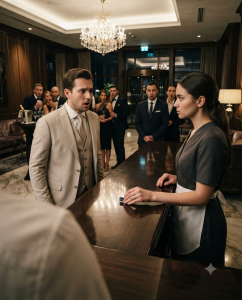
They gave the worst room in the hotel to the maid they called “too slow to matter.”
That was how people described Lena when they thought she was too far away to hear, which was often. At the Grand Marlowe, a luxury hotel built on polished stone, scented lilies, and expensive lies, housekeepers were expected to move silently and disappear quickly. Guests liked spotless mirrors, fresh linens, and folded towels shaped into something charming, but they did not like to think about the people who made those things happen.
Lena had worked there for nine years.
Nine years of rising before dawn. Nine years of aching feet and cracked hands and managers who said “the girl from housekeeping” even when they had known her name for almost a decade. Nine years of entering rooms after honeymoons, business deals, affairs, breakdowns, and celebrations, cleaning the evidence of other people’s lives while being treated as though she had none of her own.
She was not actually slow. She was careful.
There was a difference, but places like the Grand Marlowe never rewarded that difference. They rewarded charm at the front desk, obedience in the corridors, and silence everywhere else.
Lena had become very practiced at silence.
She pinned her hair back the same way every morning, tucked a notepad into her apron, and checked the room assignments with the focus of someone who understood that one missed detail could become a written warning. She knew which suites needed hypoallergenic detergent, which VIP guests demanded fresh flowers twice a day, and which long-term residents pretended not to drink while hiding empty bottles in shoe bags.
Most people assumed that because she said little, she saw little.
The opposite was true.
Lena noticed everything.
She noticed which staff members stole pastries from kitchen trays and which ones stole time by disappearing into storage rooms. She noticed who smiled upward and sneered downward. She noticed which guests traveled with one suitcase and left with two. She noticed when a husband wore a wedding ring into the lobby and slipped it into his pocket before entering the bar.
Most of all, she noticed patterns.
Patterns were how a hotel truly functioned. Guests came and went, managers changed, uniforms were updated, but habits stayed. People who lied repeated the same kinds of lies. People who stole developed favorite methods. People who thought they were untouchable almost always made the same mistake: they assumed invisible people were blind.
That morning, the Grand Marlowe was running on nerves.
The owner’s son, Adrian Voss, was coming in with investors from London. The entire management team had been preparing for the visit all week, speaking of it like a royal inspection. The hotel needed fresh capital for an expansion. Adrian, who had recently started acting as though he already owned the building, made it very clear that the investors must see perfection.
The marble floors were polished twice. Every brass fixture shone. Champagne was chilled in silver buckets. A florist replaced arrangements that still looked fresh because Adrian didn’t like the shade of white in the lilies. At the morning briefing, the floor supervisor repeated the same instructions three times.
“No errors. No delays. No unnecessary staff in guest view.”
No one had to ask what that meant. Housekeeping, maintenance, laundry, dish runners—people whose work made luxury possible but whose presence disrupted the illusion of effortless elegance—were to use service routes only.
Lena spent the early part of the morning on the top floor, where the hotel’s most expensive suites overlooked the river. Those rooms were usually handled with theatrical caution. But that day one assignment stood out immediately.
Suite 1402.
Still occupied, according to the board.
Clean immediately, according to the supervisor.
Lena frowned when she saw it.
“Guest hasn’t checked out yet,” she said.
Her supervisor, Marta, barely looked at her. “Management order. Do it now.”
That in itself was unusual. The Grand Marlowe catered to powerful guests, and powerful guests did not like staff entering their rooms prematurely. Lena took the service elevator up with fresh linens and her cart stacked neatly with towels, robes, soap trays, and a small vacuum.
When she opened Suite 1402, she understood at once that something was wrong.
The bed had been slept in only lightly, as though the guest had lain down fully dressed for an hour rather than spending a full night there. One whiskey tumbler sat on the desk beside a bottle of water. A drawer near the wardrobe had been left open. A cufflink glittered on the carpet by the window. And the wall safe stood open.
Not cracked. Not damaged. Simply open.
Lena paused with a pillowcase in her hand.
Guests sometimes forgot to close safes, but not in suites like that. People who booked 1402 did not forget much. She looked around again, paying attention to the kind of details experience had taught her not to ignore. There was no luggage. No toiletries in the bathroom. No charger by the bed. The room looked less like a checkout and more like a place someone had left in a hurry after choosing exactly what to take.
Marta’s voice crackled sharply over the internal radio clipped to Lena’s cart.
“Finish and leave. Quickly.”
Lena made the bed, replaced the used glass, collected the cufflink, and noted the open safe in her pad. When she exited into the corridor with a bag of used linens, another detail stopped her.
The camera above the top-floor elevator was dark.
Every other security camera in the building gave off a faint blinking light. This one showed nothing at all. No pulse. No hum. Dead.
Lena stood there for only a second, but she felt her stomach tighten.
Then she kept moving.
The hotel did not reward curiosity.
Still, as she wheeled her cart toward the service alcove, something tugged at her memory. There was another camera in that wing, one that most newer employees didn’t know existed. Years ago, after a VIP guest accused a courier of entering the wrong suite, a hidden backup camera had been installed behind a decorative service mirror to monitor deliveries and staff access. It wasn’t part of the main visible security line. The head of maintenance had once grumbled about it while fixing a panel, and Lena had remembered.
She glanced at the narrow mirror inset beside the service door. To guests it looked ornamental. To staff it was just part of the wall.
The backup system still had a small access panel nearby.
Lena looked over both shoulders, then crouched beside the panel and opened it. The tiny status light was active.
Recording.
That made her pulse kick harder.
Why would the main camera be dead while the backup still ran?
She closed the panel, finished her rounds, and told herself to leave it alone. Yet when she passed by again a few minutes later and saw the elevator camera blinking normally once more, the unease did not fade. She checked the hallway clock.
Seven minutes.
Only seven minutes had passed.
The rest of the morning became a blur of pressure. Linen shortage on the third floor. A guest complaint about coffee temperature. An urgent request for extra bathrobes. And then, just before eleven, the lobby incident.
Lena was supposed to take the service corridor, but laundry had backed up because another attendant was absent, and the shortest path to the west wing cut across the edge of the lobby. She pushed her cart carefully, trying to be quick and unseen.
She was almost through when Adrian spotted her.
He had just entered with three investors from London, elegant people in dark coats who looked like they judged furniture for a hobby. Adrian himself was polished to the point of shine: pale tailored suit, expensive watch, hair fixed just enough to look effortless. He loved being seen. He loved appearing in control even more.
His gaze landed on Lena and hardened.
He snapped his fingers.
The sound cracked through the lobby.
“Back hallway,” he said, loud enough for everyone nearby to hear. Then his mouth twisted into a smile that wasn’t a smile at all. “People like you ruin the image.”
The words hung in the polished air.
The receptionist froze. A bellman looked away. One of the investors shifted, uncomfortable, but said nothing. Adrian’s father, owner of the hotel and lifelong practitioner of selective blindness, pretended to check something on his phone.
Lena felt heat rise in her face. Not because she had never been insulted before. Because he needed an audience for it.
She lowered her head and turned the cart.
She heard one of the investors murmur something to Adrian as she left, but she couldn’t catch the words. She went into the service corridor and kept walking until the sting in her chest settled into something colder.
Not rage.
Certainty.
Something was wrong on the top floor, and the same man who had just humiliated her was at the center of a visit built entirely on appearances.
That evening the hotel glowed with curated perfection. The private dining room was reserved for the London investors. Candles flickered behind glass. Sommelier service was timed to the minute. Staff were told to smile, answer only what was asked, and avoid all unnecessary visibility.
Lena worked the linen stations and corridor refresh, replacing towels, clearing service trays, and staying out of sight.
Just after dessert, the illusion shattered.
An investor named Celeste Warren came down from the private lounge with fury written across every inch of her face. She was elegant, controlled, and very clearly unaccustomed to being ignored. Her diamond necklace, an heirloom piece she had removed before dinner, was gone.
At first there was confusion. Then alarm. Then panic dressed up as discretion.
Managers closed off the lounge. Security reviewed visible access logs. Staff were questioned in clipped, tense voices. Someone suggested the necklace might have been misplaced. Celeste informed them, icily, that a piece insured for more than most of their yearly salaries was not “misplaced.”
Within minutes, the entire hotel was vibrating with rumor.
A theft at a luxury investor dinner was not just an embarrassment. It was a threat to the hotel’s future.
And when powerful institutions feel threatened, they look for the cheapest sacrifice.
Lena was folding towels in the laundry room when two supervisors arrived.
“Come with us.”
She asked why. No one answered.
They brought her to reception, where a crowd had already formed. Bellmen stood stiffly near the doors. Reception staff tried and failed to look busy. Security guards hovered with performative seriousness. Celeste stood with her arms crossed. The owner’s face was red with stress.
Adrian stood near the desk, perfectly placed to appear responsible.
“There she is,” he said.
Lena understood immediately.
He didn’t accuse her as a question. He accused her as a solution.
“She was on the top floor this morning,” he told the room. “She was also out in guest view during investor arrival after direct instructions were given. I said discipline had become a problem.”
His father looked at Lena, not with concern, but with the weary irritation of a man already preparing an apology to richer people than himself.
Adrian continued smoothly, “We need to act quickly. Search her things.”
Not one person asked whether there was actual evidence.
Lena saw shame flicker across a young receptionist’s face. She saw the head of security avoid eye contact. She saw Marta, her supervisor, keep her mouth shut to protect herself. Years of hierarchy had trained them all too well.
Adrian finally turned to Lena. “Unless there’s something you’d like to tell us.”
That was the moment everyone expected tears. Pleading. Maybe anger. Something easy to dismiss.
Instead, Lena untied her apron.
The entire lobby seemed to lean toward her.
From a hidden inner pocket, she took out a tiny memory card and set it on the reception desk.
“You forgot the hallway camera behind the service mirror,” she said.
Silence fell so completely that even the fountain in the lounge could be heard.
Adrian’s expression changed first. It was subtle, but Lena saw it. His confidence didn’t vanish all at once. It fractured.
The owner frowned. “What camera?”
“The backup on fourteen,” Lena replied. “The one not tied to the main lobby feed.”
Celeste stepped closer. “Can it be viewed?”
The head of security swallowed. “Yes.”
“Then do it,” she said.
No one argued with her now.
The card was inserted into the reception computer. Staff crowded behind the desk. Adrian stood very still. Lena stayed where she was, hands at her sides, pulse steady in a way that surprised even her.
The footage loaded in grainy monochrome.
Top-floor service corridor. Time stamp. Quiet hallway.
Then Adrian entered from the stairwell, not the elevator.
He looked both ways before pulling a master keycard from his pocket. He slipped into Suite 1402. A minute later he emerged carrying a dark velvet case. He opened it briefly, and even on black-and-white video, the necklace flashed. Another figure appeared—assistant manager Colin Reeves, whose access logs always looked suspiciously tidy. Adrian shoved the case into a built-in linen cabinet, said something hurriedly to Colin, then adjusted his jacket and walked away.
Seven minutes later, the visible elevator camera came back online.
No one in the lobby moved after the video ended.
The owner looked at his son as if he were seeing him for the first time without the polish. Celeste’s face had gone white with rage. The assistant manager, who had remained near the back, started stammering before anyone addressed him.
Adrian tried the easiest lie first.
“This isn’t what it looks like.”
No one answered.
Then he tried to redirect. “Colin asked me to secure it. We thought—”
Colin burst. “That’s not true!”
And once one frightened person starts talking, the rest becomes inevitable.
Security opened the linen cabinet on the top floor. The necklace was exactly where the footage showed it would be. Alongside it were other items that should never have been there: a luxury watch, an envelope of foreign currency, and two wallets.
Celeste demanded the police immediately.
The owner shouted at security, at Colin, at anyone within range. Adrian’s composure dissolved into a mess of denial, anger, and desperation. He insisted he had only “borrowed” the necklace to stage a crisis and then triumphantly recover it later, proving the hotel’s security response. It was such a stupid explanation that even he seemed ashamed while saying it.
The truth, once Colin started talking, was worse.
For months, Adrian and Colin had been targeting wealthy guests unlikely to report smaller losses aggressively while internal logs were adjusted to blur timelines. Visible cameras were occasionally disabled under the pretext of maintenance. Staff from housekeeping were sent into areas at strategic times, creating convenient suspicion if anything went missing. The thefts were selective, careful, and designed to avoid too much noise.
Lena had not been their first intended scapegoat.
She had simply been the easiest one that night.
When the police arrived just before dawn, Adrian was no longer the smooth heir gliding through marble light. He was pale, sweating, and begging his father to keep the matter private. Colin had already begun trading information to save himself. Celeste was on the phone with lawyers. The London investors, who had come to discuss expansion, were now discussing liability, negligence, and reputational collapse.
The owner found Lena in the back corridor holding a stack of towels.
He looked broken in a way she had never seen.
“I didn’t know,” he said.
It was the first thing he had ever said to her that sounded like it came from the truth instead of a position.
Lena looked at him for a long moment. She believed he had not known every detail. She did not believe he had known nothing. Hotels like his were built on layers of tolerated cruelty. Not every owner steals, but many create the world in which stealing becomes easy for the right kind of son.
“Maybe not,” Lena said. “But you knew enough.”
He flinched.
From the lobby came the sound of a younger receptionist telling police there might be irregularities in archived bookings too. Once fear shifted sides, people started speaking. Deleted reservations. Unlogged access. Complaints quietly erased. Guests who had been paid off, dismissed, or made to feel foolish.
The rot ran deeper than one necklace.
By noon, Adrian’s name was off the staff system. Colin was in custody. Two investors had left for the airport. The third stayed only long enough to inform the owner that any future business discussion was over.
News didn’t take long to spread in a city where luxury scandals were devoured before lunch. The Grand Marlowe issued a statement. It promised full cooperation, internal review, and immediate restructuring. It did not mention Lena by name.
That changed the next day.
Celeste Warren returned with a lawyer and requested to meet “the housekeeper who saved your hotel from lying to itself.” She found Lena in a plain staff room with bad coffee and fluorescent lighting.
“You should have been protected,” Celeste said. “Instead, you were nearly sacrificed.”
Lena did not know what to say to that. Protection had never been part of her job description.
Celeste set a card on the table. It belonged to a legal and hospitality ethics firm. “There are people who would want to hear exactly how this place treated the workers who made it run.”
For the first time in years, Lena felt something unfamiliar stir beneath all the caution she had built around herself.
Choice.
Within a month, three things happened.
The Grand Marlowe dismissed several managers, including Marta, after internal audits exposed falsified reports and coerced staff statements. The owner, desperate to salvage what remained of the hotel’s reputation, implemented new oversight and—under pressure from investors who hadn’t fled—created formal protection channels for lower-level staff. Whether he believed in them was another matter. He believed in survival. Sometimes that was enough to force change.
Adrian was charged.
And Lena resigned.
She did not leave dramatically. No speech. No slammed cart. She turned in her uniform, folded cleanly, and signed her exit papers in the same office where she had once received warnings for being “behind pace” after cleaning up a flood no one else would touch.
The owner asked whether she would consider staying in a supervisory role. It was the closest thing to repentance his pride allowed.
Lena almost laughed.
Instead, she said, “You only see me now because I became useful in a way you couldn’t control.”
He had no answer.
She walked out through the front entrance that day.
Not the service exit. Not the back hallway.
The front.
The doorman, who had ignored her for years, opened the glass door for her with both hands.
Outside, the city moved as always—taxis, rain-streaked pavement, people hurrying past expensive windows. Nothing looked different. Yet to Lena, the air felt strangely light.
Later, when people told the story, they focused on the hidden camera and the necklace and the hotel heir undone by his own arrogance. They liked the neatness of it. The maid no one noticed sees everything. The cruel man gets exposed. Truth wins in the end.
But Lena knew the reality was less neat.
Truth had not won because the system was fair. Truth had won because the system had made one mistake too many in front of someone it had spent years teaching itself not to see.
That was the real red flag, the one that should have frightened them long before the police arrived: not that Adrian thought he could steal, but that he believed he could frame an innocent woman in plain sight and no one would hesitate.
Maybe that was what lingered afterward more than the scandal itself.
Not whether Adrian deserved forgiveness—he didn’t.
Not whether the owner deserved sympathy—he didn’t have much claim to it.
But how many disasters begin in exactly the same way: with one person deciding another person does not matter enough to be dangerous.
At the Grand Marlowe, the heir lost everything because he mistook silence for weakness.
Lena had been silent for nine years.
She had never been weak.
