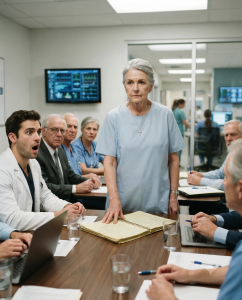
The hospital board laughed when the retired nurse asked to speak during the emergency meeting.
It was not loud laughter. Not the kind that fills a room. It was the softer kind, the more poisonous kind—the kind people let slip when they are convinced someone does not belong at the table.
Margaret Whitaker heard it all the same.
At seventy-six, she had become a familiar but easily overlooked figure in St. Bartholomew Memorial Hospital. Every Tuesday she worked in the gift shop near the front entrance, arranging flowers that family members bought in panic, helping confused visitors choose cards they were too upset to read, pressing peppermints into the trembling hands of children waiting for news they were too young to understand.
Most of the younger staff knew her only in fragments. The cardigan. The silver hair pinned back neatly. The sensible shoes. The habit of smiling at everyone from surgeons to janitors as if they were all equally human.
They had no idea who she had once been.
Thirty years earlier, Margaret Whitaker had been the nurse everybody listened to. She had run night shifts, trained new graduates, corrected physicians without flinching, and developed the kind of clinical instinct that rarely makes it into policies but saves lives anyway. She knew which patient was getting worse before the monitors did. She knew when a medication reaction was not what it appeared to be. She knew when an error was not truly an error, but a pattern no one had noticed yet.
Retirement had taken her off the payroll, not out of the building. After her husband died, volunteering at the gift shop had become a way to stay close to the work without reopening the ache of leaving it. She liked the rhythm of Tuesdays. She liked feeling useful. She liked that she could still help, even if most of that help now came in the form of flowers, directions, and peppermints.
But that Tuesday, the air in the hospital felt wrong before noon.
A code had been called on cardiac step-down before breakfast. Another patient in post-op had suddenly destabilized after a routine medication administration. By early afternoon, whispers had reached the lobby that something bad had happened overnight—something administrators were trying to keep tight and clinical in their language while panic spread under the surface.
Margaret noticed little things. A pharmacy tech moving too quickly. A nurse manager walking past the gift shop without returning her greeting. Two residents arguing in low voices about dosage logs. The kind of tension that made the entire building feel as if it were bracing.
At 2:15 p.m., she watched the chief nursing officer hurry toward the executive conference suite with three department heads and a face drawn hard with worry.
Margaret asked a unit clerk what was going on.
The young woman hesitated. “Three patients almost died after medication administration,” she whispered. “They’re saying maybe charting errors. Or the new software. Or nursing handoff mistakes. Nobody knows.”
Margaret’s fingers tightened around the ribbon she had been cutting for a bouquet.
Three patients.
Different units.
Routine administration.
No clear explanation.
The phrase touched something old in her memory, not like a thought but like a bruise.
She set the ribbon down, removed her volunteer apron, and walked away from the gift shop.
By the time she reached the executive floor, the emergency meeting was already underway. Voices leaked through the conference room doors—sharp, defensive, frightened beneath their polish.
The assistant outside tried to stop her politely. “Mrs. Whitaker, they’re in the middle of—”
“I know,” Margaret said. “Open the door.”
Something in her tone made the younger woman obey.
Inside, a dozen faces turned toward her with immediate irritation. The board sat at one end of the long table. Department chiefs flanked them. Pharmacy, nursing, risk, IT, medicine. Every powerful person in the building was there, and every one of them looked like they had been talking in circles for too long.
On the wall screen were three anonymized patient charts.
One board member frowned. “Mrs. Whitaker, this is a restricted meeting.”
A surgeon in his thirties leaned back with a tired sigh. “Ma’am, this is not a bake sale.”
Scattered laughter followed.
Margaret looked directly at him, not angry, not wounded. Simply measuring him.
Then she crossed the room and laid an old yellowed notebook on the polished table.
The sound it made was quiet. Somehow that made everyone shut up.
“I trained half this hospital before you bought your first white coat,” she said.
No one laughed after that.
The chief nursing officer, Elaine Foster, stared at her, recognition slowly replacing confusion. “Margaret?”
Margaret opened the notebook.
It was one of the many she had filled over the years—incident notes, unusual reactions, supply anomalies, handwritten observations from eras before everything lived inside a database. She had always kept them. Not because policy required it, but because memory fades and systems forget the shape of old mistakes.
She turned pages with deliberate care until she found the one she wanted.
“Thirty-two years ago,” she said, “we had a cluster of medication reactions that didn’t present cleanly. First patient coded in less than twenty minutes. Second looked like an allergy. Third looked like renal decline. It took too long to realize they had all received the same formulation from the same supplier.”
The pharmacy director frowned. “We’ve already checked dispensing logs.”
“That’s not enough,” Margaret said.
Risk management leaned forward. “What are you suggesting?”
Margaret tapped the page.
“The labels were correct. The doses ordered were correct. The charting looked correct. But the concentration in the shipped medication was wrong.”
The room went still.
The IT director immediately seized on the least threatening angle. “You think the software mismatch masked—”
“No,” Margaret cut in. “I think the software gave everyone a convenient place to point while they ignored the patients.”
The silence after that was heavier.
Elaine Foster rose from her chair and moved closer to the notebook. “Margaret… what made you think of that incident?”
Margaret nodded toward the screen. “Timing after administration. The symptom profile. And the way everyone started blaming staff before asking what else had changed.”
That landed harder than anyone wanted it to.
Because it was true.
The board had already begun drifting toward a narrative that was easy to contain: human error, retraining, workflow improvement. Blame a nurse, cite the software, write a statement, tighten procedures, move on. Hospitals do it every day when faced with the possibility that the system itself has failed. Individual mistakes are easier to survive than structural ones.
The surgeon who had mocked her crossed his arms. “A concentration error from a supplier would have been caught.”
Margaret looked at him long enough to make him regret speaking. “Would it?”
The older pharmacist at the end of the table suddenly straightened. “Wait.” He looked at the notebook. “What supplier was involved back then?”
Margaret named the company.
His face changed. “They merged. New name.”
“New stationery,” Margaret said. “Same roots.”
The pharmacy director began searching recent procurement records. “That company only handles overflow sourcing now.”
Margaret said nothing.
His fingers paused over the keyboard.
Overflow sourcing.
Temporary substitutions.
Shortage contingencies.
The kinds of workarounds hospitals rely on when supply chains tighten and no one wants to admit how fragile the entire system has become.
The lab liaison entered the room then, carrying preliminary analysis from medication samples rushed downstairs an hour earlier. She looked young and frightened.
“I have the first confirmation,” she said.
Nobody moved.
She swallowed. “The active concentration in the tested vials does not match the labeled concentration. It’s significantly higher.”
The room broke apart.
Phones appeared. Chairs scraped. Instructions collided.
“Alert all units.”
“Pull floor stock immediately.”
“Trace every administration.”
“Get pediatrics on the line now.”
“Hold all substitutions pending review.”
The board members who had been calm while discussing “human error” were now pale and sweating. Liability had a way of making people move faster than compassion ever did.
Margaret remained where she was.
“Check beyond the flagged batch,” she said over the noise.
Elaine looked up. “Why?”
Margaret turned another page in the notebook. Her old writing filled the margins in tight blue ink.
“Because last time,” she said, “the concentration error wasn’t the only problem.”
Elaine went still.
Margaret continued. “There was a shortage that month. Pharmacy approved an emergency substitution under a parallel code. Same medication family, different sourcing chain. The bedside labels looked similar enough that nurses assumed consistency. The inventory records did not.”
The pharmacy director stared at her. “That’s impossible.”
Margaret’s eyes met his. “Check.”
He checked.
In less than thirty seconds, the blood drained from his face.
There had been a substitution.
Late Friday evening, under shortage protocol, an alternative shipment had been approved and distributed to multiple units under a secondary internal code. It had passed through the system quietly because everyone was too busy solving the immediate problem of low stock.
The board chair gripped the table. “Are you saying we have more than one affected batch?”
“I’m saying you don’t yet know how many you have,” Margaret replied.
For the first time all afternoon, nobody in the room tried to dismiss her.
The next two hours moved with the frantic precision of disaster containment. Automated dispensing cabinets were locked down. Units were instructed to quarantine all relevant medications, not just the first identified batch. Nurses cross-checked bedside records with pharmacy issue logs. Patients who had received recent doses were reassessed. Physicians were told to watch for symptoms they had overlooked earlier because the presentations were not identical enough to feel connected.
Three scheduled administrations were stopped in time.
One patient in oncology had a dose hanging outside the room when the call came through. Another on orthopedics had the medication scanned and ready. In pediatrics, a vial from the substituted stock was pulled from a tray minutes before use.
The scale of what almost happened settled over the building in waves.
Margaret helped wherever she was useful. She reviewed symptom patterns, flagged documentation inconsistencies, and directed younger nurses toward the questions they should have been asking from the start. No one challenged her presence anymore. Even the executives deferred when she spoke.
The young surgeon, Daniel Reeves, hovered at the edges of the command center with a face that had lost all trace of arrogance. He had been brilliant on paper, fast-tracked, confident, admired. Now he looked very young.
At one point he approached Margaret while she stood near the nursing station reviewing infusion times.
“I owe you an apology,” he said quietly.
She kept reading. “You owe your patients humility.”
The words hit him harder than anger would have.
He nodded once. “You’re right.”
She looked at him then, not unkindly. “Being smart is useful, doctor. Believing that smart people cannot miss old mistakes is how hospitals bury them.”
By evening the immediate crisis was under control. The compromised stock had been identified and pulled. The state reporting requirements had been triggered. Senior leadership had begun preparing for the legal and regulatory fallout that was now all but guaranteed.
And yet Margaret still did not look relieved.
Elaine noticed first. They were back in the conference room, now littered with coffee cups, printed batch records, and the wreckage of a day nobody would forget.
“Margaret,” Elaine said softly, “what is it?”
Margaret had reopened the notebook to the original incident from thirty-two years earlier. Her finger rested beside a note Elaine could not fully read.
“This part,” Margaret said.
Elaine stepped closer.
Written in the margin were six small words:
Approved during shortage by acting administrator.
Elaine frowned. “What about it?”
Margaret looked up slowly. “In the old case, the bad shipment didn’t just enter the system because of a supplier problem. It entered because someone bypassed scrutiny during a shortage and signed the substitution through with minimal review.”
The board chair exhaled. “That can happen in emergencies.”
“Yes,” Margaret said. “And sometimes emergencies are exactly when the wrong people take shortcuts.”
The pharmacy director shifted uncomfortably. “The substitution this weekend was approved according to protocol.”
“By whom?” Margaret asked.
He named the acting operations administrator covering for the regular vice president.
Elaine’s face tightened. “He’s not even clinical.”
“No,” Margaret said. “He’s procedural. Which is worse when procedure becomes a shield.”
They pulled the authorization chain.
The more they looked, the uglier it became.
The substitute shipment had not merely been approved quickly. Certain routine verification steps had been waived because the hospital was under pressure to maintain uninterrupted supply. The internal coding had been entered in a way that prevented clear bedside distinction between standard and substitute stock. Two warning prompts in the software had been bypassed under emergency override. The documentation was technically complete and functionally dangerous.
Daniel Reeves, standing near the wall, said what no one else wanted to say. “So everybody can claim they followed process.”
Margaret closed the notebook. “Exactly.”
That was the true horror of it. Not one monstrous act. Not one villain twirling a mustache in a supply room. It was bureaucracy doing what bureaucracy does best—slicing responsibility into such thin pieces that nobody feels the full weight of what they are helping create.
The three patients who had nearly died would survive. One would require several more days of monitoring, another might face lingering complications, and all three would leave the hospital with stories they had never agreed to be part of. But they would live.
Others would live, too, because Margaret Whitaker had recognized a pattern before the institution buried it beneath jargon.
Late that night, after the first round of mandatory calls had been made and the state investigators notified, the board chair approached her in the now-quiet hallway outside the conference room.
“I don’t know how to thank you,” he said.
Margaret looked at the closed conference room doors. “You can start by remembering what nearly happened before you let yourselves forget again.”
He nodded, chastened.
“You were right,” he said. “We were too quick to blame staff.”
Margaret’s expression did not soften. “No. You were too quick to protect the system by sacrificing the people inside it. That’s different.”
He did not answer.
In the lobby, the gift shop lights were still on. The bouquet ribbon she had been cutting that afternoon lay where she left it. Everything looked painfully normal.
Daniel Reeves found her there as she put her volunteer apron back on the counter.
“I was arrogant,” he said. “I saw a volunteer and assumed—”
“You saw an old woman and decided experience had an expiration date,” Margaret said.
He accepted that.
After a moment he asked, “Why keep the notebooks?”
She looked toward the elevators, where families still waited, where nurses still hurried, where the building kept trying to convince itself it was under control.
“Because institutions forget what embarrasses them,” she said. “Patients pay for that forgetting.”
He had no answer for that either.
Margaret picked up the flowers she had meant to arrange hours earlier and began trimming the stems with the same steady hands that had just saved a hospital from itself. Around them, the building moved on in the strange way hospitals always do—disaster in one room, hope in another, coffee brewing somewhere down the hall, grief arriving through automatic doors.
By morning, everyone would know her name.
Some would tell the story as a feel-good moment: the sweet retired volunteer who saved the day. It would travel that way because people prefer uplifting versions of events that should actually disturb them.
But the truth was less comforting.
A hospital full of educated, credentialed, powerful people had nearly missed a deadly pattern because they were too busy defending departments, trusting labels, and dismissing memory that arrived in sensible shoes.
The woman they mistook for a kindly volunteer had once been the kind of nurse who kept catastrophe from spreading. Age had not taken that from her. It had sharpened it.
And when she left that night, carrying her yellowed notebook under one arm, the polished executive floor behind her finally felt quieter for the right reason.
Not because the crisis was small.
Because the truth had entered the room, and nobody had been able to laugh it away.
Even after everything was resolved, one question lingered in the minds of the people who had watched Margaret Whitaker turn panic into clarity: what was more dangerous—the bad shipment, or the fact that almost everyone in charge had needed an old nurse from the gift shop to remind them how to see it?
That was the part nobody could easily forget.
And maybe they shouldn’t.
Because sometimes the biggest red flag is not the mistake itself.
It is the moment an entire room decides the one person worth ignoring is the one who remembers exactly how this kind of disaster begins.
