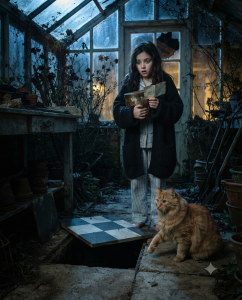
The cat kept dropping dead flowers on the little girl’s pillow.
That was how it started—quietly, strangely, the sort of thing an adult might dismiss with a sigh and a muttered complaint. But to Sophie, who had learned very quickly that grief changed the shape of a house, it felt like the beginning of something important.
Every morning, she woke to find another rose beside her face.
The first one was dry and brittle, its petals the color of old paper, its stem thorny and stiff. It lay on her pillow so carefully placed that for a few groggy seconds she wondered if she had dreamed it. Then she saw Whiskers at the foot of the bed, sitting upright, eyes fixed on her with such unusual stillness that she forgot to breathe.
Whiskers had never been a graceful cat. He was orange, long-haired, and usually looked mildly annoyed by the existence of furniture. He knocked cups off tables, clawed curtains, and meowed at closed doors with theatrical outrage. But now he sat in perfect silence, as if waiting for her to understand something.
Sophie picked up the rose. It crackled in her fingers.
“Did you bring this?”
Whiskers blinked once.
When she carried the flower downstairs, Aunt Linda wrinkled her nose. “That animal is dragging rubbish into your room now,” she said, not even turning around from the sink. “Honestly, Martin, I can’t live like this forever.”
Uncle Martin lowered his newspaper just enough to glance at the rose. A shadow crossed his face. “He’s been odd since your grandmother died,” he said. “Animals get strange.”
Sophie looked from one of them to the other. “It’s from the greenhouse.”
Both adults went still.
Only for a moment. Just a flicker. But Sophie noticed.
Aunt Linda recovered first. “No, it isn’t.”
“It looks like Grandma’s roses.”
“That greenhouse is shut,” her aunt snapped. “And it’s staying shut. It’s full of mold, dead plants, and enough dust to make you sick.”
Uncle Martin folded the paper too carefully. “The key’s lost, Sophie.”
That became the answer every time she asked after that.
The key’s lost.
The greenhouse is unsafe.
Some things are better left alone.
Sophie stopped asking out loud, but she didn’t stop thinking about it. Before Grandma Evelyn died, the greenhouse had been the warmest place on the property, even in winter. The glass panes always fogged from the inside, and the air smelled of damp earth, fertilizer, and roses in every stage of bloom. Her grandmother used to tie back her silver hair with a scarf and hum old songs while pruning stems. She knew the names of flowers the way other people knew neighbors.
She would let Sophie sit on an overturned pot and hand her seed packets like tiny treasures.
“This one needs patience,” Grandma would say, pressing a packet into her hand. “This one likes sun but not too much. And this one will surprise you if you think it’s dead.”
Sophie loved those afternoons. The warmth. The bees tapping softly against the glass. The sense that the greenhouse belonged to a world with slower rules.
Then Grandma Evelyn got sick, and everything changed too fast.
After the funeral, Aunt Linda and Uncle Martin moved into the master bedroom upstairs. They said it was easier that way, that they needed to manage the house, the bills, the arrangements. They spoke in efficient voices, as if grief were simply a pile of paperwork to get through. The greenhouse was locked. The curtains in Grandma’s room were changed. Some of her clothes disappeared. And everyone started acting as though the back garden no longer existed.
Only Whiskers refused to move on.
The second rose appeared the next morning. Then a third. Then a fourth.
Always dead. Always from the greenhouse. Always placed with eerie care beside Sophie’s sleeping face.
By the fifth morning, she had stopped showing them to the adults. Aunt Linda only got angrier. Uncle Martin only got quieter.
Instead, Sophie began watching Whiskers.
He was restless at night. She heard him padding through the hall long after the house had gone still. Some evenings he sat at the back door staring into the darkness, his tail twitching. Once Sophie found a fleck of potting soil on the hallway rug and knelt to touch it. Another time she noticed a torn rose petal caught in the fur near Whiskers’s ear.
He was going to the greenhouse.
Not only that—he wanted her to know he was going.
The idea grew in her mind until it stopped feeling like imagination and started feeling like certainty. Whiskers wasn’t being strange. He was trying to tell her something.
One rainy afternoon, Sophie stood at the kitchen window and looked out at the greenhouse through a blur of drizzle. Its old frame leaned slightly to one side. Ivy crept up the glass. The door was still chained. To anyone else it might have looked abandoned.
But she knew better.
Something waited in there.
That night, she pretended to go to sleep as usual. Aunt Linda came to her room, checked that the lamp was off, and pulled the door mostly closed. Sophie lay still until the sounds of the house settled into their usual nighttime rhythm: the low hum of the refrigerator downstairs, the ticking of the hall clock, the muted murmur of her aunt and uncle speaking in their room.
Then silence.
A scratch touched her door.
Sophie sat up instantly.
Whiskers slipped inside when she opened it and turned around at once, pausing only long enough to make sure she was following. He moved with purpose, not like a cat wandering at whim. Sophie pulled on her cardigan and crept behind him.
Down the stairs.
Across the dark kitchen.
To the back door, which was closed but not latched all the way.
The moonlit garden beyond looked silver and unreal. Grass bent under a faint breeze. The old swing by the apple tree creaked once, softly, though no one was on it. Sophie hesitated on the threshold, suddenly aware of how alone she was.
Whiskers glanced back, then slipped into the garden.
She followed.
The greenhouse loomed at the far end of the path, its clouded panes reflecting moonlight in dull, fractured shapes. Sophie expected the cat to stop at the chained door. Instead, he veered to one side and disappeared low along the wall.
When she reached him, she saw the damage: one lower glass panel had been cracked, probably for years, and the wooden frame around it had warped enough to leave a gap at the bottom.
Big enough for a cat.
Barely big enough for a child.
Whiskers wriggled through. Sophie knelt, brushed dirt from the hem of her pajama trousers, and squeezed in after him.
The greenhouse air was stale but not ruined. It held old warmth trapped in wood and soil, even in the cool night. Broken trays lay stacked in corners. Empty pots lined the shelves. Long-neglected vines had tangled around hooks overhead. Yet under all that abandonment, the room still felt inhabited by memory. A glove hung from a nail. A watering can stood near the bench. A faded apron was folded over a chair exactly where Grandma might have left it.
Sophie swallowed hard.
On the far side of the room, the rosebushes waited in shadow. Most of the blooms had dried on the stem, petals curling inward, colors drained to rust and brown. They looked like time itself had settled over them.
Whiskers didn’t stop there.
He trotted to the old potting table in the back corner, leaped lightly onto it, and immediately began scratching at the floor beneath.
“Whiskers?”
He scratched harder.
Sophie knelt and shoved aside a stack of shallow trays. Beneath the table was a tiled section of floor. One tile, black-and-white and cracked across one corner, sat slightly uneven from the rest. She wouldn’t have noticed if the cat hadn’t shown her exactly where to look.
Her pulse kicked higher.
She pressed her fingertips into the crack and pulled.
At first nothing happened. Then the tile lifted with a dry scrape, releasing a faint smell of dust and damp. Beneath it was a shallow cavity carved into the concrete.
Inside sat a biscuit tin wrapped in cloudy plastic.
Sophie stared at it, suddenly afraid to touch it.
Then Whiskers gave a single impatient meow.
She lifted it out.
The plastic crinkled under her fingers. The tin itself was old, decorated with blue flowers rubbed pale by time. When she pried the lid loose, it stuck for a moment before giving way.
Inside were three things: a neat bundle of seed packets tied with faded ribbon, a small gold locket, and a folded letter.
The moment Sophie saw the handwriting on the envelope, the world seemed to narrow to a point.
For Sophie, when it’s time.
Grandma Evelyn’s handwriting was impossible to mistake. Sophie had seen it on birthday cards, seed labels, recipes, and little notes tucked into lunch bags. Soft loops. Firm slant. Elegant even in haste.
Her hands shook as she unfolded the letter.
The first line made her eyes burn.
If you are reading this, my clever girl, then Whiskers remembered.
A laugh almost escaped her, half sob, half disbelief. Of course Grandma would trust the cat with a secret. She’d always said Whiskers had more sense than most people.
Sophie kept reading.
The letter was longer than she expected, and every line made the greenhouse feel colder. Grandma wrote plainly, as if she had prepared these words carefully and knew time might run out before she could say them another way.
She wrote that the house had been left to Sophie.
Not in some distant someday after everyone else had taken what they wanted. Not informally. Not as a wish.
Legally. Entirely.
The house, the greenhouse, the garden, and the land belonged to Sophie.
A second copy of the will and related papers had been placed with Mr. Harrow, the solicitor in town, to be released if the originals were ever “misplaced,” challenged, or ignored. Grandma Evelyn wrote that she feared greed more than grief and had learned not to confuse the two.
Sophie had to stop and read that sentence twice.
Greed more than grief.
Her throat went tight.
The next paragraph explained the locket. Inside it, Grandma wrote, was a tiny key for the locked drawer in her writing desk. In that drawer were names, account details, and one more note Sophie was only to read once she was somewhere safe.
Somewhere safe.
The phrase made the hairs rise on Sophie’s arms.
Then she read the part about Aunt Linda and Uncle Martin.
Grandma never directly accused them of anything terrible. That almost made it worse. She wrote only that some people become very helpful when they suspect a house may soon need new occupants. She wrote that promises made beside a sickbed were not always promises meant to be kept. She wrote that if Sophie was ever told the greenhouse key was lost, she should understand that this was a lie.
Sophie stared at those words until they blurred.
A lie.
So the greenhouse had not been sealed because of mold. Or sadness. Or even because no one could bear to go inside.
It had been sealed because someone didn’t want what was hidden there to be found.
Near the end of the letter, Grandma’s tone changed. It became more urgent.
Do not confront anyone until you know where you can go. Do not let them see this letter. Trust the cat. Trust what you remember. And if they suddenly become kind, ask yourself why they waited until now.
Sophie lowered the paper and listened.
The greenhouse was silent except for the faint rustle of leaves against glass.
Then a floorboard creaked.
She spun so fast that the paper slipped in her hand.
Nothing moved in the shadows. No one stood by the door. But the stillness had changed. It no longer felt empty. It felt as if the room had inhaled and was holding its breath.
Whiskers arched his back and gave a low, warning sound she had never heard from him before.
Sophie stuffed the letter, the locket, and the seed packets back into the tin. Her fingers fumbled with the plastic. She finally shoved everything under her cardigan, climbed awkwardly toward the broken panel, and wriggled through so fast she scraped her elbow.
She didn’t stop until she reached her bedroom.
There, shaking under the blankets, she opened the locket.
Inside was a tiny brass key, tucked behind a photograph so small she nearly missed it. It showed Grandma Evelyn sitting in the greenhouse years younger, smiling into the camera, one hand resting on a little girl’s shoulder.
Sophie touched the picture and began to cry for the first time since the funeral.
Not loud crying. Not dramatic. Just the silent kind that left her chest sore and her pillow damp. Because buried under the fear was something else now: proof that Grandma had been thinking of her, protecting her, planning for her even when everyone else had spoken over her as if she were too small to understand anything important.
She must have drifted into a shallow, uneasy sleep near dawn.
When she woke, gray light filled the room.
Whiskers sat by the door.
And at his paws lay one more rose.
Only this one wasn’t dead.
It was fresh. Deep red. Alive enough that a drop of dew still clung to the outer petal.
Sophie stared at it, then at the cat.
“What does this mean?”
He turned his head toward the hallway.
Downstairs, she heard the back door open.
Then her uncle’s voice, sharp with alarm: “Linda!”
Aunt Linda answered from the kitchen. “What is it?”
“The greenhouse.”
The word cracked through the house like something breaking.
Sophie snatched up the tin from where she had hidden it under the bed. Her fingers closed around the fresh rose without thinking. In the hallway, Whiskers’s tail puffed up.
Then came the next words, lower and far worse.
“Someone’s been in there.”
Aunt Linda’s footsteps rushed across the kitchen floor. There was a pause. Sophie imagined them seeing the shifted trays, the cracked tile out of place, the hollow beneath the floor now empty.
When Aunt Linda spoke again, her voice shook with anger. “Check her room.”
Sophie’s entire body went cold.
Whiskers pressed against her ankle, staring at the door. He wasn’t hiding. He looked almost defiant.
The stairs began to creak under hurried feet.
Sophie glanced at her bedroom window. Too high to jump. She looked at the wardrobe. Too obvious. Under the bed? Useless.
Then she remembered the locket key.
Grandma’s writing desk.
If the desk still held the drawer Grandma mentioned, it might hold the rest of the truth. Maybe enough to prove everything. Maybe enough to protect her before Aunt Linda and Uncle Martin could take the tin away.
The doorknob trembled.
Once.
Twice.
Then Uncle Martin’s voice came through the wood, disturbingly calm. “Sophie, open the door.”
She backed away, clutching the tin harder.
“We just need to talk.”
His gentleness sounded rehearsed. Sophie had never noticed that before. Adults could make their voices soft for all sorts of reasons.
“Sophie,” Aunt Linda said, sweetness forced so thin it almost snapped, “if you found something in the greenhouse, you may have misunderstood it.”
Misunderstood.
Sophie looked down at the letter visible where the tin lid hadn’t closed all the way. Her grandmother’s handwriting stared back at her like a hand reaching across time.
On the other side of the door, Uncle Martin lowered his voice even more.
“Your grandmother didn’t tell you the whole story,” he said. “There are things about that house you don’t know.”
Sophie froze.
For one terrible second, doubt flickered through her. What if there was more? What if Grandma had hidden only part of it? What if she ran to the desk and found nothing that could help her?
Then Whiskers sprang suddenly from the floor onto the dresser, then onto the windowsill, then down again, racing to the hallway side wall and pawing frantically at the narrow door hidden beside her room.
The linen cupboard.
Sophie blinked.
No—the old servants’ stair door.
It had been painted over years ago and nearly disappeared into the wall. She’d thought it was sealed shut.
Whiskers clawed at it again.
The adults outside heard him.
“What’s that?” Aunt Linda demanded.
Uncle Martin rattled the doorknob harder. “Sophie, open this door now.”
But Sophie was already moving.
She dragged the small chest away from the hidden door, found the recessed latch beneath layers of paint, and pulled. It stuck, then gave with a crack. Cold air breathed out from the darkness beyond.
A narrow staircase spiraled down between the walls.
Whiskers darted onto the steps without hesitation.
Behind her, the bedroom door shook under a hard blow.
Sophie hugged the tin to her chest, picked up the living rose from the floor where she had dropped it, and stepped into the dark passage just as wood splintered behind her.
The stairs led down not to the kitchen, but toward the older part of the house where Grandma Evelyn kept her study. Sophie descended with one hand against the wall, heart pounding so hard her vision pulsed. Dust coated the rail. Cobwebs brushed her sleeve. Above her, the crash of her door finally breaking open echoed through the hidden shaft.
“They’ve gone,” Aunt Linda shouted.
“Find her!”
Whiskers flew down the final steps and vanished through another narrow door at the bottom. Sophie pushed through after him and stumbled directly into Grandma’s study.
The room had been left mostly untouched. Heavy curtains. Bookcases. A brass lamp. The writing desk in the corner.
Whiskers was already on top of it.
Sophie lunged for the desk, nearly dropping the tin in her panic. Her fingers slipped on the little brass key before finally guiding it into a narrow hidden keyhole along the side drawer. It turned smoothly.
The drawer opened.
Inside lay a thick envelope, a leather-bound notebook, and a second letter marked: Open only if they force the matter.
Footsteps thundered overhead.
Sophie tore open the envelope first. It contained copies of property documents, signed and stamped. Her name was there. Sophie Evelyn Hart. Sole beneficiary. Trusteeship conditions until age eighteen. Temporary guardianship provisions—not Aunt Linda. Not Uncle Martin.
Aunt Linda’s voice sounded from somewhere down the hall now, far too close. “Martin, check the study!”
Sophie grabbed the notebook.
The first pages were dates, observations, money transfers. Notes about missing jewelry. Notes about Uncle Martin pressuring Grandma to “simplify future arrangements.” Notes about Aunt Linda insisting Sophie should be sent away to boarding school “for stability” after the funeral. At the back, tucked into the cover, was a business card for Mr. Harrow, the solicitor, with a handwritten line beneath:
If you are alone, go directly to Mrs. Bell at the post office. She knows to call him.
Sophie almost sobbed with relief.
There was a plan. Grandma had truly prepared for this.
The study door handle moved.
Uncle Martin’s shadow darkened the frosted glass panel.
For one suspended second, nobody moved. Sophie stood by the desk holding the proof of everything. Whiskers crouched beside her, fur bristling. In the hallway, Aunt Linda’s breathing was audible now—fast, angry, frightened.
Then Uncle Martin pushed the door open and stopped.
His eyes went first to the papers in Sophie’s hands.
All the softness drained from his face.
Aunt Linda appeared behind him and gave a tiny involuntary gasp.
The expression on both of them was not grief.
It was the look of people watching a door close on something they had already decided belonged to them.
“Sophie,” Uncle Martin said, and this time the false gentleness was gone, “give me those.”
She stepped backward. “Grandma left everything to me.”
Aunt Linda laughed once, too sharply. “You don’t even understand what you’re reading.”
“I understand enough.”
Uncle Martin took one step into the room. “Your grandmother was very ill. She changed her mind often.”
Sophie lifted the signed papers with shaking hands. “Not about this.”
For the first time, he looked uncertain.
And that uncertainty was everything.
Because it meant he knew the documents were real.
Because it meant Grandma had been right.
Because whatever story they had planned to tell, it was already collapsing.
Aunt Linda’s gaze dropped to the tin, then to the fresh rose in Sophie’s other hand. Something unreadable flickered across her face—anger, yes, but under it something almost like fear.
“Of all things,” she whispered, staring at Whiskers, “that stupid cat.”
Whiskers let out a low growl.
Sophie didn’t wait for the next move. She darted sideways through the second study door into the corridor leading to the front of the house. Uncle Martin lunged after her, but she was smaller and faster, and fear made her quicker than either of them expected. She ran barefoot through the hall, yanked the front door open, and sprinted across the lane toward the village post office two houses down.
Mrs. Bell was unlocking the side entrance when Sophie nearly collided with her.
The woman took one look at Sophie’s face, the papers, the adults charging out of the house behind her, and understood more quickly than Sophie could speak.
“Inside,” Mrs. Bell said.
She shut the door, turned the key, and reached for the phone.
What happened after that moved both slowly and all at once. Mr. Harrow arrived with a police officer. Voices rose, then sharpened. Documents were compared. Names were called. Explanations were offered and then withdrawn. Aunt Linda cried at one point. Uncle Martin tried anger, then reason, then outrage. None of it helped.
The second will was authentic. The trusteeship paperwork was real. The notes from Grandma’s desk aligned too neatly with bank records and witness statements for comfortable lies to survive.
By evening, Aunt Linda and Uncle Martin were told they would need to leave the property pending further investigation into financial irregularities and guardianship interference. No one used dramatic words in front of Sophie, but she heard enough to understand that this had gone beyond a family misunderstanding.
They had not simply hoped for the house.
They had acted as if it were already theirs.
That night Sophie did not sleep in the old bedroom upstairs. Mrs. Bell stayed with her in the guest room while arrangements were made. Whiskers slept at her feet, waking every time she moved.
The next morning, Mr. Harrow came back with official copies of everything. He explained the trusteeship in gentle terms. The house would remain legally hers. Mrs. Bell had agreed to temporary care until a longer plan could be settled, if Sophie wanted that.
Sophie listened, nodded, and signed where she was told. She felt older than she had a week earlier.
After everyone left, she walked alone to the greenhouse.
For the first time since Grandma’s funeral, the door stood open.
Dust floated in the sunlight. The rosebushes still needed tending. The shelves needed clearing. Several panes needed replacing. It was not beautiful in the easy way it used to be.
But it was hers.
Whiskers wound around her ankles and then trotted to the potting bench as if expecting her to get started. Sophie laughed through a sudden sting of tears.
She untied the faded ribbon around the seed packets and spread them across the table. Her favorites. Exactly as Grandma had promised. Poppies, foxgloves, sweet peas, evening stock.
Life waiting in paper sleeves.
Sophie touched the gold locket at her throat. She had cleaned it and put the tiny photo back inside. Through the open greenhouse door, the garden stretched bright and damp under the afternoon sun.
For the first time since the funeral, the house no longer felt like a place where things were being hidden from her.
It felt like a place where truths had survived long enough to be found.
She looked down at Whiskers. “You knew all along, didn’t you?”
He blinked with maddening dignity and leaped onto the windowsill.
Sophie smiled.
The strangest part, later, was not that a cat had led her to a hidden letter, or that her grandmother had trusted instinct more than appearances, or even that two adults had nearly taken a child’s home while pretending to protect her.
It was how close the truth had come to staying buried forever.
Just one locked door. One missing key. One child told she was too young to understand. Sometimes that was all it took.
And sometimes the only reason the truth survived was because someone—human or otherwise—refused to stop carrying it to the right doorstep.
Years later, Sophie would still wonder what the biggest warning sign had really been.
Was it the greenhouse being sealed so quickly?
The way Aunt Linda hated questions more than bad news?
The softness in Uncle Martin’s voice when he wanted control?
Or was it simpler than that—grief making room for greed, and love noticing before everyone else did?
She never decided.
But every spring after that, when the first roses opened in the greenhouse, Sophie cut one fresh bloom and set it on the windowsill for Whiskers.
A thank-you.
And a reminder that sometimes the smallest witness sees everything.
