Nora’s sons put her in a nursing home on Monday and listed her house for sale on Tuesday.
By Thursday afternoon, the whole neighborhood believed the same story: Nora was declining, she had agreed to leave the house, and her sons were doing their best to manage a painful situation with grace.
They told that version well.
They said she had become forgetful.
They said she wandered.
They said she repeated questions and signed papers she no longer understood, which was why they needed to step in. They spoke with solemn expressions and tired eyes, as if grief itself had made them noble. They thanked people for their concern. They asked for privacy. They used soft words to cover sharp actions.
Most people accepted it because that is what people do when they hear a family matter explained in the language of sacrifice. No one wants to be the person who doubts two grown sons caring for their elderly mother. No one wants to imagine greed where loyalty should be.
But there were details that did not sit right.
The move happened too quickly. The For Sale sign appeared before Nora’s favorite robe had even been taken from the hook behind her bedroom door. The realtor was seen at the house less than twenty-four hours after Nora had supposedly “settled in” at the nursing home. And while the neighbors were told Nora was too confused to be involved in any decisions, some mysterious legal authority had somehow appeared at exactly the right time, complete with her signature, giving her sons control over her home, finances, and property.
It was efficient in a way real family emergencies almost never are.
Nora knew that from Room 214.
The room was clean in the sterile way places are when no one loves them yet. Beige curtains. A framed print of a sailboat. A dresser that smelled faintly of disinfectant no matter how many times she asked them to wipe it down again. The staff was not cruel. That almost made it worse. They were cheerful, practiced, busy. They called her sweetheart. They asked whether she had finished lunch. They assumed the life she had left behind was already closed.
But Nora was not confused.
She was furious.
On her first night there, she barely slept. She lay awake under a thin blanket, replaying every conversation from the last six months. Her oldest son, Daniel, showing up more often with folders under his arm. Her younger son, Eric, asking strange questions about account numbers and “where Dad kept the originals.” Both of them suddenly eager to help after years of keeping a comfortable distance. They had arrived bearing casseroles, concern, and that sickly sweet tone people use when they are trying to walk you toward a cliff without letting you feel the edge.
“Mom, you don’t need to worry about all this anymore.”
“Mom, let us carry the burden.”
“Mom, trust us.”
Trust us.
That was the phrase Thomas had stopped trusting long before he died.
Thomas had not been an easy man, but he had been a careful one. He believed in locks, backup keys, written instructions, and the quiet protection of preparation. When his health began failing, he had insisted on meeting with their lawyer more than once. Nora had argued with him the first time.
“You’re acting like the boys are strangers,” she had said.
Thomas had looked at her for a long moment, pain and disappointment tangled together in his face.
“No,” he said. “I’m acting like they’re my sons.”
She had hated hearing that. It sounded bitter, and Thomas was not usually bitter. But he had seen things she had tried to explain away. Borrowed money that was never repaid. Half-truths told too smoothly. Sudden interest in property values. Daniel asking what would happen if one parent became “unable to manage things.” Eric joking once, not really joking, that the house would “solve a lot of problems” if they ever sold it.
Thomas had noticed every word.
One rainy October evening, long before the stroke that weakened him, he stood in the den beside the blue rocking chair and changed the code on the bedroom safe. Nora had asked why. He spun the dial, clicked it shut, and said, “Anniversary. You won’t forget that.” Then, after a silence heavy enough to matter, he added, “And there are things I don’t want found in a hurry.”
She understood later what he meant.
The chair had always been part of the family’s landscape. Painted blue before their first child was born, it sat in the den near the lamp and the side table where Thomas used to keep the newspaper folded just so. Every grandchild had been rocked there. Every bad phone call had been absorbed in its creaking rhythm. The wood had softened under years of hands and weather and stories. It looked ordinary enough that no one would imagine one leg had been hollowed and resealed from the inside years earlier.
That was Thomas’s hiding place.
Not for money. Not for jewelry. For documents.
The kind that mattered when memories were challenged and intentions were rewritten.
After Thomas’s death, Nora left everything mostly as it was. She paid the bills. Watered the plants. Made coffee in the same chipped mug every morning. She grieved quietly and functioned loudly, which is how many women of her generation survived all the things no one praised them for surviving.
Then Daniel started arriving with paperwork.
At first it was framed as organization. End-of-life planning. Medical directives. Emergency contacts. Nothing alarming by itself. But the stack kept growing, and his tone kept changing. He began flipping directly to signature lines. He began using urgency as pressure.
“Mom, this really can’t wait.”
“Mom, the bank is making this difficult.”
“Mom, you signed a version before, remember?”
That last one chilled her. Because she had not.
Nora stopped signing almost anything after that. She told him she wanted to review documents later. She asked for copies he never left. She began locking drawers. She mentioned the lawyer once, casually, and watched Daniel’s smile tighten before he recovered.
That was the day she knew Thomas had been right to prepare for more than illness.
Still, knowing someone may betray you is not the same as believing they actually will.
The real blow came the day her sons took her “for an evaluation.”
Daniel said the doctor wanted to check her medications. Eric said it would only take an hour. Nora noticed neither of them answered directly when she asked which doctor or why she had not been told beforehand. By the end of the afternoon, they were discussing care options in front of her as if she were not fully in the room. By evening, she was in a nursing home with a small suitcase, two cardigans, and the humiliating sense that events had moved too quickly to grab hold of.
On Monday she was placed in Room 214.
On Tuesday, her house was listed.
On Wednesday, they began clearing it out.
She found out because her granddaughter Leah called in secret.
Leah was twenty-two, sharp-eyed, and often dismissed by the family as emotional when what they really meant was observant. She had never liked the way Daniel talked over people. She had learned young that Eric laughed whenever he was lying. When Nora answered the phone, Leah did not waste time.
“Grandma,” she whispered, “I’m at your house.”
Nora sat up straight in bed. “Why?”
“Because Mom said something felt wrong. And because Daniel’s truck is here. And a moving van.”
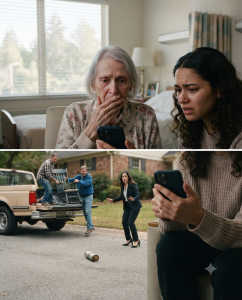
Then the camera turned, and Nora’s world began disappearing in real time.
Men in gloves wrapped dishes from her kitchen. Someone took framed photographs off the mantel and stacked them face down. A stranger carried out the cedar chest Thomas built the winter Daniel was born. Leah tried to stay hidden, filming from the side yard and then the open front window. Her breathing shook the picture.
Nora kept giving small instructions without meaning to.
“That bowl was my mother’s.”
“Don’t let them drop that box.”
“Oh God, that’s his toolbox.”
Then Leah moved closer to the den, and there it was.
The blue rocking chair.
Daniel bent to lift it, smiling as he balanced it awkwardly against his shoulder.
“She won’t remember,” he said to one of the movers.
The man chuckled.
Nora felt something inside her go very cold and very clear.
She remembered everything.
She remembered Thomas showing her, years ago, how the small cap inside the back left leg could be removed with a narrow twist and a push. She remembered the metal tube he slid inside. She remembered him saying, “If anything ever feels wrong, this is where the truth is.” She had laughed at the drama of it then. He had not laughed back.
“Leah,” she said, voice steady now. “Listen to me carefully. Do not let that chair leave.”
Leah froze. “Why?”
“It has documents in it.”
“What kind of documents?”
“The kind your uncles never wanted found.”
But by then the chair was already on the porch.
Leah hurried closer, trying not to be seen, the camera bouncing with each step. Daniel crossed the driveway toward a buyer’s truck. The realtor, a woman in a cream blazer with a clipboard tucked under one arm, stood nearby reviewing something with Eric. They all looked relaxed. Confident. Almost finished.
Daniel lifted the front of the rocker to slide it into the truck bed.
Something dropped free from the underside.
A silver metal tube, sealed at both ends, hit the driveway and rolled in a bright line of afternoon sun before striking the curb with a sharp metallic ping.
Every person there looked down.
“What is that?” the buyer asked.
Daniel moved first. Too fast.
“Nothing,” he said. “Old piece of furniture. Just junk.”
But the realtor had already crouched and picked it up. When she felt the weight of it, her expression changed immediately. That was not junk. That was hidden. Intentionally hidden.
“Give me that,” Daniel said, and all the softness left his voice.
The realtor did not hand it over.
Instead, she straightened slowly and asked, “Why was this concealed inside the furniture?”
Eric stepped forward. “Because it’s our furniture.”
Leah, trembling but suddenly brave, spoke before Nora could tell her not to.
“My grandmother said that chair wasn’t supposed to leave.”
Every head turned toward her.
Daniel’s face hardened. “Leah, put the phone down.”
She didn’t.
And because she didn’t, Nora heard everything that happened next.
The buyer backed away first, instincts kicking in faster than courtesy. He no longer looked like a man making a purchase. He looked like a man discovering he had walked into someone else’s family deception.
The realtor looked from the tube to the brothers to the open front door of the house. A good agent knows when a transaction has crossed from urgent to contaminated.
“Who exactly gave consent for this sale?” she asked.
Daniel recovered enough to answer smoothly, but not smoothly enough. “Our mother did. Through legal authority.”
“Then why,” the realtor asked, “is her granddaughter saying otherwise?”
Eric snapped, “Because she’s a child.”
Leah lifted the phone. “She’s on this call right now.”
That changed the air.
The realtor asked to speak to Nora directly. Leah put the phone close. Nora’s heart pounded, but when she spoke, her voice was firm.
“I did not consent to selling my home. I did not authorize my sons to remove my property. And if the document in that tube is what I think it is, they have no right to touch anything.”
There was a long silence.
Then the realtor said, “No one move the chair.”
Daniel took a step forward anyway. “This is a misunderstanding.”
“No,” said the realtor. “This is a legal problem.”
She unscrewed one end of the tube carefully. Inside were rolled papers, protected in plastic. She drew them out one by one.
The first was the original durable power of attorney, properly executed years earlier. It named not Daniel or Eric, but Nora’s daughter, Margaret, as primary authority if either parent became incapacitated, with specific language requiring direct confirmation from Nora whenever possible. The second document was a notarized statement from the family attorney noting concerns about attempted pressure from unnamed relatives regarding property decisions.
Then came the envelope.
Old cream paper. Thomas’s handwriting across the front.
For Nora. Open only if the house is being sold without your voice.
Daniel lost color the instant he saw it.
“Don’t open that,” he said.
The realtor looked at him as if he had confirmed her worst suspicion.
“Why not?”
No one answered.
She opened it.
Inside was a letter and supporting copies. Thomas’s letter was brief, precise, devastating. He wrote that he had reason to believe one or both sons had attempted to imitate Nora’s signature during a prior banking matter. He documented suspicious withdrawals, conversations about forcing a sale, and his decision to preserve evidence in case pressure intensified after his death. Attached were photocopies of checks, attorney notes, and a dated memo summarizing concerns after a family dispute none of the neighbors had known about.
The date at the top of the memo was three years old.
Thomas had known three years earlier that the danger was real.
Then came the detail that shattered the brothers’ united front.
The attorney memo did not describe a plan by “the sons” together. It described a private warning given after Daniel accused Eric of moving money from a joint family account. The brothers had not simply conspired. At some point, they had been suspicious of each other too.
The realtor read enough to understand the essentials. The buyer understood enough to get back in his truck. Leah understood enough to start crying.
And Nora understood enough to feel something she had not allowed herself to feel yet.
Relief.
Not because the betrayal hurt less. It hurt more now that it had shape. But because the truth had finally stepped into daylight where lies could not keep rearranging it.
The realtor canceled the listing before sunset.
She did it from the driveway while both sons argued at once, each insisting the other had handled the documents, the bank, the signatures, the contact with the attorney. Their voices rose, overlapped, cracked. The performance of united devotion vanished in minutes once accountability appeared.
By nightfall, authorities were asking questions.
Nora’s daughter, Margaret, drove straight from another county after Leah called her in tears. She arrived at the nursing home before dark and went straight to Room 214. The moment Nora saw her, both women broke in the same place they had been trying to hold together all week.
“I’m sorry,” Margaret whispered, kneeling beside the bed. “I should have been here sooner.”
Nora touched her face. “You’re here now.”
Margaret had copies made that same night. She contacted the attorney whose name appeared in Thomas’s papers. He was retired, but alive, and still had records. By the next morning, the false authority Daniel and Eric had used was already under scrutiny. Signatures were compared. Dates were checked. Timelines unraveled.
The nursing home placement itself was reviewed as well, and that was where the sons’ story began collapsing completely. They had exaggerated incidents. Omitted context. Used selective statements to create an image of cognitive decline that did not match Nora’s records. She had moments of grief, moments of forgetfulness like anyone her age, but not the sweeping incapacity they had claimed.
Once official questions replaced family assumptions, the facts became embarrassingly plain.
Nora had not been confused.
She had been isolated.
There is a difference, though people with bad intentions depend on others not noticing it.
Margaret arranged to have Nora discharged. When she brought her home two days later, the house felt bruised but still standing. Boxes were half-packed in the dining room. Cabinets hung open. The den looked wrong without the chair, which now sat where Margaret had placed it back by the lamp after retrieving it from evidence photographs and inventory checks. Nora walked into the room slowly and put one hand on the worn blue arm.
For a long time, she said nothing.
Then she sat down and let the chair move under her weight.
It creaked exactly the way it always had.
Thomas had left more than proof in that hollow leg. He had left a final act of protection. A way for Nora’s own voice to survive even when others tried to erase it. Not dramatic for the sake of drama. Practical. Specific. Loving in the flinty, guarded way Thomas had always loved.
The legal consequences for Daniel and Eric took time. These things always do. There were denials, blame, and ugly attempts to call the whole matter a misunderstanding fueled by stress. But paper trails are stubborn. Handwriting experts are unimpressed by family tears. People who act invincible in private often look very small once records are placed side by side.
The brothers stopped speaking to each other before the process was over.
In the end, what hurt Nora most was not the forged control or even the attempt to sell the house before she could fight back. It was hearing Daniel say, “She won’t remember,” with that easy little smile, as if the mother who had given him his first home had already become a shadow he could use.
That sentence stayed with her.
So did another one.
“If the house is being sold without your voice.”
Thomas had written that for her. Not just as warning, but as recognition. He knew the real danger was not money alone. It was being spoken over, categorized, managed, and disappeared while still alive enough to witness it.
Weeks later, after the noise had settled and the neighbors finally understood what had nearly happened on their street, people began treating Nora differently. With more care. More respect. A little guilt, too. Several admitted they had believed the sons at first. One woman from across the road cried on Nora’s porch and said she should have knocked sooner.
Nora did not hold onto anger toward the neighbors. Lies told with confidence are persuasive. That was the lesson. The harder one was closer to home: sometimes the people most eager to “take care of everything” are the very people you should ask the most questions.
One evening, Margaret found Nora in the den, rocking gently in the blue chair while sunlight faded across the floor.
“Are you all right?” she asked.
Nora looked at the empty doorway and thought about the family she had built, the sons she had loved, the husband who had seen trouble coming before she did, and the granddaughter whose shaking hands had helped pull the truth into the open.
“I am now,” she said.
And yet even then, the story did not settle into anything simple. Because protection can look like suspicion until it turns out to be wisdom. Because love can survive in one child and fail completely in another. Because the cruelest betrayals often arrive wearing the face of help.
Maybe the biggest red flag was not the forged paper or the rushed sale.
Maybe it was how quickly they needed everyone to believe Nora had lost her voice.
