The lunch crowd always came in waves at Alvarez’s Bistro, though nobody called it that anymore.
The old regulars still did, out of habit. They remembered when the place had belonged to Rafael Alvarez’s older brother, Mateo, who had built the restaurant from nothing but a leased corner space, a battered stove, and recipes their mother had carried north in a notebook wrapped in cloth. Back then the sign over the door had been painted by hand, the tables had never matched, and the kitchen ran on long hours, shouted Spanish, and the kind of trust that made people work harder than they had to because the place felt like theirs.
But Mateo had died eight years earlier. His son, Daniel, had inherited the business. He kept the family name on the liquor license and took it off almost everything else.
The hand-painted sign was replaced by brushed steel lettering. The old tiled floor in the entryway was covered in polished concrete. The menu got smaller, the prices got higher, and the servers were told to say “our concept” instead of “our restaurant.” By the time Daniel finished renovating, the place looked good in photos and colder in person.
Only the kitchen remained stubbornly old.
It was still cramped, still hot, still patched together by memory as much as hardware. And the person who knew that kitchen best was Mateo’s younger brother, Rafael Alvarez—Mr. Alvarez to everyone who worked there.
He had started at the restaurant before Daniel graduated high school. He washed dishes at first because that was the job nobody wanted, and then because he was too proud to ask for something easier when his body began wearing down. Forty years bent him into a quieter shape. Arthritis thickened his fingers. A slipped disc turned his posture into a permanent bow. But he stayed.
He stayed through ownership changes, equipment failures, rent scares, menu overhauls, staff turnover, and one flood that left the dining room underwater. He stayed when younger cooks used the dish pit as a place to dump their bad moods. He stayed when tips were great and when business was thin. He stayed because the restaurant was family, even after family started forgetting what that word meant.
Every morning he arrived before dawn.
The prep cook, Marisol, sometimes saw him through the frosted back door glass when she came in at five-thirty. He was always already there, apron tied, radio low, steam rising from the sinks. He laid out racks in the same order every day. He checked the sanitizer. He restocked towels. He swept under the shelves because he knew inspectors looked where managers didn’t.
He had rituals nobody noticed because he never announced them. He set aside less bruised produce for staff meal. He wrapped extra bread in paper and left it by the alley after close for the men who slept behind the laundromat. He kept a little screwdriver in his locker because the freezer handle jammed every third week and waiting for maintenance took too long. He knew how to reset the pilot on the old oven and which corner of the dry storage attracted roaches first if humidity got bad.
Daniel didn’t value that kind of knowledge because it didn’t photograph well.
What he valued was image.
He had started using phrases like “brand refresh” and “elevated experience.” He hired younger servers, replaced the old specials board with a digital screen, and once complained in a staff meeting that the open kitchen concept wasn’t working because “the back-of-house optics feel dated.” People knew what he meant. He made them know.
At first the comments about Mr. Alvarez were indirect.
“We need more pace.”
“We need sharper presentation.”
“This place can’t feel tired.”
Then they got more specific.
“Rafael, you can’t move like that during service.”
“Rafael, customers can see you from table seven.”
One night Daniel said, within earshot of two bartenders, “There’s a reason modern restaurants don’t put old men in the visual line.”
Marisol nearly quit over that. Mr. Alvarez told her not to.
“He’s stressed,” he said simply, rinsing a stack of plates under scalding water. “Owners forget themselves.”
But Daniel wasn’t forgetting himself. He was revealing himself.
The final straw, at least in his mind, came after a food blogger posted a flattering review and included one candid photo of the kitchen pass. In the background, slightly out of focus, Mr. Alvarez was visible lifting a dish rack.
Daniel called it “off-brand.”
Two days later he made his decision.
The restaurant was full when he did it, which later made it impossible to deny.
The lunch rush had just peaked. Every table in the dining room was occupied, and the front windows threw bright summer light across the polished floor. A pair of businesswomen near the entrance were splitting a salad. An older couple sat by the banquette with soup and coffee. At table twelve, a mother was cutting grilled chicken into pieces for her son.
In the kitchen, tickets were clipped in a line above the pass. The sauté cook was behind. The dishwasher racks were stacking up because one server had dropped an entire tray of side plates and Mr. Alvarez had stopped to sweep every shard twice.
Daniel came into the kitchen with irritation already arranged across his face.
“You’re backing up service,” he said.
Mr. Alvarez kept washing. “I’m almost caught up.”
“That’s the problem,” Daniel snapped. “Almost.”
People heard the tone before they heard the words. Heads turned. The hostess stiffened. A server carrying iced tea slowed to a stop.
Daniel stepped closer, lowering his voice only enough to make it cruel rather than private.
“This is exactly what I mean. You move too slow. The whole place feels old because of you.”
Mr. Alvarez set down the plate in his hands.
Daniel pulled an envelope from his jacket pocket. “You’re bad for business.”
Then he tossed the envelope to the floor.
It landed near the drain with a papery slap.
The room went silent in that strange, total way only public humiliation can create. All the background noises—the silverware, the low conversations, the clink of glasses—seemed to pull away at once.
Marisol stared at Daniel in disbelief. The youngest server looked ready to cry. At table twelve, the mother stopped cutting her son’s food and just watched.
Mr. Alvarez looked at the envelope. His face didn’t change much, but the color in it seemed to fade. Slowly, with visible pain, he bent down and picked it up.
Everyone waited for him to say something.
He tucked the envelope into his pocket.
“Thank you,” he said.
The words landed harder than shouting could have.
He removed his apron, folded it carefully, and placed it on the stainless counter. Then he walked to the back door and left.
Daniel exhaled through his nose, a man trying to appear in control of a room that had just judged him. “Back to work,” he said.
Nobody answered.
For the next ten minutes the restaurant limped forward on shock.
A server entered the wrong order. Someone over-salted a pan sauce. Daniel hovered at the pass trying to regain authority through volume, but the kitchen’s rhythm had changed. There are some absences that are immediately practical and some that become spiritual. Mr. Alvarez’s was both.
Then the oven exploded.
Later, the fire captain would say it was likely caused by a gas buildup near a compromised ignition line, worsened by deferred maintenance and poor access around emergency shutoffs. At the moment it happened, none of that mattered. What people heard was a violent crack and then a deep metallic boom that punched through the kitchen like a physical force.
The hanging pans rattled. Wine glasses trembled on tables. A wall of heat burst from the line, followed by black smoke.
One cook dropped a pan and bolted. Another grabbed the wrong extinguisher. A server screamed. Customers shoved back chairs and surged for the exits. Daniel yelled for everyone to stay calm in exactly the voice of someone no longer calm.
Then came the hiss.
Long, sharp, unmistakable.
Gas.
“Shut it off!” Daniel shouted. “Someone shut off the gas!”
But nobody knew where the emergency valve was.
The original line had been installed before most of the younger staff were born. During renovations, Daniel had insisted on adding a steel storage shelf along the wall to maximize usable space. The contractor had warned him that the old shutoff access would be partially blocked.
Daniel told him to make it work.
Now the shelf sat where it shouldn’t, loaded with stock pots, sheet trays, and boxed dry goods, hiding the valve behind metal and shadow.
Marisol stared at it through the smoke and felt her stomach drop. She knew then what Daniel had just thrown away.
Rafael knew the valve.
Of course he did. He knew everything old in that kitchen—the hidden switch, the warped floor tile, the breaker that stuck in humid weather. He had probably touched that valve more times than Daniel had looked at it.
But Rafael was gone.
The smoke thickened. The hiss went on. Heat pushed outward from the line, turning panic into terror.
Then the back door flew open.
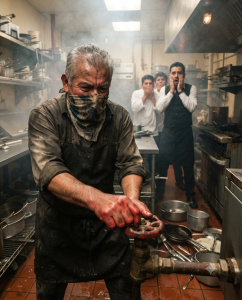
Mr. Alvarez came in with a wet towel wrapped over his mouth and nose.
For one heartbeat nobody moved. It was like seeing memory itself walk back into the room.
He didn’t waste time speaking. He went straight to the shelf, braced himself, and shoved. Metal screamed against tile. A stack of pans crashed to the floor. He coughed once, hard, and pushed again.
Marisol saw his hands shaking. She also saw that he didn’t stop.
The shelf shifted enough to expose a narrow gap.
Mr. Alvarez dropped to one knee and reached into the space behind it. His shoulders tightened. The valve was stiff. For a moment that felt endless, nothing happened.
Then his arms strained, his back bowed, and the hissing stopped.
The silence afterward felt impossible.
Not true silence—people were crying, coughing, gasping—but the sound they had all been listening to with dread was gone.
The fire crew arrived minutes later and contained what remained of the flare-up before it could spread into the walls. Outside on the sidewalk, smoke rose from the roofline while customers, staff, and neighboring shop owners gathered in a shaken crowd.
Daniel approached Rafael then, gratitude and fear fighting across his face.
“Rafael,” he began, “I—”
Rafael looked at the restaurant, at the windows where customers had watched him get fired, and said, “I was never bad for business. I was the reason it stayed open.”
No one argued.
In fact, once the shock cracked open, the truth started spilling out from all sides.
The fire captain asked who had shut off the gas. Three customers pointed to Rafael at once. A server quietly confirmed that Daniel had blocked access to the valve during renovations. Marisol, done protecting management with silence, told the captain she had heard contractors warn Daniel about safety clearance months earlier.
Daniel tried to interrupt. “That’s not what they said.”
“It is,” Marisol replied, loud enough for everyone to hear.
Then one of the customers—a lawyer, as it turned out—said she had watched the firing from ten feet away and would be happy to give a statement about that too.
Something in Daniel’s expression changed. Not remorse exactly. Calculation. He was suddenly seeing witnesses, inspections, insurance consequences, social media, legal exposure. The cost of contempt was beginning to invoice him.
A quiet young server named Elise stepped forward holding Rafael’s apron. “You forgot this,” she said.
Rafael took it politely but did not put it on.
That was when Tomas, the oldest line cook, came out carrying a binder and an envelope rescued from the office before the fire department sealed it.
“Rafael,” Tomas said, “you need to see this.”
Inside the binder were maintenance records. Or rather, what should have been maintenance records. Pages had been altered. Safety check dates were changed. Notes from contractors had been crossed out. One attached estimate mentioned “urgent replacement” for the aging oven ignition assembly and specifically warned that emergency gas access must remain unobstructed.
Daniel had postponed the repair three times.
Inside the envelope was something worse: paperwork from a temp agency and a note scheduling Rafael’s replacement to start the following Monday at lower pay and no benefits. Daniel had not fired him on impulse. He had planned it.
Tomas looked sick as Rafael turned the pages.
“He asked me to sign that the oven had already been serviced,” Tomas said. “I wouldn’t do it.”
Several staff members heard him. So did the lawyer from table six.
The next week unraveled Daniel’s ownership faster than the explosion had shaken his kitchen.
The fire report cited blocked emergency access and neglected equipment. The insurance company opened an investigation. A city inspector reviewed the renovation permits and found discrepancies. Staff who had kept their heads down for years started speaking up. Stories surfaced about unpaid overtime, ignored hazards, and Daniel’s habit of pushing image over basic operations.
Then a customer posted online about what she had witnessed that day: an elderly dishwasher publicly humiliated, thrown out, then returning through smoke to save the very restaurant that discarded him. Others added their accounts in the comments. The post spread through the neighborhood first, then farther. People remembered Rafael’s kindness. Former employees shared details. Neighbors mentioned the bread bags left in the alley. The story stopped belonging to Daniel’s restaurant and started belonging to the city.
Within a month, business collapsed.
Daniel tried apologies. He released a statement calling the firing “a regrettable misunderstanding during a stressful service incident.” Nobody accepted it. The language was too polished, too bloodless, too late. An apology that arrives only after witnesses gather rarely sounds like truth.
The landlord, already unhappy about code issues, declined to renew under Daniel’s terms. Facing investigations, legal pressure, and a reputation that no branding consultant could save, Daniel sold his stake for less than he had bragged it was worth.
The surprising part came after.
Rafael had no interest in revenge. He didn’t even seem to enjoy Daniel’s downfall. When Marisol asked him whether it felt good to watch everything catch up with Daniel, he took a long time to answer.
“It feels sad,” he said finally. “His father loved this place.”
That was how people knew Rafael was still himself. Even then, he grieved what had been damaged more than he celebrated who had caused it.
What he did want was simple: dignity, safety, and a kitchen run by people who understood that restaurants survive on labor nobody applauds.
With help from Tomas, Marisol, Elise, and a small loan arranged by two longtime regulars, Rafael made an offer on the business alongside Mateo’s widow, Teresa, who had quietly retained a legal interest Daniel had underestimated. The sale was messy, but it happened.
The sign changed again.
This time it didn’t become trendier. It became truer.
They put the family name back over the door.
The dining room kept some of the polished updates, but the coldness disappeared. The digital screen came down. The old specials board returned. Staff meals became a rule, not an afterthought. The blocked valve was uncovered, repainted red, and labeled clearly. Preventive maintenance was scheduled and posted. Bread still went into paper bags at closing.
Rafael refused the title of owner at first. He said he was too old and too tired. Teresa told him ownership was not a title but a record of who had already been carrying the place for years.
So he accepted one condition: he would oversee operations, not run the dish pit every day.
They hired two dishwashers, both younger men, and Rafael spent his mornings teaching them things nobody had ever written down. How to hear when a pipe was about to clog. Which plates chipped easiest. Why rushing made more mistakes than speed corrected. Why every dish should be washed as if someone you loved would eat from it next.
He still arrived early. Habit outlives humiliation.
Sometimes customers recognized him. A few would come by his station, awkward and sincere, to tell him they had been there the day of the fire. Some apologized for not speaking up sooner. Rafael always nodded and told them the same thing.
“You’re speaking now.”
The restaurant grew busy again, though differently this time. Not because it looked young. Because it felt solid. People trusted it. Staff stayed longer. The food improved. The story brought attention, but the work kept people coming back.
As for Daniel, his name turned into a cautionary example whispered in hospitality circles—what happens when someone mistakes invisible labor for unimportant labor. The last anyone heard, he was consulting for a corporate chain in another city, far from the kitchen that had exposed him.
One rainy evening nearly a year later, Rafael stood in the doorway after closing and watched Tomas lock the front entrance while Marisol counted the till. The new dishwasher, a kid named Luis, came out carrying two paper bags of bread for the alley. He hesitated, then asked, “You really used to do this every night?”
Rafael smiled. “Somebody should.”
Luis nodded as if he had just learned something bigger than where the bread went.
That was the real aftershock of what happened—not the investigation, not the public shame, not even the ownership change. It was the way one man’s quiet worth, dismissed for being old and slow, forced everyone around him to reconsider what actually keeps a place alive.
Was Daniel wrong because he was cruel, or because he was blind? Was Rafael extraordinary because he saved the building, or because he had been saving it in smaller ways for years without anyone noticing? And when a room full of people watches dignity get thrown on the floor, at what point does silence become part of the insult?
Those questions stayed with people long after the smoke cleared.
So did the answer Rafael gave without ever turning it into a speech: the person who looks easiest to replace is sometimes the person holding everything together.
