When Laura’s husband died, she believed the worst thing she would ever endure was already happening.
She had held his hand through the final weeks, watched his strength disappear by degrees, learned how to smile for him even when she wanted to break apart in the hallway outside his hospital room. She had slept in chairs, eaten from vending machines, memorized the sound of machines that beeped too slowly and footsteps that always meant another update. By the time the funeral was over, she was hollowed out with exhaustion. Her body moved, but her mind lagged somewhere behind, stuck in the terrible gap between before and after.
That was why, when her brother-in-law handed her a grocery bag and told her to pack only what fit inside, Laura could not immediately process the cruelty of it.
They were standing in the cabin she had shared with her husband on the lake. It wasn’t a grand place, but it had been theirs. Pine walls. Stone fireplace. A porch that looked out over the water. A kitchen table scarred with knife marks and coffee rings. It was where they had spent their evenings, their first Christmas as husband and wife, the first night they brought their baby home. It was where her husband had laughed, coughed, hoped, declined, and finally disappeared from the world.
And now his older brother stood in the hallway acting as though Laura were a temporary guest who had overstayed her welcome.
“The rest belongs to the family,” he said, holding out the bag.
Laura shifted the baby higher on her hip and stared at him. “What are you talking about?”
“The cabin. The truck. The fishing boat. Everything that came through this family stays with this family.”
His voice was flat, almost rehearsed. Not emotional. Not embarrassed. He had come prepared for this.
Laura looked past him toward the kitchen. Her mother-in-law sat at the table with both hands wrapped around a mug. She wasn’t drinking from it. She was just holding it, as if warmth from porcelain might excuse what she was allowing.
“Mom?” Laura said softly, because she still believed the older woman would stop it.
Her mother-in-law lifted her eyes for a second, then dropped them again.
That silence was the first real betrayal.
Her brother-in-law mistook Laura’s disbelief for weakness. “You were only married three years,” he said. “Don’t act like you earned a lifetime.”
The words landed harder than a shove.
Three years.
As if love had an hourly rate. As if marriage could be audited by duration. As if the nights Laura spent sleeping upright beside her husband’s bed, the prescriptions she organized, the tears she wiped away, the baby she brought into the world with him—none of it counted because the calendar had not turned enough pages to satisfy his brother’s sense of inheritance.
Laura wanted to scream. She wanted to throw the bag at him. She wanted to ask what kind of man stood in his dead brother’s house, facing a widow with an infant, and argued over furniture before the flowers from the funeral had even wilted.
But grief had drained her. The baby was restless and tired. Her head hurt. Her chest hurt. Everything hurt.
So she took the bag.
Not because she agreed. Because she needed to get through the next five minutes without collapsing.
Upstairs, in the nursery, she stood for a long time doing nothing. The room was full of the life she and her husband had planned together. Tiny clothes folded by size. Burp cloths draped over the chair. A stack of diapers near the changing table. And by the window, the crib he had built with his own hands.
He had worked on it all winter in the garage, even when he was already getting tired too easily. He had refused to let anyone else help. “I want her to sleep in something I made,” he had said with sawdust in his hair and a grin on his face. “That way she’ll always know I was here.”
Laura ran her hand along the smooth rail now and swallowed a sob.
Downstairs, his brother had already claimed even that.
Family wood, he’d said. Family labor. Family property.
She packed diapers first because the baby needed them. Then two clean onesies. Wipes. A sweater. A bottle. Each item felt like proof of how small a person’s life could be made by other people’s greed.
Then she opened the nightstand drawer and saw the little wooden music box.
Her husband had carved it during his last winter too, on evenings when treatment had left him too weak to do much else. It was slightly uneven, but beautiful in the way handmade things often are—imperfect and full of intention. It played a lullaby he used to hum while pacing the living room with their daughter against his shoulder.
Laura took that for herself.
She went downstairs. No one stopped her. No one apologized.
Outside, the sky was beginning to dim. The lake reflected bruised colors. She buckled the baby into the back seat and placed the grocery bag on the passenger side as though it were a record of the insult. Then she drove away from the cabin, crying so hard at the first stop sign that she had to pull over before she could see clearly enough to continue.
She ended up at a motel twenty miles away because it was cheap and because grief leaves people unable to care where they sleep as long as there is a door and a lock.
The room was narrow and stale. The bedspread scratched at her skin. The air conditioner rattled. She fed the baby, changed her, and sat with the music box in her hands while the motel neon blinked red and blue through the curtains.
When she wound the key, the lullaby trembled into the room.
Laura closed her eyes and saw her husband at the kitchen sink, singing under his breath while washing bottles. She saw him on the porch, holding the baby up to the sunset. She saw him in the garage, carving this very box while telling her not to peek because it was a surprise.
The grief that came then was so fierce it bent her over.
She was still wiping her face when the baby rolled unexpectedly and swatted the music box from the bed. It hit the floor with a hard crack.
“No,” Laura whispered, dropping to her knees.
She picked it up carefully, afraid the mechanism was ruined. But the damage was stranger than a simple break. The bottom panel had split, and inside the hollow base she saw something tucked away.
For a moment she forgot how to breathe.
She pried the opening wider and tipped the contents gently into her lap: a folded note, a flash drive, and a tiny brass key.
Her husband had hidden them there.
Not lost them. Not forgotten them. Hidden them.
Laura stared at his handwriting on the note so long that the edges of the paper blurred. Then she unfolded it.
Laura, my brother has always wanted the lake property. If he comes for it, open the box under the dock.
The room seemed to tilt.
She kept reading, and with every line her husband became vividly present again—clear-minded, careful, anticipating exactly what might happen after his death. He wrote that he had seen the tension building for years. His brother believed the cabin and the surrounding lake property should pass to him because he had “always been around” and because Laura was “still new.” But Laura’s husband had known what mattered. He had known who stayed through sickness, who built a family with him, who understood the life he actually wanted.
In the letter, he explained that the property was not as simple as his brother assumed. There were deeds, trust documents, a legal transfer he had set up quietly after the diagnosis worsened. He had feared confrontation while he was alive. He had hoped his family would do the decent thing after he was gone. But if they did not, he had prepared proof.
The flash drive, he wrote, contained digital copies of every relevant document and one recorded statement made when he was still strong enough to speak clearly.
The brass key opened a metal box hidden under the dock.
By the time Laura reached the last line, her tears had dried.
I’m sorry if you’re reading this because it means I was right. But if my brother comes after our home, do not let him take it from you. I left the truth where only you would find it.
She sat in the motel room until dawn, reading the letter again and again, each time with a little more steadiness.
Then she got to work.
Among the estate papers she had hauled away in a folder weeks earlier was a business card for an attorney her husband had consulted after his diagnosis. Laura called the number the moment the office opened. The lawyer, a calm middle-aged woman named Denise Harper, listened without interrupting while Laura explained what had happened, then told her to bring everything immediately.
At the office, Denise reviewed the letter, examined the flash drive, and watched the video file stored on it. In the recording, Laura’s husband sat upright in a chair, thinner than he once had been but composed. He explained, in clear language, that the lake cabin and adjacent property had been legally transferred into a trust for Laura and their child. He described his brother’s longstanding attempts to pressure him otherwise. He named the location of supporting originals hidden in the dock box. And he stated plainly that any attempt to remove Laura from the property against his wishes was just that—against his wishes.
Denise’s expression sharpened as she watched. “This is very strong,” she said.
She made copies, printed documents, and called the sheriff’s office, explaining that a property dispute with possible unlawful eviction was unfolding and that original legal materials were secured on-site. A deputy agreed to meet them there to prevent escalation.
Laura had slept perhaps ninety minutes total, but by then she felt more awake than she had in weeks. Grief had not vanished. It was still there, deep and raw. But now something stronger ran beside it: purpose.
She put her daughter in a fresh onesie, smoothed her tiny hair with trembling fingers, and drove back to the lake.
The cabin looked almost peaceful in the morning light. Mist hovered over the water. Birds moved in the reeds. Anyone passing by might have thought this was a family home beginning another ordinary day.
Then Laura saw her brother-in-law on the porch.
He had one hand braced against a post and a coffee mug in the other. When he recognized her car, his face hardened. When he saw the second vehicle behind hers, then the marked sheriff’s SUV, his confidence faltered for the first time.
Laura stepped out with the baby on her hip. Denise emerged carrying a briefcase. The deputy shut his door and adjusted his hat.
“What is this?” her brother-in-law demanded.
Denise answered before Laura could. “A review of rightful ownership.”
He gave a short, disbelieving laugh. “There’s nothing to review. She left.”
“She was forced out,” Laura said quietly.
He looked at her then the way people look at someone they thought would stay broken. “Don’t start making scenes.”
The deputy’s voice was even. “Sir, we’re here to keep this civil.”
From the kitchen window, Laura caught sight of her mother-in-law standing behind the curtain. Watching.
Her brother-in-law kept talking as they moved toward the dock. He called it harassment. He said Laura was confused. He suggested grief had made her unstable. Each accusation grew more desperate, less convincing. Denise ignored him. The deputy took note of every word.
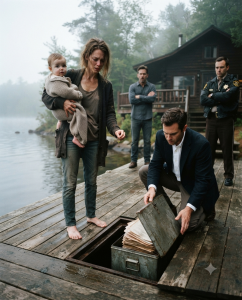
At the far side of the dock, Laura found the spot described in the letter. A small metal hatch was concealed beneath weathered boards, nearly invisible unless you knew where to look. Her hands shook as she crouched. The brass key felt warm from being clenched in her fist all morning.
She inserted it into the lock.
Behind her, everything went quiet.
The key turned with a metallic click.
Laura pulled up the hatch and reached into the compartment below. Her fingers found a weatherproof box, heavier than expected. She lifted it out and set it on the dock while Denise knelt beside her.
Inside were thick stacks of papers sealed in plastic, a second envelope addressed to Laura, and one smaller packet marked with her mother-in-law’s name.
Her brother-in-law swore under his breath.
Denise opened the document packet first. She scanned the pages quickly, then again more slowly, and finally stood up with the kind of measured satisfaction professionals reserve for moments when truth becomes undeniable.
“These are original trust documents,” she said. “Filed and notarized. The lake property, the cabin, the boat, and the truck were transferred months ago to the Harper Family Trust, with Laura as trustee and sole adult beneficiary during the child’s minority.”
Her brother-in-law’s face drained of color. “That’s impossible.”
“It is not impossible,” Denise said. “It is legally binding.”
He took a step forward. The deputy moved between them.
“There’s more,” Denise added, lifting another page. “This also includes a signed statement noting prior attempts by you to pressure your brother regarding inheritance and property transfer.”
“That means nothing,” he snapped, but now his voice had lost its force.
Denise looked at him over the page. “It means your brother anticipated this exact situation.”
Laura opened the second envelope with unsteady fingers. Inside was a letter written in the same careful hand as the one from the music box.
If you’re reading this at the dock, he wrote, then I’m gone and he did exactly what I feared. I know this is a cruel thing to ask of you, but I need you to be strong one more time. This home is yours because you made it a home. Not by blood, but by love. Not by history, but by loyalty. If they try to shame you for not belonging, remember this: I chose you. That was the whole point of marriage. I chose you, and I put it in writing so no one could undo it after I was gone.
Laura had to stop for a moment because she could no longer see through her tears.
The deputy, perhaps out of kindness, looked toward the water.
Then Denise opened the smaller packet addressed to the mother-in-law. She skimmed it, hesitated, and handed it silently to the older woman, who had finally come down from the house and approached with one hand pressed to her throat.
Laura’s mother-in-law unfolded the paper. As she read, her shoulders caved inward.
Later Laura would learn what it said: that her son loved her, but he could not trust her silence. That if she stood by while Laura was mistreated, she would lose more than property. She would lose any right to call herself part of the family he had built.
The older woman lowered the letter with shaking hands and looked at Laura for the first time since the confrontation began.
“I didn’t think he’d do this,” she whispered, glancing at her remaining son. “I thought he was just angry.”
Laura said nothing. There was too much to say.
Her brother-in-law, cornered now, tried a new tactic. He said he had been protecting family assets. He said he assumed there was no paperwork. He said Laura must have misunderstood his tone. He even muttered something about stress making people harsh.
The deputy was unmoved.
Denise was less so. “You told a widow with an infant to leave her legal residence with whatever fit in a grocery bag. There are witnesses. There is documentation. And there is a recorded statement from your brother.”
At the mention of the recording, his head jerked up. “He made a recording?”
“Yes,” Denise said. “A very clear one.”
That was the moment he understood it was over.
The bluff was gone. The performance collapsed. He looked not grieving, not righteous, but small.
The deputy informed him that because Laura was the lawful trustee and occupant, he needed to remove his belongings immediately and leave the premises. Any further interference could result in trespass charges. If items had been removed from the property in the last twenty-four hours, they were to be returned.
His mouth opened, then closed.
The same porch where he had stood in certainty yesterday now became the place where he was told to pack.
Laura watched him walk back toward the house in a stunned, uneven stride. She felt no triumph at first. Only a kind of distant amazement. As though she were watching justice happen to someone else in some other story.
But when he reappeared carrying a duffel bag and a plastic crate, when she saw his jaw set with helpless humiliation, something inside her finally steadied.
The scales had not magically balanced. Her husband was still gone. Nothing would change that. No paper, no apology, no legal victory could touch that wound.
Still, this mattered.
It mattered that the home he meant for her could not be stolen by cruelty. It mattered that his voice had reached across death and answered the insult she had been too shocked to answer herself. It mattered that his brother, who had counted on grief making her powerless, was wrong.
Before leaving, her brother-in-law stopped beside the truck. “He turned you against us,” he muttered.
Laura looked at him evenly. “No. He protected me from you.”
He flinched as if slapped.
Her mother-in-law began to cry then—real, ugly tears that seemed to come from a place of belated understanding. She tried to speak, but Laura was not ready to hear whatever version of regret she might offer. Silence had already spoken for her when it mattered most.
The deputy stayed until the brother’s vehicle disappeared down the road. Denise remained long enough to help Laura make an inventory of the property and discuss next legal steps. There would be paperwork, locks to change, accounts to secure. But the central fight was done.
When the house finally quieted, Laura carried her daughter inside.
The cabin smelled the same as it had before pine, coffee, lake water, old wood. Sunlight stretched across the floorboards. On the wall by the fireplace hung a photograph of her husband holding the baby on the porch, both of them squinting into the light.
Laura stood there for a long time.
Then she went upstairs to the nursery.
The crib was still by the window.
She ran her hand along the rail and thought about all the things that can be built by hand—cribs, cabins, music boxes, legal protections, final acts of love. Her husband had known he might not be there to defend her. So he had defended her in advance. Quietly. Carefully. Completely.
That night, back in her own bed, with her daughter asleep in the next room and the music box repaired as best she could on the nightstand, Laura read his dock letter one more time.
I chose you.
Those three words settled into the emptiness like warmth.
In the weeks that followed, people in town took sides the way they always do. Some said the brother had acted out of grief. Some said Laura was lucky her husband had been so thorough. Some wondered why the mother had stayed silent. Some insisted blood should matter more. Others said blood had been the problem all along.
Laura never bothered answering all of them.
She only knew what was true.
A man saw the ugliness that might rise after his death and left behind not just proof, but protection. A woman who had been treated like a placeholder discovered she had never been temporary at all. And a family that tried to measure belonging by blood learned too late that love, when chosen fully and put in writing, can outlast greed.
The cabin stayed with Laura and her daughter.
The brother lost everything he reached for.
And the mother was left with the hardest thing of all: living with the moment she had said nothing when saying one word might have changed who she became.
Maybe that was the sharpest part of the whole story.
Not that greed showed its face after death.
But that the only person who truly planned for love to survive was the one everyone thought was leaving the world with empty hands.
