By the time people in Briar Hollow decided what they thought of Mabel Hart, none of them had asked her for her version.
That was the way small towns worked when grief met gossip. A story started in one doorway, crossed the road by noon, and by supper it had become a fact no one could remember inventing. Mabel heard all of it without trying. She heard it at the feed store while weighing cracked corn. She heard it outside church from women who lowered their voices too late. She heard it from men who acted as if pity was kindness.
Poor girl.
Her father left her in a mess.
That farm is finished.
She should sell before she loses the lot.
And always, tucked into the talk like a familiar joke, there was Jasper.
That old donkey’s worthless.
Stubborn beast.
More trouble than he’s worth.
Jasper belonged to the farm as surely as the creek and the wind-bent poplars did. He was gray and rough-coated, with a back slightly dipped by age, one torn ear, and eyes so pale some people assumed he could barely see. He moved slowly when he pleased and not at all when he didn’t. Children laughed at him. Men waved him off like a broken tool. But Mabel’s father had loved that animal with the calm certainty he usually reserved for weather signs and soil.
“He notices what people miss,” he used to say.
As a child, Mabel thought that was just one of her father’s country sayings, the kind adults repeated because they liked the sound of them. Years later, standing alone on a struggling farm after his death, she would realize he had meant every word.
Her father, Elias Hart, had not been a wealthy man. Nobody in Briar Hollow expected he would be. But he had been careful, practical, and proud in the quiet way that didn’t need witnesses. He knew how to repair a wagon wheel with scrap wood, how to stretch a bag of feed through two extra weeks, how to read a banker’s smile the way other men read storm clouds. He and Mabel had managed the little farm together for years.
Then he died in the middle of planting season.
It happened so fast that half the house still looked like he had only stepped outside. His coat remained on the peg near the back door. His work gloves sat on the table. A hammer and a pouch of nails were left beside the porch where he had meant to fix a loose board. In the first weeks after the funeral, Mabel moved through those rooms like a guest in a museum of unfinished intentions.
That was when her uncle Vernon began appearing more often.
Vernon was her father’s younger brother, though the word brother always seemed too generous for the thin respect between them. He dressed a little better than the farmers in town, talked louder than he needed to, and had perfected the art of sounding helpful while making someone feel small. Before Elias died, Vernon rarely visited the farm unless he wanted something. Afterward, he came constantly.
He arrived with paperwork.
At first Mabel thought it was genuine concern. Vernon spoke of the bank, of outstanding balances, of obligations she didn’t fully understand. He spread documents across her kitchen table and tapped the numbers with one blunt finger.
“Your father borrowed against the property,” he said. “More than once, from what I can tell.”
Mabel stared at the pages. “He never said—”
“Because he didn’t want to worry you.”
He said it with such confidence that her uncertainty became his evidence. Each visit followed the same pattern. Vernon would bring new papers, new deadlines, new warnings. He talked about foreclosure, liens, penalties, forced sale. The language was thick and official, designed to make resistance feel childish.
“You need to think sensibly,” he said. “Sell while there’s still something left to sell.”
Mabel tried calling the bank once, but Vernon somehow heard of it before she got clear answers. He showed up that evening already irritated.
“You’ll only make things worse fumbling through this yourself,” he snapped. “That manager barely knew your father’s file. Let me handle it.”
In grief, authority can look like rescue. Mabel hated that she knew so little. Her father had always managed the finances. She knew crops, feed schedules, weather patterns, repairs. But paper power belonged to another world, and Vernon moved through it like someone who knew all the doors.
So the weeks passed.
The debt hung over her like weather that refused to break. She sold what she could without damaging the farm’s future. She mended fences instead of replacing them. She skipped meals sometimes and told herself she wasn’t hungry. Through all of it, Jasper remained exactly what he had always been: present.
Every morning he waited for her.
He hauled kindling from the tree line. He stood patient while she loaded feed sacks across his back. When she worked in the far field, he lingered near the fence, swishing flies with his tail, watching. There was something grounding about him. He did not care about bank letters or whispered opinions. He cared about routine, apples, dry bedding, and whether Mabel remembered to scratch the place just beneath his jaw.
Still, even she had to admit one thing about Jasper: he hated the old bridge.
The bridge crossed the creek at the narrowest safe point, connecting the main yard to the far pasture. It was sturdy enough overall, though age had roughened it. Elias always inspected it after winter thaw. Since his death, Mabel had used it on foot many times, but Jasper had grown increasingly resistant. He would approach, stop, pin his ears, and refuse to take another step. She assumed it was age, maybe poor footing or nerves.
Vernon turned it into another insult.
“That donkey has more sense than you,” he said one evening. “At least he knows that side of the property isn’t worth dragging yourself toward.”
It was such an oddly phrased remark that Mabel remembered it later.
The breaking point came on a cold bright morning when the frost still clung to shaded grass. Mabel had just finished cleaning the stall when she heard wagon wheels on the lane. She stepped outside to find Vernon climbing down with a stranger.
The man was broad-shouldered, clean-shaven, and dressed in a dark city coat that looked expensive enough to resent mud. He introduced himself as Walter Talbot with the careful politeness of someone who expected to be welcomed wherever he went.
“Mr. Talbot is interested in the far pasture,” Vernon announced.
Mabel frowned. “Interested?”
“In buying,” Vernon said, already irritated by her tone. “Assuming he likes what he sees.”
“I never agreed to sell.”
Vernon smiled the way people do when they are trying not to show their teeth. “No one said anything is final. But we should be practical.”
Talbot glanced between them, clearly sensing strain but not yet understanding its shape. “I’m only here to take a look.”
Vernon gestured toward the creek. “Lead the donkey across. Let’s show him the pasture.”
It was an absurd request. Jasper was no show horse, and the far pasture could be viewed from several spots without dragging him anywhere. But Vernon insisted, and Talbot seemed amused enough to treat the whole thing as entertainment.
Mabel took Jasper’s rope and walked toward the bridge.
The air smelled of damp boards and cold water. Sunlight struck the creek in broken flashes. Jasper followed until they reached the first plank. Then he stopped.
Not slowed. Stopped.
Mabel tugged gently. “Come on.”
He braced all four hooves and refused.
Vernon barked from behind, “Pull harder.”
She did. Jasper threw up his head and released a bray so harsh and desperate it made the hair rise on her arms. This was not ordinary stubbornness. His body trembled. His breathing turned sharp. His cloudy eyes fixed not on the opposite bank, but at the center of the bridge.
Talbot laughed once. “What in heaven’s name is wrong with him?”
“He’s old,” Vernon said. “And useless.”
“Don’t call him that,” Mabel said, more sharply than she intended.
Vernon stepped nearer. “Move him.”
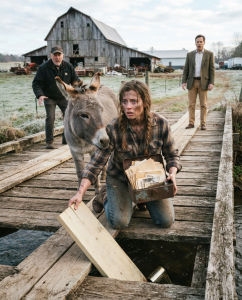
Jasper brayed again, louder. It echoed off the water and sent birds bursting from the reeds. Mabel looked where he was looking.
At first she saw nothing except old wood and shadow. Then the sun shifted. One board near the middle flashed slightly at the edge, as if something metallic sat beneath it. Mabel narrowed her eyes. That plank was lighter than the others. Newer. Cleaner. Installed crooked.
Her stomach turned.
She had crossed this bridge dozens of times on foot and never noticed. But now that she saw it, she couldn’t unsee it. Even the nail heads were wrong.
Vernon saw her staring.
For one instant — brief, naked, unmistakable — fear crossed his face.
Mabel dropped Jasper’s rope.
“What is it?” Talbot asked.
She didn’t answer. She walked onto the bridge and knelt by the pale board. It shifted under the pressure of her hand. Not secured properly. Not repaired. Hidden.
“Mabel,” Vernon said. “Stand up.”
She wedged her fingers under the edge and pulled. The plank came free with a dry creak and a burst of stale dust. Beneath it, fitted into the frame and wrapped in oilcloth, was a small metal lockbox.
Talbot stopped smiling.
“That doesn’t belong to you,” Vernon said too quickly.
Mabel looked up. “Then how do you know what belongs under my bridge?”
The question landed hard enough that even Talbot went still.
Mabel lifted the box. It was heavier than it looked. Rust had eaten lightly at the latch, but when she forced it open, the contents were dry and intact. The first paper she unfolded held her father’s unmistakable handwriting across the top of a bank receipt.
Paid in full.
She stared. Opened another. Paid in full again. Another. The dates went back nearly two years, each stamped and signed. Beneath them was an official bank letter confirming that the farm loan had been settled completely. No outstanding balance. No delinquency. No pending claim against the property.
The world narrowed around the page.
Every warning Vernon had given her. Every deadline. Every panic-soaked conversation. Gone in one breath.
Then she found the forged documents.
Her name appeared at the bottom of papers she had never seen before — transfer authorizations, refinancing requests, consent forms. The signature looked enough like hers to fool a stranger, but not her. The loops were too stiff. The slant was wrong. Someone had practiced.
At the bottom of the box lay three photographs.
In the first, Vernon stood at a county office desk. In the second, he leaned over a form, pen in hand, writing with that familiar hunched concentration. In the third, he slid papers back toward a filing tray while the clerk’s back was turned.
The images were grainy but clear enough.
Talbot stepped closer. “Let me see those.”
Mabel handed him one without taking her eyes off Vernon.
Color had drained from her uncle’s face. “This isn’t what it looks like.”
“It looks exactly like forgery,” Talbot said.
Vernon tried a different tone at once, as if calm authority might still save him. “You don’t understand the family situation.”
“No,” Talbot said, “but I understand fraud.”
Jasper came forward, his muzzle pressing firmly against Mabel’s shoulder. The trembling was gone. He was steady now, almost solemn. It hit her then with a force so strange it felt like memory catching up to the present: Jasper had not feared the bridge. He had guarded it.
He had been stopping at the exact place where the truth was hidden.
Mabel reached back into the box and found one final folded page. It was a letter from her father, dated six weeks before his death. His handwriting wavered in places, but each word was sharp.
If anything happens to me, do not trust Vernon with the land, the bank, or the papers. He has already tried once to force my hand. I hid the receipts where only a patient soul would stop long enough to find them. Jasper knows this bridge better than any man alive. If he refuses it, pay attention.
Mabel read the line twice, then lowered the page slowly.
The morning seemed to hold its breath.
“You knew,” she said to Vernon.
He swallowed. “Your father was confused near the end.”
Mabel’s grief hardened into something cleaner than rage. “Was he confused when he paid off the loan?”
Vernon said nothing.
“Was he confused when you signed my name?”
“He was going to waste the property,” Vernon burst out. “That land should’ve been in more capable hands.”
“Yours?”
He didn’t answer that either, which was answer enough.
Talbot released a long breath. “You told me she was desperate,” he said to Vernon. “You told me this sale was practically done.”
Vernon turned toward him, desperate now. “I can explain.”
“No,” Talbot said. “I think explaining is the one thing you should stop doing.”
The matter might have ended there if Mabel hadn’t noticed one more item at the bottom of the lockbox: a brass key wrapped in cloth with a small tag tied around it. On the tag, in Elias Hart’s handwriting, were four words.
For the barn floor hatch.
Mabel looked toward the leaning barn.
Memories shifted in her mind — nights when her father had stayed there later than usual, the sound of boards moving, his strange habit of checking the latch even when nothing valuable seemed stored inside. She had assumed it was old-man caution. Now it felt like a second warning.
Without waiting for permission from anyone, she closed the lockbox and walked toward the barn. Jasper followed at once. Talbot, after the briefest hesitation, marched behind her while keeping Vernon close enough to prevent him from slipping away.
The barn smelled of hay dust, old leather, and weathered wood. Light came through the slats in thin gold shafts. Mabel crossed to the back corner where feed barrels used to stand. Beneath a layer of straw was a square seam she had never noticed clearly before — a hatch fitted flush with the floorboards.
Her hands shook as she inserted the brass key.
The lock turned.
She lifted the hatch to reveal a shallow storage pit lined with tin. Inside were two wrapped bundles, a ledger book, and a smaller pouch of coins and folded notes. The first bundle contained cash, more than Mabel had seen in one place in years. The second held copies of deeds, tax records, and a written statement signed by two witnesses from a neighboring county. The ledger documented every payment Elias had made, every conversation with the bank, and every attempt Vernon had made to pressure him into signing control of the land over “for management purposes.”
At the back lay one final note.
Mabel unfolded it while Talbot and Vernon watched.
Mabel, if you’re reading this, then Jasper did his job and you trusted him before you trusted loud men with papers. I knew Vernon would wait for me to be gone. I didn’t know if I’d have time to fight him in court, so I prepared the truth instead. The money here is yours. Use it to keep the farm or leave it, but let it be your choice. Never his.
For a moment Mabel could not see.
All the months of fear, all the humiliation, all the nights spent imagining the bank taking the place while the town shook their heads and said what a shame — all of it had been built around a lie Vernon thought she would be too overwhelmed to challenge.
She lowered the note and finally looked at him the way she should have long ago: not as family, not as authority, not as a rescuer, but as a man caught.
Vernon tried one last time. “I was trying to protect what your father built.”
“By stealing it?”
He opened his mouth, closed it, and looked away.
Talbot took off his hat and ran a hand through his hair. “I’ll be giving a statement,” he said. “And I imagine the clerk in county office will have a few things to say too.”
Vernon muttered something about misunderstandings, but even he no longer sounded convinced.
By afternoon, the sheriff had come.
By evening, half the town knew there had been shouting at the Hart farm, a buyer turned witness, forged signatures, and a lockbox under the bridge. By the next morning, the version people repeated sounded very different from the one Mabel had been forced to live under for months.
Funny thing about gossip: it can turn around as fast as a weather vane when shame changes direction.
Some people came by awkwardly to offer apologies disguised as errands. Others avoided the farm entirely. A few claimed they had always suspected Vernon was slippery. Mabel let them talk. She had learned what their certainty was worth.
What mattered was simpler.
The land was hers. Legally, clearly, fully hers.
The debt was gone because it had been gone all along.
The money in the barn was enough to make repairs, settle taxes, and buy herself time to choose a future that was truly a choice.
A week later, Mabel stood in the yard with fresh lumber stacked beside the porch. The barn still leaned, but now it leaned on a property no one could trick out from under her. Jasper grazed nearby, peaceful as ever, occasionally lifting his head to watch her.
She walked to him with an apple in hand.
“You knew,” she murmured, rubbing the rough spot beneath his jaw.
He accepted the apple with slow dignity.
She laughed then, the sound surprising her with how natural it felt. “All right. Maybe Papa was right about you.”
Jasper flicked an ear as if that was obvious.
In the months that followed, Mabel repaired what needed repairing. She hired help where she had once felt ashamed to spend. She met directly with the bank manager and kept copies of every paper in her own locked drawer. She learned which neighbors were dependable and which were only loud. Talbot, to his credit, testified cleanly and without trying to purchase anything else from her. The case against Vernon moved forward in its own grinding official way.
People still talked, of course. They always would.
But now, when children passed the Hart place and pointed at Jasper, their parents corrected them.
“That donkey saved the farm,” someone said one day at the feed store.
Mabel, standing within earshot, almost smiled.
Saved the farm was not exactly right. Her father had saved it with foresight. The documents had saved it with proof. The law would help save it with consequence. But Jasper had done something no paper could do. He had stopped her. He had refused to let her walk across danger disguised as ordinary wood.
He had insisted, in the only language he had, that something was wrong.
And the strangest part was not that a donkey had guarded the truth.
The strangest part was how close Mabel had come to believing the louder voice instead.
Years later, she would still remember that morning on the bridge — the cold air, the creek beneath the boards, Vernon’s face when she noticed the loose plank, Jasper’s body trembling with urgency. She would remember the moment grief gave way to clarity. The moment she understood that being called foolish often just meant refusing to surrender before the facts were in.
Sometimes the people who mock your loyalty are counting on it.
Sometimes the person urging you to hurry is afraid of what happens if you stop and look closely.
And sometimes the creature everyone calls useless is the only one standing between you and the lie meant to bury you.
Whether Vernon deserved forgiveness became one of those questions Briar Hollow liked to debate in lowered voices. Some said blood was blood. Others said betrayal from family cut too deep to mend. Mabel never answered them directly. She just kept working her land, kept her papers in order, and trusted her own judgment a little more than she had before.
As for Jasper, he still refused that bridge for a long time.
Mabel never forced him again.
