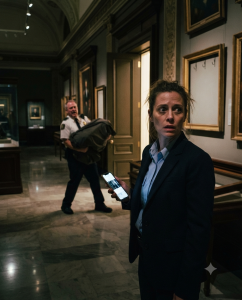
They laughed when the single mother applied for the security job at the museum.
It wasn’t loud, not the kind of laughter that makes everyone turn and stare. It was quieter than that. Sharper. The kind meant to slip under your skin while still giving the people who said it room to pretend they meant no harm.
Tanya heard it the second she stepped into the security office for her interview.
The museum lobby behind her was all marble floors, polished brass, and tall glass that made the winter light look expensive. Everything inside seemed designed to remind visitors that they were entering a place where priceless things were protected, studied, admired, and handled only by people with the right education, the right pedigree, the right confidence.
Tanya had none of those.
She wore a navy blazer borrowed from her neighbor, sleeves slightly too short, shoulders slightly too broad. She had pressed it herself the night before over a towel on the kitchen table because her iron had stopped working months ago. Her shoes were clean but old. Her résumé had been folded into her purse and unfolded again so many times it had become soft at the creases.
She knew exactly how she looked.
A woman trying hard.
A woman one emergency away from falling apart.
A woman people thought they could measure in a single glance.
The head of museum security sat at the far end of the office with a coffee cup in one hand and an expression that made it clear he had already made up his mind. He was broad-shouldered, silver at the temples, the kind of man who leaned back when he spoke as if every room already belonged to him.
He looked her up and down, then at the line on her application that listed her availability.
“Night shifts only?” he asked.
“Yes,” Tanya said. “I have childcare during the evening and overnight.”
He let out a short laugh and glanced at the two guards near the lockers.
“This is a night security position,” he said. “Not a daycare.”
One of the guards snorted. The other looked away, trying not to smile.
For a moment, Tanya imagined what it would feel like to stand up, gather her résumé, and leave before any of them got another chance to humiliate her. She imagined the bus ride home, the silence in her apartment, the unopened pharmacy message on her phone reminding her that her daughter’s prescription was ready for pickup but not yet paid for.
That fantasy lasted less than a second.
She swallowed the sting in her throat.
“I understand the job,” she said evenly. “And I can do it.”
The head guard studied her, maybe waiting for attitude, maybe hoping for it. But Tanya had spent too many years learning how to keep her face still in front of people who wanted to see it crack.
He shrugged.
“Report Monday. Midnight.”
That was how she got the job.
Not because they believed in her. Not because they respected her. But because the schedule was hard to fill and she was willing to take what no one else wanted.
The first night, Tanya showed up fifteen minutes early.
The museum after midnight didn’t feel like the museum she had visited once as a teenager on a school trip. Back then, it had felt grand and hushed and full of stories. At night, it felt watchful. The marble floors reflected strips of low security lighting. Statues turned into silhouettes at the edge of vision. Portraits seemed to follow movement from gilded frames. Every footstep echoed just enough to make the building feel larger than it was.
The head guard, whose name was Roland Mercer, walked her through the basic procedures in the bored tone of a man repeating rules he didn’t expect her to remember.
Check side entrances every hour.
Verify motion sensors on three designated wings.
Log rounds in the digital system.
Report anything unusual immediately.
“Try not to spook yourself,” he added with a smirk. “This place makes newbies jumpy.”
Tanya nodded.
What he didn’t tell her, she learned within three shifts.
The digital log system froze constantly. Sometimes it failed to save entries at all. Camera feeds in two corridors flickered black for several seconds at random intervals. One of the emergency exits in the east wing needed to be pulled hard before it would latch. Half the guards were careless, and the other half were lazy.
One guard named Mick disappeared for smoke breaks that lasted thirty minutes. Another, DeShawn, liked to put his feet up in the control room and stream baseball highlights with the volume low. A younger guard named Luis actually tried to do the job properly, but even he spoke about the museum with the weary resignation of someone who had learned that pointing out problems only earned him more work.
Tanya didn’t complain.
She watched.
She listened.
She learned the route of the cleaning crew, the timing of the climate-control cycle, the way a certain case in the antiquities room rattled lightly whenever the air system kicked on. She learned which curator worked late and which one never did. She learned that Roland kept a separate ring of keys from the official issue set and grew strangely curt whenever anyone asked why. She learned that the private restoration room in the rear wing was supposed to require dual authorization, but somehow Roland always entered it alone.
More than anything, she learned that this museum ran on appearances.
If the polished surfaces looked right, management assumed everything underneath was fine.
That bothered her.
So on the fourth night, after the logging system erased one of her completed rounds, Tanya started doing something extra.
At the end of each checkpoint, she took a photo on her phone.
Nothing dramatic. Just quick, clear, timestamped shots: a locked service door, a dark hallway, a motion panel glowing green, the entrance to a gallery, a staircase landing. She kept the camera angle consistent and the sequence neat. She told no one.
She didn’t trust the system.
And deep down, she wasn’t sure she trusted the people running it either.
At home during the day, she slept in fragments. Her daughter, Lila, was seven and recovering from a respiratory infection that clung longer than the doctor liked. The medication helped, but it was expensive, and every pharmacy pickup felt like a small negotiation with disaster.
Tanya got Lila to school when she could, leaned on her neighbor Mrs. Alvarez when she couldn’t, and stretched every dollar until it felt thin enough to tear.
Still, she showed up to every shift on time.
Around the end of her second week, the museum changed.
A donor breakfast was scheduled for Friday morning. Important names. Board members. A private collector with money tied to half the new renovation plans. The staff buzzed with anxious energy for days. Curators fussed over placements. The director walked the galleries with his hands clasped behind his back and his jaw set tight. Even Roland became more alert, though not in a way Tanya found reassuring.
The centerpiece of the event was a seventeenth-century painting newly on loan from a private collection. A dark, luminous portrait in a carved frame, insured for an amount so high that when Tanya overheard it, she first assumed she had misunderstood the number.
The painting had been installed in the European gallery under brighter lights and tighter access.
Everyone talked about it.
The curator called it irreplaceable.
The director called it a privilege.
Roland stood in the security office the night before the event, sipping coffee and looking at the feed from the gallery monitor.
“That one,” he said, pointing lazily at the screen, “is the only piece in this whole place worth stealing.”
A few guards chuckled.
Tanya didn’t.
There was something in the way he said it. Too casual. Too familiar.
At 12:14 a.m., she passed the north archway and took her routine photo. The painting hung in place beneath its spotlight.
At 12:41 a.m., she came back through the same corridor. Still there.
At 12:56 a.m., she photographed the east hallway she was assigned to monitor. Clear.
At 1:03 a.m., she noticed Mick missing from his station again. At 1:07, the side exit near the loading area was closed and secure. At 1:11, the service stairwell was empty.
At 1:16, she reached the corridor outside the private restoration room.
The lights there were dimmer than usual, one overhead bulb flickering weakly before settling. Tanya paused, lifted her phone, and took the photo.
She barely looked at it before slipping the phone back into her pocket and continuing her round.
Nothing in the hallway registered at the time.
That was the part she would replay later, wondering if some part of her had sensed something before her mind caught up.
At 1:22 a.m., she turned into the European gallery and stopped so suddenly her shoes squeaked against the floor.
The painting was gone.
The wall behind it seemed unnaturally bare, the empty mounting brackets exposed under the bright spotlight like bones.
For a second, the scene made no sense. There was no broken glass, no alarm, no sign of forced entry. Just absence.
Then her radio exploded with voices.
“Central gallery—”
“Who’s on that wing?”
“Get Roland now.”
Footsteps echoed from the corridor. Luis arrived first, breathless and confused. A moment later Roland Mercer strode in, and Tanya saw something in his face that made her blood run cold.
He did not look surprised.
He looked ready.
He took in the empty wall, then looked straight at her.
“She found it missing?” he asked.
Luis nodded.
Roland exhaled slowly, as if disappointed but not shocked. “Of course she did.”
Tanya stared at him. “What is that supposed to mean?”
His voice sharpened, loud enough to carry. “It means we have a missing painting and a brand-new guard standing right here with a known financial situation.”
Luis frowned. “What financial situation?”
Roland didn’t answer him. He kept his eyes on Tanya.
“Single mother,” he said. “Asked about payroll timing on her first day. Said she needed extra shifts.”
Heat flooded her face.
“I asked when the first paycheck cleared,” Tanya snapped. “That’s not a crime.”
“No,” Roland said. “But desperation makes people inventive.”
By the time the police arrived, the accusation had already settled over the room like dust.
The responding detective introduced herself as Detective Mara Ellis, a woman with tired eyes and a calm voice that didn’t rise no matter what anyone else did. She listened while Roland laid out a story that sounded smooth because he had likely been building it in his head for days.
Tanya was new. Tanya had money problems. Tanya had access. Tanya happened to be closest when the theft was discovered.
Then Roland made his mistake.
“She’s desperate,” he said with a thin smile. “People like her always are.”
The detective turned to Tanya.
“Would you like to tell me your side?”
Tanya felt panic crash through her chest so hard it almost made her dizzy. She thought of Lila asleep under a cartoon blanket, of the medicine bottle on the kitchen counter, of rent due in four days. She thought of being blamed because she was easier to sacrifice than a man who had worked there fifteen years.
Then she remembered her phone.
“Yes,” she said.
She took it out, unlocked it, and held it toward Detective Ellis.
“I started documenting every round because the digital log keeps failing,” she said. “Timestamped photos. Every night.”
Roland’s expression didn’t change at first. If anything, he looked entertained.
The detective began scrolling.
12:14 a.m. The painting visible in the European gallery.
12:41 a.m. The painting still in place.
12:56 a.m. Tanya’s assigned east corridor, clear.
1:07 a.m. Side exit by the loading dock, closed.
1:11 a.m. Service stairwell, empty.
Then the detective stopped.
“Go back,” she said.
She enlarged the 1:16 a.m. photo from the restoration corridor.
In the dim light, half-shadowed but unmistakable, was Roland Mercer.
He was holding a large rectangular object wrapped in dark protective cloth as he moved through the restoration room door.
No one breathed.
The detective swiped to the next image.
1:18 a.m. Same corridor. Roland again. The wrapped object was gone from his arms. A transport cart stood beside the wall.
Another swipe.
1:20 a.m. Private loading exit at the rear service lane. The door stood cracked open, and Roland was visible in profile, shoulders bent as if maneuvering something bulky through the gap.
Not through Tanya’s hallway.
Not through any public gallery.
Through a restricted route few guards were even authorized to use.
Roland’s face changed so fast it was almost frightening. The smugness dropped away and left something meaner underneath.
“That could be anything,” he said.
Detective Ellis didn’t look at him. “We’ll verify the metadata.”
“You can fake timestamps.”
“We’ll verify the metadata,” she repeated.
An officer stepped closer to Roland. Another asked for his access badge.
The room shifted around Tanya in a way she could almost feel physically, as though the floor beneath everyone had tilted and all the assumptions were sliding in a new direction.
Luis stepped back from Roland.
Mick stared at the floor.
The director, called in from home, arrived pale and half-dressed, his tie hanging loose as he demanded to know what was happening. Detective Ellis showed him the photos without expression. Whatever he had expected to see, it wasn’t that.
Within the hour, police recovered the painting from a rented storage unit less than ten miles away. Roland had arranged transport, but the sale had not yet been completed. He was arrested before sunrise.
The museum opened late that morning under a cloud of whispers.
Tanya stood in the lobby with a paper cup of burnt coffee and watched pink light spill across the marble floor through the east windows. It should have felt triumphant. Instead, it felt strange. Too quiet. Too fragile.
The guards who had laughed at her avoided her eyes. A few muttered apologies they clearly wished they didn’t have to make. One manager thanked her three times in two minutes. None of it erased what had happened.
Then the museum director asked to see her privately.
His office overlooked the sculpture courtyard. Everything in it was expensive and restrained: dark wood desk, leather chairs, framed awards, a painting far less famous than the one nearly stolen but probably worth more than Tanya’s entire apartment building.
He gestured for her to sit.
“We owe you an apology,” he said.
Tanya remained standing.
“No,” she said. “You owe me the truth.”
That caught him off guard.
He blinked. “About what?”
“About how long Roland had access to that restoration room without oversight,” she said. “And who knew the cameras in that wing were failing.”
The director’s face tightened.
Not enough for most people to notice.
Enough for Tanya.
She felt a slow chill move through her.
Because men like Roland didn’t walk priceless paintings through private exits unless they believed the system around them would protect them. Maybe not actively. Maybe not with direct orders. But with loopholes. With indifference. With the confidence that no one checked too closely when the right person said everything was under control.
Before the director could answer, there was a knock on the office door. Detective Ellis stepped inside.
“We confirmed the photos,” she said. “Metadata matches. No edits.”
The director exhaled.
But the detective didn’t leave.
“There’s more,” she added.
She opened a slim folder and placed it on the desk. “We pulled Roland’s access history. He made three unlogged visits to the restoration room over the last month. All on nights tied to donor events or private collection transfers.”
The room went still.
Tanya looked from the detective to the director.
“So this wasn’t the first time.”
Ellis held her gaze. “That’s what I’m starting to think.”
The director sank slowly into his chair.
For a long moment, he said nothing. Then he rubbed one hand over his face and stared at the folder as though it contained a problem too large to keep pretending away.
“We’ve had discrepancies before,” he admitted at last. “Minor inventory issues. Paperwork delays. Framing errors blamed on shipping. I was told they were administrative.”
“By Roland?” Ellis asked.
The director hesitated.
“By Roland,” he said.
Tanya thought about every broken system, every flickering camera, every shrugging explanation. About how institutions decide which flaws are inconvenient and which are dangerous. About how easily a woman with unpaid bills had almost become the official answer to a crime she didn’t commit simply because she fit the story people were comfortable telling.
“What happens now?” she asked.
Detective Ellis closed the folder.
“Now,” she said, “we find out whether Roland was stealing alone.”
The investigation stretched over the next two weeks.
It turned out he had been skimming more than security hours. He had manipulated records, falsified maintenance requests, and exploited blind spots in the restoration wing to substitute originals with expertly aged copies during private transfers. Not often. Not enough to trigger panic. Just enough to build a quiet criminal side business under the cover of prestige and routine.
One outside appraiser was implicated. So was a shipping contractor. Two museum employees were cleared after a miserable week of suspicion. The director spent his days in meetings with insurers, board members, and police. Reporters called constantly.
And Tanya?
Tanya kept working.
Only now, people listened when she spoke.
When she said the east exit latch needed replacing, maintenance fixed it that afternoon.
When she recommended redundant manual logs, the museum implemented them.
When the board asked for a review of security procedures, the director put Tanya in the room.
That felt almost absurd at first. She still took the bus. She still clipped coupons. She still counted pharmacy costs before grocery costs. Her life outside the museum remained as hard and ordinary as ever.
But inside those walls, the story about her had changed.
One evening, as the museum prepared to close early for a private event, the director stopped her in the lobby.
He looked tired in a way that seemed deeper now, stripped of polish.
“I was wrong about you,” he said.
Tanya adjusted the strap on her bag. “No,” she replied. “You didn’t think about me enough to be wrong. You just trusted the wrong person.”
The honesty of it landed hard.
He nodded once.
“I’m changing that.”
Maybe he meant the museum. Maybe he meant himself. Maybe both.
A week later, Tanya was offered a permanent full-time role with a raise and benefits. Real benefits. The kind that meant she didn’t have to choose between medication and rent the next month. She read the offer letter twice before signing it because part of her still expected someone to take it back.
That night, she brought home takeout for Lila and let her pick dessert from the corner store freezer.
“Did you get promoted?” Lila asked, mouth already ringed with chocolate.
Tanya smiled for the first time all day. “Something like that.”
Lila grinned. “I knew you would.”
Children say things adults spend years trying not to believe.
Later, after Lila had gone to sleep, Tanya stood by the kitchen window with the city lights blinking faintly beyond the glass and thought about everything that had happened.
Roland had called her desperate like it was an insult. Like desperation made a person small. Reckless. Dishonest.
But he had gotten that part wrong.
Desperation had made Tanya observant.
It had made her careful.
It had made her impossible to fool.
Comfort had been the thing that made other people lazy. Comfort had told them their systems were good enough, their assumptions were reasonable, their instincts were sound. Comfort had allowed a thief to wear authority like a uniform and point suspicion at the person least likely to be defended.
In the end, it wasn’t rank, wealth, or reputation that protected the museum’s most valuable painting.
It was a woman everyone had underestimated because they mistook struggle for weakness.
The museum recovered. The headlines faded. Roland took a plea deal. The board approved a complete overhaul of security operations. Somewhere along the way, Tanya’s photo ended up in an internal newsletter beside a bland headline about diligence and professionalism. She laughed when she saw it. Not because it was funny, but because the truth was far messier than institutions ever like to print.
Months later, people still asked her how she knew to take those photos.
She never gave them a dramatic answer.
“I noticed the system wasn’t reliable,” she would say.
That was true.
But it wasn’t the whole truth.
The whole truth was that when life has taught you how quickly blame looks for the easiest target, you learn to protect yourself before anyone else thinks to.
And that was the part that lingered longest.
Not the theft. Not the arrest. Not even the apology.
It was the realization that the biggest red flag had never been the missing painting.
It had been how ready everyone was to believe the wrong person.
