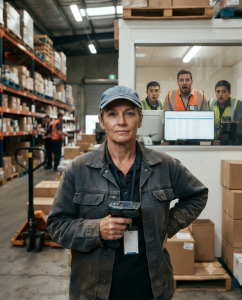
They called the new warehouse picker “dead weight” because she walked with a limp and kept one hand pressed against her lower back.
That was the first thing people noticed about April. Not her eyes, which missed nothing. Not the way she learned the layout of the building faster than workers who had been there for months. Not how carefully she handled every order, every label, every scan. Just the limp, the guarded posture, the quiet way she moved as if every step cost something.
In a place like that, quiet made people cruel.
The warehouse sat on the edge of an industrial strip where the mornings smelled like wet concrete, diesel, and hot metal. Before sunrise, the building glowed under floodlights, all loading docks and steel doors and forklifts whining awake in the dark. Inside, the pace could turn brutal in minutes. Orders stacked up. Radios crackled. Supervisors barked numbers. Everyone complained about time, volume, labor, pressure.
It was exactly the kind of place where people decided who mattered in the first ten seconds.
April failed that judgment the moment she walked in.
On her first morning, she parked under a broken lot lamp, sat in her car for an extra few seconds, and pressed her palm against her lower back before getting out. She wore plain work boots, old jeans, a long-sleeve shirt despite the heat, and a faded cap she pulled low over her hair. In the locker area, two younger women glanced at her limp and then at each other.
“That’s new hire?” one asked.
The other snorted. “For picking? No chance.”
April heard them. She gave no sign.
She clipped on her badge, picked up her scanner, and went to orientation with the same unreadable expression she would wear for most of the next few weeks.
The warehouse floor manager, Darnell, led the morning huddle. He was one of those men who confused intimidation with authority. He talked louder than necessary, stood too close when he criticized people, and loved humiliating workers in front of the group because he thought public fear improved performance.
When he saw April shift her weight during the huddle, his eyes dropped to her stance.
“You have a problem keeping up?” he asked.
The room quieted immediately.
April met his gaze. “No.”
“You sure?” he said. “Because this isn’t a charity position.”
A couple people laughed.
April only said, “I understand.”
That answer should have ended it. Instead, Darnell smiled in the way people do when they think they’ve found a safe victim.
By the end of the second day, the jokes had spread.
Dead weight.
Grandma.
Broken picker.
Workers said them under their breath or just loud enough to be overheard. Some of them were careless and mean. Some were simply joining the mood because cruelty is easier when it’s already in the air. April never challenged any of them. She worked her route, asked precise questions, made no small talk, and stayed out of the breakroom as much as possible.
That silence made everyone assume they understood her.
They thought she was desperate.
They thought she was weak.
They thought she stayed quiet because she had no choice.
What none of them knew was that April had spent years in inventory control before taking that warehouse job. She had worked distribution, compliance, shipping reconciliation. She understood scanner logs, label chains, override permissions, batch reporting. Life had knocked her sideways in ways no one there could see, and the limp was only the most visible reminder of that. Pain had taught her patience. It had also taught her to watch before speaking.
So she watched.
She watched people skip procedures when the line got busy. She watched order counts get rushed through without verification. She watched Darnell drift between stations, alternately threatening and joking, changing tone depending on who was listening. She watched which workers he favored and which ones he seemed to test.
Most importantly, she watched the numbers.
That was where the first wrong note appeared.
On her third Thursday, April was reconciling a high-value outbound batch near the loading side when she noticed a discrepancy between what she had scanned and what the system later showed as completed. It was small enough that most people would have shrugged and assumed they had remembered wrong. But April trusted process more than memory. She knew exactly what had crossed her scanner. She knew what lot codes she had touched. The final posted batch was different.
At first she considered a harmless explanation. Maybe another worker had corrected a pallet after she moved on. Maybe receiving had swapped damaged units. Maybe she had been assigned an outdated route sheet.
Then she checked the time stamp.
The adjustment happened after the floor had thinned out, after normal outbound close, after the payroll processing window.
Manager-level override.
She remembered glancing toward Door 7 that same night and seeing the camera light off.
The next morning, she asked casually whether Door 7 had been down long.
A loader shrugged. “It’s always acting up on Thursdays.”
“Only Thursdays?” April asked.
He looked at her strangely, then laughed. “Guess so.”
She said nothing more.
A week later it happened again.
Another high-value batch. Another Thursday night. Another discrepancy that only appeared after the official scans should have been locked. Again Door 7’s camera glitched. Again Darnell stayed late. Again he left the office with that smug, impatient look of a man who thought everyone around him was too slow to notice what mattered.
That was when April stopped assuming.
She started preserving.
The handheld scanners the warehouse used were old but not stupid. Most workers treated them like glorified barcode readers. April knew better. Temporary files could be copied before full sync. Deleted entries left behind metadata. Relabeled pallets still carried hidden sequence histories. If you knew where to look and how quickly to save them, the machine could remember what a person hoped to erase.
So April began making careful copies of her completed scan trails before docking the device.
She never took anything off-site. She never tampered. She simply kept evidence of what she herself had processed, along with time stamps, aisle positions, and load sequences. On nights when the pattern repeated, she documented more. Badge IDs. Door assignments. The minutes when camera outages began. Which workers remained after others were sent home.
The deeper she looked, the uglier it became.
The theft was not random. It was structured.
A high-value shipment would be correctly scanned during active operations. Later, a manager-level override would delete or reroute the final scan chain. Replacement labels tied the shipment to lower-value inventory or phantom adjustments. On paper, the load remained clean enough to avoid immediate alarms. In reality, expensive product exited under altered identification. Small enough portions vanished each week that the company chalked them up to normal inventory loss.
It was careful work.
But careful work becomes sloppy when it succeeds too long.
The same people were always nearby. The same loading lane. The same Thursday pattern.
One night, while pretending to reorganize a mixed pallet, April saw Darnell speaking in low tones to two men near Door 7. One was a loader named Bryce, a broad-shouldered favorite who laughed at every one of Darnell’s jokes. The other was Vic from receiving, who never looked anyone in the eye. Darnell handed Bryce a paper manifest, then glanced toward the dark camera housing overhead before stepping back inside.
April lowered her eyes before anyone noticed her watching.
She felt the now-familiar ache in her lower back but ignored it.
The next morning, she compared outbound seals. One truck number was missing from the formal record yet present in a partial handheld scan. That meant the truck had been there. The system just no longer admitted it.
April saved that too.
She might have gone to HR then if the culture had been different. But she had already seen how people survived in that building. They protected whoever held the schedule and the write-up authority. Darnell controlled shifts, overtime, disciplinary notes, productivity reports. Workers laughed at his jokes because they feared becoming the target of his temper.
And April already was the target.
By the time the fourth Thursday came around, she knew enough to understand two things with complete certainty.
First, Darnell was stealing from the company.
Second, he was confident he could pin the loss on someone else if he needed to.
She suspected that someone would be her.
That suspicion hardened into fact the following Tuesday, when she entered the office to drop off signed count sheets and heard Darnell on the phone behind the half-closed door.
“No, I’ve got a fallback,” he said. “New girl. Slow, quiet, nobody likes her. Easy.”
April froze just long enough to know she had heard correctly, then walked away without making a sound.
After that, she prepared.
She organized her saved files by date. She checked them twice. She copied the visible proof into a sequence even an outsider could follow. She added a note to each discrepancy so the chain would make sense to someone who didn’t live inside warehouse software every day. She did it all quietly, between tasks, while the people around her kept mocking the way she walked.
Then the surprise audit came.
The client was the company’s largest account, the kind that could damage an entire regional operation if trust broke. Nobody expected them that morning. There was no warning email, no polished tour, no chance to clean up reports or quietly patch missing stock. Two representatives arrived with corporate compliance, badges visible, expressions serious.
The lead auditor was a woman in a navy blazer named Elena Torres. She had the kind of calm that instantly unsettled liars. She didn’t waste time on introductions or niceties. She asked for outbound histories, exception reports, and high-value load confirmations for the previous month.
Darnell turned charming so fast it was almost funny.
“Absolutely,” he said. “We’ve had some staffing transitions, but everything’s under control.”
Elena barely looked at him. “Let’s verify that.”
The first few checks were routine. Then she selected three shipments tied to the client’s most expensive product line and asked to physically match them against the recorded load sequence.
The numbers didn’t work.
One pallet was logged as shipped but appeared nowhere in the dock history. Another showed a completion time when the associated bay camera had gone offline. A third was assigned to a truck seal not recognized by the client’s transportation ledger.
Elena looked up from her tablet. “These do not reconcile.”
The air on the warehouse floor seemed to collapse inward.
Darnell felt it too. And instead of slowing down, he lunged for the easiest sacrifice.
“She’s new,” he said, pointing straight at April. “She’s been handling relabeling in that zone. She must have mislabeled the pallets.”
April stood beside an order cart holding her scanner.
Around her, workers went still. Some looked shocked. Some looked relieved. A few avoided her eyes because in that moment they understood exactly what was happening and still said nothing.
Elena turned to April. “Is that true?”
April looked at Darnell for a long second, then at the workers around him. She saw Bryce near the back trying not to look alarmed. She saw Vic suddenly fascinated by the floor. She saw people who had laughed at her for weeks now waiting to see whether she would sink quietly.
She lifted her scanner slightly.
“I didn’t mislabel anything,” she said. “I saved every scan he deleted.”
No one moved.
Darnell blinked. “What?”
April repeated herself. “I saved every scan you deleted.”
The silence that followed was so complete the idling forklift two aisles over sounded deafening.
Elena stepped forward. “Show me.”
Darnell snapped instantly. “That device isn’t authorized to—”
“Elena cut him off. “Now.”
April walked to the office with that same uneven step, feeling every eye on her. She connected the scanner to the main system and opened the stored sequence she had built over weeks of watching, documenting, and waiting.
The first file appeared.
Then the next.
Original scan chains. Overridden entries. Time stamps that showed valid outbound confirmation followed by deletion. Relabeled pallet IDs. Access logs tied to Darnell’s credentials. Notes marking repeated Thursday anomalies. Door 7 camera outages aligned almost perfectly with each missing shipment.
Elena leaned in closer with every click.
A regional compliance officer standing behind her muttered, “Jesus.”
Darnell began talking over the screen. “Anyone could have used my login. This proves nothing. She could have altered local data.”
April clicked open another record. This one showed a handheld seal scan from a truck never formally recorded. Then another file with side-by-side label history proving the same pallet had carried two identities within twenty minutes. Then another where a deleted chain had been preserved before sync, making it impossible to claim the shipment never existed.
One by one, the missing shipments appeared on the screen.
Each one ended at the same point: manager-level override attached to Darnell’s account.
His face lost color.
Bryce slipped away from the office door.
Elena noticed immediately. “Stop him.”
A supervisor rushed out, but Bryce was already halfway down the back corridor.
At that same moment, April opened one more folder.
“This part matters too,” she said.
Inside were payroll records. Not full payroll, just bonus adjustments and coded disbursements tied to weeks where losses were recorded. They were small enough not to raise instant suspicion. But beside the theft pattern, the implication was obvious.
He wasn’t only stealing inventory.
He was paying people to help and to stay quiet.
Darnell’s voice sharpened into panic. “You have no right—”
“I have every right to document my work when someone tries to frame me,” April said.
It was the first time anyone on that floor had heard heat in her voice.
Elena straightened. “Security. Lock the exits.”
Panic spread faster than sound.
Workers began whispering all at once. One of the younger women who used to mock April covered her mouth with her hand. Vic from receiving backed away from the crowd like he could somehow leave without being seen. Darnell tried one last version of outrage, insisting he was being sabotaged, but nobody gave him the benefit of the doubt now. Not with the evidence glowing on the monitor.
April turned toward the gathered workers.
“One of you knew,” she said quietly.
No one answered.
Then she clicked into a final recovery folder. It contained salvage pulled from a corrupted camera file associated with Door 7. The image quality was poor, but a frame had survived long enough to capture two figures near the truck lane. One was clearly Darnell. The other stood slightly behind him, face turned away, sleeve pulled up enough to show a dark tattoo winding above the wrist.
A snake around a dagger.
A design almost everyone on that floor recognized.
Because Bryce had shown it off in the breakroom more than once.
Someone whispered, “Oh my God.”
And then Bryce, realizing the image had surfaced, made the worst decision possible.
He ran.
Security intercepted him at the rear exit before he could reach the parking lot. Vic lasted three more minutes before Elena asked a direct question about the altered receiving logs and he folded under the pressure of being looked at. He admitted he had been changing inbound descriptions when instructed. Bryce admitted to moving relabeled pallets through Door 7 after the camera was disabled. Both men blamed Darnell first, then each other, then desperation.
Darnell still denied everything until corporate accessed full system authentication records from the server. Once those arrived, the denial ended.
He was escorted out of the warehouse just after one in the afternoon.
No one laughed then.
No one called April dead weight.
The floor looked different after that, though nothing visible had changed. Same concrete. Same shelves. Same buzzing lights. But the confidence had gone out of the place, replaced by the raw discomfort of people forced to confront what they had tolerated.
The young picker who had joked about April not lasting a week approached her near the time clock at the end of shift. He looked about nineteen, suddenly younger than he had when he was part of a crowd.
“I’m sorry,” he said.
April studied him for a moment. “For what part?”
He swallowed. “All of it.”
She gave a small nod. Not warm. Not cruel. Just final.
Another worker asked quietly why she had taken the job if she knew enough to see what was happening.
April adjusted her cap. “I didn’t know when I started.”
“That’s not what I mean,” the woman said, glancing at April’s back. “You shouldn’t have had to be here.”
April looked across the floor toward Door 7, where maintenance was already replacing the camera.
“Most people are somewhere they shouldn’t have to be,” she said.
It wasn’t an answer, not exactly. But it was honest.
Over the next week, corporate investigators came and went. Statements were taken. Logs were reviewed. Policies changed overnight now that important people were suddenly paying attention. The client kept the account, though not without consequences. New supervisors were installed. The Thursday theft ring turned out to have stretched further back than anyone guessed.
And April?
She was offered a permanent role in compliance support.
She almost laughed when they told her.
In the end she accepted, but only after making one condition clear: if they wanted her help fixing the place, they would stop rewarding managers for silence and speed while punishing workers for speaking up. To their credit, maybe because they were scared enough to listen, they agreed.
Months later, people still told the story.
How the quiet woman with the limp walked in before sunrise, let everyone underestimate her, and then opened a scanner file that destroyed a theft ring by lunchtime.
But the real story lived in the smaller details. In the way a room full of people had chosen convenience over courage until evidence forced them awake. In how quickly a bully pointed at the easiest target when the numbers stopped matching. In how the person everyone dismissed had been the only one carrying the truth the whole time.
Some workers said they would have spoken up sooner if they had known how bad it was.
Maybe.
Some said April should have reported it immediately instead of waiting.
Maybe.
Some said she was brave.
April would probably have called it something simpler than that. Necessary, maybe. Careful. Tired of being watched by people who thought pain made a person powerless.
The strangest part was this: after the arrests, after the audits, after the whispers died down, the warehouse still remembered the first thing it had gotten wrong.
They had looked at a woman moving carefully through pain and decided she was weak.
They had mistaken silence for helplessness.
They had seen a limp and imagined dead weight.
What they missed was that some people learn to carry pain so long, so steadily, that carrying one more burden barely shows on the surface at all.
And that was the aftershock no report could measure.
Not just that Darnell stole.
Not just that others helped him.
But that an entire room of people had watched someone be diminished every day and found it normal—right up until she became the one person strong enough to expose all of them.
Maybe that was the biggest red flag in the whole story.
Not the missing pallets.
Not the broken camera.
Not even the false labels.
Just how easy it had been for everyone to believe the wrong person looked breakable.
