When Elisa Márquez stepped off the bus in Durango, she had 82 pesos in her purse, a broken suitcase dragging at her side, and one fragile hope left in the world.
Her uncle Joaquín had written to her in January, telling her to come.
Come, mija. There’s work here, land here, and a life that can still be rebuilt.
She had read that letter so many times the folds had gone white. In Veracruz, there had been nothing left to hold her. Her mother was gone. The small rented room she had been clinging to was about to be taken. The sewing machine her mother had used for years was the last thing of value they owned, and Elisa sold it with shaking hands to pay for the trip north.
She packed lightly because poverty teaches efficiency. Three dresses. A pair of good shoes wrapped in paper. Old family letters tied with ribbon. A photograph so faded it looked like memory itself had started to leave it behind.
All the way to Durango, she imagined her uncle waiting at the station with a crooked smile, apologizing for the dust, taking her bag, telling her not to worry because she was home now.
Instead, the man at the Hotel Imperial looked at her with tired pity and said, “Don Joaquín died two weeks ago. Pneumonia.”
At first Elisa didn’t understand the words. It was not that she couldn’t hear them. It was that her mind refused them.
“He left a note with the grocer,” the clerk added, shifting awkwardly. “And some debt. He’d been talking about a niece from Veracruz, but… he didn’t leave a signed deed or anything official. I’m sorry.”
A niece from Veracruz.
That was all she had become in the end. A sentence almost completed.
Elisa thanked the man because manners survive long after stability dies. Then she took her suitcase outside and sat on the hotel steps, where she stared at the street until her eyes blurred.
Durango moved around her without pause. Vendors called out prices. A truck backfired. Church bells marked the hour. Women passed with covered baskets and sun-tired faces. No one knew her. No one expected her. She had arrived in a city where even the one person who had wanted her there was already under the ground.
That was when a boy stopped in front of her.
He could not have been older than nine. He was thin in the restless way active boys often are, with bright eyes and a face too honest to pretend not to notice pain.
“Why are you crying?” he asked.
Elisa touched her cheek and felt the tears she hadn’t realized had fallen.
Before she could answer, a male voice came from behind him.
“Mateo.”
The boy turned but didn’t retreat. “She looks sad, Dad.”
“The sadness of strangers doesn’t always belong to us,” the man said, though there was no harshness in his voice.
“But we could still ask.”
That made the man stop.
Elisa looked up fully then and saw him for the first time. Tall. Broad. Rolled sleeves. A sack of feed over one shoulder, groceries in the other hand. He had the face of a man who had once been quicker to smile and had gradually forgotten how. Beside him stood a small girl with a dark braid and grave, watchful eyes. She was younger than Mateo, maybe six or seven, and kept one hand twisted in the fabric of his shirt.
The man set the feed down.
“I’m Andrés Larios,” he said. “This is Mateo. And this is Camila.”
“Elisa Márquez.”
She held out her hand. He took it with simple respect, not pity. That nearly made her cry again.
“You’re not from here,” he said.
“I came from Veracruz. My uncle sent for me.”
“And did you find him?”
She looked away. “They buried him before I arrived.”
Something in Andrés’ face softened into a grief-shaped understanding. “I’m sorry.”
The words were simple. But they came from someone who had walked close enough to loss to know its smell.
When he asked whether she had somewhere to stay, Elisa lied politely with the practiced skill of the desperate. “I’m looking into it.”
What she had, in truth, was enough money for one cheap room and maybe breakfast. She spent the rest of the day searching for work with a determination sharpened by fear. The grocery had no opening. The café owner barely let her finish speaking before shaking her head. The school needed no assistant. At the neighborhood laundry, Doña Chabela said perhaps next week, if the regular girl did not come back from visiting her sister.
Perhaps.
That evening Elisa counted her remaining coins on the bed and tried to decide which was worse: staying long enough to fail or leaving with nowhere to go.
A knock came at the door.
Mateo stood there balancing a small pot wrapped in cloth.
“My dad made beef broth,” he announced. “He said you probably haven’t eaten.”
At the end of the hallway, Andrés stared very hard at a patch of wall as if he had no connection to the delivery at all.
“You didn’t have to,” Elisa said.
Mateo shrugged. “He does things he doesn’t have to do.”
From behind Andrés, Camila peered at Elisa with solemn eyes. “Since Mama died,” Mateo added with the brutal plainness of children, “Camila says he has too much care in him and nowhere to put it.”
Andrés’ jaw tightened, but he didn’t deny it.
The next morning the hotel clerk informed Elisa that someone had already paid for three more nights. She marched to the feed store where Andrés was working and confronted him with as much dignity as she could gather.
“You paid for my room.”
“Yes.”
“I’ll repay every peso.”
He nodded once. “Then I’ll accept it.”
No false nobility. No refusal meant to make her feel smaller. He allowed her pride room to breathe. That, more than the money, stayed with her.
Doña Chabela gave Elisa work two days later. The laundry was hot, wet, unforgiving labor. Her hands reddened and cracked. Steam soaked her blouse. By the end of each shift her back felt splintered. But hard work was easier to bear than helplessness, and Elisa did it well.
On Saturday, Andrés appeared outside the laundry with the children.
“We were nearby,” he said.
The lie was transparent. The laundry was not near anything useful.
While Andrés spoke to Doña Chabela, Mateo sidled up to Elisa. “Camila asked if you’re staying in town.”
“And what did your father say?”
“He said he didn’t know,” Mateo answered. “But in the voice people use when they hope yes.”
Camila did not deny it.
By Sunday, after Mass, Andrés was introducing Elisa to women in the plaza. “This is Elisa Márquez,” he said, not explaining too much, not apologizing for her presence. Just giving her a place in conversation.
Camila studied Elisa for a long moment, then asked, “Do you know how to braid hair?”
“Yes.”
“My dad tries,” Camila said gravely, “but he leaves my head crooked.”
Andrés looked toward the church steps with a composure strained enough to be funny. Elisa laughed before she could stop herself. It was the first real laugh she’d had in weeks.
That afternoon she braided Camila’s hair while Mateo narrated the history of every horse at the Larios ranch. Andrés sat in a wooden chair nearby, listening in silence. He never hovered, but he noticed everything. When Camila winced, his eyes lifted. When Mateo nearly tripped, one hand came out automatically. When Elisa tucked the braid with a ribbon and Camila touched it with shy satisfaction, something eased in his face that had likely been clenched for a very long time.
Dinner invitations followed. Then Sunday coffee. Then practical little habits of shared life.
Elisa learned the Larios house still belonged deeply to a woman who was no longer in it. Her name had been Lucía. Elisa discovered this not because anyone gave her a speech, but because grief lived in the details.
A shawl hung over a chair in the bedroom no one used much anymore. Dish towels had neat embroidery no one in the house could have made. There was a wooden box in the kitchen filled with recipe cards written in a rounded hand. One of Camila’s dresses had been patched carefully in pink thread, and Elisa knew without asking that the repair had been Lucía’s.
Andrés almost never spoke of his wife directly. But absence has a language.
Camila tested Elisa in quiet ways. She would ask where sugar was kept, though she knew perfectly well. She would stand nearby while Elisa folded laundry or chopped vegetables, as if measuring how far trust could go. Mateo accepted her faster, because boys with warm hearts often do. He handed her stories, opinions, complaints, and wild theories about horses without restraint.
One night, as Elisa dried dishes, Camila asked from the doorway, “If someone else learns where Mama kept everything, does that mean we’re forgetting her?”
The question struck so deep Elisa had to set the plate down.
Andrés turned from the stove. “No,” he said carefully. “It means we’re still living.”
Camila absorbed that. Elisa did too.
Later that night, alone in her hotel room, Elisa cried into her pillow. It frightened her how much the children had begun to matter. It frightened her more that Andrés mattered too.
He was not a man who charmed easily. He worked constantly. He spoke little. His kindness arrived in useful forms rather than pretty words. He fixed problems before mentioning them. He listened longer than most people. And when he was tired, there was a shadow in him that made Elisa think his grief had not lessened so much as learned to hide while standing up.
The town noticed.
Small places always do.
Some people looked at her with harmless curiosity. Others looked longer. A widow—or almost a widow, for grief creates its own category—and a woman alone do not spend too much time in each other’s orbit without becoming a story. Elisa felt it in the pauses when she entered a shop, in the way two women once lowered their voices as she passed, in how the butcher smiled too knowingly when Andrés bought extra meat on a day Elisa was expected for supper.
She tried to step back. Then Mateo would arrive at the hotel asking whether she could come help with a school shirt button. Or Camila would appear needing her braid redone. Or Andrés would come by with some practical excuse and look at her in that quiet, searching way that made refusal feel dishonest.
It might have continued that way for months—carefully, uncertainly, the possibility of a new life forming so slowly no one could accuse it of rushing—if not for the day Lucía’s mother returned.
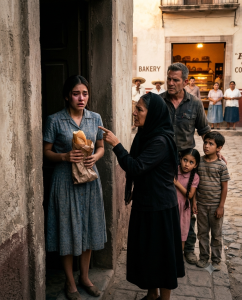
It happened on a hot afternoon outside the bakery.
Elisa had just bought a loaf of bread with the few coins she could spare. Across the street she saw Andrés with the children. Mateo spotted her first and waved both arms as though signaling a ship. Camila, for once, smiled openly. Andrés lifted a hand in greeting.
Two women outside the pharmacy turned to look.
Then a third woman stepped off the curb.
She wore black from neck to ankle, though the heat was merciless. Her posture was rigid, her face narrow and severe, her grief sharpened into something harder over time. She crossed the street without hesitation and stopped in front of Elisa as if she had been waiting for precisely this moment.
“So it’s true,” she said.
Andrés’ expression changed instantly. “Señora Teresa—”
But the woman raised her voice before he could continue.
“My daughter did not die so that some stranger could take her place.”
The bread fell from Elisa’s hands into the dust.
Everything stopped. Mateo’s mouth opened, but no sound came out. Camila grabbed her father’s shirt. People nearby slowed, then fully stopped, the way they do when public humiliation begins to bloom.
Elisa tried to speak, but shame came faster than words.
Teresa looked her up and down with cold contempt. “You arrive with nothing,” she said, “and suddenly you’re in my daughter’s kitchen, touching my grandchildren’s hair.”
“That’s enough,” Andrés said.
“No, it is not enough.” Teresa’s voice shook now, powered by rage old enough to feel righteous. “I buried my child. I watched those children cry for their mother. And now this woman appears and everyone pretends not to see what’s happening?”
Camila stared at Elisa.
Not with hatred. Not even fear.
With uncertainty.
That was the cut that hurt deepest.
Elisa wanted to say she had never asked for anyone’s place. That she knew what it was to lose family and arrive too late and stand outside a life you longed for but had no right to claim. She wanted to say that kindness was not theft, that loneliness did not make her a predator, that the dead were not honored by humiliating the living.
But the words tangled.
The whole street seemed to be listening.
Teresa took one step closer. “My grandchildren already lost their mother. I will not let them lose her twice.”
Andrés moved between them at last. “Go home, Teresa.”
But Elisa was already retreating.
She picked up the loaf with shaking hands, turned, and walked back toward the hotel without looking behind her. She heard Andrés call her name once. She kept walking.
In her room, she locked the door and sat on the bed staring at the half-open suitcase. The room looked exactly as it had on the day she arrived, which suddenly felt like proof that she had been foolish to believe anything had changed. Three dresses. Letters. Faded photo. A woman could still disappear with almost no effort.
A knock came at dusk.
When Elisa opened the door, Camila stood there alone, holding a pale blue ribbon.
Andrés and Mateo were on the stairs a few steps behind her.
“My mom used this on Sundays,” Camila said. “For my braid.”
Elisa felt her heart twist. “Then you should keep it.”
Camila shook her head. “Grandma says no one can take her place. I know that.” Her voice trembled, but she lifted her chin bravely. “I don’t want another mama.”
The honesty hurt. But before Elisa could answer, Camila’s eyes filled.
“I just don’t want you to leave.”
Mateo came up behind her, breathing hard from the stairs. Andrés reached the landing and stopped, giving the child room to finish what she had come to do.
“My mother-in-law was wrong,” he said quietly. “Her grief speaks before her judgment does.”
Elisa looked from him to the children. “People already think I came here for something that was never mine.”
“You came here for your uncle,” Mateo said at once, with the clean certainty only children carry.
That nearly broke her.
Andrés took one step closer. “Let people think what they want.”
Elisa looked at him then, really looked. At the exhaustion around his eyes. At the steadiness underneath it. At the care he kept trying to contain because he feared what it might cost everyone if he let it grow too visible.
Before she could respond, footsteps sounded on the stairs below.
Teresa emerged into view.
“If she touches that ribbon,” Teresa said to Andrés, “I will tell her what Lucía confessed before she died.”
The hallway went silent.
Andrés’ face drained of color. “This is not the place.”
“No? You’d rather let her walk blindly into my daughter’s wreckage?”
Elisa felt cold despite the heat. “What confession?”
Teresa’s gaze sharpened. “You don’t know?”
“Teresa,” Andrés warned.
But Teresa had crossed too far to turn back.
“My daughter knew she was dying,” she said. “And before she did, she told me something your husband has hidden from those children ever since.”
Husband.
The word hung there because Teresa’s fury had already decided the future before anyone else had.
Andrés stepped forward. “Enough.”
Teresa ignored him. She looked at Elisa. “Lucía told me Camila is not Andrés’ biological child.”
The hallway seemed to tilt.
Mateo made a confused sound. Camila blinked, too young to grasp the full shape of the sentence but old enough to feel its violence. Elisa stared at Andrés, who stood utterly still, like a man taking a blow he had always known might come.
Teresa pressed on, years of bitterness finally uncorked. “Lucía made a mistake before she married him. One she thought would ruin everything. She confessed when the illness had already reached her lungs. She begged me to keep quiet unless he ever tried to replace her, unless another woman came in and started pretending to be what she was.”
Elisa’s first instinct was not curiosity but horror. Not because of the secret itself, but because Teresa was throwing it at a child like a knife.
Camila turned slowly toward Andrés. “What does that mean?”
At last he moved.
He went to her first.
Not to Teresa. Not to Elisa. To Camila.
He knelt so they were eye level, and when he spoke, his voice shook with anger and tenderness all tangled together.
“It means nothing changes.”
Teresa made a disgusted sound. “Nothing changes? She lied to you for years.”
“Yes,” Andrés said, standing now. “She lied because she was terrified. And I forgave her because by then Camila was already my daughter in every way that matters.”
The hallway fell silent again, but this silence was different. It was no longer the silence before destruction. It was the silence after a truth finally refuses to stay hidden.
Mateo looked stunned. Camila looked as if the floor beneath her had become uncertain. Elisa felt tears sting her eyes, not because the secret was shocking, but because she saw all at once what kind of man Andrés had been carrying those children through grief.
Teresa stared at him. “You call that forgiveness?”
“I call it love,” Andrés said.
Then he turned to Camila again. “Listen to me. I held you the day you were born. I fed you, carried you, sat awake when you had fever, taught you how to pray, how to tie your shoes, how to sit a horse. You are my daughter. No confession, no blood test, no angry voice in a hallway can change that.”
Camila burst into tears and threw herself at him.
Mateo clung to both of them.
Teresa’s face hardened, then faltered. For the first time, Elisa saw not just fury in her, but fear. Perhaps she had held that secret for years believing it gave her some final power over the wreckage grief had left behind. And now, spoken aloud, it had not restored her daughter or protected anyone. It had only exposed how badly she herself was breaking.
“You had no right,” Andrés said to her, every word measured. “Not in front of them.”
“She was my daughter,” Teresa whispered.
“And these are my children.”
The force of it ended the argument more completely than shouting would have.
Teresa looked at Camila sobbing against Andrés’ chest and finally seemed to understand that grief had turned her cruel in a place she had once believed was love. She said nothing else. She simply turned and walked back down the stairs, older somehow with every step.
The hallway remained still for a long time.
Then Camila lifted the ribbon with trembling fingers and held it toward Elisa again.
This time Elisa took it.
Not as a replacement. Not as a claim. But as trust.
Her hands were shaking as she tied the pale blue ribbon carefully at the end of Camila’s braid. The child stood still, crying quietly but no longer shrinking away from the truth. Mateo wiped his face with his sleeve and pretended he was not crying too. Andrés watched Elisa’s hands, then her face.
There are moments when an entire future turns without anyone announcing it. That was one of them.
In the weeks that followed, Teresa stayed away. The town, of course, devoured the story. People whispered about Lucía’s confession, about Andrés’ choice, about Camila, about Elisa. But gossip loses some of its power when the people at the center of it stop bowing to it.
Elisa moved out of the hotel and into a small room on the Larios property first, not the main house. That mattered to her. She needed the step to be honest. She needed everyone, especially the children, to see that she was not slipping in through absence but being allowed in through truth.
She kept working at the laundry. She paid Andrés back every peso for the hotel. He accepted every coin.
Camila continued asking for braids. Mateo continued asking impossible questions. Andrés continued showing affection in practical forms until, slowly, he learned to show it in other ways too.
One evening months later, while the children chased each other in the yard, Andrés stood beside Elisa under the portal and said, “For a long time I thought surviving was the best I could do for them.”
Elisa looked at him. “And now?”
He watched Camila laugh with blue ribbon flashing in her braid. “Now I think living might be possible.”
Their relationship did not erase Lucía. It never tried to. Her memory remained in the house, in the children, in the recipes, in the caution with which love was approached. But what grew afterward was not theft. It was not replacement. It was something quieter and harder-won than that.
It was a family remade after being broken.
Years later, people in town would remember the scene outside the bakery because small towns preserve drama like dried flowers. Some would still insist Teresa had only been protecting her daughter. Some would say Andrés had been too quick to forgive. Others would say Elisa should have walked away before she risked being swallowed by another family’s grief.
Maybe all of them would have pieces of reason.
But if you had seen the way Camila looked up at Andrés when he told her nothing changed, or the way Elisa tied that ribbon with the care of someone who understood what was sacred, you might have wondered whether the biggest danger had never been love arriving after loss.
Maybe the biggest danger was grief deciding no one still living had the right to be held again.
And maybe the real red flag was not that Elisa came with nothing, but that everyone assumed a woman with empty hands must be reaching to steal—when all she had really wanted was a place where kindness did not have to apologize for surviving.
