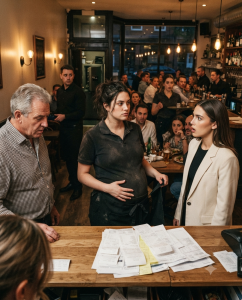
They told the pregnant waitress to stop standing near the front window because she made the restaurant look “tired.”
The comment was delivered softly, almost politely, which somehow made it crueler.
Nina stood with a tray tucked against one hip and one hand pressed into the ache at the base of her spine. At seven months pregnant, every part of her body felt overworked. Her ankles swelled before noon. Her feet throbbed by midafternoon. By the time the dinner rush started, she could feel each step like a pulse of heat through the cheap soles of her black work shoes.
Still, she showed up.
She showed up because rent was due. Because the baby she hadn’t even met yet already needed diapers, a stroller, and a crib she kept saving in her phone without buying. Because life did not pause itself for swollen ankles or back pain or the quiet terror of doing the math and realizing nothing stretched far enough.
So when the owner’s daughter looked her up and down and said, “You can work in the back until you leave. Customers don’t need to see all that,” Nina did what she had done her whole adult life when money was on the line.
She swallowed it.
The daughter had returned from college three weeks earlier with a degree in hospitality branding and the confidence of someone who had never once depended on tips to pay an electric bill. Her name was Vanessa, and from the day she arrived, she acted as though the restaurant were a failed group project she had been forced to rescue.
The place itself wasn’t fancy. It was a neighborhood Italian restaurant with scratched wood tables, framed black-and-white photos on the walls, and the kind of regulars who asked for “the usual” before they even sat down. It had survived twenty-two years because people trusted it. The portions were generous, the prices fair, and the owner, Martin, was the sort of man who remembered anniversaries and comped dessert when someone had a bad week.
Nina had worked there for almost four years. Long enough to know which booth rocked slightly on uneven legs, which dishwasher clogged if anyone rinsed rice into it, and which regular customers would tip extra if their server looked tired enough. She knew the rhythm of the place better than some of the people who technically outranked her.
Vanessa didn’t care about rhythm. She cared about optics.
She wanted brighter branding, sleeker menus, cleaner photos for social media. She replaced the chalkboard specials with laminated inserts. She changed the lighting. She moved plants. She told the hostess to seat younger couples near the front because they “fit the image.” She corrected servers’ lipstick, hair, posture, even the way they laughed.
When she saw Nina near the front window, hand absently resting on the curve of her stomach as she waited for a cappuccino to come up, Vanessa’s expression sharpened.
Not compassionate. Not concerned.
Annoyed.
The humiliation of that moment sat in Nina’s chest for days. Maybe longer. What made it worse was that no one defended her. Some people looked away. Some pretended they hadn’t heard. One busser gave her an apologetic glance, but he was nineteen and terrified of being fired. The older servers simply kept moving, because everyone in restaurants knew the same rule: if management targeted someone, getting involved only made it easier for the target list to grow.
So Nina moved to the back.
Officially, it was temporary. Unofficially, it was exile.
She still worked full shifts. She just did them out of sight.
She ran plates from the kitchen. Folded napkins. Refilled ramekins of dressing. Restocked takeout containers. Cleared service stations. Wiped menus. Prepared desserts. Helped the line when they got slammed. She became the pair of hands everyone needed and no customer was meant to notice.
That was when she started seeing things.
Invisible people always do.
At first, it was small enough to shrug off. Caleb, the new floor manager Vanessa had hired two months earlier, stayed late after close and spent too much time alone at the register. Once, Nina came back for her water bottle and saw him voiding a cash order from table fourteen, even though she remembered the couple at fourteen paying in full and leaving ten dollars on top.
He jumped when he saw her.
“Training mode cleanup,” he said too quickly.
She didn’t answer. Just took her bottle and left.
Then there were the deliveries.
The wine invoices seemed wrong. Nina noticed because she was often the one stacking boxes in the storage room when the back-of-house got busy. An invoice would say twelve bottles of a certain pinot noir, but only eight appeared on the shelf. Another would list six bottles of a reserve label the restaurant hadn’t served all week. Once or twice could be a supplier mistake. Repeatedly, it was something else.
She might have let that go too, except the office trash started telling a different story.
One night, as she was tying up garbage bags after close, she saw a strip of register paper sticking out from the office bin. She recognized the table number. A four-top from the window section. Cash payment. She remembered it because one of the guests had spilled sparkling water and apologized three times. The receipt in the trash was marked VOID.
Nina frowned and smoothed the wrinkled paper flat.
The date was right. The items were right. The amount was right.
Only the void stamp wasn’t.
The next night she found two more.
A few nights later, she found a duplicate invoice copy with a handwritten total that didn’t match the printed one. Then a deposit summary missing one cash batch. Then another voided ticket from a table she distinctly remembered paying.
Individually, each item could have meant nothing.
Together, they started to look like a system.
She began keeping what she found.
Not out of revenge. Not at first.
Out of fear.
Because Vanessa had already shown how quickly she would sacrifice Nina’s dignity for appearances. Caleb had the slippery calm of someone who lied often and well. And Martin, kind as he often was, had grown more distracted lately. He signed papers while answering phone calls. Approved invoices while greeting regulars. Trusted too easily because he wanted to believe the people around him were helping him.
Nina had seen enough in life to know that when money went missing, blame fell downhill.
And she was standing at the bottom.
So she folded every discarded duplicate and slid it into her apron pocket.
Over the next three weeks, the pattern sharpened.
Cash-heavy tables were being voided after closing. Delivery totals were adjusted. Several vendor invoices were stamped PAID, but their copies showed no matching bank confirmation. She even found a printed transfer summary from the office printer tray one morning before anyone else arrived, though that page vanished from the desk by noon. She didn’t take that one. Not yet. But she remembered the account number fragment she had seen.
Then Saturday happened.
It was the kind of dinner service servers dreaded and managers bragged about later if it went well. Every table was booked. The bar was two deep before six. The kitchen printer screamed nonstop. The hostess was giving forty-minute wait times, then forty-five. Martin floated through the dining room greeting birthday parties and shaking hands with regulars. Vanessa wore a tailored cream blazer and moved from table to table adjusting candles and checking plate presentation like she was staging a photoshoot.
Nina stayed mostly in the service corridor, carrying hot dishes through the swinging doors and returning with empty plates. Sweat dampened the back of her neck. Her belly tightened now and then with the sharp discomfort that came whenever she’d been on her feet too long. She pressed her palm there and kept moving.
At seven-fifteen, the front door opened and the whole mood shifted.
The man who walked in wasn’t a customer. Nina knew that immediately. He had the clipped impatience of someone arriving with a purpose and no interest in pretending otherwise. She recognized him after a second: Russell, the rep from one of the restaurant’s largest food and wine suppliers. He rarely came in person. When he did, it was serious.
He went straight to the host stand and asked for Martin.
Martin approached with a smile that died halfway to his face.
Russell opened a folder and placed several invoices on the counter.
Even from a distance, Nina could see the red notices attached.
“What is this?” Martin asked.
“This,” Russell said, keeping his voice just low enough to force everyone nearby to lean in, “is three months of outstanding balances, final notices, and a delivery hold that should have started last week.”
Martin blinked. “That’s impossible. We paid these.”
Russell tapped the papers. “No, you didn’t.”
A few customers at the bar had gone quiet. The hostess stood frozen with menus in hand. One of the line cooks poked his head out through the kitchen window before another cook yanked him back.
Martin grabbed the top invoice and scanned it. “There’s some mistake. We have records.”
Russell’s mouth tightened. “Then I’d love to see them.”
Before Martin could respond, Vanessa stepped forward.
She did not look surprised enough.
She looked inconvenienced.
“These things happen when paperwork isn’t handled properly,” she said smoothly. Her eyes flicked across the room, landed on Nina near the kitchen doors, and hardened with sudden decision. “She handles receipts sometimes. Maybe she lost them.”
The accusation hit the room like glass breaking.
Nina felt every eye swing toward her.
For a heartbeat, she couldn’t move. Not because she was shocked—some part of her had always known it could come to this—but because the sheer ease of it was stunning. Vanessa didn’t hesitate. Didn’t soften it. Didn’t even bother inventing a better lie. She simply pointed at the most disposable person in the building and expected the story to stick.
The pregnant waitress hidden in the back.
Of course she was the one.
Caleb appeared from the hallway then, expression taut. He didn’t say anything, but his silence was almost worse. It was the silence of someone waiting to see whether the blame would hold.
Nina looked at Vanessa. At Caleb. At Martin, confused and paling by the second. At Russell, angry and suspicious. At the customers pretending not to stare.
Then she set down the tray in her hands.
Slowly, deliberately, she untied her apron.
The knot loosened. The fabric dropped away from her waist. From the front pocket, she pulled out a thick stack of folded papers she had carried for days, adding to it little by little each time she found another piece that didn’t make sense.
Her voice, when it came, was calm.
“I didn’t lose them.”
She walked to the counter and placed the papers in front of Russell.
“I found the ones you tried to erase.”
Nobody moved.
Russell unfolded the first receipt. Then the second. Then the third. His brows drew together. He pulled one invoice from the middle of the stack, compared it to the unpaid copy in his folder, and swore under his breath.
Martin snatched up another page. His eyes moved across numbers, dates, void stamps, adjusted totals. His face changed with each sheet. Confusion gave way to dawning horror.
Vanessa recovered first.
“This is absurd,” she snapped. “She’s been stealing internal paperwork.”
“From the trash,” Nina said.
Caleb finally spoke. “You had no right—”
“No right to pick up what you threw away?” Nina asked. Her exhaustion had burned into something sharper now. “Or no right to notice what you were doing?”
Russell laid several duplicates side by side. “These voided cash checks correspond to nights with missing deposits,” he said. “And these delivery amounts don’t match what we billed.”
Martin turned to Caleb. “What is this?”
Caleb’s face had gone almost gray. “I can explain.”
Vanessa stepped closer to her father. “Dad, don’t do this here.”
But it was already there. In the open. In front of staff, customers, and a supplier who now looked less frustrated than furious.
Martin held up one altered invoice. “Did you change this?”
“No,” Vanessa said instantly.
Too instantly.
Russell looked at Nina. “Is there more?”
Nina hesitated.
There was.
One page. One page she had found two nights earlier when she came to return a tray and saw the office printer spit a document no one had collected yet. She had picked it up only because she thought it was a delivery form. Instead, it was a bank transfer confirmation. A transfer from the restaurant’s business account into another account whose name she recognized a second later.
Vanessa Martin Consulting.
She had folded it and slipped it into her sweater pocket before anyone came back down the hall.
Now, with the room holding its breath, Nina reached into that pocket.
“I kept this separate,” she said.
She handed the paper to Martin.
He took it with a distracted impatience that vanished the moment he read the header. His entire body seemed to hollow out. The color drained from his face. He read it again, slower, as though the words might rearrange themselves into something survivable if he gave them enough time.
Russell leaned in. “What is it?”
Martin didn’t answer at first. His eyes lifted to Vanessa.
There was no authority in them anymore. Only disbelief.
“Tell me,” he said, voice rough, “that this isn’t your account.”
Vanessa’s composure cracked. “Dad—”
“Tell me.”
Caleb took one careful step backward toward the office.
Russell saw it. “Stay where you are.”
Customers had stopped pretending by then. The whole front of house was openly staring. One of the older regulars at the bar removed his glasses as if seeing more clearly might make the scene less real.
Vanessa straightened, the softness dropping from her face. “You don’t understand how bad things were,” she said.
Martin blinked. “What?”
She laughed once, but there was no humor in it. “This place was bleeding money before I came back. You were too sentimental to fix it. I was trying to stabilize it.”
“By stealing from me?” he said.
“By moving funds,” she snapped. “By restructuring. By covering shortfalls the way any competent operator would until the rebrand started paying off.”
Russell let out a stunned breath. “You diverted vendor payments into a personal account?”
“It wasn’t personal,” she shot back, though the words sounded weak even to her. “It was temporary.”
Caleb spoke then, too quickly. “Vanessa handled transfers. I only did what she told me.”
She turned on him. “Don’t you dare.”
Martin looked from one to the other, and the picture finished itself in his mind. The late nights in the office. The altered invoices. The missing deposits. The unpaid suppliers. The slick promises about modernization while the business under his feet was being siphoned dry.
All this time, he had been blaming market shifts, rising costs, bad luck.
It had been his daughter and his manager.
The betrayal landed harder because it wasn’t only financial. It was intimate. Domestic. The kind that sat at your dinner table and asked for trust like it was owed.
Russell took the transfer confirmation from Martin’s hand and studied it. “This is enough for legal action,” he said flatly.
Vanessa’s face went white. “You can’t be serious.”
“I’m completely serious.”
“No.” She looked at her father, and for the first time the polished confidence disappeared. “Dad, say something.”
Martin did.
“Give me your keys,” he said to Caleb.
Caleb stared.
“Now.”
Then he turned to Vanessa. His voice shook, but not from uncertainty.
“And you’re done here.”
The words landed in total silence.
Vanessa looked around as if expecting someone—anyone—to step in and restore the version of reality where she was still in control. No one did. Not Caleb. Not the staff she had ordered around. Not the customers she had arranged like props. Not even Martin, who looked older in that moment than Nina had ever seen him.
Security wasn’t dramatic. There were no shouting matches, no police cars that second, no cinematic scene. Just keys handed over with stiff fingers. Office access revoked. Two staff members quietly standing nearby in case Caleb tried anything. Vanessa retrieving her bag from the office under Russell’s watchful eye and Martin’s shattered stare.
The restaurant emptied slowly after that, buzzing with whispers.
Some customers left cash on tables without waiting for checks. Some lingered just to watch. Staff moved through the rest of service in a stunned daze, finishing what they could because muscle memory takes over when the mind can’t keep up.
Around ten-thirty, when the last table was gone and the chairs were being turned upside down onto tables, Martin found Nina in the service station folding linen with stiff, tired hands.
For a moment, he simply stood there.
“I’m sorry,” he said at last.
Nina kept folding.
“I should have seen what was happening,” he continued. “And I should have stopped what she said to you the day she—” He swallowed. “There’s no excuse for that.”
Nina looked at him then. He seemed smaller somehow. Not less responsible. Just stripped of the confidence that had once made the restaurant feel steady.
“I kept those papers because I thought they’d blame me someday,” she said.
He closed his eyes briefly, as though the sentence hurt because it was true. “You were right to.”
He asked her to sit, and for the first time in weeks, she did so without worrying someone would tell her to get back up. Martin brought her tea from the kitchen. Real tea, not the stale server coffee they all survived on. Then he told her he had called his attorney and accountant. The supplier had agreed to delay any formal action until a full review was done, mainly because Nina’s documents showed Martin himself might not have known what was happening.
“Russell said those papers may have saved the business,” Martin said quietly.
Nina wrapped both hands around the warm mug.
He offered her paid leave through the rest of her pregnancy. Health coverage extended. Her job protected if she wanted it after maternity leave. He also offered something that mattered in a different way: a written apology and the promise that Vanessa would never set foot in the restaurant again.
Nina listened, exhausted enough that relief felt almost unfamiliar.
A week later, the story had spread through the neighborhood.
Restaurants live on gossip as much as reservations, and people loved this one. They loved Martin, and they loved Nina more after hearing what had happened. Regulars started asking for her by name even when she was already home on leave. Someone anonymously paid for the crib in her online cart after a coworker mentioned it to the wrong regular, who then told the right one. A local bakery dropped off cupcakes that said STRONG MAMA in careful frosting. The busser who had looked away that day by the window brought her a tiny pair of baby socks and looked embarrassed until she hugged him.
Vanessa did send one message.
Not an apology.
An email saying Nina had “misunderstood internal restructuring decisions” and escalated a private family matter.
Nina didn’t respond.
Martin did, through his lawyer.
By the time Nina gave birth to a healthy baby girl six weeks later, forensic accountants had confirmed what the papers suggested. Vanessa and Caleb had diverted thousands from the business over several months, hiding the theft by voiding cash sales, manipulating invoices, delaying vendor payments, and moving money into an account Vanessa claimed was meant for a future consulting structure. No one believed that. Least of all Martin.
He never publicly destroyed his daughter. He didn’t have to. Facts did that well enough.
When Nina returned to the restaurant three months later, the front window still caught the afternoon sun the same way it always had. The menus were simpler again. The lighting was warm. The staff photos Vanessa had staged for social media were gone, replaced by nothing more than handwritten specials and the ordinary charm the place had once been so eager to abandon.
Martin met Nina at the door with her updated schedule and a key to a small locker they had cleared out just for her.
Then he said, in front of everyone, “You can work anywhere you want.”
Nina glanced at the front window.
For one second, the old humiliation flickered. Then it disappeared.
She took her section right out front.
Customers smiled when they saw her. One regular clapped. Another stood to hug her before remembering she was balancing a tray. Sunlight fell across her shoulder as she moved between tables, no longer hidden, no longer reduced to “all that,” no longer a convenient target waiting to be blamed.
She was still tired, of course. She had a newborn at home. Her life was not magically easy. Bills still existed. Sleep was still scarce. Some wounds heal into tenderness, not strength.
But something had changed that couldn’t be reversed.
She knew exactly what people were capable of when they thought someone vulnerable wouldn’t fight back.
And she knew what happened when the person they dismissed kept the proof.
The story never stopped making people argue.
Some said Martin deserved sympathy because he had been betrayed by his own daughter. Others said he should have noticed sooner, should have defended Nina the first time Vanessa humiliated her, should have protected the staff before the scandal ever reached the dining room. Some thought Vanessa had only revealed what had always been buried in the business: a willingness to value appearances over people the moment pressure hit. Others thought the real mistake was underestimating the woman they pushed out of sight.
Maybe that was the part people remembered most.
Not the invoices. Not the safe. Not even the stolen money.
Just the fact that the woman they told to disappear ended up being the only one brave enough to bring the truth into the light.
And once she did, nobody in that restaurant could look at the front window the same way again.
