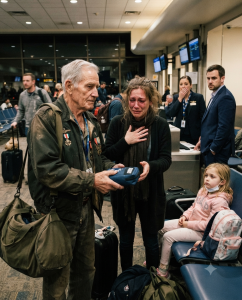
The airline gate agent asked the old veteran to step aside because his hands shook too much to hold his boarding pass.
It happened in the kind of moment most people forget five minutes later.
A crowded airport. A delayed evening flight. A line of tired passengers inching toward the scanner with the drained, brittle patience that only travel can create. People were balancing coffees, phones, backpacks, and irritation. The overhead announcements kept interrupting themselves. A baby had been crying somewhere down the concourse for nearly ten minutes. Two screens above the desk flashed the same destination and the same warning: FULL FLIGHT.
Thomas Mercer stood in line with a worn duffel bag on his shoulder and a folded boarding pass in his hand. He looked to be somewhere in his late seventies, maybe older. His hair was silver, his jacket old but clean, and his shoes had been polished recently even though the leather had long since cracked in places. The thing people noticed first, though, wasn’t the bag or the jacket. It was his hands.
They shook.
Not a little. Not in a subtle way that could be politely ignored. They trembled hard enough to make the paper in his fingers flutter. Hard enough that when he tried to line the pass up over the scanner, he missed the first time.
The gate agent, a woman named Carla who had been dealing with delays, seat changes, and impatient passengers since before sunrise, reached for the pass. Thomas tried to hand it to her, but his hand jerked slightly and the edge of the paper brushed past her fingers.
She exhaled and glanced at the line behind him.
“Sir,” she said, keeping her voice flat with effort, “we need to keep this moving.”
Thomas looked at her, then at the scanner, then down at his hand as if it had betrayed him in public one time too many.
“Yes, ma’am,” he said.
There was no argument. No wounded pride. No demand for respect. He simply nodded and stepped out of line.
People in line sighed behind him.
Some did it because they were stressed. Some because they were tired. Some because once one person in public becomes inconvenient, everyone else feels licensed to treat them like an obstacle. Thomas moved to the wall near the windows and stood quietly beside a charging station, duffel still on his shoulder.
A man in a navy suit two places back shook his head and muttered to no one in particular, “Some people shouldn’t travel alone.”
He said it softly, but not softly enough.
Thomas heard him.
He didn’t turn. He didn’t say a word. He just looked down, folded the boarding pass more neatly, and waited.
If anyone had paid close attention, they might have noticed a few things that did not fit the picture they had drawn of him. His posture was too straight for someone truly frail. His eyes, though tired, moved around the gate with quiet awareness. And tucked just inside his jacket, barely visible when the fabric shifted, there was the dull glint of metal. Medals, though no one looked long enough to be sure.
The line moved again. Carla resumed scanning passengers. The businessman checked his watch with exaggerated irritation. A college kid complained under his breath about the connection he was going to miss. Near gate 12, a mother bent to unzip a backpack while her daughter sat cross-legged on the floor, listless and pale.
Then the little girl began to cry.
It wasn’t a cranky whine or a bored complaint. It was sharp and frightened and full of distress. The sound sliced through the terminal noise so suddenly that people turned before they understood why.
Her mother dropped to her knees at once. “No, no, no,” she whispered, then louder, “No, where is it? Where is it?”
She ripped through one bag, then another. Snacks, wipes, charging cables, crayons, a stuffed rabbit, travel documents, receipts. Everything came out in frantic handfuls. The girl leaned weakly against the row of seats behind her, crying harder.
A nearby airport employee hurried over. “Ma’am, what’s wrong?”
“My daughter’s insulin kit,” the woman said, voice cracking. “It was in here. It was right here.”
The employee blinked. “Was it checked?”
“At security. They looked at it. They gave it back. I think they gave it back.” She grabbed another bag and dumped it out with shaking hands. “I can’t find it. I can’t find it.”
Another employee arrived with a radio. Someone else brought water. Questions started flying.
“What does it look like?”
“When did you last have it?”
“Did you leave anything at the checkpoint?”
“Can someone call medical?”
The mother tried to answer, but panic had overtaken language. Her little girl’s breathing had changed. She was crying less now, which somehow looked worse.
Thomas pushed himself off the wall.
Later, Carla would remember that exact moment. The room had been full of movement before that—rushing, asking, reaching, crowding. But when Thomas stepped forward, everything around him seemed chaotic by comparison. He was still old. Still tired. Still trembling. Yet something in his face had sharpened. The uncertainty was gone.
He approached the mother and crouched slowly in front of her.
“When did you last use the kit?” he asked.
His voice was low, but it cut through the noise because it carried no panic at all.
The woman looked at him with wet, unfocused eyes. “At security. I had to show them.”
“Did they open it separately?”
“Yes.”
“Did you repack while standing or kneeling?”
She hesitated. “Standing.”
“Was your daughter crying then?”
“Yes.” She pressed both hands to her forehead. “She hates the checkpoint. She was crying, I had bins, shoes, her jacket—I was trying to carry everything.”
Thomas nodded once.
It was such a small motion, but it did something to the room. It suggested understanding. Not sympathy alone, but analysis. Like he had already started building the scene backward in his head.
He turned to the nearest employee. “Where’s the closest trash bin to the table people use after screening?”
The employee frowned. “Sir, let us—”
“Where is it?” Thomas repeated.
The employee pointed down the concourse.
Thomas stood. His hand shook at his side, but the rest of him moved with practiced certainty. He crossed to the post-screening area near the side table where travelers often reorganized their belongings. A stack of gray bins sat crooked against the wall. Beside them stood an open trash can filled with cups, wrappers, napkins, and plastic trays from rushed repacking.
He glanced once at the table, once at the floor, once at the bin.
“In storms,” Thomas would later say, if anyone had asked, “people lose things when they’re afraid and moving too fast. Not because they’re careless. Because the mind starts sorting by urgency instead of order.”
No one at the gate knew that in Vietnam, in monsoon conditions and mud and darkness, he had learned exactly how fear changes human behavior. He had learned what hands drop first. What eyes stop noticing. Where items end up when people think they are putting them away.
He reached into the trash bin.
Carla, the agent, had followed by then, along with two airport employees, the little girl’s mother, and half the nearby passengers. The businessman in the navy suit stood a few steps back, arms crossed, skepticism still on his face but weaker now.
Thomas moved aside the top layer of trash. His motions were efficient, careful, almost methodical.
A coffee cup.
A balled-up receipt.
A napkin.
A juice bottle.
Then his hand closed around a soft pouch.
Blue.
Medical tag.
He pulled it out and zipped it open just enough to confirm the contents.
The mother gasped so hard it sounded like a sob tearing loose.
“Oh my God.”
She rushed forward. Thomas handed her the pouch.
For a split second, no one spoke. It was as if the whole terminal had frozen around the tiny object in her hands.
Then the mother crumpled. Not to the floor, but emotionally. Relief slammed into her so fast she had nowhere to put it. She clutched the pouch, turned to her daughter, and cried openly while preparing what the child needed with trembling fingers. One of the airport staff called for a medic anyway, but the crisis had shifted. The edge they had all been standing on was no longer immediate.
The little girl leaned into her mother and began to settle.
The woman looked back at Thomas with tears streaming down her face.
“Thank you,” she whispered.
He gave a small nod.
Then she stood and hugged him.
It was the kind of hug people give when “thank you” is too small a sentence. Thomas looked startled at first, as if he wasn’t used to being embraced by strangers. Then one of his hands rose awkwardly and rested against her shoulder.
Behind them, the terminal had gone silent.
Carla felt heat crawl up her neck.
Ten minutes earlier she had treated him like a delay. Like a fragile inconvenience. Like a boarding problem to move to the side. Now she was staring at a man who had walked into a medical emergency and solved it faster than anyone with a radio, badge, or authority.
“I’m sorry, sir,” she said.
He released the woman gently and turned toward Carla. Up close she saw the inside of his jacket had fallen partly open.
Medals.
Not bright and polished for show, but faded with age, carefully pinned to the lining. They looked like things carried in private, close to the heart.
Carla’s expression changed instantly.
The businessman saw them too.
His mouth tightened. The smug impatience disappeared from his face in a way that was almost painful to watch. He glanced toward Thomas’s trembling hand, then away, ashamed. Whatever he had expected this old man to be, it wasn’t this.
Thomas simply said, “No harm done.”
But the truth was harm had been done, just not the kind people usually count. It lived in the assumption. In the dismissal. In how quickly a room had mistaken visible weakness for uselessness.
The medic arrived, checked the little girl, and confirmed that the immediate danger had passed. Her mother kept one hand wrapped around the insulin pouch like she was afraid the world might snatch it away again. She sat her daughter in a chair, kissed her forehead over and over, then looked at Thomas each time with fresh disbelief.
Carla walked back to the gate desk with him.
“Let me take care of your boarding pass,” she said softly.
Thomas handed it to her. His fingers shook as before.
Only now nobody was watching that tremor with annoyance. They were watching it with humility.
Carla scanned the pass, then stopped.
The reservation carried a note. She looked up at him. “Mr. Mercer… are you traveling for the memorial service at Arlington?”
Thomas was quiet for a beat.
“Yes, ma’am.”
The businessman, still close enough to hear, lowered his eyes.
“Family?” Carla asked.
Thomas’s face changed in a way that made the question feel heavier than intended. “My grandson.”
The words landed like another silence.
The little girl’s mother looked up from her seat. “You still helped us?”
Thomas looked toward her daughter, then back at Carla. “She needed help first.”
No one said anything after that because there was nothing worthy to say.
Carla came around the desk instead of waiting for him to approach again. “Would you like a wheelchair assist, Mr. Mercer?”
He smiled faintly. “No, thank you. Just a little patience.”
The line behind him shifted, but no one complained. In fact, the businessman stepped forward and spoke for the first time since his remark.
“Sir.” He swallowed. “I owe you an apology.”
Thomas regarded him for a moment.
The businessman continued, voice stripped of its earlier edge. “I judged you. I was wrong.”
Thomas studied his face, then nodded once. “Most people are in a hurry.”
It wasn’t exactly forgiveness. But it was more grace than the man deserved.
Boarding resumed. Carla waved Thomas forward first, and this time no one objected. People actually stepped aside. A college student lifted Thomas’s duffel without being asked and placed it gently near the scanner. Carla held the pass steady while Thomas took it back. The little girl, now recovering color in her cheeks, raised one small hand and waved at him.
Thomas waved back.
As he turned toward the jet bridge, Carla noticed faded stitching on the side of his duffel bag. A name. Not his.
DANIEL MERCER.
And below it, in smaller worn letters, U.S. ARMY.
She remembered then the memorial notice that had circulated among airport staff that morning because a military escort team would be meeting an incoming family member at the destination. Same surname. Same unit reference.
Her throat tightened.
“Mr. Mercer,” she said.
He paused.
“That was your grandson’s bag?”
Thomas looked down at it for a moment. When he answered, his voice was nearly lost beneath a boarding announcement.
“Yes.”
Carla didn’t ask how old he had been. She didn’t ask when he was lost. She didn’t ask how a man carried both medals and grief inside the same jacket without collapsing under the weight. She only said, “I’m very sorry.”
Thomas gave the smallest nod. “Thank you.”
He started down the jet bridge.
The businessman stood aside and removed his glasses, rubbing a hand over his face. The mother with the little girl watched Thomas go with tears in her eyes. A few other passengers stared after him too, all of them changed a little by the same realization: strength does not always look steady.
Sometimes it looks like a trembling hand holding itself together.
Sometimes it looks like an old man no one wants to wait for.
And sometimes the person everyone quietly dismisses is the one who sees clearly when everyone else is overwhelmed.
Thomas reached the end of the jet bridge and stopped for a second before boarding. He rested one hand on the wall as if gathering himself. Then he straightened, adjusted his grandson’s duffel on his shoulder, and kept walking.
Later, Carla would replay the whole thing in her mind. The impatient line. The muttered comment. The trembling boarding pass. The little girl. The blue medical pouch rising out of the trash bin like something pulled back from disaster. She would think about how quickly people create stories about strangers and how rarely they wonder if they are wrong.
At thirty thousand feet, somewhere over the dark sweep of clouds below, Thomas would be flying toward a memorial for the grandson he had outlived.
And everyone at that gate would remember that before he went to grieve, he had paused long enough to save someone else’s child.
That was the part no one forgot.
Not the shaking hands.
Not the delay.
Not even the medals.
What stayed with them was the calm.
The room had been full of younger people, faster people, louder people, people with credentials and luggage and opinions. Yet when fear entered, only one of them truly knew how to stand still, think clearly, and act.
The old veteran they had nearly pushed aside had been carrying grief, age, memory, and a body that no longer obeyed him cleanly. Still, when the moment demanded steadiness, he was the steadiest person there.
And long after the plane departed, after the gate had emptied and the terminal returned to its usual noise, one question lingered in the minds of the people who had watched it happen:
How many times had they mistaken quiet dignity for weakness before that day?
