The first stone appeared on a Tuesday morning.
Mrs. Eleanor Lang found it beside the welcome mat when she opened her front door to let in the cool air. It was smooth, oval, and dark gray, still damp as if it had only just been lifted from the river. She looked at it for a moment, then at Buddy, the black Labrador sitting three steps down with his tail still and his chest rising slowly.
“Did you bring me this?” she asked.
Buddy only stared.
He was her late husband’s dog more than hers, though in twelve years of marriage she had long ago stopped pretending there was a real difference. He had slept at the foot of their bed, followed Martin Lang to the garage every morning, and waited by the door whenever Martin went out to the river. After Martin died, Buddy had become quieter. Not wild with grief, not restless, just watchful. It was the kind of watchfulness that made people lower their voices without knowing why.
Eleanor picked up the stone and set it on the porch rail.
The next morning there was another one.
And then another.
By the end of the week, her neighbors had noticed.
“I think he misses Martin,” said June Harper from next door, pressing a hand over her heart as she peered down at Buddy. “Animals know. Sometimes they do the oddest little rituals.”
“Maybe he thinks stones are gifts,” said another neighbor with a kind chuckle. “Better than dead squirrels, I suppose.”
Eleanor smiled because smiling was easier than explaining the feeling she couldn’t shake. Everyone in town seemed to want grief to settle into some recognizable shape. A casserole. A folded church bulletin. A sympathetic touch on the elbow. People liked sorrow best when it behaved itself.
But Buddy had never been random a day in his life.
Martin used to say that dog could tell the difference between a delivery truck, a customer, and a liar before the tires stopped rolling. It was one of those things Eleanor used to laugh at, right up until the number of times Buddy proved him right became too many to count.
So when he began bringing stones from the river and placing them with strange care at her doorstep, she paid attention.
Martin Lang had been dead for three months.
According to the official story, he had drowned in the river near the old dock at the south bend, the stretch of water that curled around a stand of trees before widening near the marsh. He had gone out there alone in the evening, supposedly to check one of the small storage boats their company used for hauling equipment. There had been rain earlier that day. The dock was slick. Martin had probably slipped, hit his head, and gone under.
That was the explanation.
Simple. Sad. Acceptable.
The sheriff had used the word “tragic.” The insurance company had used the phrase “pending clarification.” The town, predictably, had turned the whole thing into one of those stories people tell with a sigh and a shake of the head—terrible luck, one bad step, gone too soon.
But the details never sat right with Eleanor.
Martin was not careless near water. He had grown up on that river. He knew every bend, every snag, every season’s change in current. He had taught half the town’s boys how to bait a hook without tearing the worm in half, and he could spot a dangerous board on a dock in near darkness. If anyone else had drowned there, she might have accepted an accident. Martin was harder to believe.
Then there were the missing pieces.
His phone was never recovered.
His wedding ring was gone.
No one could clearly account for the hour before his death.
And before the week was over, Edwin Pike had started speaking too often and too confidently for a man who claimed to be heartbroken.
Edwin had been Martin’s business partner for seven years. He dressed better than everyone else in town and spoke in polished, measured sentences that made ordinary matters sound like boardroom strategy. He handled expansion, investors, supply contracts. Martin handled operations, staff, equipment, and the practical side of the company. Together they made money. At least that was what everyone said.
At the funeral, Edwin stood close enough to Eleanor to seem supportive without becoming intimate. He touched her elbow when people came through the receiving line. He told her Martin had respected her deeply. He told her the company would do everything possible to protect his legacy. He told her to call if she needed anything at all.
A week later he came to her house with paperwork.
She still remembered the way the afternoon light caught the edge of his watch while he laid the documents on her dining room table like he was setting out a sympathy bouquet.
“The business is vulnerable right now,” he said. “Your husband was handling some sensitive areas. There are debts we may need to settle. Contracts that could collapse if investors get nervous.”
Eleanor sat across from him, staring at the figure he had written in the offer line.
It was insulting. Not low in a careless way. Low in a calculated way.
“You want my share of the company for this?” she asked.
Edwin gave a regretful smile. “I’m trying to protect you from what might come next.”
The sentence landed wrong. Too smooth. Too ready.
She slid the papers back toward him.
“I’m not signing anything.”
For the first time, something flat passed behind his eyes. It was gone so quickly she might have imagined it.
“Of course,” he said. “Take your time.”
After that, Buddy started bringing stones.
At first she tried to ignore it. Then she tested it.
One morning she kept him inside after breakfast. He paced the kitchen, whining under his breath, stopping every few seconds to look at the back door. When she still didn’t let him out, he pressed his body against it with enough force to rattle the frame.
The moment she opened it, he shot across the yard and disappeared down the path behind the church lot.
He returned hours later, wet to the chest, carrying another smooth gray stone.
That same evening, Eleanor lined all the stones along the porch rail and studied them. Eleven in all. Similar, but not identical. River stones, every one. Some with pale lines running through them. Some flattened by years of current. Not trophies. Not random scraps from play.
Markers, she thought suddenly.
Or steps.
The idea unsettled her enough that she barely slept.
The next afternoon a storm rolled in low and heavy, darkening the sky before supper. Buddy had been gone longer than usual. Eleanor stood at the kitchen sink, pretending to rinse a clean cup while really watching the yard, when she saw him appear at the back gate.
He was soaked. Mud splashed his legs and belly. He came straight toward the porch with his head lowered carefully, carrying something in his mouth.
Another stone.
But wrapped around it was a length of fishing line.
Eleanor’s breath caught.
She knelt as Buddy approached and took the stone from him. The line was frayed and gritty with silt. Near one end was a knot she recognized at once, the sort Martin tied without looking, neat and tight and practical.
“Buddy,” she whispered.
The dog turned and looked toward the trees.
Then he started walking.
No hesitation. No circling. No waiting to see whether she understood.
He expected her to follow.
Eleanor snatched her raincoat from the hook by the back door and went after him. The path behind the houses narrowed quickly, swallowed by wet weeds and low branches. Buddy kept a steady pace, glancing back only enough to make sure she remained close. Her shoes slipped in the mud. Damp leaves brushed her face. Somewhere ahead, the river murmured in that ceaseless low voice she had known all her life and feared ever since it took her husband.
When the trees opened, the old dock came into view.
It leaned slightly now, more tired than broken, its boards dark with moisture and green at the edges where moss had crept across them. The river bent around the bank there, pushing debris toward a cluster of exposed roots beneath a large sycamore. Martin used to call it a trap for the river’s lost things.
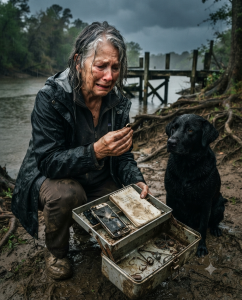
Buddy splashed through the shallows and scrambled up the muddy edge beyond the dock. Then he began digging.
His front paws worked furiously at the base of the roots, sending wet soil flying. He whined once, sharp and urgent.
Eleanor hurried to him and dropped to her knees. Mud soaked through her stockings at once. She shoved both hands into the loose earth where Buddy had opened a space under the roots.
Her fingers struck metal.
She froze.
Then she pulled.
A tackle box emerged from the mud, jammed sideways beneath the roots as though it had been forced there by current and trapped. One corner was wound with old fishing line. The lid was cracked. The latch gave way after two hard tugs.
Inside was a damaged phone, a waterproof notebook swollen at the edges, and a gold wedding band.
Martin’s ring.
For a second the world narrowed so sharply that Eleanor could hear only her own breathing and the river.
“He never took it off,” she whispered.
Buddy sat beside her, silent now, his wet fur plastered to his ribs.
The notebook took effort to open. The pages stuck at first, but the waterproof coating had preserved more than she expected. The early entries were brief and practical—shipment times, supply issues, payment notes, names of clients and subcontractors. Then the tone changed. More rushed. More suspicious. A few lines about numbers not matching. About invoices Martin hadn’t approved. About money moving somewhere it shouldn’t.
Eleanor’s heartbeat climbed.
Near the back, she found the final dated page.
The day before Martin died.
The writing was hurried, pressing hard enough to dent the paper beneath.
Meeting tomorrow. River. 7:30 p.m. Edwin says he can explain everything.
Eleanor read the line once.
Then again.
Rain began falling in earnest, cold and sudden, speckling the open pages. Her hand tightened around the ring until the edge bit into her palm.
Edwin.
Not rumor. Not suspicion. Not the sour instinct she had been trying not to trust.
His name.
There, in Martin’s own hand.
She was still staring at the page when she heard someone crashing through the brush behind her.
The sheriff arrived a minute later with a deputy at his back, both of them wet from the hike down. Someone must have seen Eleanor following Buddy toward the river and alerted them, or perhaps June Harper’s habit of watching every movement in the neighborhood had finally done some good.
Sheriff Nolan took one look at Eleanor kneeling in the mud, the ring in her hand, the tackle box open before her, and his expression sharpened.
“What did you find?”
Without a word, she handed him the notebook.
He read quickly, then more slowly when he reached the last page. The lines around his mouth deepened.
“Did anyone else know about this notebook?” he asked.
“No,” Eleanor said. “Not unless Martin told them.”
The sheriff crouched beside the box and picked up the water-damaged phone with two careful fingers. “This should have been in evidence if it had been found with the body.”
“It wasn’t found,” Eleanor said. “Someone made sure of that.”
Sheriff Nolan looked at her then, really looked, and she knew he had been uneasy about the case too. She saw it in the silence before he stood again.
Buddy rose to his feet.
The dog’s ears lifted. A low growl rolled up from his chest.
Nolan turned toward the trail.
Footsteps approached through the brush—measured, careful, too controlled for surprise.
And then Edwin Pike stepped into view.
He wore a dark raincoat and expensive shoes already stained by mud. His hair was damp at the temples, and he was breathing just a little harder than he should have been.
“Sheriff,” he called, forcing a note of concern into his voice. “I heard Eleanor came down here alone. I thought maybe—”
Then he saw the box.
Saw the ring.
Saw the notebook in Nolan’s hand.
For a fraction of a second, every prepared expression dropped from his face.
Fear, naked and cold, flashed there.
Eleanor felt it like a physical blow.
Edwin recovered quickly. “What is this?”
No one answered.
Buddy moved in front of Eleanor and the tackle box, body rigid, lips peeled back just enough to show his teeth.
Edwin looked at the dog, then at the sheriff. “That animal needs to be controlled.”
Sheriff Nolan didn’t move. “Interesting choice of words.”
Edwin forced a laugh. “I’m just saying—”
“The notebook says Martin met you here the night before he died.”
The rain fell harder. Edwin’s eyes flicked to the trees, to the river, to Eleanor.
“He was upset,” Edwin said. “He thought there were accounting irregularities. I told him I’d explain. We met, yes. We argued, yes. But he was alive when I left.”
Eleanor stood slowly, muddy and trembling but suddenly steadier than she had been in months.
“Then why was his ring in that box?” she asked. “Why was his phone hidden under the roots? Why did you try to buy me out a week after the funeral?”
Edwin’s jaw tightened. “Because the company was at risk.”
“Because you thought I wouldn’t know what it was worth,” she said.
He didn’t answer.
Sheriff Nolan held out a hand. “Your phone, Edwin.”
“What?”
“Your phone. Now.”
“That’s ridiculous.”
“Now.”
Edwin hesitated one beat too long.
The deputy stepped forward. Edwin slowly handed over the device. Nolan passed it back without looking away from him.
“We’ll also need you at the station.”
“This is insane,” Edwin snapped, and for the first time the polish cracked completely. “You have a wet notebook and a dead man’s dog acting like a bloodhound. That’s your evidence?”
“No,” said Eleanor quietly. “That’s what found the evidence.”
In the days that followed, the rest came apart faster than she expected.
The damaged phone from the tackle box was sent for recovery. Enough data remained to confirm Martin had taken photographs of financial records from the office and drafted messages to himself about missing funds and falsified invoices. Edwin had been siphoning money through shell vendors for over a year, counting on Martin’s trust and busy schedule to keep him from noticing.
But Martin had noticed.
Worse for Edwin, the sheriff’s team pulled location records, call logs, and deleted messages that placed him at the river when he first claimed he had been home. One deleted thread showed Martin pressing for answers. Another suggested Martin had threatened to go to the authorities if Edwin didn’t confess and repay everything.
No one could reconstruct every second of what happened at the dock that night, but the broad shape turned grimly clear. Martin confronted Edwin. The argument escalated. Whether Edwin shoved him, struck him, or simply left him injured to fall into the river, the result was the same. Martin died there. Edwin removed the phone and ring, perhaps in panic, perhaps to delay questions, perhaps because he believed he could erase motive if he erased enough evidence. He hid what he could in the tackle box, intending either to come back later or trusting the river to finish the work for him.
The river kept the box.
Buddy remembered where.
Maybe he had been there that night. Maybe he had followed Martin’s scent. Maybe he had returned to the river over and over, picking at the same place, carrying off stones disturbed around the roots until the buried secret loosened enough for him to find the line. Eleanor would never know exactly how a dog solved what people missed.
But he had.
Edwin was arrested before the week was over.
The charges shifted as forensic details came in, but fraud was easy to prove, obstruction nearly as easy, and the death no longer looked accidental to anyone willing to follow the evidence where it led. The insurance company reopened the file. Investors backed away. The story spread through town in the ugly, electric way such stories do, turning sympathy into scandal almost overnight.
People came to Eleanor with new faces then—apologetic, curious, embarrassed.
Some admitted they had always found Edwin too smooth.
Some said they’d had doubts but didn’t want to make trouble.
Some cried for her as if they had not already chosen the simpler story months earlier.
Eleanor accepted none of it and rejected none of it. She was too tired for performance. Grief had changed shape again. It was no longer just loss. Now it held anger, vindication, and the terrible relief of no longer having to pretend her instincts were unreasonable.
One evening, several weeks later, she stood on the porch with Buddy beside her and looked at the row of stones still lined neatly along the rail.
She had kept every one.
The sheriff had once joked that Buddy deserved a badge. June Harper said he deserved a steak every night for the rest of his life. Children in town began asking to pet “the detective dog” when Eleanor walked him near the square.
Buddy accepted all of it with calm dignity and no visible interest in fame.
He still liked the river, though Eleanor never let him go there alone again.
Sometimes she thought about that first week after Martin died—how quickly Edwin had moved, how smoothly he had tried to turn shock into leverage, how close she had come to signing papers that would have buried more than a business fraud. If Buddy had not insisted, if he had not returned each morning with another silent signal, the tackle box might have stayed hidden until the phone rotted beyond use and the notebook dissolved into pulp.
Instead, the truth reached her porch piece by piece.
Stone by stone.
On the anniversary of Martin’s death, Eleanor carried his recovered wedding band down to the river at sunset. Not to throw it in, never that, but simply to stand where the bend caught the light and let herself feel everything at once. The rage. The sorrow. The love. The impossible gratitude toward the animal seated quietly beside her.
“I almost missed it,” she told Buddy.
He leaned against her leg.
Maybe that was the part she would never stop thinking about—not only that Edwin lied, or that Martin had been betrayed by someone he trusted, but that the clearest warning in the entire story came from the one creature who had no words at all. People had offered explanations that were easy, tidy, comforting. Buddy offered none. He just kept carrying what he could until someone paid attention.
And in the end, that was what stayed with Eleanor most.
Not the fraud.
Not the arrest.
Not even the courtroom where Edwin finally lowered his eyes and heard his own choices named aloud.
It was the image of a black Labrador in the morning light, setting down one small river stone after another, refusing to let the truth stay buried.
Even now, when Eleanor looked at the line of smooth gray stones on her porch rail, she sometimes wondered which was the real red flag—the hidden money, the rushed buyout, the too-perfect sympathy, or the simple fact that a dog had to keep bringing evidence to her door before the adults around her were willing to admit something was terribly wrong.
And she still wasn’t sure what said more about loyalty:
That Martin’s partner betrayed him so completely—
Or that his dog never did.
