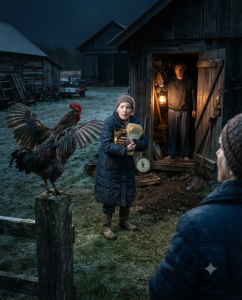
The old rooster crowed every night at 2:13 a.m.
Not around that time. Not once in a while. Every single night, with the precision of a clock and the force of a warning. The sound ripped through the dark and echoed across the farmyard so sharply that even the windows seemed to tremble.
No one in the house could sleep.
At first, Martha blamed herself for noticing it so much. Since her husband died, sleep had become strange and shallow anyway. She drifted in and out of it, waking at every groan of the old house, every gust of wind against the siding, every loose board clicking in the hallway as if someone had stepped on it. Grief had tuned her ears to absence. She heard everything now because the one voice she needed was gone.
Still, the rooster was impossible to ignore.
He was old—too old, according to everyone else. His tail feathers were broken and thin, one spur had cracked years before, and one of his eyes had gone pale with cloudiness. He no longer chased the hens. He no longer strutted the yard at sunrise like a king announcing himself. Most mornings, he moved slowly, picking through the dirt in short, deliberate pecks as if time belonged to him and no one else.
But every night at 2:13, that bird came alive.
He would leap to the fence post near the garden, face the tool shed behind the pasture, spread his wings slightly, and crow with such urgency that the sound felt less like instinct and more like accusation.
Martha had watched him through the window more than once, wrapped in a blanket and half hidden by the kitchen curtains. He never faced east. Never greeted morning. He aimed himself at the shed and screamed at the closed door as if something inside was trying to breathe.
Her nephew hated the bird.
“It’s useless,” Dale said one morning, tossing grain so hard it scattered beyond the trough. “Old, loud, and mean. Sell it.”
Martha stood at the sink washing a chipped bowl and looked outside at the rooster standing alone in the frost.
“He was your uncle’s favorite,” she said.
Dale leaned against the counter and gave a quick shrug. “Your husband kept a lot of things he shouldn’t have.”
It was a small sentence. Casual on the surface. But something in the way he said it made the room go colder than the December air outside.
Dale had moved in two weeks after the funeral. He arrived with casseroles from neighbors in the truck bed, a toolbox in the cab, and a face carefully arranged into concern. He told Martha she shouldn’t be alone on the farm. Told her he wanted to help with the repairs, the animals, the bills, the winter prep. At the time, she had been too exhausted to question kindness. Her husband had handled most of the property work. The farm was too large for one person to manage easily, and she was still moving through her days like someone walking underwater.
So she let Dale stay.
At first, he did the things helpful relatives do. He stacked wood, fixed a gate latch, patched part of the chicken run. But over time, Martha noticed his help had a pattern. He counted the livestock often, more often than necessary. He checked every lock before bed without being asked. He walked the fence lines with a notebook, pausing at boundary posts and writing things down. And every few days, he found a new reason to ask about papers.
Where did Uncle keep the deed?
Did he ever update the survey?
Were there copies of the tax maps somewhere?
Did she know whether he had a private file box?
He always asked in a soft, practical voice, like a man just trying to keep things organized. But Martha began to feel as if she were living with someone who wasn’t helping her carry the farm so much as measuring it for someone else.
Then she began noticing the way he looked at the tool shed.
The shed sat thirty yards behind the house, beyond the kitchen garden and just past the low fence. It was older than the barn and smaller, built of weathered wood that had gone nearly silver with age. Her husband kept shovels there, seed trays, broken harness parts, jars of nails, feed sacks, and things he swore would be useful someday. Dale wandered near it often, but rarely went inside. He would stop, glance at the door, then move on the moment Martha appeared.
That alone might not have meant much.
But the rooster kept crowing.
Always at 2:13.
Always at the shed.
On the fourth night in a row, Martha stopped trying to explain it away.
She stayed awake in her chair by the front window with all the lights off and her husband’s heavy coat folded across her knees. The house settled around her in quiet snaps and sighs. Upstairs, she could hear the faint movement of Dale crossing his room, then silence. In the barn, a chain knocked softly against wood whenever the wind reached through the cracks.
Martha watched the dark yard and waited.
At exactly 2:13 a.m., the sound came.
The rooster’s cry sliced through the night with such force that she jerked upright before she realized she had drifted off. She looked out and saw him on the fence post, wings lifted, neck stretched forward, beak open toward the shed.
A strange certainty rose in her then—not logic, not proof, just certainty.
She stood, pulled on the coat, and stepped outside.
The cold hit like a slap. Frost glazed the grass. Her breath billowed in front of her. The moon hung low and thin, giving the yard a washed silver light that made every shadow seem deeper than it should have been.
The rooster didn’t move when she approached. He turned his clouded eye toward her for a second, then back toward the shed and crowed again.
“Enough,” Martha whispered, though she wasn’t know whether she was speaking to the bird, to her fear, or to the memory of her husband that seemed suddenly close enough to touch.
She crossed the yard.
The shed door stuck at first, swollen from damp weather. She put her shoulder into it and forced it open. A stale smell rolled out—earth, rust, old fertilizer, mouse droppings, cedar dust. She lifted the lantern from its hook just inside the doorway and lit it with shaking fingers.
Nothing looked different.
The shovel rack stood where it always had. Jars of nails and screws lined the shelf. Her husband’s old leather gloves sat on the workbench, fingers curled inward as if they had kept the shape of his hands. A cracked radio lay under a tarp. Feed bags were stacked in the corner.
Martha stood still and listened.
The rooster had gone silent.
The quiet pressed on her ears until she could hear her own pulse.
She raised the lantern and slowly let the light drift across the floor.
That was when she saw the marks.
Fresh scratches in the dirt beneath the old feed scale.
The scale was a heavy iron thing with a broad round base, the kind too awkward to move casually. Her husband had left it there years earlier when the spring went bad. Yet the earth around its feet looked disturbed. Not a lot. Just enough. Thin streaks and rough lines where it had been shifted and dragged back.
Martha set the lantern down, crouched, and gripped the side of the scale. It resisted at first, then scraped a few inches across the floor.
Beneath it was a patch of loose earth.
A chill moved through her that had nothing to do with the weather.
She grabbed a garden trowel from the corner and knelt. The top layer came away easily. Whoever had dug there before had done it carefully and recently. Martha dug faster, dirt packing under her fingernails, the muscles in her hands burning as she worked. She didn’t stop when the cold numbed her wrists. She didn’t stop when the lantern flame flickered and threw giant shadows against the wall.
Then the trowel hit something with a hard metallic ring.
She dropped it and started using her hands.
Buried beneath the dirt was an old coffee tin, dented at one corner, wrapped in clay and roots. She lifted it out, wiped it with her sleeve, and stared.
Her husband had saved coffee tins for bolts, twine, loose washers. This one was sealed with black tape, old and brittle.
Martha peeled it back.
Inside, wrapped in oilcloth, were papers.
The first page made her breath catch.
It was a land survey—one she had never seen. Her husband’s handwriting covered the margins in tight precise notes. Boundary lines were marked in red pencil. The western edge of the property had been measured twice, then compared to a county copy. Beside one figure he had written: altered.
Her eyes raced down the page. Another map. Another note. Stakes moved. Acreage discrepancy. Unauthorized adjustment.
Her husband had been documenting something. Not carelessly, not vaguely. Carefully. Quietly. As if he knew the truth mattered and also knew he couldn’t trust it to remain in plain sight.
Beneath the surveys was a loan agreement.
Canceled.
The farm had nearly been used as collateral for a development-backed loan. The signatures were there. Dates were there. But the final filing had been withdrawn before completion. Martha stared at the page in disbelief. Her husband had never told her. Or maybe he had tried and never found the right moment. Maybe he had discovered the scheme before it was finalized and buried the proof instead of confronting the wrong person too soon.
Then she found the photographs.
She lifted the small stack and held them near the lantern.
In the first, Dale stood behind the church with a man in a camel coat. Martha recognized him instantly: Victor Haines, a local developer with polished shoes, smooth promises, and a talent for turning inherited farmland into gated lots with fancy names. He had been circling the county for years, buying weak holdings, pressuring families with debt, offering “opportunity” in exchange for history.
In the second photo, Dale and Haines stood over a folded map on the hood of a truck. Dale’s hand was on a corner of the paper, pointing.
In the third, Haines smiled while Dale held a sheaf of documents.
Property documents.
Martha’s stomach turned.
So that was why Dale had moved in so quickly. Why he watched the locks. Why he counted the livestock and paced the fence lines and kept asking about her husband’s files. He wasn’t helping. He was searching.
Her hand hit something on the shelf behind her and knocked it forward.
An old kitchen clock tipped off a box and landed face-up in the lantern glow.
The hands had stopped at 2:13.
Martha stared at it.
Memory opened beneath her with sickening clarity.
A month before he died, her husband had come inside in the middle of the night with mud on his boots and his coat half buttoned. She had woken enough to hear drawers opening in the kitchen. When she asked what he was doing, he turned toward her with a look she had never forgotten—tired, tense, and resolved.
“Not tonight,” he had said quietly. “I just need to keep something safe till morning.”
She had asked him what was wrong.
He only shook his head.
In the morning, he said nothing.
A week later, some papers were missing from his desk.
A month later, he was dead.
The doctor had called it a heart attack brought on by strain. Martha had accepted that because grief leaves no room for suspicion. But kneeling there in the shed, with the clock frozen at 2:13 and her husband’s hidden proof spread across her lap, she felt the shape of another truth pushing through the years.
The rooster had not been crowing by chance.
Every night, at the exact minute her husband had hidden the evidence, that old bird had turned toward the shed and cried out.
Not at dawn.
At the truth.
A floorboard creaked behind her.
Martha spun around so fast the lantern light swung wildly across the walls.
Dale stood in the doorway.
He wore flannel pajama pants and boots shoved on without lacing. His hair was rumpled, but his eyes were fully awake. He took in the open tin, the moved scale, the dirt on her hands, the photographs.
For a moment, no one spoke.
Then outside, the rooster gave one long ragged cry.
Dale stepped inside and pushed the door partly shut behind him. His face had lost all pretense of nephewly concern. What remained was calculation—and something else. Fear.
“Aunt Martha,” he said carefully, “you shouldn’t have dug there.”
She rose slowly, clutching the papers.
“You knew.”
He exhaled through his nose. “I knew enough.”
“Enough to steal from us?”
“It wasn’t supposed to happen like this.”
She laughed once, a small broken sound. “That’s what people say when they’ve already done it.”
Dale looked toward the yard, then back at the tin. “Your husband found out about the line change before the county finalized the revision. If he had filed those surveys, the whole deal would’ve collapsed.”
“So you helped them bury it.”
“No.” His voice sharpened. “I helped delay it.”
Martha stared at him.
He seemed to realize he had said too much. His jaw tightened. Then he gave up the effort of pretending.
“You think I came here for the farm,” he said. “I came because they believed your husband made copies. They wanted the originals, every version, every note. They said if the surveys resurfaced, everything would fall apart.”
“They?”
Dale swallowed and looked toward the photographs still in her hand. “Turn one over.”
Martha did.
On the back, in blue ink, was a date—and another name.
Harold Weaver.
Her chest constricted.
Harold had been her husband’s oldest friend. He sat with them at church picnics. Helped with haying one bad summer. Brought soup after the funeral. If his name was on those photographs, this wasn’t just a nephew making side deals. This was a circle.
“No,” Martha whispered.
Dale took a step forward. “Your husband trusted the wrong people.”
“So did I.”
The rooster screamed again, louder this time, frantic.
Then headlights flashed across the shed wall.
Both of them froze.
A truck rolled slowly up the gravel drive, lights off until the final seconds. It stopped near the garden. The engine idled low. A door opened. Heavy boots crunched across the frozen ground.
Dale’s face drained of color.
“He found out first,” he muttered.
“Who?”
But then the shadow reached the doorway before he could answer.
Victor Haines filled the entrance in a dark wool coat, his expression calm in the way only dangerous men can manage.
“Evening,” he said.
Martha tightened her grip on the papers. “You altered our land.”
Haines glanced at Dale with visible annoyance. “I told you to handle this.”
“You said she wouldn’t be awake.”
“I said the documents mattered more than her schedule.”
Martha backed toward the shelf, searching without looking. Her fingers found the iron handle of a shovel leaning behind her leg. She wrapped one hand around it.
Haines noticed. “Mrs. Carter, no one needs to make this worse.”
“My husband hid these from you.”
“Yes,” Haines said. “And that was inconvenient.”
The casual cruelty of the word made Martha’s fear harden into something steadier.
“Inconvenient?” she repeated. “He died.”
Haines did not answer quickly enough.
It was a tiny delay. Less than a second. But it told her more than any denial could have.
Dale saw it too. “You said nobody touched him.”
Haines turned his head slightly. “Nobody did.”
“That’s not what I asked.”
Haines’s voice cooled. “Your uncle was an anxious man with a weak heart. He learned something upsetting and failed to manage it.”
Martha felt sick.
There it was. Not a confession, not fully. But the shape of one. Her husband had uncovered the altered boundaries, the hidden loan, the deal to strip the farm out from under them. He had buried the proof. And before he could bring it to light, the men involved had cornered him with pressure, threats, or worse—enough to push a strained heart into silence.
She could not prove the exact final moment.
But she suddenly understood the months before it.
The worry. The secrecy. The mud on his boots at 2:13 a.m. The vanished papers. The sleeplessness he tried to hide.
Dale looked shaken now, less conspirator than fool who had walked too far in with men worse than himself.
“You told me this was a paperwork issue,” he said.
Haines gave him a contemptuous glance. “And it would’ve remained one if you had found the tin.”
Martha lifted the lantern and swung it hard against the doorframe beside Haines. Glass shattered. Flame flared bright and wild, not enough to start a fire in the damp cold, but enough to make all three of them jerk back in surprise.
At the same moment, she shoved the photographs and surveys under her coat, grabbed the shovel, and rushed past Dale.
Haines lunged, but Dale instinctively blocked him for half a second—one guilty, panicked movement, perhaps the first decent thing he had done in months.
It was enough.
Martha ran into the yard.
The rooster exploded from the fence post in a burst of feathers, beating his wings straight at Haines’s face. Haines cursed and flung up an arm. Dale stumbled backward into the door. Martha cut across the garden and headed not for the house but for the road.
At the edge of the driveway, headlights turned the corner.
A county patrol truck.
Martha nearly fell with relief.
Earlier that evening, before deciding to sit up and wait, she had done one thing she hadn’t told anyone: she had called Deputy Lena Ortiz and left a message asking her to stop by in the morning about suspicious behavior on the property. Ortiz had lost her father’s land to a forged easement years before becoming a deputy. She knew exactly how ugly land fraud could get.
Apparently, she had decided not to wait until morning.
The patrol truck stopped hard. Deputy Ortiz stepped out, hand on her flashlight, eyes moving quickly from Martha’s dirt-streaked face to Haines in the yard to Dale in the shed doorway.
“Martha?” Ortiz called.
Martha pulled the surveys from under her coat with shaking hands. “I found what my husband hid.”
Ortiz took one look at the papers and her posture changed entirely.
“What happened here?”
Haines opened his mouth first, but Martha spoke over him.
“No,” she said, louder than she had spoken in months. “You’ll listen to me first.”
And for the first time since her husband died, people did.
By dawn, two more deputies had arrived. The county clerk had been called from home to confirm the survey inconsistencies. The loan documents were photographed and bagged. The images of Dale and Haines behind the church were taken as evidence. When Harold Weaver’s name surfaced, another deputy went out before sunrise to bring him in for questioning.
Dale tried to explain that he had only been trying to get ahead of debts, that Haines had promised him a share after the sale, that he never meant for his uncle to get hurt. Martha heard every word and felt none of them soften anything.
Haines said almost nothing.
Men like him often believed silence was power. Sometimes it was. That morning, surrounded by evidence pulled from frozen dirt and hidden too carefully to dismiss, it looked more like calculation arriving too late.
In the weeks that followed, the truth widened.
The western boundary had indeed been altered on unofficial copies used to pressure owners during loan negotiations. Several adjacent properties were involved. False acreage calculations, misleading valuations, quiet offers, strategic intimidation. Dale had been used first as an informant and then as a go-between because family access made him useful. Harold Weaver had fed information about which widows, older farmers, and debt-strapped families were easiest to target. Martha’s husband had discovered enough to stop the final transfer of his own farm and had begun documenting everything.
He never got the chance to expose it.
But he had hidden the proof.
And somehow, impossibly, absurdly, beautifully, an old rooster had marked the hour until someone finally listened.
The investigation did not bring Martha’s husband back. It did not erase the months she spent doubting her instincts or the nights she sat alone hearing grief move through the house like weather. It did not make betrayal smaller simply because it had been named.
But it did stop the sale.
The altered records were overturned. The canceled loan stayed canceled. The farm remained hers.
Dale was charged alongside the others. His last words to Martha before they led him away were, “I never thought it would go this far.”
She answered, “That’s because you only ever counted what could be owned.”
Spring came late that year.
When the ground softened, Martha stood by the tool shed with Deputy Ortiz while new survey stakes were set in the proper places. The rooster wandered nearby, pecking at thawed patches of earth, looking ordinary again—small, worn, almost ridiculous for a creature that had carried a secret more faithfully than any person in her life.
Ortiz smiled and nodded toward him. “You keeping that one?”
Martha looked at the bird as he hopped onto the fence post and settled himself in the pale morning sun.
“Yes,” she said. “He’s earned it.”
That night, for the first time in months, 2:13 came and went in silence.
Martha woke on her own a few minutes later and lay still in the dark, listening.
No crowing. No warning. No alarm.
Only the old house, breathing softly around her.
She cried then—not from fear, and not only from grief. Something else had joined those tears. Relief, maybe. Or the ache that comes when love leaves behind one final act of protection and you realize it was there all along.
In the end, the strangest part wasn’t that her husband had hidden the truth beneath a feed scale in a rusted coffee tin. It wasn’t even that an old rooster had kept calling the hour like a watchman who refused to give up.
It was this:
The people she expected to trust had sold pieces of her life before she knew they were missing.
And the creature everyone called useless was the one that refused to let the truth stay buried.
Maybe that was the red flag she would think about for the rest of her life—not just greed, not just lies, but how often the loudest warnings come from the voices people dismiss first.
