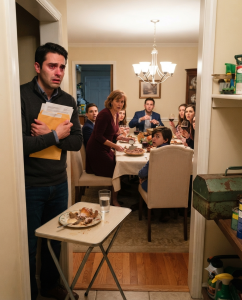
At Thanksgiving dinner, Aaron’s relatives made him sit at the folding table in the hallway because he was “only adopted.”
The humiliation of it landed with such precision that for a moment he couldn’t even react. It wasn’t new. That was the worst part. It was familiar. Carefully preserved. A cruelty aged over decades and served like family tradition.
He stood in the front hallway with his coat still in his hand while the dining room glowed warm and golden beyond him. The long table was already set beneath the chandelier. Crystal glasses caught the light. Silverware had been polished. Candles were lit. His aunt Lorraine was directing traffic near the kitchen, deciding who sat where with the same authority she used to run every holiday after Aaron’s grandfather got too tired to bother arguing.
She glanced at Aaron, then at the full table, then toward the narrow folding table set against the hallway wall.
“Oh,” she said, in the bright voice people use when they want to pretend something insulting is simply practical. “We had to make adjustments this year.”
Adjustments.
The folding table held one place setting. A mismatched fork. A paper napkin. A chipped plate already waiting there as if his arrival had been accounted for and downgraded in advance.
Aaron looked at the dining room. His cousins were settling in beneath the chandelier with wineglasses in hand. One of them laughed and pulled out a chair for his wife. Another was already pouring bourbon for Aaron’s uncle Dean. No one said a word. No one looked surprised.
Aaron was thirty-two years old, six feet tall, broad-shouldered, steady-handed, and more successful than most of the people pretending not to notice what was happening. He had his own apartment, his own career, his own life. Yet one glance at that folding table and he was twelve again, standing in a school gym while another kid asked if he knew his real parents.
He set his coat down slowly.
Lorraine approached with a turkey platter balanced in both hands. “You understand,” she said, lowering her voice like that made her kinder. “Blood matters with inheritance.”
The sentence slid into him like a blade finding an old scar.
Aaron said nothing. He had learned years ago that people like Lorraine often became bolder when challenged, then later rewrote the scene to make themselves victims. So he just nodded once and sat where she had placed him.
From the hallway table, he had a perfect view of the empty chair at the head of the dining room.
His grandfather’s chair.
No one sat in it now. No one would have dared. The old man had been dead for less than three months, and despite the greed crackling through the family like dry static, even they knew better than to take that place yet. The chair faced the room with a strange authority, as if its owner might still return from the kitchen and demand to know why everyone had suddenly become so shameless.
Aaron couldn’t stop looking at it.
His grandfather, Walter Hayes, had never once made him feel adopted.
Aaron arrived in the family at ten, carrying one duffel bag and the kind of watchful silence adults called “well-behaved” because they didn’t want to name what had caused it. Walter had crouched in front of him on that first day, rough hands on his knees, and said, “You hungry?” Not where are you from, not are you scared, not are you grateful. Just hungry. Then he took Aaron into the kitchen and made him a ham sandwich thick enough for a grown man.
That was Walter’s way. No speeches. No sentimental performances. He loved through repetition, through consistency, through teaching.
He taught Aaron to fish at dawn on the lake when the mist still sat low over the water like breath. He taught him to change a tire on the shoulder of a road without panicking. He taught him how to shake a man’s hand and look him in the eye. He taught him to pray before hard days, not because prayer erased hardship, but because it steadied your spine while you walked into it.
And once, when Aaron was fourteen and furious after one of his cousins told him he was lucky anyone had wanted him, Walter had found him in the garage punching a heavy bag so hard his knuckles split.
Walter handed him a rag and said, “Don’t answer cruelty with cruelty until the truth has room to breathe.”
Aaron had never forgotten that.
So now, in the hallway, he ate in silence while the family discussed the estate as if Walter had died solely to create their opportunity.
The meal itself should have been comforting. Turkey, stuffing, roasted carrots, green beans with almonds, sweet potatoes with pecans. But Aaron received the worst of everything. The end slices. The last scoop. Gravy poured thin and careless. Lorraine handed him the chipped plate no one else wanted and moved on.
At the real table, the conversation sharpened with each refill of wine.
“The cabin should stay in the family,” cousin Brent said, leaning back like he was already imagining himself on the dock next summer.
“I agree,” replied his sister Melanie. “It would be ridiculous to sell it.”
“With what money are you maintaining it?” asked Uncle Dean. “The taxes alone—”
“There are accounts for that,” Brent said.
Lorraine gave a little cough. “Nothing has been finalized.”
But her tone suggested she expected certain outcomes. Expected them enough to defend them before anyone could question them.
Aaron kept his eyes on his food.
Then Brent said, too loudly, “Well, obviously blood should come first.”
No one corrected him.
Aaron looked up slowly. Brent wasn’t even looking at him. He was staring into his wineglass, smirking, enjoying the performance of saying what everyone else wanted said without having to own it.
Aaron’s gaze shifted to the empty chair again.
Walter had not been a sentimental man, but he had been observant. He knew exactly who each person was when no one was trying to impress him. He knew who showed up when storms knocked down trees. Who called when someone was sick. Who borrowed tools and returned them dirty. Who took and who carried.
He knew.
That certainty was the only thing that kept Aaron in his seat until dessert.
When the pie came out, the room somehow got uglier. The conversations turned from speculative to possessive. Brent mentioned changing the fishing dock at the lake cabin. Melanie began talking about appraising Grandma’s silver. Dean asked pointed questions about whether Walter had ever updated the trust. Lorraine kept saying things like “we’ll have to be practical” and “these matters need to stay with family,” each phrase landing with all the subtlety of a slap.
Aaron set down his fork.
No one noticed.
He rose quietly and stepped away from the folding table. The hallway carpet muffled his footsteps as he moved toward the mudroom and into the attached garage. Behind him, the dining room carried on without pause. Their confidence was so complete they didn’t even bother watching him leave.
The garage was cold, dim, and full of the smell of motor oil, old lumber, and dust. It felt more honest than the dining room. Walter had spent half his life in that space building shelves, fixing tools, and refusing to throw away anything that still had one good use left in it.
Aaron leaned against the workbench and let himself breathe.
On the pegboard hung wrenches outlined in marker. Jars of screws lined one shelf. A coffee mug full of drill bits sat near a can of machine grease. Every object looked exactly where Walter would have left it.
Then Aaron’s eyes landed on the tackle box.
It was sitting near the back of the workbench, half-covered by a faded shop rag. Green metal. Rusted hinges. A shallow dent on the left side. Aaron felt a sharp pull in his chest the moment he saw it.
He knew that box.
As a boy, he had watched Walter open it before every fishing trip, lifting the compartments with a kind of care that made even cheap lures seem important. The box smelled like river water and iron and mornings before sunrise. Walter once told him, after a long quiet day on the lake, “One day, this old thing is yours.”
Aaron had smiled, thinking it was just one of those small promises old men made without ceremony.
Now he crossed the garage and pulled it closer.
The latch resisted. When he finally got it open, the hinges gave a brittle metallic groan.
Inside lay the ordinary contents no one else would value: tangled line, sinkers, faded bobbers, spoons, hooks in yellowed packaging. The kind of box greedy people dismiss because it does not glitter.
Aaron lifted the top tray.
Beneath it sat a sealed envelope.
His name was written across the front in Walter’s unmistakable handwriting.
Aaron froze.
From inside the house came a burst of laughter, then the faint clink of glass. He stared at the envelope while his heartbeat climbed. It felt suddenly impossible that no one else had found it. Impossible that Walter had trusted chance this much. But Walter had never trusted chance. He trusted people to reveal themselves. That was different.
Aaron slid a thumb beneath the seal and opened it.
Inside was a short letter.
My boy,
They will say blood matters. Let them.
Then show them my will.
Aaron’s vision blurred for one stunned second.
Behind the letter was a folded legal document. He unfolded it carefully, hands suddenly unsteady. It was Walter’s will, fully executed, signed, witnessed, dated only weeks before his death.
Aaron read the first paragraph once, then again, because the words were too large to believe on first contact.
He was named executor of the entire estate.
Not a token mention. Not an afterthought. Not the recipient of the tackle box alone, or the old truck, or some sentimental item to prove Walter had cared. Executor of everything. Responsible for administering the estate according to Walter’s directives.
Aaron turned the pages with growing disbelief.
Walter had been thorough. Specific bequests. Conditions. Signatures. Legal language clean enough to cut. There was no ambiguity in the document, and there was certainly no room for Lorraine’s bloodline speeches. Walter had known exactly what was coming after his death. More than that, he had known exactly who would need protecting from it.
Aaron rested both palms on the workbench and bowed his head.
He should have felt triumph, maybe. Vindication. Instead what came first was grief. Fresh and sudden. Because this—this hidden letter, this quiet act of protection—felt so much like Walter that Aaron could almost hear his voice in the room.
Not angry. Not dramatic. Just prepared.
After a minute, Aaron folded the will back into order and slid it behind the letter. His heartbeat steadied. Something inside him shifted—not into arrogance, not into revenge, but into certainty.
The dining room noise floated faintly through the wall again. Brent’s laugh. Lorraine’s sharp correction. Dean saying, “I’m only being realistic.”
Aaron looked down at the rusted tackle box and almost smiled.
No one had wanted it because no one had understood where Walter hid the things that mattered.
He took the envelope and walked back toward the house.
The room looked exactly the same when he entered, but the balance of it had changed completely.
Lorraine was serving pie. Brent was still wearing Walter’s watch, turning his wrist every few minutes to admire it. Melanie was stacking dessert plates. Dean was explaining probate with the confidence of a man who had read one article and mistaken it for expertise.
Aaron stepped into the dining room doorway.
At first, no one noticed.
Then Lorraine looked up.
Her eyes went to the envelope in his hand. “What is that?” she asked.
Aaron didn’t answer immediately. He walked in far enough that everyone had to stop pretending he was background scenery.
“In the garage,” he said, his voice calm. “Inside Grandpa’s tackle box.”
Brent laughed, too quickly. “What, did he leave you fishing advice?”
A few people smiled in reflex, but the joke died fast. Aaron’s expression gave them nothing.
“No,” he said. “He left me this.”
He pulled out the letter first.
Lorraine frowned. Dean set down his fork. Melanie straightened in her chair. The room’s energy changed with startling speed, greed giving way to wariness.
Aaron read aloud: “My boy, they will say blood matters. Let them. Then show them my will.”
Silence hit like a dropped curtain.
Brent’s face twitched first. “What will?”
Aaron unfolded the document and laid the front page on the table beneath the chandelier. The legal heading alone was enough to drain the room of color.
Dean stood so abruptly his chair legs scraped the floor. “Where did you get that?”
“I just told you,” Aaron said.
Lorraine moved around the table, hands damp from pie filling and dishwater. “Let me see that.”
Aaron placed one hand flat over the papers before she could grab them. Not aggressive. Just firm.
“No.”
That stopped her.
He turned the pages slowly, letting each one land in front of them like evidence. Walter’s signature. The witnesses. The notarization. The appointment of executor.
Melanie pressed a hand to her mouth.
Brent stared so hard at the signature page that Aaron followed his gaze—and that was when he noticed it. One of the witnesses was Mr. Callahan, Walter’s longtime attorney. The other was Ruth Mercer, Walter’s church friend and neighbor for thirty years.
“Impossible,” Brent muttered, but he sounded less outraged than afraid.
Dean recovered first. “This doesn’t mean what you think it means.”
Aaron met his eyes. “I know exactly what it means.”
“It could be old.”
“It’s dated six weeks before he died.”
Lorraine tried another angle. “Walter wasn’t himself near the end.”
The lie was so fast and shameless that Aaron felt something go still inside him. Walter had been weak near the end, yes. In pain, yes. But confused? Never. Until his final days, his mind had been the sharpest thing in any room.
“You’re saying his lawyer didn’t notice?” Aaron asked quietly. “Or Ruth? Or the notary?”
Lorraine’s mouth tightened.
Brent finally took off the watch.
That tiny movement told Aaron more than any speech could. Brent had been smug all night, but now his fingers fumbled. He set the watch on the tablecloth as if it had suddenly become evidence too.
Aaron looked around the room at all of them. The chandelier light was harsh now, not warm. It exposed every face instead of flattering it.
Then he continued reading.
Walter had not merely named Aaron executor. He had left specific instructions meant to prevent exactly the kind of circling greed happening at that table. The cabin was to be sold and the proceeds split according to terms Walter laid out himself. Several items were designated to named recipients. A charitable gift was included for the children’s home in the county where Aaron had once lived before being adopted. And attached to the back was a separate letter of intent explaining why Aaron had been chosen: because he was the one Walter trusted to do what was right when everyone else began fighting over what they felt entitled to.
Melanie started crying first.
Not from heartbreak. From shock. From the collapse of expectation.
Dean began pacing. “This can be contested.”
“Maybe,” Aaron said. “But not here. Not tonight.”
Lorraine’s face hardened. “You think this makes you family?”
The room went deathly still.
Aaron looked at her for a long moment. There it was. Not grief. Not confusion. Not even greed, finally stripped down. Just the pure insult of being contradicted by someone she had never fully accepted.
He answered in the same tone Walter used when he wanted the truth to stand on its own feet.
“No. He made me family a long time ago. This just proves he knew exactly who you were.”
Lorraine slapped the table.
The pie server rattled against a plate. Melanie sobbed harder. Brent swore under his breath. Dean started saying lawyer, lawyer, lawyer as if repetition could turn panic into strategy.
Aaron gathered the documents carefully.
No one tried to stop him this time.
He picked up the watch Brent had set down and placed it beside Walter’s empty chair. Then he slid the chair in fully under the table, a simple gesture that somehow silenced everyone more effectively than shouting would have.
“I’ll contact Mr. Callahan on Monday,” Aaron said. “Until then, nothing leaves this house that isn’t already yours.”
Dean opened his mouth.
Aaron raised one hand—not threatening, just final.
“For once,” he said, “listen.”
And astonishingly, they did.
He told them the locks would remain unchanged until the attorney advised otherwise. He told Brent to empty his pockets if he had removed anything from Walter’s study. He told Melanie the silver would stay exactly where it was. He told Lorraine that no family discussion about distribution meant anything now except what the signed document said.
With every sentence, the old hierarchy fell apart more visibly.
Because power in that room had never really belonged to the loudest person. It had belonged to whoever had Walter’s trust.
And Walter had given that to Aaron.
Later, after the dishes sat untouched and no one had any appetite left for pie, Aaron stepped out onto the back porch alone. The night air was cold enough to sting. Across the yard, the trees stood dark and bare against the sky. Somewhere beyond them lay the lake where Walter had taught him to cast without jerking the line.
Aaron took the letter out one more time and read it beneath the porch light.
My boy, they will say blood matters. Let them.
Then show them my will.
He laughed once, softly, the sound breaking under the weight of fresh grief. Walter had known. He had seen all the way to this moment and left Aaron not just instructions, but armor.
Inside, he could hear muted voices. Less certain now. Less proud.
He folded the letter and tucked it back into the envelope.
The next weeks were ugly, of course. Lawyers were called. Objections were threatened. Lorraine stopped speaking to him except through clipped messages. Dean tried to imply undue influence until Callahan produced notes from multiple meetings proving Walter had initiated every change himself and argued for each one with perfect clarity. Brent returned two pocketknives and an old coin set he had quietly removed from Walter’s study “for safekeeping.” Melanie apologized once, tearfully, then ruined it by asking whether sentimental value could be reassessed in light of emotional distress.
Aaron did the job anyway.
That was what being executor required. Inventory. Calls. Meetings. Locks changed. Appraisers scheduled. Documents filed. He handled the estate exactly as Walter had asked—firmly, transparently, without cruelty. The cabin was sold. The proceeds went where the will directed. The charitable gift to the children’s home was delivered in Walter’s name. The watch was passed on according to the written instruction attached to it. Lorraine received less than she expected and more than she deserved, which Walter probably would have considered a balanced outcome.
The tackle box Aaron kept.
He cleaned the rust from the hinges but not all of it. Some of the dents he left alone. On quiet mornings, he set it on a shelf in his apartment and thought about how the family had overlooked it because it did not look valuable.
That, more than anything, stayed with him.
People who worship appearances rarely recognize where truth is hidden.
By spring, the noise died down. The cousins found other things to fight about. Lorraine turned the story into one where she had been blindsided and mistreated. Dean told anyone who would listen that Walter had made things “more complicated than necessary.” No one ever admitted what happened that Thanksgiving in the simplest possible terms: they had tried to humiliate the wrong man in the house of someone who had seen straight through them all.
Aaron visited Walter’s grave alone the first time the estate was fully settled.
He brought a folding chair from his truck and set it in the grass for a moment before sitting in it himself. That made him smile. Then it made him cry.
“You were meaner than I realized,” he said quietly, looking at the headstone.
The wind moved through the cemetery trees. In his mind he could almost hear Walter answer: No. Just prepared.
Aaron stayed there a while, speaking only now and then. Thank you. I miss you. I did it right.
When he finally stood to leave, he noticed something that would have made Walter laugh. The cheap folding chair had sunk one leg into the soft ground, leaving it slightly crooked, small and awkward and out of place.
Aaron looked at it and thought of that hallway on Thanksgiving. The chipped plate. The lowered voice. Blood matters.
Maybe blood mattered to some people. Maybe it always would.
But when everything was stripped down—when pride, tradition, and performance burned away—what mattered more was who showed up, who stayed, who taught, who protected, who trusted, and who loved without asking for proof.
Walter had answered that question long before the will ever did.
The document only forced everyone else to read what he had known all along.
And if there was one detail Aaron kept turning over after all was said and done, it was not the money, or the house, or even the public humiliation of watching the family hierarchy collapse in a single evening. It was this:
They gave him the folding table because they thought it showed exactly where he belonged.
They never imagined it was the last place he would ever sit beneath them.
