They laughed when the new lunch lady asked why the children’s milk cartons were being counted twice.
At Jefferson Elementary, that question was treated like a joke.
The cafeteria was loud, messy, and fast, and people assumed the woman asking it didn’t understand how any of it worked. Patty was new to the kitchen staff, though not exactly new to hard work. She wore a clear plastic hairnet that flattened her graying curls, thick rubber gloves that made her hands sweat, and orthopedic shoes that squeaked every time she crossed the polished cafeteria floor. By ten-thirty each morning, she smelled like bleach, canned green beans, and industrial dish soap.
To everyone around her, she was just the lunch lady.
To Principal Dennis Harlow, she was barely that.
He had the kind of polished voice that sounded warm in front of parents and cold in private. He liked to sweep through the cafeteria with his tie tucked over one shoulder, nodding at children, complimenting bulletin boards, and ignoring the people who actually kept the school running. When Patty asked about the milk count during her second week, he gave her a flat smile and said, “You worry about gravy. We’ll worry about numbers.”
The cafeteria manager laughed. A few others did too.
Patty smiled back like she didn’t mind.
But she did not forget.
Numbers had once been her whole career. Long before the hairnet and the steam trays, Patty had worked in school district accounting. Twenty years. Budgets, claims, food service reimbursements, transportation expenses, payroll adjustments, audits. She knew the shape of honest paperwork. She knew where mistakes usually happened, how sloppiness looked, and how fraud liked to hide inside routine.
Then life had hit all at once.
Her husband, Raymond, had a stroke at sixty-one. The kind that didn’t kill him, which almost made it crueler. One side of his body weakened. His speech slowed. Rehab bills piled up. Insurance covered some of it, but not enough. They refinanced, then borrowed, then sold what they could. Eventually they lost the house with the hydrangeas she had planted herself along the front walk. Patty took the first steady job she could find.
That was how she ended up serving mashed potatoes to children in a school district she used to audit from the inside.
At first, she tried to keep her head down. Work was work. She needed the paycheck. She needed the insurance. She needed to get through the day without anyone treating her like pity wrapped in a uniform.
But things began catching her eye almost immediately.
Breakfast logs listed one number of milk cartons. The invoice sheets reflected another. Lunch count reports were rounded up too neatly. Fruit cups disappeared faster on paper than they did from the refrigerator. Cases of food arrived with quantities that didn’t match the shipping slips, yet the signed receiving forms always claimed everything had been delivered in full.
Patty didn’t say much. She watched.
She also listened.
Cafeteria workers complained there never seemed to be enough for the last lunch period, especially on Tuesdays and Thursdays. Teachers quietly bought crackers for students who came back from lunch hungry. One boy started stashing unopened ketchup packets in his pocket because, as he told another child, “It tastes like something.”
That one sat with Patty all day.
When she tried asking questions casually, the answers came too quickly.
“Oh, the office handles the reimbursement adjustments.”
“Sometimes counts get corrected later.”
“Deliveries are weird this year.”
“Federal rules are a mess.”
Excuses. Not explanations.
Then Patty noticed something else. Every Friday afternoon, when the buses pulled away and the campus emptied, Principal Harlow’s assistant, Marlene, left through the side door by the gym carrying large sealed envelopes. She was a nervous woman with stiff blond bangs and the habit of clutching everything to her chest. She never used the front lot for these trips. She went around back, where a black SUV waited near the old equipment shed.
She would lean in, hand over the envelopes, and come back with empty hands.
The first Friday Patty saw it, she told herself it might be payroll documents or district mail.
The second Friday, she noticed Marlene was looking around before walking out.
The third Friday, Patty wrote down the plate number on a napkin and tucked it into her apron.
That was the beginning.
She started keeping notes the way she used to during district reconciliations. Dates. Counts. Invoice totals. Shortages. Student meal denials. Staff initials. She wrote in neat block letters because neatness made things harder to dismiss. Sometimes she copied numbers onto grocery receipts in her purse. Sometimes she went to the bathroom and locked herself in a stall just to jot down a discrepancy before someone could change the paperwork again.
The more she tracked, the uglier it got.
The school was claiming reimbursement for meals that didn’t exist.
In public school nutrition programs, every approved meal mattered. There were procedures, eligibility categories, compliance rules, state reviews. The system wasn’t glamorous, but it was there for a reason: children who couldn’t afford food were supposed to be fed anyway. That money was not supposed to become anyone’s side income.
At Jefferson Elementary, it looked like someone had figured out exactly how to turn that process into cash.
Duplicate counts inflated reimbursement claims. Altered receiving sheets hid missing inventory. Approved low-income students were flagged as “pending” or “incomplete” and denied full meals even after being cleared, which lowered actual food costs while the paperwork still showed a claimable meal. The more Patty studied it, the more she understood the trick. Keep the records saying food was served. Keep the supplies looking ordered. Skim the difference.
Hungry children were the gap no one thought anyone would measure.
Then came the Tuesday that made silence impossible.
It was just before noon when a woman rushed into the cafeteria clutching a crumpled folder and dragging her son beside her. Patty knew them both by sight. The mother, Elena Ruiz, worked the early shift at a nursing home and often came straight from work in navy scrubs. Her son, Mateo, was in third grade. Serious eyes. Gentle manners. The kind of child who apologized when someone else bumped into him.
Elena looked like she had been crying in the car.
“They told him again,” she said, voice shaking. “They told him he wasn’t approved.”
Mateo stood there staring at the floor with an empty tray.
Patty felt a chill run through her before she even checked the list. She had seen his name herself on the approved roster posted in the back office days earlier.
She glanced at the tray line, then back at the boy.
“What did they give him?”
Elena swallowed. “Yesterday a cheese sandwich. Today they told him to wait until everyone else had eaten.”
The boy said nothing. That somehow made it worse.
Patty took a full tray from the line and loaded it herself. Chicken patty. Mashed potatoes. Green beans. Applesauce. A carton of milk. She placed it in front of him and said, “Go sit down, sweetheart.”
Then, lower, to Elena: “Please don’t leave yet.”
While Mateo walked to a table, Patty asked another worker to cover her station for five minutes. She headed straight to the office, where she found Marlene sorting forms.
“There’s a problem with Mateo Ruiz,” Patty said.
Marlene didn’t look up. “Then the problem is in the system.”
“He’s approved.”
Now Marlene looked up, just for a second, and Patty saw it: not confusion, not irritation, but alarm.
“I’ll handle it,” Marlene said.
That response told Patty almost everything.
During her break, she went downstairs to the records room under the excuse of searching for surplus napkins. The room smelled like dust and toner. Stacks of banker’s boxes lined the walls. She knew enough about office habits to guess where someone careless would hide what they assumed no one else understood.
She found duplicate meal claim summaries in a mislabeled binder. She found handwritten corrections on receiving logs. She found copies of eligibility rosters with names marked through, then restored later. And in one drawer, tucked under stale fundraiser brochures, she found reimbursement submissions that did not match the daily meal counts being posted in the cafeteria.
She stood there holding the papers so tightly her fingers hurt.
It wasn’t one mistake.
It was a system.
And the children denied meals were not random. They were the easiest families to push around. Parents working double shifts. Grandparents raising kids. Mothers who couldn’t take off work to sit in the office and fight. Children too embarrassed to say anything after being singled out in front of their classmates.
Patty made copies over the next three days. Not all at once. Never enough to be obvious. A page here. Two there. She hid them inside an old coupon binder because nobody looked twice at a woman her age carrying coupons.
At home, Raymond watched her spread the papers across their small kitchen table.
He spoke slowly now, but his mind was still sharp. “Bad?”
Patty stared at a line of totals highlighted in yellow. “Worse than bad.”
He looked at her for a long moment. “You going to tell?”
She almost said no.
Not because she didn’t want to. Because she knew exactly what happened to people who told the truth when the truth was expensive. They lost jobs. They got called unstable. They were accused of misunderstanding. She was fifty-six, broke, and one emergency away from disaster.
Then she thought of Mateo waiting for everyone else to eat.
“Yes,” she said.
The next school board meeting was Monday evening.
Usually those meetings drew a few parents, a couple of teachers seeking approval for field trips, and one or two retirees who came for every agenda no matter what it was. That night the room was a little fuller because rumors had already started. Elena Ruiz had told another mother. That mother had told two more. By the time Patty arrived, carrying her folder in a reusable grocery bag, there was a nervous edge in the air.
Principal Harlow sat in the front row wearing his best community smile.
Patty took a seat in the third row.
The meeting moved through pledges, minutes, maintenance updates. Harlow joked once about copier paper costs and got polite laughter. Then came public comment.
The board president had barely invited speakers forward before Harlow stood and said, “Given the routine nature of tonight’s agenda, I’d recommend limiting comment time so we can move efficiently through housekeeping matters.”
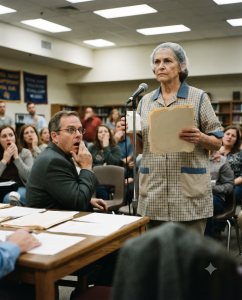
Patty rose before anyone answered him.
Heads turned.
She walked to the microphone carrying her folder in one hand and a single unopened milk carton in the other. She had taken it from the cooler at the end of lunch and slipped it into her bag. It was cold against her palm even now.
Harlow forced a smile. “Ms. Patty, if this concerns cafeteria workflow, we can address—”
She set the milk carton on the table beside the microphone.
“This concerns theft,” she said.
The room went completely still.
Harlow’s face changed first, just slightly. Then Marlene’s. Then the board members began looking at one another.
Patty opened her folder.
For the next six minutes, she did what she had done for most of her adult life: she explained the numbers.
She walked the board through duplicated milk counts. Inflated meal claims. Altered receiving records. approved student meal denials. Mismatched inventory. Copies of claims submitted for reimbursement after children had been given lesser meals or turned away. She handed over highlighted pages, side-by-side comparisons, dates, signatures.
Then she lifted the milk carton.
“This was counted twice,” she said. “So were breakfasts. So were lunches. On paper, anyway. But some of these children never got what the school claimed for them.”
Nobody interrupted.
Patty turned and looked directly at Principal Harlow.
“You stole from hungry children.”
The sentence landed like glass breaking.
A gasp came from the back of the room. One board member began flipping through the pages so fast they rattled. Another looked up and asked Harlow if he wanted to respond, but his response came out fragmented. He talked about procedures. Miscommunications. Complex compliance requirements. Clerical issues.
Every excuse made him sound guiltier.
Then Patty said, “There’s more.”
She described the Friday envelope deliveries behind the gym. Same assistant. Same black SUV. Same pattern. Same dates lining up with unexplained spikes in reimbursement claims and missing supporting documents.
Marlene started crying.
At first she tried to hide it, covering her face with one hand. But the room was too silent, and everyone heard the sound she made.
Then Elena Ruiz stood up in the back and told the board how her son had been denied lunch three days in a row despite being approved. Another father stood and said his daughter had been told to put back a fruit cup because her account was “flagged.” A grandmother described sending extra crackers in a plastic bag because her grandson kept coming home hungry. One teacher admitted she had started keeping granola bars in her desk because too many students returned from lunch asking for something to eat.
The stories kept coming.
This was no longer about paperwork.
It was about children.
The board president called for a recess and told no one to leave. The district’s legal counsel, who had attended remotely, demanded copies of every document immediately. Someone called the superintendent. Someone else called the district compliance officer. Harlow tried to step into the hallway, but a board member told him sharply to remain seated.
That was when the board president turned to Marlene.
“What was in the envelopes?”
Marlene looked at Harlow.
He stared back at her with the hard, dead look of a man whose charm had finally failed.
She started shaking.
“Cash logs,” she whispered.
No one moved.
“Petty cash withdrawals. reimbursement transfers. He said it was temporary. He said he’d fix it before audit season.”
Harlow snapped, “Marlene, stop talking.”
But she was already unraveling.
She admitted the SUV belonged to her brother-in-law, who had been cashing out portions of diverted funds through a small vending company to make the money harder to trace. Harlow had told her the district would never notice because food program accounting was “too messy” and no one paid attention to lunch staff. They had used altered counts to increase reimbursement claims, then reduced actual food costs by denying some approved students full hot meals whenever they thought parents wouldn’t fight back.
The board room erupted.
One man shouted. A mother began crying. A teacher covered her mouth. Harlow stood and insisted none of them understood the pressure schools were under, the budget constraints, the “creative decisions” required to keep programs afloat. It was the worst possible defense, because it wasn’t denial. It was entitlement.
Patty listened with her jaw clenched.
For a brief second, Harlow looked at her the way he always had—like she was small, temporary, beneath him. Then he realized that everyone else in the room was looking at her differently now.
Not as the lunch lady.
As the woman who had seen what none of them had.
Police arrived before the meeting ended.
The district placed Harlow and Marlene on immediate administrative leave pending investigation. Within forty-eight hours, state officials were reviewing Jefferson Elementary’s meal program records. By the end of the week, local news stations were running the story on the evening broadcast. A still frame of Patty leaving the board building in her cafeteria uniform appeared online under headlines nobody in town could ignore.
Lunch Lady Exposes School Meal Fraud.
Parents who had barely known her name before stopped her in grocery store aisles to thank her. Children waved at her from car windows. Some of the cafeteria staff who had laughed at her that first question wouldn’t meet her eyes for days.
The district uncovered months of falsified claims. More missing funds than anyone expected. Enough evidence for criminal charges. Harlow resigned before he was formally terminated, but it did not save him. Marlene cooperated and received lesser charges in exchange for testimony. The vending company was investigated too.
As for the school, new oversight was imposed almost immediately. Meal eligibility files were reviewed. Every child improperly denied meals was reinstated. Families received apologies, though many said apologies weren’t enough. A local church donated emergency grocery cards. A community group started a weekend backpack food program. Teachers no longer had to hide snacks in desk drawers.
One afternoon, a few weeks later, Mateo Ruiz came through Patty’s lunch line holding his tray with both hands.
“Hi, Ms. Patty,” he said.
“Hi, sweetheart.”
He hesitated, then asked, “Can I have milk today?”
The question hit her harder than any board meeting had.
She smiled and picked up a carton. “You can always have milk.”
He took it, nodded solemnly, and went to sit down.
That night, Patty told Raymond about it while reheating soup in their apartment kitchen. He listened, his speech still halting but his eyes clear.
“Proud,” he said.
She looked at him. “Of me?”
He gave the smallest smile. “Always.”
The town kept talking about the scandal for months. About corruption. About oversight failures. About greed. About how many adults had seen pieces of the problem and chosen not to look too closely because looking might have required doing something.
But what people remembered most was simpler than that.
A woman they dismissed because she served lunch had noticed one thing no one else thought mattered. A number off by one. Then another. Then another. A milk carton counted twice.
That was all it took to start pulling at the thread.
And maybe that was the hardest part to forget.
Not that a principal stole from hungry children.
Not even that he thought he could get away with it.
It was that he was almost right.
If Patty had been just a little more tired, a little more scared, a little more willing to believe her job was only gravy and trays, the whole thing might have gone on much longer. Children would have kept getting less. Parents would have kept blaming paperwork. A thief would have kept calling himself an administrator.
Instead, the person everyone overlooked became the one person who could not be fooled.
Even after the arrests, people argued about blame. Some said Marlene was pressured. Some said budget desperation made monsters out of ordinary people. Some said Harlow had probably started with one “temporary adjustment” and taught himself not to see the damage. Maybe all of that was true in pieces.
But none of it changed the part that mattered most.
When the choice came down to protecting a paycheck or protecting children, Patty chose the children.
And for a town that had almost missed what was happening right in front of it, that truth lingered longer than the scandal itself.
Because once you know who looked away—and who didn’t—you start seeing everything differently.
