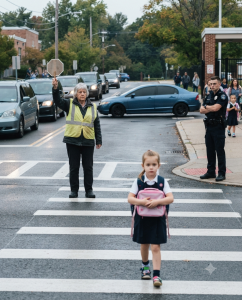
The young police officer thought the old crossing guard was overreacting.
By the end of the day, he understood he had been standing beside someone who had probably saved more lives with instinct than most people ever would with authority.
Every morning before sunrise, Agnes Nolan followed the same routine. She filled a small floral thermos with black tea, buttoned her coat, pinned her thinning gray hair back from her face, and tugged her faded yellow safety vest over her sweater. The vest was a little too large and the reflective strips had dulled with age, but she wore it with the same neat care she once gave to her dispatcher’s headset.
At 7:15, she left her house.
At 7:22, she reached the corner by Hartwell Elementary.
At 7:25, she took her post at the crosswalk.
Children came in waves after that, first in twos and threes, then in clumps. Some skipped. Some dragged their feet. Some shouted to friends across the street until she raised one finger and gave them a look that meant: not until the cars stop.
She knew almost every child’s name. She knew which parents were always late, which siblings fought every morning, which kids pretended they were too grown up to wave goodbye and then secretly looked back anyway.
The neighborhood treated her as part of the landscape. She was the woman with the stop sign. The one in the vest. The one who stood there in rain and heat and November wind and never seemed bothered by any of it.
They liked her.
But they did not really see her.
Before she stood at that corner, Agnes Nolan had spent twenty-seven years as a police dispatcher. Nearly three decades listening to panic come through phone lines in every form it could take. She had heard calm voices crack apart mid-sentence. She had heard people whisper addresses while hiding in bathrooms. She had heard children answer questions they were too young to understand because an adult nearby had told them exactly what not to say.
Dispatch work had taught her something that never quite left the body: danger often arrived before proof did.
It showed up in patterns.
In timing.
In silence where there should have been noise.
In tiny things no one else bothered to connect.
That Wednesday morning, nothing looked unusual at first. A school bus had already passed. A man in running clothes jogged by with wireless earbuds in. Two mothers stood side by side comparing after-school schedules while their children made sword-fighting motions with rolled-up homework packets.
Agnes stood at the curb, thermos in one hand, stop sign in the other, breathing in the ordinary rhythm of the hour.
Then she noticed the girl.
The child was alone, walking down Maple Street toward the school gate. She looked to be around seven, maybe eight at most. She held a pink plastic lunchbox in both hands, pressed high against her chest the way children did when they felt uncertain and wanted something solid to anchor themselves. Her chin was slightly tucked. Her expression was empty—not exactly sad, not tearful, not dazed in the usual sleepy way.
Empty.
That was the word that settled in Agnes’s mind.
Her hair was unevenly brushed, one side smoothed down, the other puffed out. Her socks didn’t match. And then Agnes saw the detail that pulled everything else into sharper focus.
The girl’s shoes were on the wrong feet.
Not loosely. Not by childish accident that had gone unnoticed until the first few uncomfortable steps. They had been forced onto the wrong feet in a hurry. The shoes bent awkwardly at the sides as the girl walked. The laces were sloppy, half-tied, one trailing dangerously low.
Agnes felt the old instinct wake up.
She looked around for the adult who might be hurrying behind the girl. No one.
Then a blue sedan rolled past the block.
It was clean, older model, dark-tinted rear windows, no child visible in the back. It moved slowly enough that Agnes noticed the driver’s side mirror was slightly cracked. The car did not stop. It did not signal. It simply passed the school entrance, continued to the corner, then turned out of sight.
She watched it go.
A minute later, one of the mothers beside her said, “I swear this school pickup line takes years off my life,” and laughed. Agnes gave a polite smile, but her attention stayed on the far corner.
The blue sedan came back.
Same direction.
Same crawl.
This time it slowed a little more as it passed the crosswalk.
Agnes felt her fingers tighten around the thermos. She shifted it into the crook of her arm and kept watching. The driver’s face was hard to make out through the glare and windshield reflection, but the posture was wrong. The car wasn’t moving like a lost parent or someone searching for an address. It moved like it was observing.
It reached the end of the block and disappeared again.
Agnes looked back at the girl. The child had reached the edge of the school property, but she still had not looked around, had not smiled at another kid, had not adjusted her shoes, had not shown a single sign of being fully present in the morning around her.
Agnes had taken hundreds of calls involving children over the years. Custody disputes. Domestic incidents. Attempted abductions. Neglect cases. Terrified relatives. Panicked schools. She knew the look of a child moving on instruction instead of comfort.
Then the sedan appeared for the third time.
That was enough.
Agnes stepped off the curb, planted herself squarely in the lane, and raised the stop sign before anyone had entered the crosswalk.
Brakes squealed almost immediately.
A contractor in a pickup leaned on his horn. A woman in a luxury SUV slapped her steering wheel and mouthed something furious through the windshield. The line of cars began to bunch up behind the intersection.
“Mrs. Nolan?” one parent called, confused.
Agnes did not answer.
Her eyes stayed fixed down the street.
A patrol officer assigned to the corner that week turned from where he had been standing near the gate. Officer Daniel Ruiz had joined the department less than a year earlier. He was bright, eager, and by-the-book, with a clean uniform, careful haircut, and the kind of confidence that came from still believing every situation had a standard response.
He walked toward her quickly, already seeing the traffic problem before he saw anything else.
“Ma’am,” he said, keeping his voice low, “you’re blocking the intersection.”
Agnes didn’t lower the sign.
“You’re creating a problem,” he added.
She looked at him only once.
“No,” she said. “I’m waiting for one.”
For a second, Daniel thought maybe he had misheard her.
Behind him, another horn sounded. Someone shouted, “Come on!” from a car window. He felt heat rise up his neck. The crossing guard was supposed to help maintain order, not freeze the whole street because of a feeling.
“Please step back onto the curb,” he said, more firmly this time.
Agnes ignored the instruction.
At the far end of the block, the blue sedan came into view again.
Daniel followed her line of sight. “What am I looking at?”
Agnes said, “That car has passed three times.”
“So?” he said.
“It hasn’t dropped off a child. It hasn’t parked. It keeps slowing here.”
Daniel squinted toward the vehicle. There were dozens of cars around schools every morning. People got lost. Parents doubled back. Delivery drivers hesitated. He was about to say exactly that when the sedan slowed again near the crosswalk.
Not a normal slow.
A deliberate one.
The kind that held for a beat too long.
Agnes slipped a pen from her vest pocket, pulled the cardboard sleeve off her tea cup, and wrote down the plate number in fast, practiced strokes. Her handwriting was tight, all business.
“Take this,” she said.
Daniel looked at the cup sleeve.
He almost waved it off.
Almost.
But there was something in her face he didn’t know how to dismiss. Not fear. Not drama. Certainty. Hard-earned certainty.
He took the number and radioed it in mostly to settle the matter.
Agnes stepped back. The traffic moved. The cars rolled forward with the universal irritation of people who had no idea what had just nearly brushed against their morning.
Daniel expected the response to come back clean. Maybe a registration match. Maybe nothing at all. He expected to hand the cardboard sleeve back to her later with an awkward, “Looks like it was just someone circling.”
Instead, thirty-five minutes later, dispatch asked him to repeat the plate twice.
Then he was told to stand by.
Then the plate came back belonging to a completely different vehicle.
Fake plate.
His spine went cold.
From there, events picked up speed. The information was routed to detectives and nearby patrols. Units were quietly told to monitor schools in the surrounding area. A search was launched for the blue sedan without triggering panic around Hartwell Elementary.
Daniel stayed on post, but the whole morning tilted under his feet. He kept replaying the moment Agnes had stood in the street as if she had known.
By early afternoon, the blue sedan was found parked near a smaller school three neighborhoods away.
No driver in sight.
The fake plate still attached.
And on the back seat, several children’s backpacks.
Daniel was in the station when the update landed. He stared at the report for a long second, reading the same line twice as though the words might rearrange into something less sickening. Several backpacks. Not one. Not an innocent misunderstanding. Not a parent in the wrong drop-off lane.
Several.
A detective later told him they were still sorting through what it meant and who the driver was connected to. Some of the bags had school keychains, some had names removed, and none of it sat right. The details were still unfolding, but one fact was already clear: Agnes Nolan had spotted something before it had the chance to become worse.
That afternoon Daniel drove back to Hartwell early for dismissal.
Agnes was there as always, standing straight at the curb as children began to spill toward the gate. Nothing in her face suggested she had spent the day proving half the department wrong. She looked exactly as she had that morning: yellow vest, thermos, sensible shoes, silver hair pinned back.
Daniel crossed to her with a humility that felt unfamiliar but necessary.
“Mrs. Nolan,” he said.
She glanced over. “Officer.”
He cleared his throat. “They found the car.”
“I figured they might,” she said.
He almost smiled at how understated that was. “The plates were fake.”
Agnes nodded once, not surprised.
He added, quieter now, “There were backpacks in the back seat.”
That earned the smallest pause from her. Not shock—more like grief confirming itself.
Daniel exhaled. “I owe you an apology.”
Agnes looked at him properly then.
“For this morning,” he said. “I should’ve listened.”
She held his gaze for a moment that made him feel both forgiven and instructed at the same time.
Then she said, “You listened eventually. That matters too.”
Before he could answer, the school doors opened and the children came out in streams of chatter, sneakers squeaking, lunch bags swinging, teachers calling reminders over the noise.
Among them was the little girl from that morning.
Daniel recognized her immediately. She was still quieter than the others, though less hollow now. Her lunchbox dangled at her side. An older woman rushed forward the instant she saw her and dropped to both knees on the sidewalk.
The woman pulled the girl into her arms so tightly the child’s body rocked with the force of it.
Daniel watched, assuming it was the mother, until Agnes said, almost to herself, “That’s not her mother.”
He turned. “How can you tell?”
Agnes nodded toward them. “The child isn’t collapsing into her. She’s tolerating the hug. And look at the woman’s face.”
The woman was crying hard, but beneath the relief was something else—raw alarm, as if she had only just learned how close something had come.
“An aunt, maybe,” Agnes said.
Daniel stared. “You can tell all that from this distance?”
Agnes gave a dry, humorless little smile. “Years of people telling me they were fine.”
Daniel looked back at the girl. The child had pulled away and was saying something up to the woman. The woman froze, both hands still on the girl’s shoulders.
At that exact moment, a dark sedan—not blue, a different make—slowed at the end of the block.
Daniel saw Agnes see it.
Everything in both of them went still.
The girl noticed too.
And flinched.
It was tiny, but unmistakable.
Agnes lifted the stop sign instantly, blocking the crosswalk though no child had stepped out yet. Daniel’s hand flew to his radio.
The dark sedan rolled closer, not illegal, not overtly threatening, but slow enough to make every nerve in his body start firing. He moved a step forward.
The aunt bent down as the little girl whispered something into her ear.
The woman’s face drained of color.
Daniel didn’t wait. He called in the vehicle and moved into the street just as the sedan accelerated—not fast, not a chase-worthy burst, but enough to confirm what instinct had already said. It kept going, turned the corner, and vanished into traffic.
When he came back, the aunt was shaking so badly she had to sit on the low brick wall outside the school. The little girl stayed pressed against her side, staring at the sidewalk.
“What did she say?” Daniel asked gently.
The aunt looked up with eyes red from crying and fear.
“She said,” the aunt whispered, “‘That’s the car the man told me to watch for if he came back for me.’”
The words settled over the sidewalk like cold rain.
Daniel crouched to the child’s level, softened his expression, and introduced himself. He asked careful questions, the way he’d been trained to do, but Agnes could hear the edge in his voice now. This was no longer theory to him. It had become a living, breathing child standing in uncomfortable shoes.
The girl explained in fragments. That morning, her mother had not taken her to school. A man she didn’t know well had driven her instead because “Mom’s friend said it was okay.” He had been nice at first. Too nice. He had bought her a juice. He had told her to keep looking down. He had tied her shoes for her after laughing that she’d “done them silly,” except he’d put them on wrong himself while talking fast and checking the mirrors. Before letting her out a block from school, he had leaned over the seat and told her if a dark car came later, she was to walk to it because plans changed sometimes and grown-ups forgot to explain.
The aunt started crying harder as the girl talked.
Daniel asked where the mother was.
That answer was uglier. The mother had left early for work, believing the child was being driven by someone safe. The arrangement had come through a boyfriend she had only been seeing a short time. The boyfriend was now not answering calls. Detectives would later uncover enough lies, fake names, and shifting stories around him to fill a wall.
But that afternoon, all of that came second to one brutal fact:
A child had been handed into danger through trust borrowed from the wrong person.
And an old crossing guard had noticed because the shoes were wrong.
The investigation stretched for weeks. There were arrests. There were interviews. There were details that never fully made it into public view because some stories involving children stayed mercifully sealed. But enough came out for the neighborhood to understand how close the edge had been. The backpacks in the sedan were connected to attempted lures near schools in nearby districts. The fake plates were only one layer. The man tied to the morning drop-off was part of something darker than one impulsive act.
Hartwell Elementary changed after that.
More police presence.
Tighter pickup procedures.
Parents checking names twice, then a third time.
The principal publicly thanked Officer Ruiz and “a vigilant staff member” without using Agnes’s name, at her request. She had no interest in newspaper photos or local TV interviews. She hated fuss.
But the neighborhood started looking at her differently.
They saw the vest, yes.
They also saw the history standing inside it.
Children still waved. Parents still hurried. Cars still lined up every morning. The world kept going, because that is what the world does even after it learns how narrowly disaster missed.
A week after the incident, Daniel brought Agnes a new cardboard notepad small enough to fit in her vest pocket.
“For plate numbers,” he said.
She took it, glanced at it, and said, “You assume I’ll need it again?”
“I assume you’ll notice things before I do,” he replied.
That made her laugh for the first time.
It became an unspoken habit after that. Daniel took her instincts seriously. Not because she was older. Not because she had once worked in dispatch. Because she had earned the right to be believed.
On a chilly morning later that fall, he stood beside her at the corner while a line of second-graders crossed with paper pumpkins sticking out of their backpacks.
“You really knew from the shoes?” he asked.
Agnes sipped her tea before answering.
“Not from the shoes alone,” she said. “From everything. The shoes. The face. The lunchbox. The car looping back. The way no one else noticed because everyone was busy looking at their own morning.”
Daniel nodded.
“That’s the hard part,” Agnes went on. “Danger doesn’t always look dramatic. Most of the time it looks ordinary—until you hold still long enough to see what doesn’t belong.”
He thought about that for a long time.
The girl recovered slowly, Daniel heard. The aunt became the one handling school drop-offs for a while. The mother, burdened by guilt and bad choices, had to reckon with how trust had been exploited through her own carelessness. No one came out of it untouched. That was the aftershock of these things: even when the worst outcome was prevented, something still broke. Security. Assumptions. The easy belief that bad things always looked obvious from a distance.
As for Agnes, she kept showing up at 7:22 every morning.
Yellow vest.
Thermos of tea.
Stop sign in hand.
She never told the story. Other people did that for her, often badly, sanding it down into something simpler. The crossing guard who saved a child. The grandmotherly hero at the school gate. The sweet old lady who trusted her gut.
But Daniel knew the truth was sharper than that.
Agnes Nolan had not acted from vague intuition.
She had acted from decades of listening to what fear sounded like before it had a name.
She had seen a child moving through the world in a way that did not fit.
She had seen a car circling not with confusion, but intention.
She had been willing to inconvenience strangers, irritate authority, and look foolish for a few minutes because she understood something most people didn’t: embarrassment is cheap. Regret is not.
Years later, Daniel would tell younger officers about that morning whenever they got too attached to procedure without perception. He’d tell them to learn the paperwork, yes. Learn the codes. Learn the policy. But also learn to pay attention to the person who had been watching the same corner longer than you had been wearing a badge.
Because sometimes the person who prevents the emergency is never the one who gets credit for responding to it.
Sometimes it’s the woman everybody stopped noticing.
The one people assume is just part of the scenery.
The one with the tea thermos and the fading yellow vest.
The one who looked at a little girl’s backward shoes and understood that a child’s whole life might be hanging from that one wrong detail.
And even after everything was over—even after the fake plates, the backpacks, the apology, the police reports, the shaken parents and the tightened rules—the question that lingered most stubbornly in the minds of the people who knew the full story was not whether Agnes Nolan had done the right thing.
It was how many times in their own lives they had ignored something small because it was easier to call it nothing.
Maybe that was the real aftershock.
Not just gratitude that a tragedy had been stopped.
But the uneasy realization that the biggest red flags rarely wave themselves.
Someone has to notice them.
And when that person does, you can only hope everyone else is wise enough to listen.
