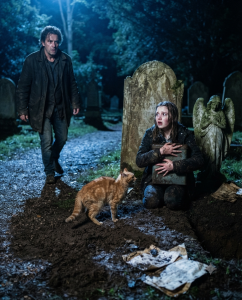
The orange tabby first appeared so often that people stopped treating him like a stray and started treating him like part of the cemetery.
Every Sunday, just after the church bells rang across the small town, he would slip through the rusted side gate, move past the newer plots without even glancing at them, and head straight for the oldest section in the back. He never hesitated. He never wandered. He went to the same grave every single time, climbed onto the worn patch of earth beneath a weathered stone angel, wrapped his tail around his paws, and sat there until dusk.
No one knew where he came from. No one knew where he slept during the week. The groundskeeper started leaving scraps out for him and called him Pumpkin, mostly because of his color and partly because it was easier than calling him “that strange cat again.”
Children tried to pet him once or twice, but Pumpkin made it clear he wanted no one near him unless he chose otherwise. He was not mean for the sake of it. He was watchful. Serious. As if he had a job to do.
The grave he chose belonged to a man named Henry Cole.
Lily knew the name long before she understood why it mattered.
She was twelve the first time she really paid attention. She had gone to the cemetery with her grandmother to place fresh flowers on family graves. It was warm, the grass was overgrown in places, and the old stones leaned like tired shoulders under years of wind and rain. Pumpkin was already there on Henry Cole’s grave, staring at them as they approached.
Lily’s grandmother stopped walking.
It happened so suddenly Lily nearly bumped into her. Her grandmother stared at the headstone, and all the color left her face. A moment later her eyes filled. She turned away quickly, but not before Lily saw tears spill down her cheek.
“Grandma?” Lily asked gently. “Who was Henry Cole?”
Her grandmother pressed her lips together. “No one you need to worry about.”
That answer might have worked once. It did not work after Lily saw the grief in her face.
On the drive home, Lily asked again. Her mother, who was at the wheel, tightened both hands on the steering wheel and said nothing. Her uncle, sitting in the passenger seat, gave a dry, irritated laugh.
“Dead people don’t need to become dinner table stories,” he said. “Let old things stay buried.”
The mood in the car turned so cold that Lily looked out the window and kept quiet. But the question remained.
Why did her grandmother cry over a stranger?
Why did her mother go silent every time the name came up?
Why did her uncle react as though the grave itself insulted him?
Those questions sat in the background of Lily’s life for years, never answered but never disappearing.
There were other strange things too.
Her grandmother kept an old framed photograph in her bedroom drawer, always hidden beneath folded scarves. Once, while helping put away laundry, Lily accidentally saw it. It showed a younger version of her grandmother standing beside a tall dark-haired man with a serious expression and kind eyes. The man had one hand resting on the shoulder of a little boy Lily did not recognize at first. Then she realized the child looked unmistakably like her uncle.
Before Lily could ask anything, her grandmother had quietly taken the photograph and turned it face down.
“Some memories make too much noise,” she said.
Lily never forgot the sentence, though she didn’t understand it.
Then everything changed the summer the funeral home sold the back acres.
The cemetery had always seemed permanent to Lily, the kind of place no one could touch. But land was land, and once development money entered the conversation, permanence suddenly became negotiable. The funeral home announced that an old section near the rear boundary would be cleared to make room for an access road and utility work for a housing project. Some graves would be relocated “with respect and legal oversight.”
That phrase spread quickly through town.
Legal oversight.
Respectful relocation.
Approved paperwork.
Lily’s uncle repeated those same words over and over as if saying them enough times would make everyone stop asking questions. He handled family matters loudly and confidently, which often worked because most people hated conflict more than they loved truth.
At Sunday supper, he laid out the situation as though it were already finished.
“The paperwork is done,” he said, slicing his roast with quick angry movements. “Everything has been reviewed. The old section isn’t protected the way you think it is. Some graves are being moved, that’s all.”
Her mother stared down at her plate. Lily’s grandmother didn’t touch her food.
“Which graves?” Lily asked.
Her uncle looked annoyed that she had spoken at all. “Several old ones. Including Henry Cole’s.”
Her grandmother’s fork slipped from her hand and clattered against the plate.
No one moved.
“It’s legal,” her uncle said flatly. “And this family needs to stop acting like a stone with a name on it changes anything.”
Lily looked at her grandmother, expecting tears.
Instead, she saw fear.
Not ordinary sadness. Not nostalgia. Fear so sharp it seemed to hollow her out from the inside.
That was when Lily understood something terrible.
Whatever Henry Cole represented, it wasn’t only grief.
It was danger.
A few days later, workers arrived at the cemetery with survey flags, equipment, and the kind of casual impatience people bring to jobs they think are straightforward. Lily went after school because she couldn’t shake the feeling that something irreversible was about to happen.
Pumpkin was already there.
The cat sat on Henry Cole’s grave beneath the stone angel, his body still, his eyes fixed on the approaching men. One worker laughed when he saw him.
“Well, there’s your foreman,” he joked.
He took two steps forward.
Pumpkin rose in a flash, back arched, ears flat, hiss tearing out of him so viciously the man stumbled backward.
The others laughed at first too. Then another tried. Pumpkin lunged again, claws cutting dirt, body between the workers and the grave with a fury far too focused to be random.
“Get that thing out of here,” one of them muttered.
But no one could.
Every time someone approached the plot, Pumpkin attacked the space in front of it like a guard dog trapped in a cat’s body. He did not run when shouted at. He did not retreat when dirt kicked up around him. He held the line.
By the time Lily’s grandmother arrived, half the workers were standing back muttering that the grave could wait until animal control came. Her grandmother stopped at the sight of Pumpkin protecting the headstone and covered her mouth with both hands.
Her uncle arrived moments later, angry before he even got out of his truck.
“This is ridiculous,” he snapped. “Move the cat and do the job.”
Pumpkin turned toward him with a sound Lily had never heard before, lower and harsher than a hiss. The cat stared at him with a kind of focused hatred that made the hair rise on Lily’s arms.
Her uncle looked away first.
Lily noticed it immediately.
He would bark at workers. He would glare at his mother. He would ignore Lily entirely. But he would not hold the cat’s gaze.
“Grandma,” Lily whispered, stepping closer. “Tell me what’s going on.”
Her grandmother’s eyes moved from Henry Cole’s grave to the stone angel beside it. The angel was old and darkened by age, one wing chipped, one hand stretched down toward the earth as though pointing.
For a moment, her grandmother said nothing.
Then, barely above a whisper, she said, “Dig near the stone angel.”
The nearest worker frowned. “Ma’am, I can’t just start digging wherever—”
“Dig there,” she said again, louder.
Lily’s uncle whipped around. “No.”
One word, but it cracked through the cemetery like a gunshot.
Everyone went still.
Lily stared at him. Her grandmother slowly turned to face him, and the expression on her face was unlike anything Lily had ever seen. Her grandmother had always been soft-spoken, even when upset. But now her grief had hardened into something that looked almost like contempt.
“You knew,” she said quietly.
His jaw tightened. “You need to stop.”
“You knew,” she repeated.
The workers exchanged nervous looks. One muttered that they were not getting involved in a family dispute. Another shut down a machine. Within minutes the entire crew had retreated into awkward excuses about permits, supervisors, and coming back later.
Her uncle stepped close to her grandmother and said something too low for Lily to hear. Whatever it was made her grandmother sway, but she did not back down.
By sunset, everyone was gone.
Except Pumpkin.
And Lily.
She spent the evening pretending to do homework while the hidden tension in her house thickened around every doorway. Her grandmother locked herself in her bedroom. Her mother washed the same plate twice. Her uncle left in his truck after making a phone call from the back porch, his voice clipped and urgent.
Lily waited until darkness settled fully over the town.
Then she took a garden spade from the shed and rode her bike back to the cemetery.
The place looked different at night. Larger. Older. The new survey flags fluttered in the wind like warning markers. The stone angel cast a long shadow under the moonlight. Pumpkin sat exactly where she expected him to be, between Henry Cole’s grave and the angel, as though he had been waiting for her specifically.
“You know,” Lily whispered, breathless from the ride. “You really know.”
Pumpkin stood and walked to the angel.
That was all the invitation she needed.
The ground near the statue was packed tight, covered in roots and years of neglect. Lily dug carefully at first, then harder as excitement and fear made her reckless. Dirt coated her hands. Sweat dampened the back of her shirt. More than once she almost stopped, convinced she was chasing a family ghost that would lead nowhere.
Then the metal edge of the spade struck something hollow.
Her breath caught.
She dropped to her knees and clawed dirt away until she uncovered a small waterproof box sealed against time. Pumpkin came closer but made no sound. He simply watched.
Lily opened the box with shaking fingers.
Inside was a bundle of letters tied with faded blue ribbon, an old marriage certificate, and a birth record.
At first the documents made no sense because Lily’s mind refused to read what was plainly there.
The marriage certificate listed her grandmother’s name.
And Henry Cole’s.
Married.
Years before the date everyone in the family claimed her grandmother had first wed.
Lily stared until the words blurred. Then she reached for the birth record.
Her own mother’s name.
Henry Cole listed as father.
The air left Lily’s lungs.
Henry Cole was not a stranger. He was not a family friend or a forgotten relative.
He was her grandfather.
Her real grandfather.
The one no one spoke about.
Her hands trembled so badly she nearly dropped the papers. She forced herself to read farther. There were property documents too, older and more brittle. They showed ownership rights tied to her grandmother and Henry Cole, not to the man Lily had always known as the legal head of the family estate after them. There were notes in the margins. Corrections. Signatures. Dates.
Enough to show one thing clearly.
The portion of cemetery land sold to the developer had not belonged to Lily’s uncle.
He had no right to sell it.
A chill crawled over Lily’s skin. All the silence in her family began to rearrange itself into shape. Her grandmother’s tears. Her mother’s avoidance. The photograph hidden away. Her uncle’s anger every time Henry Cole’s name surfaced. The urgency to move the grave. The refusal to dig near the angel.
Pumpkin had not been guarding a random grave.
He had been guarding evidence.
Lily untied the ribbon around the letters and pulled out the top one. The paper crackled in her hands. The handwriting was unmistakably her grandmother’s, but younger, tighter, and full of panic.
If anything happens to Henry, do not trust our son with the land.
Lily read the line twice.
Their son.
Not just her grandmother’s son. Henry’s son.
Her uncle.
Her pulse hammered.
She read on. The letter referenced missing papers, shouting in the house, and Henry’s insistence that “the truth has gone on long enough.” Another line, squeezed into the margin as if added in haste, made her stomach turn.
He knows the child is not his, and he said he will expose everything after Sunday.
Not his.
Lily lowered the page slowly.
Which child?
Her uncle?
Her mother?
What truth?
The crunch of tires on gravel snapped her head up.
Headlights swept past the cemetery gate.
Pumpkin moved instantly, body low, fur bristling.
Lily shoved the letters back into the box, but she was too late. A truck door slammed. Footsteps came fast through the dark.
“I told them to leave that grave alone.”
Her uncle’s voice.
He stepped into the moonlight looking nothing like the loud confident man from Sunday dinners. His face was pale and tight, his eyes fixed on the muddy box in Lily’s hands. He looked angry, yes, but beneath the anger was something uglier.
Panic.
Pumpkin launched himself forward with a vicious hiss and planted himself between Lily and the path. Her uncle stopped.
“Move the cat,” he said.
Lily backed up, clutching the box against her chest. “Why?”
“Give me that.”
“Why did Grandma say to dig here?”
His expression flickered. “Because she’s spent half her life feeding herself stories.”
“You sold land that wasn’t yours.”
“That’s not what happened.”
“I found the marriage certificate.”
For one terrible second, all the confidence drained from his face.
Then it came back, colder than before.
“She lied to all of you,” he said. “She lied before you were born, and she’s lying now.”
Lily’s voice shook. “Henry Cole was my grandfather.”
Her uncle laughed once, but it held no humor. “That’s the problem with old papers. People think ink tells the truth.”
Pumpkin hissed again, louder.
Lily tightened her grip on the box. “Then tell me the truth.”
He stepped closer, careful not to trigger the cat. “Your grandmother had a life before the family story you were told. Henry knew pieces of it. Not all of it. By the end, he knew enough to threaten everything.”
“What does that mean?”
His eyes dropped to the letters. “It means the wrong person found the wrong box.”
Lily wanted to run, but fear rooted her in place. “Why were you so desperate to move the grave?”
He looked at Henry Cole’s headstone, and when he spoke again his voice had changed. It was no longer merely angry. It sounded old, wounded, and cornered all at once.
“Because once those letters came out, there was no way to save anyone.”
That was the moment Lily realized he was not trying to protect himself alone.
He was protecting the version of the family that had survived by keeping Henry Cole buried twice—once in the ground, and once in memory.
“Not his,” Lily said softly. “Who wasn’t his?”
Her uncle’s jaw locked.
He stared at her for a long time, then at the grave, then toward the dark road as though measuring how much of the past could still be outrun.
Finally he said, “Your mother.”
The word hit Lily harder than a scream.
He spoke before she could react.
“Henry raised her anyway. He signed everything. He gave her his name. But when he found out where she really came from, he said the land should pass only through the truth. He wanted everything corrected. Every document. Every inheritance. Every lie dragged into daylight.”
Lily’s hands went numb around the box.
Her mother wasn’t Henry’s biological daughter.
Then why had Henry hidden proof of the marriage? Why had her grandmother buried documents instead of using them? Why had her uncle acted as though exposing the papers would destroy everyone?
As if hearing the questions forming in her mind, her uncle said, “Your grandmother wasn’t protecting Henry. She was protecting herself.”
The cemetery seemed to tilt.
“No,” Lily whispered, though she no longer knew what she was denying.
Footsteps sounded behind them.
Her grandmother’s voice came from the dark, thin but steady.
“She is old enough to hear all of it.”
Lily turned.
Her grandmother stood just beyond the angel, one hand wrapped around a flashlight, the other pressed against her side. Her mother stood a few feet behind her, eyes red as if she had been crying for hours.
Pumpkin relaxed for the first time that night and walked to Lily’s grandmother, winding once around her ankles before returning to the grave.
Her grandmother looked at the box, then at her son.
“You were never supposed to sell that land,” she said.
He laughed bitterly. “And you were never supposed to hide the truth and let me carry it.”
“I carried it,” she said. “You twisted it.”
Her mother stepped forward, voice shaking. “Tell me one thing clearly. Was Henry my father or not?”
Silence dropped like a stone.
The answer, when it came, broke open the last illusion any of them had left.
“He was the only father who claimed you,” Lily’s grandmother said. “And the best man in this family.”
No one moved.
Wind stirred the trees. Somewhere in the distance a dog barked. The cemetery, which had seemed eerie all evening, now felt brutally honest.
Her grandmother took the letters from Lily with gentle hands and held them to her chest.
“I loved Henry,” she said. “That was true. We married. That was true. But before I met him, I was already pregnant. I was terrified. I told him the truth, and he chose me anyway. He said a child should never be punished for adult shame.”
Her mother let out a broken sound and covered her mouth.
“Years later,” her grandmother continued, “someone else came back into town. Someone who knew enough to threaten everything. Henry and I fought about whether the truth should be told. He wanted the legal papers corrected so no one could exploit the land later. I was afraid the scandal would destroy both of you. Then Henry died before he finished it.”
Her uncle cut in sharply. “And you left me with half a story and a lifetime of consequences.”
Her grandmother turned to him. “No. I left you with a warning. You chose greed.”
For the first time, Lily saw it clearly. This was not only about old shame. It was about inheritance. About resentment. About a son who had grown up knowing that the land could slip from his hands if certain truths ever surfaced in the right order.
“You sold it before anyone could question ownership,” Lily said.
Her uncle didn’t answer.
That was answer enough.
Her mother’s face hardened through the tears. “You knew?”
He looked at her with a strange mix of guilt and defiance. “I knew enough.”
“And you said nothing?”
“What was I supposed to do?” he snapped. “Watch this family burn over secrets none of us created?”
“No,” her grandmother said. “You were supposed to protect what was never yours alone.”
The night stretched around them, heavy and irreversible.
Eventually her uncle looked away from all of them and toward Henry Cole’s grave. “I never hated him,” he said quietly. “I hated that a dead man could still decide everything.”
No one spoke after that.
There was nothing left to hide.
The box went to a lawyer the next morning. The sale was stopped before final transfer. Old records resurfaced. Names were corrected. Ownership changed. The developer pulled out rather than get tangled in a legal battle rooted in buried inheritance claims and family fraud.
The town, of course, found out pieces of the story. Small towns always do. People whispered in grocery store aisles. They softened their voices when Lily’s grandmother passed. Some blamed her. Some blamed the uncle. Some said Henry Cole was the only decent one among them. Most agreed on that much.
Lily’s mother spent weeks walking through the shock of learning the man who raised her had chosen her fully, even knowing the truth from the start. That knowledge hurt, but it healed too. It turned what had once felt like a hidden shame into something stranger and far more powerful: proof that love had been real even when blood had not.
Her uncle moved out of town before the first hearing about the attempted sale. He did not vanish dramatically or slam doors behind him. He simply left in the quiet way people leave when the place they’ve spent years controlling suddenly knows who they are.
Lily’s grandmother began placing flowers on Henry Cole’s grave openly after that. She no longer cried in secret. She talked about him sometimes at dinner—about his patience, his stubbornness, the way he whistled while fixing broken latches, the way he fed stray animals without pretending not to. One evening she admitted Henry had been the one to leave food for Pumpkin’s mother years ago, back when a litter of kittens was born behind the tool shed near the cemetery.
Maybe that explained why Pumpkin stayed.
Maybe not.
Every Sunday after church, Pumpkin still walked through the old gate and climbed onto Henry Cole’s grave beneath the stone angel. He sat there with the same fierce stillness, green eyes scanning the path, tail wrapped neatly around his paws.
People still wondered about him.
But Lily no longer did.
Some guardians don’t protect bodies.
They protect names.
They protect promises.
They protect the thin line between what a family buries and what finally claws its way back into the light.
And long after the lawyers were done, long after the sale collapsed, long after everyone had chosen their version of who deserved blame and who deserved grace, the thing that stayed with Lily most was not the betrayal.
It was the fact that one old grave had been visited faithfully by a creature who could not read a name, could not understand a deed, could not testify in court, and yet somehow refused to abandon the exact patch of earth where the truth had been hidden.
That left Lily with a question she was never quite able to answer.
Was Pumpkin just a cat returning to the place where someone kind had once fed him?
Or had he spent all those Sundays keeping watch over the one man in the family who had told the truth, loved anyway, and almost disappeared beneath everyone else’s lies?
