When Vivian Mercer’s mother died, the house changed temperature overnight.
Before the funeral home had even collected the last arrangement card from the entry table, the place no longer felt like a home. It felt like inventory.
The air still carried traces of lilies, furniture polish, and the faint medicinal scent that had lingered through the final months of illness, but none of that seemed to slow her brothers down. They moved through the rooms with a new kind of energy—brisk, efficient, purposeful. They opened drawers, checked cabinets, lifted linen stacks, and sorted possessions with the cold confidence of people who had already decided what belonged to them.
Vivian watched it happen from the edge of every room as if she were standing behind glass.
Her oldest brother, Daniel, spoke in the language of reason. Their mother would have wanted things handled quickly. The estate needed structure. Someone had to be practical. Her middle brother, Ross, made jokes whenever the mood threatened to become uncomfortable. Their youngest, Eli, touched everything without asking, opening boxes and envelopes as though curiosity had always been a valid substitute for permission.
Vivian said very little.
She had spent the last nine months helping their mother through treatment that everyone else described in broad, heroic words but rarely showed up for in detail. She knew the exact sound the pill bottle made when there were only three doses left. She knew how many steps from the bed to the bathroom had become too many on the bad days. She knew which scarf her mother preferred when visitors came and which one she wore when she wanted to be left alone. She knew, too, that dying did not soften everyone around the dying person. Sometimes it sharpened them into their truest shape.
The first argument started over jewelry.
Their mother’s pearl earrings, wedding rings, and gold bracelet were laid across a folded dish towel on the dining room table. Daniel said they should be appraised. Ross said the bracelet should stay in the family. Eli asked whether there were any more pieces hidden somewhere else. Vivian stood at the doorway, hearing each sentence as if it were happening underwater.
“She wore those every Christmas,” Vivian said quietly, looking at the bracelet.
Daniel barely looked up. “We know.”
But he didn’t say it with grief. He said it with impatience, as though memory were delaying paperwork.
By the next day, they had moved on to the house itself.
Daniel called a realtor he knew through a client. Ross measured the formal sitting room for staging. Eli asked whether their mother had left a written list of valuables. Vivian heard them discussing market timing, curb appeal, and whether the old piano helped or hurt the sale price.
No one asked her what it felt like to hear strangers refer to the place where she had learned to read, hide, pray, and mourn as a listing opportunity.
Relatives came and went, carrying casseroles and assumptions. Vivian caught fragments of their whispers from the kitchen doorway.
She’s not up to dealing with this.
Poor thing, she falls apart too easily.
At least the boys are taking care of things.
She almost laughed the first time she heard that. Taking care of things. She had been the one paying pharmacy pickups, tracking medication charts, washing sheets at two in the morning after bouts of nausea, and holding their mother’s hand through the kind of pain that stripped all pretense from the room. Her brothers had visited in waves of noise and sympathy, then gone home proud of having shown up.
But grief made Vivian tired in strange ways. She had no energy left for correcting people who preferred simpler stories.
On the third day after the funeral, Eli found the savings bonds hidden in the Bible drawer of the old sideboard. He shouted for the others as if he had discovered buried treasure. Ross laughed. Daniel said their mother had always been old-fashioned with money. Vivian stood at the sink gripping the edge of the counter until her knuckles ached.
Her mother had once shown her that hiding place while they were putting away linens. “People who think they know everything,” she’d said with a tired smile, “usually check the obvious places first. That gives the patient people a chance.”
At the time, Vivian had taken it as one of the many sayings illness seemed to draw out of her mother. Only later would she understand it had been something closer to instruction.
By the final afternoon, the front hallway was stacked with boxes and “donation” piles that looked suspiciously curated. Daniel stood near the door with his car keys and a folder of notes. Ross carried a lamp out to the porch. Eli disappeared into rooms and reappeared with things that had not been his to decide about.
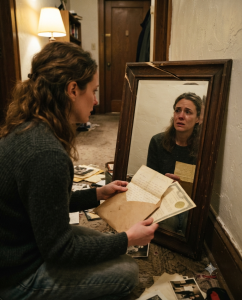
The hallway mirror still hung where it always had—between the coat closet and the front door. The frame was dark walnut, worn smooth at the corners. The glass had begun to silver at the edges, and one side of the frame was split by what looked like an old crack.
Vivian had grown up with that mirror. It reflected school mornings, prom curls, awkward thanksgivings, slammed-door teenage storms, and late-night returns from hospitals. In the final months of her mother’s life, it had reflected a woman whose body was weakening but whose attention missed less and less.
Daniel saw Vivian looking at it and gave the frame a light tap.
“You can have this,” he said with a smile too polished to be kind. “It’s cracked anyway.”
Ross snorted. Eli didn’t even bother pretending interest.
Vivian swallowed her anger and nodded. “Fine.”
No one asked why she wanted it. No one noticed that their mother, even near the end, had touched that frame every morning before leaving the hallway. Her fingers would rest there only a second, but it was always the same spot, always the same quiet pause. Vivian had noticed it and stored it away without understanding.
She carried the mirror to her car herself.
That night, in her apartment, she leaned it against the bedroom wall. Exhaustion should have sent her straight to sleep, but grief rarely moved in straight lines. She sat on the floor facing the mirror, surrounded by the few things that had followed her home: a folded quilt, two photographs, a tin of recipe cards, and the silence that comes after a loved one’s voice has stopped existing in the world.
Something about the crack bothered her.
It looked wrong.
She stood, turned on the lamp, and knelt closer. Her reflection remained whole. The line she had assumed ran through the glass didn’t distort her face at all. She touched it with one fingertip and realized the surface was smooth.
The crack was in the frame, not the mirror.
A small thing. But her mother had never done anything small by accident.
Vivian turned the mirror over and examined the backing. The paper was old and fragile. Several tiny nails held it in place, but one corner had been lifted once before and pressed flat again. She went to the kitchen, got a butter knife, and worked the edge loose with careful, shaking hands.
A faint scraping came from inside.
Her heartbeat rose.
When she removed the backing, a slim brown envelope slid forward, taped against the wood.
Her name was written on it.
There are moments in life when certainty arrives before understanding. Vivian knew before she opened that envelope that her mother had expected this exact moment. She knew it with the same force she had once known, as a child, that if she woke from a nightmare and reached for the hallway light, her mother would already be coming.
Inside the envelope were three things: property records, a bank deposit slip, and a letter.
Vivian read the deed first and frowned in confusion. Then she read it again.
Months before her death, their mother had transferred ownership of the house into a trust. Vivian was the named beneficiary. The home was not part of the free-for-all her brothers had assumed. It was not theirs to list, sell, divide, empty, or promise to anyone. The signatures had been witnessed. The filing had been completed. It was legal.
The deposit slip was tied to a safe deposit box account at a local bank, funded with money her mother had quietly moved there in increments over time. Not enough to turn Vivian into someone new, but enough to protect her from the immediate instability her brothers had clearly expected her to face.
Then came the letter.
The first line stopped her cold.
My sons will divide what shines. My daughter will save what reflects.
Vivian sat down hard on the floor and kept reading.
Her mother wrote with startling clarity. She said illness had stripped away any illusion she once held about what her sons valued. She had watched them glance past medication schedules toward silver sets, ask after insurance while pretending concern, and circle the house like men measuring fences. She did not say she hated them. In some ways, that would have been easier. Instead, she wrote like a woman mourning the living while preparing a gift for the one child who still understood that love was not a transaction.
She explained the mirror. The frame had been opened on purpose, then repaired. She had chosen it because no one would steal what they considered damaged. She had touched it every morning not from sentiment but from habit designed to keep herself calm: the truth was still there, still hidden, still waiting for the right eyes.
At the bottom of the letter, one sentence was underlined.
Do not let people who mistake softness for weakness write the ending of your life.
Vivian cried then—not the collapsing, directionless grief of the funeral days, but the fierce grief of recognition. Her mother had known. She had seen exactly what would happen after her death. She had understood her sons well enough to predict their greed and understood Vivian well enough to trust her with the response.
By morning, Vivian was no longer floating.
She dressed carefully, wrapped the mirror in a blanket, placed the documents in a folder, and went to a probate attorney recommended by a nurse who had adored her mother. The receptionist’s pleasant expression shifted the moment Vivian said, “My brothers are trying to sell a house they don’t own.”
Within half an hour she was seated across from attorney Marianne Keller, a woman with silver hair, precise glasses, and the kind of stillness that made every other person in the room more honest.
Marianne reviewed each document, asked methodical questions, and made several calls while Vivian sat gripping a paper cup of water she barely touched. The attorney confirmed the trust filing, verified the deed transfer, and requested supporting records tied to the safe deposit box. By the time she looked up, her face had softened—but only slightly.
“Your mother was very thorough,” Marianne said. “And very deliberate.”
Vivian looked at the mirror against the wall. “She knew they’d do this.”
“Yes,” Marianne said. “I believe she did.”
The legal response moved quickly after that.
The realtor was informed that the property was not authorized for sale. A formal notice went out to her brothers. The locksmith was contacted. Instructions were prepared for recovering removed contents if necessary. Marianne also advised Vivian to preserve every text message and voicemail that mentioned the house, valuables, or any assumption of ownership.
At 1:17 p.m., Daniel called.
Vivian put him on speaker with Marianne’s permission.
“What did you do?” he demanded.
“I corrected you,” Vivian said.
Ross got on the line next, accusing her of manipulation. Eli shouted in the background that this was impossible, that their mother would never have cut them out like that. Vivian almost responded with anger, but Marianne shook her head gently. Facts, not feelings.
“The house is in trust,” Vivian said. “You had no right to remove or sell anything.”
“You don’t understand,” Daniel snapped. “Mom changed things at the end because she was upset.”
“No,” Vivian said, and surprised herself with how steady she sounded. “She changed things because she understood.”
There was a silence then—thick, involuntary, different from outrage. It was the silence of people discovering the script they relied on no longer worked.
The calls kept coming for the next hour. Indignation first. Then bargaining. Daniel suggested they “sit down as family.” Ross tried guilt. Eli sent a message claiming there must be another version of the deed. Marianne advised Vivian not to engage beyond documented communication.
But just after three o’clock, Daniel called again, and this time his voice had changed.
“Vivian,” he said, quieter now, “before you do anything else, there’s something you need to know.”
She looked at Marianne, who nodded and began taking notes.
Daniel said the deed change had happened after a fight in the house weeks before their mother died. Their mother had been looking for an old blue photo box kept in the hall closet—the one that held letters, snapshots, and keepsakes from before any of them thought family history might become dangerous. Eli had found it first and opened it, searching for cash or bonds. Instead, he found letters.
“From who?” Vivian asked.
Daniel hesitated.
“Not from Dad,” he said.
The room seemed to tighten.
Their father had died when Vivian was seventeen. He had been a quiet man with patient hands and an awkward laugh. Whatever flaws he had, Vivian had never once doubted that he loved her. The idea that there were letters hidden away—letters their mother protected fiercely enough to change the course of the estate—made something uneasy unfurl in her chest.
Daniel continued. Their mother had caught Eli reading them in the downstairs den. She had gone pale, taken the box, and ordered all three sons out of the room. The next week, she met with a lawyer.
“What was in the letters?” Vivian asked.
“I only saw one name,” Daniel said. “Yours.”
That evening, after Marianne helped secure emergency control over the house access, Vivian drove there with a court-authorized locksmith. The front steps looked smaller than she remembered. The porch light was still burned out. Through the window she could see the stripped-down living room where furniture shadows remained on the carpet like ghosts of ownership.
Inside, the house felt ransacked by familiarity.
Drawers were left half open. Closet doors hung ajar. The dining room table was bare. In the hall closet, the blue photo box was missing.
Vivian stood staring at the empty shelf.
“Can they come back for it?” she asked.
“Not legally,” Marianne said, who had joined them after finishing another matter downtown. “But legality and desperation are not always the same thing.”
They searched the remaining rooms. In the den, tucked behind old magazines in the lowest cabinet, Vivian found a single loose photograph that had likely slipped from the box in the struggle Daniel described. It showed her mother standing beside a young man Vivian did not recognize. They were both laughing. Written on the back, in faded ink, were the words: Someday she should know the truth.
She stared at the handwriting.
It was not her mother’s.
The next morning, Eli appeared at Marianne’s office with red eyes and the hunted look of someone who had finally discovered consequences. He had the blue box.
He set it on the conference table and would not meet Vivian’s eyes.
“I didn’t take it for money,” he said.
Marianne made a skeptical sound, but Vivian stayed silent.
Eli swallowed. “Not at first.”
The letters inside were tied with a ribbon so old it frayed when Vivian touched it. Most were addressed to her mother. A few were written in response by her. All were from the same man—the one in the photograph. His name was Thomas Vale.
As Vivian read, the room around her seemed to recede.
Thomas had been her mother’s first love. They had been engaged young, before life separated them. A sudden family obligation took him overseas for work; a devastating misunderstanding followed; then silence. During that silence, Vivian’s mother met the man who would become her husband. She married him, built a family, and never looked back publicly.
But years later, after Vivian was born, Thomas wrote again.
The letters were tender, careful, unfinished things—not attempts to destroy a marriage, but attempts to explain an old disappearance. One letter contained the truth that had made Vivian’s mother hide the box.
Thomas had learned, through a mutual friend, that Vivian had been born just months after his last visit to town before he vanished from her mother’s life.
He had done the math.
So had her mother.
The next letters were full of fear, restraint, and finally certainty. Vivian’s mother confessed in one reply that the timeline left almost no doubt: Vivian was Thomas’s biological daughter.
The man who raised her had known.
That was the blow that took all the air from her lungs.
In a later letter, her father—her real father in every way that had shaped her childhood—had written to Thomas himself. The letter was calm, devastating, generous. He said Vivian was his daughter because he had held her first fever, first bicycle crash, first heartbreak. Biology might explain blood, but it could not compete with a life lived side by side. He asked Thomas never to interfere while Vivian was growing up. Thomas agreed.
That arrangement held for decades.
After Vivian’s father died, Thomas sent one final letter to her mother saying he was ill and did not expect to live much longer. He enclosed documents for a modest property investment they had once made together in secret before her marriage—an asset that had quietly appreciated over years. He asked her to leave it, if she thought right, to Vivian someday. He said not because of guilt, but because “truth belongs with the child who paid for it unknowingly.”
That property investment was the source of the safe deposit box funds.
Vivian lowered the last letter and cried with a kind of heartbreak that had no single target. For the man who raised her and protected her. For the mother who carried this complexity alone. For Thomas, who had stayed away out of respect and regret. For herself, standing in the wreckage of greed and discovering that the secret at the center of it was not shame but sacrifice.
Daniel covered his face. Ross stared at the wall. Eli whispered, “Mom changed the deed because she thought if we found out, we’d use it against you.”
He was right.
Vivian could already hear how they would have spoken of it if the letters had surfaced at the funeral: not as a private, painful truth, but as leverage. As scandal. As a way to weaken her claim, embarrass her mother, and rewrite the family hierarchy in their favor.
Her mother had understood that too.
The house transfer had not only been about greed. It had been a shield. A final act of control in a family where control had too often defaulted to the loudest male voice.
In the weeks that followed, Vivian recovered as many household items as possible. Some valuables were returned quickly once legal pressure mounted. Others required formal demand letters. The jewelry came back in pieces, stripped of whatever easy entitlement had first accompanied it. The savings bonds were restored. The realtor apologized. The locks were changed.
Vivian moved into the house three months later.
The first thing she rehung was the hallway mirror.
Not because she needed a monument to the secret, but because she understood at last what her mother had meant. Reflection was never about vanity. It was about honesty. About being willing to stand still long enough to see what was really there.
She placed the letters in a fireproof box and kept her father’s letter on top.
For a long time she wrestled with what name belonged to him in her heart. In the end, the answer was simple. Fatherhood had already been decided by every ordinary day he had shown up. No late revelation could take that from him. Thomas became part of her story, but not the author of it.
Her brothers never fully recovered their certainty.
Daniel sent one long apology that sounded, for the first three pages, like a legal statement and only near the end like grief. Ross cried the first time he came by the house after everything surfaced. Eli avoided her longest, then showed up one rainy Saturday to return the blue photo box in person. He stood in the doorway looking younger than she had ever seen him.
“I knew we were awful,” he said. “I didn’t know how awful.”
Neither of them tried to soften that.
Vivian didn’t forgive all at once. She didn’t believe in dramatic absolution. But she also knew that what her mother had protected in the mirror wasn’t revenge. It was truth. And truth, once uncovered, demanded more than punishment. It demanded choice.
So she let her brothers remain in her life with new terms and clear distance. No more decisions made over her. No more family myth that painted her as weak because she felt deeply. No more confusing volume with authority.
Sometimes in the morning, on her way out the front door, she paused and touched the mirror frame where the hidden split had once been repaired.
It reminded her that the most important things in a family are rarely the things that shine first. They are the things people overlook because they require patience, memory, and the courage to look directly at what reflects back.
And the part that stayed with her longest was not the money, the house, or even the secret of her birth.
It was this:
Her mother had known exactly which child would be trusted with the truth.
And when everything was stripped down to greed, grief, and what remained, that was the inheritance that mattered most.
