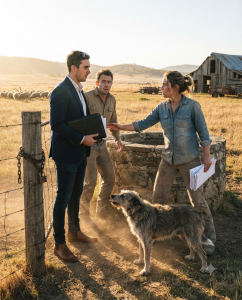
The sheepdog refused to herd the flock toward the north pasture.
On any other ranch, maybe that would have been a small thing. An annoyance. A sign the dog was getting old or stubborn or distracted. But on Clara Bell’s ranch, Scout had never ignored a command in his life.
That was what made people notice.
Every morning, just after sunrise, the routine played out the same way. The sheep drifted in a white, restless cluster near the lower field. The ranch hands shouted to each other over the sound of gates and boots and metal latches. Dust lifted off the ground in soft clouds as the day woke up around them.
And every morning, Scout ran the fence line at full speed.
He moved like he always had—lean, focused, fast enough to cut off a bolting ewe with barely a shift of his shoulders. For a moment, he looked exactly like the best dog her father had ever trained. Then, right when the flock angled toward the north pasture, Scout stopped.
He barked once.
Not wildly. Not confused. Just once.
Then he trotted to the old stone well near the edge of the field, sat in the dirt, and stared at it as if he were waiting for something buried beneath the ground to answer him.
The first few times it happened, the ranch hands laughed.
“Dog’s gone soft,” one of them said.
“Too many table scraps,” another joked.
But the laughter wore thinner each day the routine repeated itself.
By the second week, they were irritated.
By the third, they were calling him lazy.
And by the fourth, the new foreman stopped bothering to hide his contempt.
“Useless,” Wade Mercer said one morning, loud enough for everyone to hear. “A working dog that won’t work isn’t worth feed.”
Clara said nothing, but anger pulsed hot behind her ribs.
Scout was twelve years old. He had worked the Bell ranch longer than Wade had even lived in the county. Clara had grown up with him at her heels and her father’s hand resting on his broad head. She had seen Scout hold sheep steady through lightning storms, chase coyotes off lambing pens, and once block her father’s horse from stepping into a washout twenty seconds before the bank collapsed.
Her father used to say Scout noticed danger before people noticed silence.
So when the dog refused the north pasture day after day, Clara could not force herself to believe he was simply failing.
Especially not now.
Her father had died two months earlier.
Suddenly, inexplicably, brutally.
There had been no long illness. No final conversation. One minute he was standing in the kitchen with his reading glasses low on his nose, talking about replacing a water pump before winter. The next, he was gone, and Clara was standing in a funeral dress while half the county lined up to say words she barely heard.
After that, grief did not arrive as tears and soft music. It arrived as signatures, invoices, tax notices, feed bills, and men telling her what would be best.
Most of those men looked at her with pity.
Wade looked at her like opportunity.
He had been on the ranch less than six months when her father died. Hired to help manage labor and costs, he stepped smoothly into the chaos as if he had been waiting for it. While Clara was still trying to understand how a house could feel so empty and so crowded at the same time, Wade was already talking about efficiency.
He said the ranch had dead weight.
He said certain fields cost more than they returned.
He said the north pasture in particular was a problem. Bad drainage. Poor yield. Unreliable land. Not worth the repairs it would take to keep it useful.
“The smartest move,” he told her one evening while standing on her father’s porch, “is to sell that piece off before the land ruins you.”
He used the same phrase again and again.
Before the land ruins you.
It sounded practical the first time.
By the fifth, it sounded rehearsed.
Then came the developer.
His name was Brent Holloway, and he drove a spotless truck that looked absurd against ranch dirt. He wore clean boots, expensive sunglasses, and the kind of easy smile that belonged to men who expected to get what they wanted eventually.
He and Wade walked the property lines together more than once. Every time Clara approached, their conversation changed. Their voices lowered. Their expressions sharpened into something polite and blank.
When she asked direct questions, the answers were always the same.
The north pasture was worthless.
The land was a liability.
Selling it would save the ranch.
Clara wanted to believe them.
Not because she trusted them, but because she was tired. Bone-tired. Grief had made every decision feel heavier than it should. She was twenty-eight years old, trying to run a ranch that had always existed under her father’s shadow, and every day seemed to bring one more reason to doubt herself.
Still, Scout kept sitting by that well.
Watching.
Waiting.
Refusing.
One morning, Clara gave the herding command herself. Scout reacted instantly, circling the flock with his old precision. He drove them exactly where she pointed—until the lead sheep turned toward the north gate. Then he broke off and cut them away from it, almost urgently, before returning to the well.
Wade swore under his breath.
“Enough,” he snapped. “That dog is done. You need to stop indulging this.”
Clara looked down at Scout.
His ears were forward. His breathing was steady. His eyes never left the stones around the well.
Not confusion.
Not age.
Purpose.
That night, Clara lay awake remembering something her father had once told her after Scout had blocked him from crossing a flooded wash.
“Dogs don’t explain themselves,” he had said, scratching Scout behind the ears. “That doesn’t mean they’re wrong.”
The next evening, she followed Scout after sunset.
The ranch settled differently after dark. Without the noise of engines and shouting men, the place felt older. The house lights glowed amber behind her as she crossed the yard. Crickets started up in the grass. The air smelled faintly of dust, hay, and the dry metallic coolness that came after heat.
Scout was already waiting near the well.
When he saw her, he did not bark. He simply circled once, then lowered his head and pawed at the stone base.
Clara crouched beside him.
The well had been there since before she was born, lined with weathered stone and no longer used except as a landmark. Grass thinned around its base where years of boots had worn the ground hard. At first she saw nothing unusual. Then Scout pawed harder at one flat stone on the shaded side.
It shifted.
Her pulse kicked.
She dug her fingers into the dirt-packed seam and pulled. The stone loosened with a scrape, revealing a narrow hollow inside the well’s foundation.
Hidden within it was a rusted metal tube sealed with dark wax.
For a moment, Clara simply stared at it. Every sound around her seemed to recede—the insects, the wind, even her own breathing.
Then she lifted the tube out.
It was heavier than it looked.
Scout sat down beside her and pressed close enough that his shoulder touched her knee.
Clara cracked the wax seal with trembling fingers and eased the cap loose. Inside were neatly rolled survey maps, folded soil reports, water testing records, copies of county filings, and one letter written in her father’s unmistakable hand.
By the time she unfolded the page, she was already shaking.
Clara,
If you’re reading this, then either I finally remembered to tell you where I hid these papers… or Scout did what I trained him to do if anything ever felt wrong. Trust him.
Her breath caught so hard it hurt.
She looked down at Scout. The dog met her eyes and then, gently, rested his chin on her leg.
Clara forced herself to keep reading.
The letter explained what her father had discovered over the last several years. The north pasture was not barren land. Beneath it ran a protected underground spring—clean, abundant, and more valuable than surface appearances suggested. He had commissioned independent soil reports and geological surveys. He had verified water quality. He had begun quiet conversations with county officials about conservation protections and usage rights.
If handled carefully, the land could secure the future of the ranch for generations.
If sold cheaply to the wrong people, it could be stripped, privatized, or exploited before anyone understood what had been lost.
Her father wrote that he had kept the matter secret because word had begun to spread before the paperwork was complete. Interested buyers had approached him with offers that made no sense if the land were truly worthless. One man in particular had pushed harder than the others, asking strange questions not just about the pasture, but about the old well nearby.
Clara read the next lines twice.
If somebody tries to rush you into selling the north pasture, they already know enough to be dangerous.
If anything happens to me suddenly, don’t trust the man who keeps asking about the well.
Cold swept through her so sharply she had to steady herself with one hand on the ground.
The man who kept asking about the well.
Wade had asked about it three different times.
Casually.
Too casually.
Once over coffee in the kitchen, pretending curiosity about old ranch structures. Once while discussing repairs. And once, just a week after the funeral, when he had stood looking out toward the field and said, “Funny place for a well. Your father ever use it for anything important?”
At the time, Clara had not thought much of it.
Now she felt sick.
She took the papers inside and locked them in her father’s desk. Then she sat there until dawn reading every report twice. The survey maps were official. The water analyses were thorough. The county documents showed preliminary review notes and one unsigned protection draft.
The north pasture was not worthless.
It was priceless.
More than that, it was the reason people had been trying to corner her.
By sunrise, grief had sharpened into a fierce, steady anger.
She made two calls before breakfast—one to the county clerk whose name appeared on the filings, and one to a lawyer her father had trusted for years. By ten o’clock, both had confirmed enough to turn suspicion into certainty. Her father had indeed been preserving the land quietly. There had been outside interest. And Wade, while not listed anywhere official, had asked questions he had no reason to ask.
At noon, Brent Holloway’s truck pulled into the yard again.
He stepped out holding a folder.
Wade came with him.
Clara had been waiting at the gate to the north pasture, the original letter tucked safely in her pocket and copies of the key documents in her hand. The sky overhead was pale and hot. Sheep shifted in the nearby field, bells faintly clinking. Dust hung in the air behind the truck.
Scout stood in front of Clara.
Not wandering. Not resting.
Standing guard.
Brent flashed his polished smile. “Morning, Clara. I think we can wrap this up today.”
Wade folded his arms as if the matter were already settled. “You’ve had time to think. This is the smart move.”
Clara said nothing.
Brent opened the folder, revealing papers clipped neatly together. “Good offer. Clean process. Cash. Saves you a lot of trouble.”
Scout stepped forward one pace.
Brent hesitated.
Wade frowned. “Put the dog away.”
“No,” Clara said.
It was only one word, but both men looked surprised to hear it delivered without apology.
She unfolded one of the survey maps and let the breeze catch the edges.
Wade’s face changed first.
That was the moment she knew beyond all doubt. Brent looked confused. Wade looked afraid.
“You told me this land was worthless,” Clara said.
No one answered.
She lifted the soil report.
Then the water quality records.
Then the county filing draft.
Brent’s smile faded as he realized those were not random documents. They were the kind of papers that turned a cheap purchase into a failed scheme.
“The north pasture sits above one of the cleanest springs in the county,” Clara said evenly. “My father knew it. And now so do I.”
Brent turned to Wade. “What is she talking about?”
Wade didn’t answer fast enough.
Scout growled.
It was low and controlled, more frightening than a bark. His body was rigid, eyes fixed on Wade’s hands.
Clara pulled out the letter.
“My father also wrote this,” she said.
Wade took one involuntary step backward.
Brent’s expression sharpened. “Wade?”
Clara read aloud: “If anything happens to me suddenly, don’t trust the man who keeps asking about the well.”
Silence dropped over the yard.
The developer lowered his folder slowly, like he no longer wanted to be holding anything connected to the moment. Wade’s skin had gone pale beneath his tan. Sweat beaded at his temple.
For the first time since her father died, Clara saw him not as a foreman or a confident problem-solver, but as a man whose story had just collapsed.
“Clara,” he said quietly, “you don’t understand what your father got himself into.”
Scout barked once.
The sound cracked across the field like a warning shot.
Brent looked from Wade to Clara, and his voice lost all its polish. “What did you tell me this property was?”
Wade ignored him. His eyes stayed on Clara.
“Your father wasn’t making this easy,” he said. “People wanted access. Water rights. Easements. He refused to listen.”
“People?” Clara asked.
Wade swallowed.
That tiny motion gave him away even before the words did.
“There were investors,” he said. “Developers. Ag interests. Everyone knew that spring would make the land worth a fortune if it got protected or transferred the right way. Your father would never sell. Never negotiate. He kept delaying everything.”
“So you decided to help him die?” Clara asked.
Brent turned sharply. “What?”
Wade’s face drained.
“I didn’t say that,” he snapped.
“But you thought about the possibility enough to know what it sounds like,” Clara said.
She had not planned to say it that bluntly. Once the suspicion formed, though, there was no gentler version left.
Brent took two steps away from Wade.
“I was told this was a distressed sale,” he said. “I was told the daughter needed out and the pasture was practically useless.”
“It is useless,” Wade said too fast. “I mean—it was supposed to look useless until—”
He stopped.
Too late.
Clara held his gaze. “Until what?”
No one moved.
The sheep shifted nervously at the fence.
A truck engine hummed faintly as it cooled in the sun.
Wade looked at the well, then at Scout, then at the folder in Brent’s hands as if one of those things might still save him.
“They wanted the paperwork before the county protections finalized,” he muttered. “Once that happened, the price would explode, and the land would be tied up. The only way to get it cheap was to move before anyone knew what your father had.”
Clara’s throat tightened. “So you lied to me.”
“Yes.”
“You pushed me to sell.”
“Yes.”
“You asked about the well because you thought the documents were hidden there.”
Wade said nothing.
That silence was answer enough.
Brent’s voice went cold. “You said the old man died of natural causes.”
“He did,” Wade snapped. “As far as I know.”
As far as I know.
Not no.
Not absolutely.
Clara felt that phrase sink into her like a blade.
Her father had died alone in the tack room after a collapse no one had questioned deeply at the time. The doctor had listed it as sudden cardiac failure. Clara had accepted that because grief leaves so little room for suspicion. But now memory rearranged itself. Wade had been the one who found him. Wade had been the one who insisted on handling the immediate aftermath. Wade had been the one who moved fastest, spoke loudest, and redirected every conversation toward the north pasture almost before the burial flowers wilted.
Brent backed farther away. “I’m done here.”
He shoved the unsigned sale papers back into his folder. Whatever he had expected, it was not hidden surveys, a dead rancher’s warning, and a foreman unraveling in broad daylight.
Clara took out her phone.
Wade saw it and lunged—not at her, but at the papers.
Scout exploded between them.
He did not bite. He did not need to. He slammed his body into Wade’s legs hard enough to throw him off balance, barking furiously now, driving him back with years of training and every ounce of loyalty left in his aging body.
Wade stumbled and fell to one knee in the dirt.
By the time he scrambled upright, Clara had already called the sheriff.
Everything after that happened fast and strangely slow at the same time.
A deputy arrived first, then another. Statements were taken. The lawyer Clara had called that morning showed up before sunset. Brent, pale and furious, admitted Wade had approached him with inside promises and a price that now made horrifying sense. The county clerk confirmed the protected water filings were real and close to completion.
Wade was not arrested for murder that day. There was not enough yet.
But he was removed from the ranch.
And as investigators began digging into his messages, calls, financial records, and the days surrounding her father’s death, the certainty in his face vanished for good.
Weeks later, the full truth proved uglier than Clara had imagined.
Wade had been working with outside buyers trying to gain early control of the land before its true value surfaced. He had not killed her father, but he had manipulated access, intercepted correspondence, and pressured him aggressively in the weeks before his death. Whether that pressure contributed medically could never be proved. What could be proved was fraud, concealment, and attempted coercion after the death.
It was enough to end him.
The county finalized protections over the spring that autumn.
The north pasture remained part of the ranch.
And the land that everyone had called worthless became the very thing that secured its future.
Months later, when the first formal conservation marker was placed near the fence line, Clara brought Scout out to see it. He was slower by then. His muzzle had gone almost entirely gray, and his joints stiffened in the cold. But when they reached the old well, he paused and looked up at her with the same clear, watchful eyes.
Clara knelt beside him and pressed her forehead to his.
“You kept your promise,” she whispered.
Maybe that was why the ending never felt simple.
Because the land was saved, yes.
The truth came out, mostly.
The men who tried to cheat her lost.
But none of that brought her father back.
What remained was stranger and harder and, in some ways, more powerful: the knowledge that when the people around her lied, calculated, and circled for advantage, the one creature everyone dismissed as old and useless had understood exactly what mattered.
Sometimes Clara still thought about the first morning she watched Scout sit by the well and wondered why he would disobey.
Now she knew he hadn’t disobeyed at all.
He had obeyed the last command her father ever gave him.
Protect it.
Protect her.
And maybe that was the part that lingered longest after the ranch had gone quiet again—not just that greed had nearly stolen something priceless, but that loyalty had guarded it in silence the entire time.
Who was worse in the end: the strangers who wanted the spring, or the man who stood close enough to the family to betray them from inside the gate? Clara never answered that question out loud.
She didn’t need to.
Every time she crossed the yard and saw Scout resting near the porch, she thought of the men who called him lazy, the men who called him useless, and the truth they had missed sitting right in front of them.
The smartest one on the ranch had never needed words at all.
