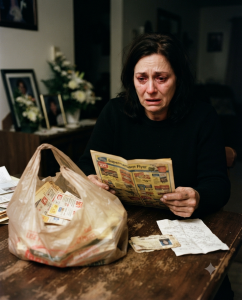
At her mother’s funeral, Diana’s brother handed her a plastic grocery bag filled with expired coupons and told her that was her inheritance.
The room didn’t go silent the way it does in stories when someone says something cruel enough to shame everyone else into stillness. It did something worse. It kept moving.
Silverware clicked softly against china. Ice shifted in water glasses. Napkins lifted to mouths that hid smiles too small to deny and too mean to mistake. A cousin across the table lowered her eyes but not before Diana saw the spark of amusement in them. Someone coughed to cover a laugh. Someone else looked down at the bag and then quickly away, as though the humiliation itself might be contagious.
Alan stood there with the practiced look of a man who wanted to appear generous while enjoying the performance. He had one hand in his pocket, funeral jacket open, tie loosened just enough to suggest grief had exhausted him. Diana knew better. Alan only loosened his tie when he felt victorious.
“Mom knew you liked saving pennies,” Renee said from beside the coffee urn, and that got a few more muffled laughs.
Diana looked at the bag in her hand.
It was a cheap white plastic grocery sack, knotted once at the top. Through the stretched sides she could see colorful rectangles of paper stuffed inside, the faded yellows and reds of supermarket flyers and discount coupons. The kind their mother used to clip at the kitchen table while circling sale items with a blue pen. The kind Diana had watched pile up in a drawer for years.
Nothing about it looked accidental.
That was the sharpest part of it. This wasn’t an oversight. It was theater.
Her brother had already taken the house. He hadn’t waited for the burial to finish before telling people he would “handle the property.” He had moved quickly, with keys and phone calls and paperwork nobody else had been allowed to review. Her sister had taken the jewelry under the sweet-sounding excuse that sentimental items should remain “with the daughters,” as though Diana didn’t count. Aunt Celia had removed the china cabinet “for safekeeping,” though everyone in the family knew that when Celia said she was protecting something, she usually meant protecting it from ending up with anyone else.
And Diana?
Diana had spent the last three years taking care of their mother while the rest of them treated illness like bad weather: something unfortunate, inconvenient, and best observed from indoors.
She had left her job six months after the diagnosis got worse because the appointments multiplied and the home nurses never stayed long enough to cover the nights. She had sold her car when the hospital bills began arriving in thick envelopes with red-letter warnings on the outside. When the hospital bed was delivered and installed in the living room because the stairs were no longer safe, Diana moved out of the bedroom and onto a folding mattress in the hallway. Her mother was afraid of waking up alone at night, afraid of the strange half-darkness that came after pain medication wore off and before dawn made the room look real again. So Diana slept where she could hear every small sound.
She learned the sounds of fear. The dry catch in her mother’s throat before a panic woke her. The friction of cotton sheets when she tried to shift and couldn’t. The weak knock against the bedrail when reaching for water felt impossible.
She learned the logistics of decline too. Pill organizers. Bed baths. Insurance appeals. The exact angle to lift someone whose body no longer trusted itself. Which soups were easiest to swallow. Which medicines needed food first. Which stories from childhood soothed her mother when pain and memory tangled together and left her frightened.
Alan visited twice in the first year, both times with the strained expression of a man eager to be seen trying. He talked loudly about work pressure in the doorway, kissed their mother’s forehead, and left before dinner. Renee sent flowers and long text messages full of heart emojis. Aunt Celia arrived often enough to collect information and spread it to the rest of the family as if she were a nurse on the case.
Diana did the actual work.
She washed sheets at 3 a.m. after accidents. She sat beside the bed with a straw when swallowing became difficult. She took notes during specialist appointments because doctors spoke too quickly and forgetting one dosage change could mean an emergency later. She signed her own name to withdrawals from her savings account without telling anyone because there was no time left for pride when there were supplies to buy.
None of them saw the hallway mattress slowly flatten. None of them saw the stack of unpaid bills hidden beneath recipe books. None of them watched Diana staring at a nearly empty refrigerator at midnight trying to calculate whether she could stretch groceries until Friday.
So when Alan placed that bag of expired coupons in her hand and Renee made her little joke, something inside Diana did not break.
It simply went still.
She lifted her eyes and looked around the table, waiting for a flicker of decency. She found none. Her cousins avoided her gaze. Aunt Celia sipped tea. Alan smiled with his mouth closed.
Diana nodded once.
No outrage. No tears. No pleading speech about sacrifice or fairness. She turned and walked out of the funeral luncheon holding the bag like it was exactly what they said it was: trash.
That silence followed her farther than any argument could have.
Outside, the afternoon air was too warm for black clothes. She walked home because there was no car anymore and because she needed the distance. By the time she reached the small house she had rented after selling nearly everything worth selling, her feet hurt and her shoulders felt hollow.
Inside, the quiet was immediate and unnatural.
For three years, quiet had never really existed. Even in the stillest hours there had been medicine alarms, monitor lights, the squeak of mattress adjustments, the low murmur of old television reruns her mother liked to keep on at night because complete silence made her anxious. Now the kitchen clock sounded loud. The refrigerator hummed like a stranger. The air itself felt abandoned.
Diana set the grocery bag on the table and stared at it.
Part of her wanted to drop it directly into the trash. Another part wanted to drive to Alan’s house—if she’d still had a car—and throw it at his front door. Instead, she stood there with both hands on the back of a chair, breathing slowly until the wave of humiliation passed enough for her to sit down.
Then she untied the knot.
The coupons spilled out in a colorful mess of expired savings and useless promises. Bread. Cereal. Dish soap. Canned vegetables. Frozen dinners. Laundry detergent. Coupons so old some stores no longer carried the brands printed on them. She sorted them into a pile without really meaning to, because order was a habit now. When chaos lived with you long enough, you learned to make little rows of things.
She noticed the folded flyer only because it had been creased more neatly than the others.
It was an old supermarket circular, the paper thicker, the edges cleaner. Instead of being crushed into the bag with the rest, it had been folded into a square and tucked between two stacks. Intentional. Protected.
Diana slid a fingernail under the fold and opened it carefully.
A stiff rectangle slipped out and landed on the table.
A library card.
She stared at it, confused. It was old, laminated, slightly yellow, her mother’s name typed across the front in the narrow font libraries used decades ago. The issue date was 1989.
Another slip of paper fell behind it.
She picked that up next.
On one side, in her mother’s unmistakable handwriting, were two words and a number: Locker 17.
On the other side was the sentence that made the room seem to tilt.
Diana, you were the only one who ever checked the small print.
For a few seconds, she could do nothing but stare.
Then she sat back slowly and let the meaning begin to gather itself.
Her mother had not been a dramatic woman. She was practical to the point of comedy sometimes. Birthday cards contained reminders to wear a scarf in cold weather. Sympathy cards were signed with notes about freezer meals. If she went to the trouble of writing something mysterious, she had done it for a reason.
Why a library card? Why hide it in a bag of coupons? Why not tell Diana directly?
Because direct things could be found.
Because obvious things could be taken.
Because the people circling her belongings had been watching for exactly that.
Diana slept badly that night. Every hour she woke and checked the library card again to make sure it had not somehow become ordinary. Each time it was still there, real and slightly warm from her fingers. By dawn she had made up her mind.
The old public library still stood on Maple Street, though the neighborhood around it had changed. The bakery next door was now a phone repair shop. The hardware store on the corner had become a yoga studio. But the library remained, solid and brick-faced, with tall windows and worn stone steps polished smooth by decades of shoes.
Inside, the smell hit her first. Dust. Paper. Old carpet. A trace of metal heat from radiators. It was the smell of childhood afternoons and overdue books and whispered warnings from librarians.
At the front desk, a young man with a neat beard and an employee badge took the card from her carefully.
“I haven’t seen one of these in a while,” he said.
“My mother left me this,” Diana said, sliding over the note. “It mentions a basement locker.”
He frowned slightly. “We used to have lockers downstairs years ago. I’m not even sure they’re still in use.”
“Could someone check?”
The uncertainty in her own voice annoyed her. She sounded like someone asking permission to hope.
The librarian looked at the card again, then at her face. Whatever he saw there made him nod. “Give me a minute.”
He returned with an older maintenance worker carrying a large ring of keys that clinked heavily with each step. The man looked at the note, gave a short grunt, and motioned for Diana to follow.
They went through a staff door, down a narrow staircase, and into a basement corridor where the overhead lights flickered before fully waking. The walls were painted institutional beige. The floor smelled faintly of damp concrete. On one side of the hallway stood a row of narrow metal lockers built into the wall, their paint chipped, numbers faded, vents furred with dust.
“They were supposed to be emptied years ago,” the maintenance worker said. “But some things fall through the cracks.”
Diana almost laughed at that. Small print. Cracks. Hidden things. It all sounded like her mother’s language now.
They counted down the lockers. 12, 13, 14. Her heartbeat sped up. 15, 16.
The maintenance worker tried one key, then another. Neither worked. The third turned with resistance, followed by a thick metallic click that sounded final enough to be ceremonial.
He opened the locker door.
Inside sat a gray metal lockbox.
Nothing else.
It looked ordinary. Scarred lid. Small handle. No label. The kind of box meant to be ignored. Diana stared at it so intensely the maintenance worker cleared his throat and lifted it out for her.
“There’s a key taped underneath,” he said after flipping it over. “You probably want somewhere private.”
A few minutes later, Diana sat alone in a small staff room with the lockbox in front of her.
Her mouth had gone dry.
She peeled the tape from the bottom, took the tiny key, and opened the box.
Inside were neatly arranged documents in labeled envelopes. Savings certificates. Property papers. A sealed letter with her name written across the front.
She picked up the letter first.
The paper trembled in her hands as she unfolded it.
My dear Diana, it began.
The first line alone nearly undid her, because her mother had always reserved endearments for moments of seriousness. The letter was written in a weaker hand than the note, but the sentences were precise.
Her mother explained that she had known for some time how the others would behave after her death. She had seen Alan’s impatience whenever legal matters came up. She had noticed Renee quietly separating pieces of jewelry under the excuse of “cleaning.” She had heard Celia asking what the china cabinet might fetch if refinished. Illness had reduced her body, not her awareness. The more they thought she was fading, the more careless they became in front of her.
She wrote that greedy people liked visible prizes.
So she gave them visible prizes.
The house Alan rushed to control was not the true center of what she intended to leave behind. Months earlier, while everyone believed she was too tired to follow paperwork, she had arranged a deed transfer for a different property that had belonged to her late sister’s estate and had reverted quietly through a family agreement. The transfer named Diana. It had been processed through an attorney she trusted, with instructions to store the papers away from the house.
There were also savings certificates her mother had accumulated over years in small amounts, rolling them over carefully, never discussing them, never keeping statements where wandering eyes could find them. Not a fortune large enough to make headlines. But enough to give Diana something she had not had in years: security.
Then came the part that changed the temperature in the room.
Her mother described, calmly and specifically, several incidents she wanted documented. Alan had tried to push papers in front of her while medication left her groggy. Renee had removed jewelry before permission was given. Celia had spoken openly in the kitchen about who should “claim” the furniture before death made things complicated. Dates were listed. Context was listed. Not accusations. Records.
Diana pressed a hand to her mouth.
All this time she had thought her mother had missed more than she understood. In reality, she had been watching. Recording. Deciding.
At the bottom of the letter, one line stood apart from the rest.
You stayed when there was nothing to win. That is why you are the one I trust.
Diana closed her eyes then, and for the first time since the funeral, she cried fully.
Not because she had found money. Not because she had found property. But because buried beneath three years of exhaustion was a wound she had barely admitted to herself: the fear that maybe none of it had mattered, that her mother had left this world too consumed by pain to know who had truly been there.
The letter answered that fear.
Every hallway night. Every crushed-up pill. Every washed sheet. Every canceled plan. Seen.
When she could read again, Diana opened the other envelopes.
The savings certificates were real. So were the deed papers. One property was a modest rental cottage on the edge of town that had been occupied for years under a low-maintenance lease. Another document cross-referenced a legal instrument tied to the family home Alan believed he had secured. The visible transfer he’d waved around was incomplete without the attached restrictions. Her mother had retained controlling conditions through a survivorship clause that activated under terms Diana now owned.
Alan had read the headline and ignored the small print.
Exactly as his mother predicted.
Diana took the box straight from the library to the attorney listed in the paperwork. His office was above an insurance agency, with faded carpeting and framed legal certificates older than Diana herself. The attorney, Mr. Heller, looked up from behind half-moon glasses when she gave her name.
When he saw the lockbox, he stood.
“She found it,” he said softly, the words less a question than a conclusion.
“You knew?” Diana asked.
“Your mother asked me to hold certain filings and wait. She said you would be the one to read the clue properly.”
He spent the next hour reviewing every page. Occasionally he made a small noise in his throat or tapped a paragraph with one finger. Diana sat opposite him, holding herself very still.
Finally, he looked up.
“Your mother was meticulous,” he said. “And your brother was overconfident.”
He explained it plainly. Alan had rushed to claim possession of the visible house transfer, but the filing chain attached to it contained conditions tied to estate conduct and a separate controlling interest. Because of how the documents had been structured, his authority was not what he thought it was. Worse for him, his behavior in taking possession before probate issues were settled could place him in a far weaker position.
Renee and Celia were not safer. The letter’s documentation, combined with timelines and witnessable removals of property, painted a picture neither of them would want examined in court.
Diana listened quietly.
“Are you all right?” Mr. Heller asked at last.
The question landed harder than all the legal explanations. No one had asked her that in months. Maybe years.
“I don’t know yet,” she admitted.
He nodded as though that was the most sensible answer in the world.
By evening, messages began arriving.
Alan: Need to coordinate final estate details. I’ll be deciding what gets sold.
Renee: Did you happen to take the silver tray? Also maybe we can talk about sentimental items.
Aunt Celia: The china cabinet shelves are damaged. I assume your mother had them that way.
Diana read each one once and set her phone face down.
Then Mr. Heller slid another document across the desk. It was a notarized statement signed six months before her mother died.
In the event of dispute, release the enclosed record.
Diana frowned. “What record?”
Without speaking, Mr. Heller opened a drawer and removed a sealed envelope. Alan’s name was written on the back in her mother’s hand.
“That,” he said, “depends on whether your brother wants to force the issue.”
“What is it?”
Mr. Heller studied her for a moment, then answered carefully. “Let’s say your mother knew exactly when to stay quiet and exactly when to preserve proof.”
The next morning Alan called, his tone already sharpening with suspicion. “I hear you’ve been talking to Heller.”
Diana stood at her kitchen window, looking out at nothing. “Have I?”
“Don’t start games with me.”
For years she would have softened her voice, avoided confrontation, tried to preserve peace nobody else ever protected. This time she said, “I’m reading what Mom left.”
A pause.
“What did she leave?” Alan asked, too quickly.
Diana glanced at the lockbox on the table.
Every visible thing her family had grabbed now seemed almost pathetic. The jewelry. The cabinet. The rushed claim on the house. They had lunged for trophies while overlooking the one trait their mother had valued most: patience. Attention. The willingness to read what others skimmed.
“More than you thought,” Diana said.
That afternoon, Mr. Heller sent formal notices.
Alan’s reply came first, furious and disbelieving. Renee called three times and left no voicemail. Aunt Celia sent a text saying this was all becoming “unpleasant,” as if unpleasantness had not begun the moment she wheeled furniture out of a dying woman’s house.
Within days, the performances cracked.
Alan demanded meetings. Renee insisted there must be some misunderstanding. Celia claimed she had only borrowed the cabinet. Each of them tried a different angle—confusion, offense, wounded innocence—but none of them had an answer for signed documents and written timelines in their mother’s own hand.
The real blow came when Mr. Heller told Alan there was one more item, to be released only if he continued contesting the estate.
Diana was present when Alan finally came to the office, red-faced and furious, still certain he could bully the truth into changing shape. He talked over everyone. He accused Diana of manipulation. He called the documents “selective nonsense.” He demanded the envelope.
Mr. Heller gave it to him.
Alan tore it open with the reckless confidence of a man who still believed hidden things favored him.
Inside was a transcript and a recording authorization statement.
Months before her death, during one of the afternoons Alan thought his mother was too medicated to fully follow conversation, he had leaned beside her bed and said more than he should have. About how the house ought to be his anyway. About how Diana had “already gotten enough” by living there rent-free while acting like a martyr. About how once the paperwork was finished, he’d make sure “there was nothing left for her to complain about.”
What Alan had not known was that a home health aide had entered midway through the conversation, heard enough to report it, and written a statement at Diana’s mother’s request. What he had also not known was that their mother, clearer than he assumed, had insisted on documenting the incident through her attorney immediately.
Diana watched his face while he read.
For the first time in her life, Alan had no quick recovery. No superior smile. No sarcastic comment. He read one line twice, then looked up as if the room had betrayed him.
“She recorded me?” he said hoarsely.
“No,” Mr. Heller replied. “She remembered you.”
That was worse.
Renee cried when she learned there was a statement about the jewelry. Celia returned the china cabinet within a week, suddenly eager to call it all a misunderstanding. Alan stopped talking about what he deserved and began asking what could be settled quietly.
Diana could have dragged every detail into court. Part of her wanted to. Not for revenge exactly, but for the recognition that quiet labor so often goes unpaid and unseen until someone dies and the wrong people rush in to count spoons. But her mother’s letter had not been written in the spirit of spectacle. It had been written in the spirit of truth.
So Diana let the law untangle what it needed to untangle and refused every attempt to guilt her back into family peace at her own expense.
The rental cottage passed cleanly into her possession. The savings certificates were redeemed over time. The legal issues around the house forced Alan to back down from claims he had made too loudly and too early. The jewelry Renee had taken was partially returned, though not with grace. The cabinet came back with one scratched shelf and no apology.
Months later, Diana visited the cemetery alone.
The weather had turned cool. She brought chrysanthemums because her mother had always liked flowers that lasted. She stood by the stone for a long time without speaking, then finally smiled at the absurdity of it all.
A bag of expired coupons.
That was the disguise.
Of course it was. Her mother had hidden everything in plain sight, inside the kind of object greedy people would dismiss and only Diana would examine. Even the final lesson had been packaged in the language of everyday life: small print matters. Read carefully. Pay attention when others don’t.
On the way home, Diana stopped at a grocery store. At checkout, the cashier asked whether she had any coupons.
Diana laughed out loud before she could stop herself.
That night, in the quiet house that was beginning at last to feel less like an aftermath and more like a future, she placed her mother’s note in a frame on the bookshelf.
You were the only one who ever checked the small print.
She looked at it for a long time.
It did not erase the years she lost or the cost of those years. It did not make caregiving fair. It did not suddenly turn cruel siblings into kind ones or restore every piece of what illness had consumed. But it gave her something she had not realized she still needed: proof that love had been seen clearly by the person who mattered most.
And maybe that was the aftershock that stayed with her longest.
Not that the greedy ones were outsmarted. Not that the hidden inheritance changed hands. But that in the end, the woman everyone thought was too weak to protect anything had protected the only child who never treated her like an opportunity.
Anyone could grab what glittered in plain sight.
It took a different kind of person to look closer.
And maybe that was the real inheritance after all: not just property or savings, but the final confirmation that the smallest overlooked details often reveal exactly who people are.
