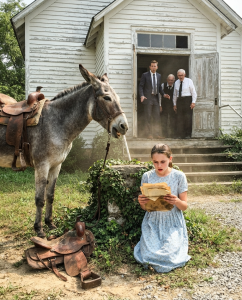
The gray mule kept dragging the old saddle to the church steps every Sunday.
At first, nobody paid much attention to it beyond annoyance. In a small town, animals sometimes got loose, and old farm creatures developed strange habits the same way old people did. But this wasn’t random. It wasn’t harmless wandering. Every Sunday morning, just before service, the mule appeared on the church road with the same cracked saddle scraping through the dust behind him. He would climb the slight rise to the front steps, heave the saddle forward, and leave it there at the entrance as if he were returning something that belonged inside.
Then he would stand and wait.
The mule’s name was Moses. He had belonged to Pastor Jim Harper for nearly fifteen years, which was long enough for people to stop thinking of him as an animal and start thinking of him as part of the church’s history. Children had fed him apple peels through the fence. Widows had laughed about how he looked offended whenever anyone but Pastor Jim touched his ears. Men who had never trusted many things said they trusted that mule on steep trails and muddy roads more than they trusted their own trucks.
Pastor Jim and Moses had been a familiar sight for years. The old preacher, tall and narrow in the shoulders, rode him to shut-ins’ homes tucked back in the woods and to hospital visits during storms when roads flooded too badly for cars. He rode him to funerals at the hill cemetery, to prayer meetings in old barns, and once, memorably, to a wedding after his truck broke down with the bridal party already waiting.
“Best church deacon I ever had,” Pastor Jim used to joke, patting Moses’s neck. “Never misses a meeting and never argues over the budget.”
People laughed because it sounded like a joke. But everyone knew what he meant. Moses was faithful. Predictable. Loyal.
Then Pastor Jim died in the middle of July.
It happened so suddenly the whole town seemed to stop breathing for a day. He had preached the Sunday before with a tiredness that some people noticed and most ignored. His sermon had been about endurance, about how truth didn’t stop being true just because it became inconvenient. A few said afterward that he seemed distracted. Others said he looked burdened. No one guessed it would be the last time they heard him preach.
On Wednesday morning, he was found dead in the parsonage from what the doctor called a massive heart attack.
By Saturday, the church bell rang slow and hollow while the town filed past his casket. Moses stood in the back pasture beyond the church lot, visible through the pines if you knew where to look, not grazing, just standing still with his head lowered. Someone tried bringing him oats. Someone else tried leading him closer for the funeral procession. He refused both.
People said animals grieved in their own way.
A week later, while people were still writing sympathy cards to no one in particular because there was no family left to send them to, the church elders called a congregational meeting.
That was when Reverend Daniel Cole stood before the members for the first time as more than a guest minister.
He was younger than Pastor Jim had been, younger by almost thirty years. He dressed sharply, spoke smoothly, and carried himself with the kind of calm confidence that made some people feel reassured and others immediately suspicious. He said he regretted having to speak about finances so soon after such a painful loss, but circumstances left no room for delay.
The church, he explained, was in severe debt.
Repair costs had grown impossible. Giving had declined. Loans had been extended as far as they could go. There was an offer from a private buyer interested in the church land, and though it was painful, selling would protect the congregation from a worse collapse later.
People stared at him in disbelief.
The white clapboard church had stood for nearly ninety years. Three generations of some families had worshiped there. Babies had been dedicated beneath the same stained glass window. Every wedding photograph in town seemed to include those front steps, those double wooden doors, that bell tower leaning just slightly to the left.
Sell it?
For a moment, it sounded impossible.
Then one of the elders, Vernon Pike, stood and said he had reviewed the financial situation personally. Vernon was the kind of man people assumed knew what he was doing because he spoke slowly and frowned while doing it. He said the church had no room for sentiment now. The bank was involved. Facts were facts.
The banker himself, Leonard Hays, was sitting three pews back and gave a stiff little nod that people took as confirmation.
That was the beginning.
Questions were asked at first. Of course they were. Mrs. Talley wanted to know why nobody had known the debt was this bad. A deacon asked whether repairs could be phased over time. One man suggested a community fundraiser. Another asked to see the books.
Reverend Cole had an answer for everything.
The records were complicated. The deficits had accumulated quietly. Pastor Jim, he said delicately, had not always been good with administration. Time was short. Delaying a sale would only increase costs and legal exposure.
It was an impressive performance. Calm. Reasonable. Almost compassionate.
And it landed especially hard because everyone was grieving. Pastor Jim was gone. People didn’t want conflict in the middle of mourning. They didn’t want to seem disloyal by questioning new leadership in the same breath as old loss. Bit by bit, resistance softened into exhausted silence.
Then the mule began his weekly march.
The first Sunday Moses showed up with the saddle, most people laughed. He must have gotten loose, they said. Maybe he smelled Pastor Jim’s things and got confused. He dragged the saddle right to the church steps and dropped it at the doors with a heavy thud that interrupted the prelude music inside.
A couple boys ran out to see him.
“Look, he brought Pastor Jim’s saddle!”
One of the ushers shooed them back in and hauled the saddle off to the side. Moses would not leave until two men and a broom forced him away from the entrance.
The next Sunday he did it again.
And the next.
By the fourth week, the laughter had thinned. People were irritated now. Mud got tracked onto the front porch. The sound of scraping leather on concrete made the women in the fellowship hall wince. Reverend Cole nearly tripped over the saddle one morning on his way in and muttered a curse before realizing two church ladies had heard him.
“This has gone far enough,” he said. “The animal is becoming a disruption.”
Some agreed. Others said less. But no one had a better explanation.
No one except Abby Mercer, though she didn’t know it yet.
Abby was twelve, narrow-faced, observant, and quiet enough that adults often said serious things in front of her because they forgot she was there. She came to church with her grandmother Ruth, who sat third pew from the back and always carried peppermints in a handkerchief. Abby liked Pastor Jim because he talked to children as if their thoughts had weight. Once, after she had correctly pointed out that a robin’s nest in the church eaves had been built with blue thread from the altar flowers, he had told her, “You see details other folks step over. Never lose that.”
She hadn’t forgotten.
On the fifth Sunday, Abby was standing by the fellowship hall window when she saw Moses make his now-familiar climb up the road. The old saddle dragged behind him, kicking little puffs of dust into the warm morning air. But this time she watched closely. Not the whole mule. Not the saddle as a lump of leather. The exact way he handled it.
Moses reached the porch, lowered his head, then used his nose to turn the saddle slightly before releasing it.
Abby narrowed her eyes.
The left stirrup pointed directly toward the church cornerstone.
Not near it. Not vaguely in that direction.
At it.
The cornerstone was an old block of carved limestone set low at the front left corner of the church foundation, partly hidden by ivy. Abby had passed it her whole life without noticing more than the date chiseled into it. But now she watched Moses step back from the saddle and stand there, looking at the same spot as though he had done exactly what he meant to do.
Inside, service began.
Reverend Cole preached from the book of Isaiah about new seasons and the danger of clinging to former things. His voice floated through the sanctuary polished and measured, but Abby barely heard him. She kept picturing the bent stirrup aimed like an arrow at the stone.
When the final hymn ended and people started milling about, Abby slipped out before her grandmother could stop her.
Moses was still on the porch.
He looked tired. Sweat darkened the fur beneath his harness marks, though he wasn’t wearing tack anymore. The saddle lay at his feet, old and tired as he was. When Abby approached, the mule turned one eye toward her and made a soft sound in his throat, almost like a warning, almost like permission.
She stepped down to the cornerstone and crouched.
The ivy was thicker than she’d realized. She pulled at it carefully at first, then harder. Vines tore loose. Damp earth crumbled under her fingernails. There, tucked in the mortar line, she found something wrong: a gap at the edge of one brick where no gap should have been.
Her pulse jumped.
She worked her fingers into it and tugged. The brick shifted with a gritty scrape, then slid free.
Behind it was a narrow hollow.
Inside the hollow lay an oilskin packet wrapped and tied with cord.
For a second Abby just stared, unable to breathe. It was too strange, too exact. Moses stood directly behind her, close enough that she could hear each breath leave him.
She lifted the packet out.
It was heavier than she expected. The oilskin was weathered but intact, sealed well against moisture. Whoever had hidden it had meant for it to survive.
Abby untied the cord with clumsy fingers and unfolded the wrapping.
Papers.
Old ledger pages first, their edges yellowed but dry. Columns of donations. Building fund records. Dates and amounts. Then bank statements. Then a stamped mortgage release bearing the county seal.
Abby didn’t know much about mortgages, but she knew what “paid in full” meant.
And there, folded on top beneath everything else, was a letter in Pastor Jim’s handwriting.
Her throat tightened the moment she saw it. She unfolded the pages slowly.
To the congregation of Faith Chapel, it began.
By the third sentence, the blood drained from her face.
Pastor Jim wrote that he had uncovered discrepancies in church finances. He wrote that the church’s mortgage had been fully satisfied and that any claim of crushing debt was false. He wrote that he feared pressure was being placed on certain men to force a sale quickly before the congregation learned the truth. If anything happened to him before he could present the records publicly, he wrote, he had hidden proof where “a faithful servant might still remember the way.”
Abby looked up so fast she nearly tore the page.
Moses.
A shiver ran through her arms.
She kept reading.
Pastor Jim named records. Dates. A transfer connected to an outside buyer. Conversations he did not trust. He ended with a plea that if the packet were found, the church should gather before any sale was finalized and read everything aloud.
Abby was already running before she reached the signature.
She burst through the sanctuary doors with dirt on her knees, ivy stuck to one sleeve, and the packet clutched in both hands. The low hum of post-service conversation collapsed into silence. Heads turned. Reverend Cole was standing near the altar rail with Vernon Pike and Leonard Hays.
“Abby?” her grandmother said sharply. “What on earth—”
But Abby didn’t stop.
“I found this,” she said, breathless. “By the cornerstone. Pastor Jim hid it.”
Reverend Cole’s expression hardened for only a fraction of a second before smoothing into concern. “Now, let’s slow down,” he said. “I’m sure there’s an explanation.”
Abby held up the mortgage release.
“This says the church was paid off.”
A murmur swept the room.
Leonard Hays, the banker, took one involuntary step forward. Vernon Pike went pale under his sun-spotted skin.
Reverend Cole extended a hand. “Give those to me, sweetheart. Financial records can be misunderstood.”
Abby drew back. “No.”
It was such a small word, but in that room it sounded like a bell.
Ruth Mercer came to stand beside her granddaughter. “Let the child speak.”
Abby unfolded Pastor Jim’s letter with shaking hands and started reading aloud. Her voice trembled at first, then steadied as the words took over. When she read the line that the church was debt-free, people gasped openly. When she read that Pastor Jim believed a false emergency was being created to rush the land sale, someone in the back pew said, “Lord have mercy.”
Vernon Pike tried to interrupt. “This could be taken out of context—”
But Leonard Hays had reached Abby by then and taken the bank papers from the packet, scanning them rapidly. His face changed as he read. Not confusion. Recognition.
“These are official,” he said quietly.
A woman near the front clutched the pew rail. “Then why did you say—”
Leonard swallowed. “I said what I was told had been restructured and pending.” His eyes lifted slowly toward Reverend Cole, then Vernon. “I was not shown these releases.”
The sanctuary erupted into overlapping voices.
“What do you mean you weren’t shown?”
“Who had these?”
“Vernon, you told us—”
Reverend Cole raised both hands. “Please. Please. Let’s stay calm. Pastor Jim was under enormous strain at the end. He may have been confused. He may have misinterpreted documents—”
Abby unfolded the final page.
“There’s more,” she said.
The room went still again.
This page was shorter, handwritten tighter, as if Pastor Jim had been in a hurry or afraid of being interrupted. He wrote that he had been approached repeatedly about selling the church to a development group. He wrote that he refused. He wrote that after refusing, he discovered internal pressure from “those smiling loudest in public while urging speed and silence in private.”
Then came the line that shifted the room like an earthquake.
If these papers are read after my death, look first to the ones who push hardest to sign before the congregation sees the truth.
Nobody moved.
Every eye turned toward Reverend Cole.
Then, almost as one, they shifted to Vernon Pike.
Vernon had been the strongest voice for the sale from the beginning. Vernon who had insisted the church was on the brink. Vernon who had said delays would be irresponsible. Vernon who now looked as if the walls themselves were closing in.
“That doesn’t prove anything,” he said, but his voice cracked on the last word.
Outside the open doors, Moses let out a low, ragged bray that rolled through the church like judgment.
Leonard Hays was still sorting through the packet. “Wait,” he said.
There was one more page tucked in the back, folded differently from the rest.
He opened it.
His jaw tightened.
“What is it?” someone asked.
Leonard didn’t answer immediately. He walked to the front, turned, and held the page where everyone could see the signatures at the bottom.
It was a preliminary transfer agreement for the sale of the church property.
The buyer’s representative had signed.
A witness had signed.
And there, in neat deliberate handwriting, was Vernon Pike’s name.
Beneath it, on a separate approval line dated two weeks before Pastor Jim died, was Reverend Daniel Cole’s signature.
A sound moved through the congregation like one body drawing breath. Ruth Mercer covered her mouth. One deacon sat down suddenly as if his knees had failed.
Reverend Cole spoke first. “That document was only exploratory. Perfectly legal. It doesn’t mean—”
“You hadn’t even told us yet,” someone shouted.
Vernon’s face flushed a blotchy red. “It was to protect the church!”
“By lying to us?”
“By selling it behind our backs?”
“By saying Pastor Jim left us in debt?”
The shouting grew louder. Vernon tried to force his way toward the aisle, but two deacons stepped in front of him. Reverend Cole kept talking, his polished voice now sharp at the edges, insisting the congregation didn’t understand the larger plan, insisting development would have brought money, growth, opportunity. He said sentimentality was choking the church. He said hard decisions were mistaken for betrayal by people too emotional to see reality.
Then Ruth Mercer, who almost never raised her voice, said from the center aisle, “You used a dead man’s name to bury the truth.”
That silenced even Reverend Cole.
Abby stood where she was, heart hammering, Pastor Jim’s letter trembling in her hands. She looked toward the door.
Moses had not moved from the porch.
The old saddle still lay at his feet. The left stirrup still pointed toward the cornerstone, as if even now he wanted them all to remember where the truth had been waiting while they complained about inconvenience.
By the time the county sheriff arrived, the sanctuary had divided into clusters of outrage and disbelief. Leonard Hays, shaken and sweating, admitted he had seen only partial records presented by Vernon and Reverend Cole and had assumed the debt restructure claims were legitimate. He said he never reviewed a paid release because none had been supplied. Vernon insisted everything could be explained. Reverend Cole requested a lawyer. The buyer’s name on the agreement turned out to be connected to a regional developer already buying land along the highway.
The church sale was halted that day.
In the weeks that followed, more came out. There had been private conversations, back-channel promises, and plans to fold the congregation into another church after the property transfer. Vernon claimed he had only wanted to secure the church’s future. Reverend Cole claimed he had stepped into a financial plan already in motion. Some believed one was greedier than the other. Some thought both had convinced themselves that manipulation counted as leadership when the outcome benefited them.
Pastor Jim’s death was ruled natural, just as it had been the first time. But that did not soften what people felt when they realized he had known enough before he died to hide the truth where he prayed it would someday be found.
And somehow, against every practical explanation anyone could offer, it was Moses who led them there.
No one could say for certain how the mule remembered. Maybe Pastor Jim had hidden the packet while Moses stood nearby and the old animal connected saddle, stone, and urgency in whatever deep, mysterious way loyal creatures sometimes do. Maybe grief had sharpened habit into purpose. Maybe there are some bonds that make room for one last act of service.
The town never fully agreed.
What everyone agreed on was this: without the mule, the packet might have stayed in that wall until the church was gone.
The sale was canceled permanently. Vernon Pike resigned from the elder board before formal charges in the property matter could be brought. Reverend Cole left town within the month. Leonard Hays publicly apologized to the congregation and paid for an independent audit out of his own pocket. The church, though bruised and embarrassed, stayed standing. Repairs came slowly. Donations increased once people believed their giving was no longer feeding a lie. Volunteers repainted the fellowship hall. Teenagers fixed the fence. Older women stitched new cushions for the pews.
And on the Sunday the congregation voted unanimously to keep the church and restore it, Abby was asked to read the opening scripture.
She stood at the pulpit that had once seemed too tall for her and looked out over faces that no longer felt sleepy or resigned. Her grandmother sat smiling through tears. The new interim preacher stood back and let the moment belong to the people. Through the open side window came the sound of a mule snorting in the pasture.
After service, the whole congregation walked outside.
Someone had cleaned Pastor Jim’s old saddle, not to use again, but to preserve. The cracked leather had been oiled. The bent stirrup left just as it was. Together, they placed it inside the church vestibule in a glass-front wooden case with a small brass plate that read: Faithful to the End.
Moses stood under the oak tree nearby, tail flicking lazily, accepting apple slices from children who no longer laughed at him.
Abby went to him last. She pressed her hand to the warm gray fur of his neck and whispered, “You brought it back.”
Moses lowered his head the way he always had when Pastor Jim prayed.
People told the story for years after that, and every time they did, the details that lingered weren’t the signatures or the hidden packet or even the halted sale. It was the image of that exhausted old mule dragging a dead man’s saddle to the church doors again and again while living people complained they were too bothered to understand.
Maybe that was the part that stung most.
The truth had been there, scraping across stone in broad daylight, and it was easier for almost everyone to call it trouble than to ask what it meant.
