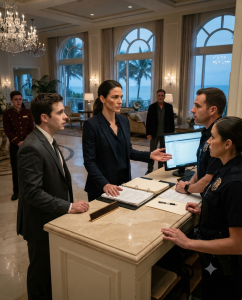
They laughed when the woman with the scar across her face applied to be the front desk manager at the luxury resort.
At the Seabriar Grand, that kind of laughter was never loud. It didn’t echo through hallways or burst out in open ridicule. It lived in glances, in lowered voices, in the tiny pause before a smile. It lived in the way people looked at Claire’s face and then quickly looked away, embarrassed not by their own cruelty but by being caught.
The resort itself was the kind of place built to make people believe elegance could erase ugliness. The entrance was lined with stone columns and tropical greenery lit from below. A fountain spilled into a black-glass basin. Inside, the lobby gleamed with polished marble, brass accents, and chandeliers that dripped crystal over guests in linen, silk, and money. Every detail was carefully chosen to communicate luxury without effort.
So when Claire crossed that floor in sensible heels and a navy blazer, carrying a leather folder with her résumé tucked inside, she could feel the shift in the room immediately.
A valet at the door looked at her face a fraction too long before pretending to check a luggage cart. A receptionist behind the counter gave her a smile so rehearsed it nearly hid the surprise in her eyes. A couple fresh from a golf outing fell briefly silent as Claire passed.
None of it was new.
The scar that crossed the left side of her face had been with her for three years. It ran from near her jawline up toward her cheekbone in a pale, uneven sweep that makeup softened but never concealed. It came from a kitchen fire that had started with a broken gas valve and ended with Claire dragging a panicked line cook toward the back exit while flames licked up the wall behind them.
She had nearly died that night.
Instead, she survived—and discovered that living afterward required a different kind of strength.
Before the fire, people noticed her smile. After the fire, they noticed the scar. Some looked sympathetic. Others looked uncomfortable. A few looked fascinated in that horrible, involuntary way people look at what frightens them. Her husband had claimed to support her through recovery, but as the months passed, he grew colder, then impatient, then openly resentful of the ways her pain rearranged their life. By the time the divorce papers were signed, Claire had already learned the truth she would carry into every room after that:
Surviving something did not mean the world would honor you for it.
Sometimes it only meant the world expected you to accept less.
Still, she had experience. Ten years in hospitality. Accounting, guest relations, staffing, systems, night operations. She had worked her way up in mid-range hotels, boutique properties, and one high-end city tower where she handled a holiday-weekend disaster so smoothly the general manager called her the calmest person in the building.
She was qualified.
More than qualified.
And she knew it.
The owner’s son came out from the office after less than five minutes.
Adrian Vale looked exactly like a man born into expensive spaces. He was in his early thirties, sharply dressed, handsome in a way that photographs well, and carrying the smooth self-assurance of someone accustomed to being treated as the answer before anyone had even heard the question. He introduced himself with polite efficiency, accepted Claire’s résumé, and let his eyes skim it so briefly she knew he had already made his decision.
“This position requires a certain appearance,” he said, sliding the résumé back across the counter. “Maybe housekeeping would suit you better.”
For a second, the whole lobby became soundless inside Claire’s head.
Not because she was shocked.
Because she wasn’t.
That was the worst part.
She had expected resistance. She had rehearsed for subtle bias, hesitant smiles, forced courtesy. But Adrian didn’t even bother disguising his meaning. He assumed she would swallow it, because people like him often mistook elegance for permission.
Claire kept her posture straight.
“I also have extensive front office and accounting experience,” she said evenly.
Adrian’s expression didn’t change. “Night audit is open. Midnight to sunrise. Minimal guest interaction.”
There it was again—that phrase, delivered like a compromise and an insult at once.
Minimal guest interaction.
A place where her work would matter as long as her face did not.
Claire almost walked away. For one long, humbling beat, she imagined herself turning around, leaving the shining lobby behind, and never giving the Seabriar Grand another hour of her life.
Then she thought about rent.
About medical debt.
About the fatigue of beginning from scratch again.
So she accepted the night audit position with a voice calmer than she felt.
The first week confirmed everything Adrian had implied.
The night shift at the Seabriar Grand was quiet in a way that felt deliberate. Day managers left notes but rarely spoke to Claire directly. Staff crossing over at shift change treated her with awkward politeness, as if they were unsure whether to be friendly or careful. Some were kind. Most were distant. A few were openly dismissive.
Claire learned their rhythms anyway.
She learned that housekeeping supervisor Elena always left ten minutes late because she rechecked every VIP suite personally. She learned that bellhop Mateo, barely nineteen, arrived early and polished luggage carts no one had asked him to polish. She learned which bartenders skimmed from the snack inventory, which concierge loved gossip, which servers complained most but worked hardest.
And she learned the Seabriar Grand after midnight.
The chandeliers dimmed. The music softened to piano instrumentals almost too delicate to notice. The expensive scent in the air thinned as flowers closed and guests disappeared upstairs. Alone behind the front desk, Claire listened to printers hum, elevators sigh, ice machines rumble in distant corridors, and the ocean beyond the windows breathing against the dark.
She liked the solitude more than she expected.
At night, no one performed.
Systems did.
And systems, when watched carefully enough, told the truth.
The first discrepancy was small: a refund to a guest who had never complained and had checked out praising the property. The second was stranger: spa charges removed from a suite known for lavish spending. Then came premium room upgrades tagged “owner approved” on nights when the owner, Lawrence Vale, had been publicly attending charity events elsewhere.
Claire told herself it might be sloppy paperwork.
Then she began cross-checking.
The refund authorizations all passed through management credentials.
Several missing charges belonged to guests personally greeted by Adrian.
A pattern of complimentary upgrades clustered around wealthy visitors who tipped heavily, partied privately, or requested favors not written into standard service notes.
None of it screamed theft on its own.
Together, it whispered manipulation.
Claire printed copies and started a folder.
She matched timestamps with shift rosters.
She compared point-of-sale records to final folios.
She reviewed door access logs on the pretext of reconciling maintenance alerts.
What emerged over the next three weeks was not one mistake, but a system. Charges disappeared after midnight. Refunds were issued strategically. Certain guests were courted with benefits the resort itself absorbed. Whenever access logs were needed, a management override key appeared near the center of the timeline.
Claire noticed another pattern too: whenever a problem required quiet handling, Adrian found a way to be near it.
He drifted through the resort with charm that impressed guests and exhausted employees. He called female staff “sweetheart” when annoyed, acted fatherly with younger male workers, and spoke about the family business as if his inheritance were a burden nobly borne. People deferred to him because power often needs no depth when it already owns the room.
But Claire had met men like Adrian before.
Men who mistook being underestimated for brilliance.
One morning near shift change, Claire walked into the staff kitchen and heard voices fall silent. A guest services associate glanced at her cheek, then down at her mug. “We were just talking about room assignments,” she lied badly.
Another time, Claire caught a bartender muttering to a server, “I heard a kid cried in the lobby after seeing her.” He laughed under his breath, then looked stricken when Claire reached past him for sugar.
She said nothing.
Humiliation had become a familiar climate in her life. The difference now was that she no longer confused enduring it with agreeing to it.
The real break came on a Thursday just after dawn.
The lobby had begun its transition into morning. Sunlight pressed pale gold against the glass doors. Fresh coffee had replaced the overnight pot. Early departures rolled suitcases over marble while two housekeepers waited near the service corridor for assignments.
Then a man in an expensive cream polo and obvious fury came down from the elevators shouting.
His name was Victor Lang, a financier from New York and a repeat guest with the kind of account the resort treasured. His face was flushed, his voice loud, and his indignation sharpened by the certainty that other people existed to solve his inconvenience instantly.
“My watch is gone,” he snapped, slamming a palm against the desk. “My diamond watch. It was on the dresser. I want security here now.”
Claire straightened. “When did you last see it, sir?”
“Before breakfast. I stepped out, came back, and it was gone.”
By then, several staff members had turned toward the noise. Mateo, the young bellhop, froze beside a luggage cart. Adrian appeared from the office almost on cue, tie perfect, concern already arranged on his face.
“Mr. Lang, I am so sorry,” Adrian said. “We’ll handle this immediately.”
Victor pointed across the lobby. “That kid was in my room earlier with my bags.”
Mateo’s eyes widened. “Only for a minute,” he said. “I left them by the bench and walked out. I didn’t touch anything.”
Adrian looked at him with grave disappointment so practiced it might have been rehearsed.
“Call the police,” Victor demanded.
Adrian nodded. “Of course.”
Mateo took half a step back. “Sir, I didn’t take it.”
“Then you won’t mind answering questions,” Adrian said coolly.
Claire looked from Mateo’s face to Adrian’s.
The thing about false accusations was that they had a rhythm. They moved too fast, relied too heavily on confidence, and counted on fear to do the rest. Mateo was young, poor, and powerless in this room. Victor was rich. Adrian outranked everyone on the floor. The story was already forming around the person least able to defend himself.
Unless someone stopped it.
Claire turned to her terminal.
The officers arrived in under fifteen minutes. One was older, broad-shouldered, patient-eyed. The other looked younger, observant, quieter. Adrian launched into the explanation before they had fully crossed the lobby.
“Likely employee theft,” he said. “We have reason to believe—”
“Before you decide that,” Claire interrupted.
Adrian stopped, visibly annoyed at being interrupted by a woman he had all but hidden in the dark.
Claire opened the folder she had built over weeks of silence and placed it on the desk. Then she turned the monitor toward the officers.
“What am I looking at?” the older officer asked.
“Room access logs for suite 1408 between 7:00 and 7:30 this morning,” Claire said. She clicked on the timestamp. “The room was entered during the seven-minute period when the watch likely disappeared.”
Victor frowned. “That would be the bellhop.”
Claire shook her head. “No. Mateo’s service key never accessed this suite after luggage delivery. Neither did housekeeping. Neither did guest services.”
She clicked again, bringing up the matched credential.
“This was a management override key.”
The younger officer leaned closer. “Assigned to whom?”
Claire raised her eyes.
The entire lobby seemed to lean with her.
“To Adrian Vale.”
Silence landed hard.
Victor stared. Mateo looked as though he had forgotten how to breathe. One housekeeper quietly covered her mouth. Adrian’s expression shifted not dramatically, but unmistakably—the fraction of a second where confidence breaks before composure can replace it.
“That proves nothing,” he said. “I could have entered for any number of reasons.”
Claire’s voice stayed calm. “Then maybe you can explain the unauthorized room upgrades marked owner-approved during your father’s absence. The removed spa charges. The refunds issued to guests who never complained. The camera outages that coincide with management access. They’re all documented.”
She slid papers from the folder one by one.
Dates.
Amounts.
Time stamps.
Terminal logs.
Not chaos.
A pattern.
Victor took a step away from Adrian. “Are you telling me he stole from me?”
“No,” Claire said, still watching Adrian. “I’m saying he had access to your room during the exact window he tried to pin this on someone else.”
The older officer asked Adrian to hand over his key.
Adrian didn’t move.
Mateo’s voice trembled with anger. “You were really going to let them arrest me?”
Adrian looked at him as if seeing him for the first time. It was not guilt in his expression. It was calculation collapsing.
Then he muttered, too low and too quick, “It wasn’t supposed to turn into this.”
The younger officer heard him. “Turn into what?”
Nobody answered.
Claire reached deeper into the folder and pulled another report. “There’s more. The hallway security camera outside 1408 went offline for eight minutes this morning. The outage was initiated from a management terminal in the back office.”
The older officer’s tone sharpened. “Who used the terminal?”
Claire didn’t even need to check again. “Adrian.”
Now Victor’s outrage changed shape. It was no longer the rage of a customer demanding service. It was the colder anger of a powerful man realizing he had nearly believed a lie because it was convenient.
“This wasn’t the first time, was it?” he said.
Claire closed the folder carefully. “No. Just the first time he blamed the wrong person while I was in the room.”
That was when Adrian finally looked straight at her.
Not at the scar.
Not around it.
At her.
For the first time since she’d entered the lobby weeks earlier, he seemed to understand who he was dealing with. And for the first time, he looked afraid.
“You have no idea who else this touches,” he said.
The officers exchanged a glance.
That sentence changed everything.
A search of Adrian’s office happened before noon. In the bottom drawer of a locked cabinet, officers found two luxury watches, a velvet pouch of loose jewelry, and a stack of handwritten guest notes tied to room numbers and preferences. There were also copies of charge adjustments, handwritten side deals, and evidence that Adrian had been offering silent perks to certain guests in exchange for cash, favors, or investments that never touched the resort’s books.
Victor’s watch was found wrapped inside a monogrammed shoe bag tucked behind a row of financial binders.
But Adrian’s scheme was uglier than simple theft.
He had been using the resort as a private marketplace—waiving charges for wealthy guests, arranging unauthorized upgrades, burying losses in accounting, and occasionally stealing high-value items when an easy target for blame presented itself. Staff with little power carried the risk. Housekeepers, valets, bellhops, overnight workers. Anyone whose word could be crushed beneath money and status.
Mateo sat in the back office afterward with tears in his eyes and both fists clenched in his lap. “I thought my mom was going to hear I got arrested at work,” he said. “I thought my whole life was done.”
Claire handed him a bottle of water and said the one thing she wished more people had said to her in the worst moments of her own life.
“You were not the problem.”
By early afternoon, Lawrence Vale arrived.
Unlike his son, the owner looked tired rather than polished, weathered by age and reputation. Claire had never spoken to him before that day. He listened in silence while the officers summarized the evidence. He looked once at Adrian, who sat pale and rigid in a side chair, and then at the folder Claire had assembled.
“Did you uncover all of this yourself?” he asked.
“Yes.”
“Why didn’t you report it sooner?”
Claire held his gaze. “I wanted proof strong enough that no one could dismiss it.”
The question hung there with another one underneath it:
Would he have listened if she had spoken earlier?
Lawrence did not ask that aloud. Perhaps he knew the answer too well.
Adrian was escorted out through a side exit to avoid the growing crowd in the lobby, but word spread anyway. Resorts survive on discretion, yet secrets move fastest among people told not to repeat them. By evening, everyone knew. The bellhop wasn’t a thief. The owner’s son had been stealing. The night auditor with the scar had exposed him.
People who had barely spoken to Claire suddenly found reasons to approach her. Some offered awkward praise. Some apologized without fully admitting what for. Elena from housekeeping squeezed Claire’s hand in the corridor and said, “I’m glad you were here.” One of the guest services women who had once fallen silent around her whispered, “I’m sorry,” with tears in her eyes.
Claire accepted their apologies the way she accepted everything now: without mistaking them for magic.
An apology did not erase the first judgment.
It only revealed that judgment had been wrong.
By the next week, Adrian had been formally charged. Several guests were contacted privately. Internal reviews began. The resort’s accounting systems were overhauled. Lawrence Vale appointed an outside investigator, then dismissed two managers who had looked away too often and asked too few questions.
Three days later, he called Claire into his office.
The same office Adrian had once stepped from to reject her.
Lawrence stood when she entered. “I owe you an apology,” he said. “For what happened in this building, and for the way you were treated inside it.”
Claire said nothing.
He slid a document across the desk.
It was an offer letter.
Front Desk Manager.
Full salary, benefits, authority over front office procedures, and direct reporting access to ownership.
Claire looked at it for a long moment.
“I’m offering you the position you should have been considered for in the first place,” Lawrence said. “Not as gratitude. Because you earned it.”
That mattered more than she expected.
Not because the title fixed anything that came before, but because the truth had finally been spoken plainly.
Claire accepted.
Her first week in the role felt different from the first moment. People still looked at her scar. That did not stop. Some guests stared. Children asked blunt questions. A few rude customers recoiled before correcting themselves. The world had not transformed overnight into a kinder place.
But the staff looked at her differently now.
Not with pity.
Not with discomfort.
With respect.
When she stood behind the front desk, she did not hide from the lobby’s lights. She trained new hires to watch details others missed. She changed audit procedures, added dual approvals to high-value adjustments, and quietly made sure no employee stood alone when a powerful guest made a convenient accusation. Mateo stayed. He got promoted six months later. Elena brought Claire coffee on hard mornings. The receptionist who had once smiled too carefully began smiling for real.
One afternoon, a little girl checking in with her parents stared openly at Claire’s face.
Her mother started to hush her, embarrassed, but Claire leaned down first.
“Does it hurt?” the girl asked.
“Not anymore,” Claire said.
The child considered that seriously, then nodded. “You look brave.”
Claire smiled. “That’s better than looking perfect.”
The girl smiled back and took her room key.
That night, long after the lobby quieted, Claire stood alone for a moment behind the marble desk where Adrian had once slid her résumé back as if her face had already answered for her. The chandeliers glowed overhead. The sea beyond the windows was black and restless. In the reflection of the glass, she could see herself clearly.
The scar.
The posture.
The eyes that had survived everything.
She thought of the fire.
Of the marriage that failed her.
Of every room where people had looked at her and quietly lowered their expectations.
They had all been wrong.
Not because the scar made her extraordinary.
Not because suffering had turned her into something noble.
They were wrong because they kept mistaking visible damage for weakness, while the real danger had always lived behind polished smiles, inherited confidence, and beautiful surfaces.
At the Seabriar Grand, people used to stare at Claire because of what happened to her face.
Now they stared because they knew what she had done.
And somewhere under all the whispers, all the apologies, all the admiration that arrived too late, one question still remained:
When someone shows you exactly who they are, what does it say about the rest of us if we only believe them after the mask slips?
