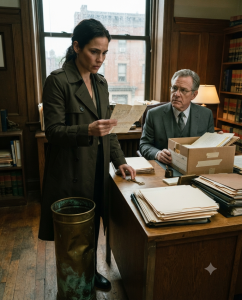
After their mother died, Julia’s sisters gave her the old umbrella stand by the front door.
It was not presented as an act of kindness. It was offered with the sort of smiling cruelty that could hide behind grief and manners and still land exactly where it was meant to hurt.
“You can have this,” her oldest sister, Vanessa, said, one hand still resting on a polished mahogany side table as if she already owned the room. “You always liked useless things.”
The younger one, Elise, did not even look up from the drawer she was going through. “It suits your apartment better anyway.”
Around them, the house still smelled faintly of funeral flowers. White lilies crowded the dining room table. Half-melted candles stood in little glass cups near the fireplace. Condolence cards were arranged in a neat stack on the mantel, just below the empty hook where the framed family portrait had hung for decades before Vanessa quietly removed it and set it aside for herself.
Julia stood in the entryway, damp from the rain outside, and looked at the umbrella stand.
It had been there for as long as she could remember. Dented brass, darkened with age, green around the edges where the polish had worn away. It was not elegant. It was not fashionable. It had never matched the hall wallpaper or the carved mirror above it. Yet it belonged there in a way expensive things never quite did. It had become part of the house’s bones.
Her mother used to tap it twice before leaving.
Always twice.
Coat buttoned, handbag in place, then two light touches with her fingertips before she stepped through the front door. Julia remembered asking about it once when she was ten.
“Why do you do that?”
Her mother had smiled in the mysterious way adults smile when they know children will understand later, not now.
“Some things guard a home better when no one notices them.”
Julia had forgotten those words for years. Or maybe she had not forgotten them at all. Maybe they had simply waited, tucked away like a pressed flower in an old book, until the day they were needed.
That day arrived in the ugliest way possible.
Their mother had been dead for three days, and already Vanessa and Elise had transformed sorrow into administration. They moved through the house with boxes, envelopes, and clipped voices. They called it sorting. Organizing. Being practical.
Julia knew theft when she saw it. She also knew that in some families, theft wore pearls and spoke softly enough that bystanders mistook it for competence.
Vanessa took the rings from their mother’s bedroom dresser and said she was “keeping them safe.”
Elise wrapped the crystal dishes in newspaper and said, “These are fragile. Someone has to be responsible.”
The bank folder disappeared from the desk drawer in the study. The spare house key vanished from the ceramic hook in the kitchen. The portrait above the fireplace came down before the last of the relatives had even gone home.
No one asked Julia what she wanted.
That part should have stung less than it did. She was used to being the one they overlooked. Vanessa was the oldest, polished and persuasive, always ready with a version of events that made her look generous. Elise was younger but sharper, quick with resentment and quicker with excuses. Between them, they had spent years deciding what kind of person Julia was: sentimental, impractical, too quiet to challenge anything in time.
They were wrong about her in many ways, but one thing they understood perfectly was that Julia hated public scenes. So at the funeral lunch, when Vanessa told distant relatives that their mother had “left everything fairly,” Julia said nothing.
She listened.
That was something her sisters had never learned to fear.
Rain hammered the windows while everyone ate finger sandwiches and tried not to stare at one another’s grief. Vanessa touched shoulders and squeezed hands. Elise offered tea. Together they moved through the room like a pair of gracious daughters carrying an impossible burden.
Julia sat near the corner and watched them perform.
Every now and then a relative glanced toward her with that awkward sympathy reserved for the family member who always seems slightly apart from the center of things. Julia had been that person all her life. Not unloved by her mother, never that. But easy for others to treat as if she had stepped back voluntarily, as if she had chosen not to compete for attention, authority, or affection.
The truth was simpler.
She had learned early that fighting certain people only gave them an audience.
So when the last tray was cleared and the coats came on and the murmured condolences thinned into silence, Julia picked up the umbrella stand.
It was heavier than she expected.
Vanessa noticed and laughed softly. “Need help?”
Julia looked at her sister’s immaculate black coat, her dry hands, her expression of polite amusement.
“No,” she said.
She carried it to the car alone in the rain.
By the time she got home, her hair was damp against her neck and the hem of her dress clung coldly to her legs. Her apartment felt too still after the charged atmosphere of the house. She set the umbrella stand near the kitchen and stood over it for a moment, staring at the water that dripped from its dented rim onto her tile floor.
Why had their mother kept it all these years?
It was not beautiful. Anyone else would have replaced it. But her mother had kept it polished as best she could, always returning it to the exact spot beside the front door, always tapping it twice before leaving.
Julia fetched a towel and crouched beside it.
Mud clung to the bottom edge. She wiped it absently, too tired to think clearly. Then she tilted it slightly to clean beneath the base.
A scraping sound came from inside.
She froze.
Very slowly, she set it upright again.
There were no umbrellas in it. She had checked earlier out of habit, maybe out of disbelief that something so empty could be given with such satisfaction. She bent down and peered into the opening now. Nothing. Just shadow.
She tipped it again.
Something slid within the base.
Her pulse thudded hard enough to make her ears ring.
The umbrella stand was lined underneath with old felt. It looked solid at first, just worn and discolored with age. But when she ran her thumb along one edge, she found a corner that lifted ever so slightly. She caught it with her fingernail and peeled it back.
Beneath it was a hidden compartment.
Julia sat back on her heels, suddenly unable to breathe properly. Inside the compartment was a narrow sealed tube wrapped in waxed paper.
For a moment she simply stared.
Outside, rain rattled the windows. In the apartment above hers, footsteps crossed from one room to another. Ordinary sounds. Ordinary evening. Yet down on her kitchen floor, in the thing her sisters had mocked and discarded, something impossible had just appeared.
Julia slid the tube out with shaking fingers.
Inside were three items.
A folded letter.
A small brass key.
And a copy of a trust document dated five years earlier.
She opened the letter first.
The sight of her mother’s handwriting undid her more completely than the funeral had. The careful loops, the firm slant of the lines, the steadiness in every word—it felt like being touched by someone already gone.
The first line read:
“Julia, your sisters always reach for what sparkles. That is why I hid the truth in the thing they never touched.”
Julia sank to the floor.
The letter continued in the same calm, deliberate tone. Her mother wrote that she had changed the structure of her estate five years ago. Not because she loved any of her daughters less, but because she had finally understood some difficult truths about two of them. Money had gone missing from one account. Jewelry had been borrowed and not returned. Documents had been moved, copied, or “helpfully reviewed” without permission. There had been explanations every time. Practical reasons. Misunderstandings. Emergencies. But their mother had stopped believing in coincidence.
She had left Vanessa and Elise enough that no one could say she had been cruel. Specific accounts. Personal items. Monetary gifts.
But the house itself, along with a protected trust linked to it and several investments, had been assigned under a separate legal structure that only the family attorney could fully release.
And only to Julia.
Not by mail.
Not through a call.
In person, with the enclosed key and trust copy.
There was another line Julia read three times.
“I know what they will do first. Let them.”
Not because her mother was vindictive. Julia could hear that in the letter too. It was not revenge that had guided her. It was accuracy. She knew which daughters reached first for visible wealth. She knew which one noticed patterns, remembered habits, and treated even ordinary objects as if they mattered.
At the bottom, her mother had signed her name with a firmness that made Julia cry.
Not the dramatic crying of collapse. Something quieter and more piercing. The grief of being seen completely by someone who was no longer there to speak.
She read the trust document next.
Even through blurred vision, the meaning was unmistakable. The family home address. Dates. Witnesses. Legal language tying the property and associated trust to instructions held on file by the attorney. Vanessa and Elise had spent the day stripping what they could from a house they did not fully control.
Then Julia picked up the key.
Small, brass, plain, and unexpectedly heavy.
She did not sleep much that night. She made tea she forgot to drink. She reread the letter until she knew whole passages by heart. She thought of all the times her mother had tapped the umbrella stand before leaving. Not superstition. Not eccentricity. A private ritual around a choice no one else knew existed.
By morning, something in Julia had settled.
Not anger. Anger burned too fast. This was steadier than that.
She dressed carefully in a charcoal sweater and black trousers, tied her hair back, placed the letter, the key, and the trust copy in her bag, then hesitated and looked at the umbrella stand.
She took that too.
At the attorney’s office downtown, the receptionist glanced first at Julia, then at the umbrella stand, then back at Julia again. Her polite smile flickered into curiosity, but she said nothing except, “Please have a seat.”
Julia did not sit long.
Soon she was shown into a private office where a silver-haired attorney named Mr. Calder rose from behind a desk. He had handled pieces of her mother’s affairs for years. He recognized Julia immediately, though his expression remained formal until she laid the letter, key, and trust copy before him.
That was when the room changed.
He read the first page of the letter. Then the second. His face sharpened.
“Did anyone else see these?” he asked.
“No.”
“Good.”
He stood, closed the office door, and made two calls from his desk phone in a voice that grew progressively more precise with each sentence. Then he returned, requested permission to copy the documents, and unlocked a cabinet at the far wall with a key from his watch chain.
Inside was a long gray box.
Julia stared at it.
Mr. Calder set it on the desk and nodded toward the brass key. “Please.”
Her fingers trembled as she inserted it into the lock. It fit perfectly.
Inside were original estate documents, notarized amendments, account schedules, property records, and a second signed statement from her mother confirming that the structure had been designed specifically to prevent interference before her death and confusion after it. Mr. Calder read through the file with the measured attention of a man used to legal surprises but still capable of respecting an extraordinary one.
When he finally looked up, his voice softened.
“Your mother was very clear.”
Julia let out a breath she felt she had been holding since the funeral.
He explained it plainly. Vanessa and Elise had inherited what had been assigned to them, and that was substantial. But the authority they had assumed over the house and its associated assets was not theirs. Certain items removed from the property pending estate execution might need to be returned immediately. Notices would be prepared that day. If the sisters resisted, the documentation was strong enough to force compliance.
“Did she know they’d do this?” Julia asked quietly.
Mr. Calder held up the letter with the first line still visible. “I believe she knew them very well.”
It was almost noon when Julia’s phone rang.
Vanessa.
Julia stared at the name before answering.
Her sister’s voice came through smooth and bright. “Hi. Quick question—have you seen a second key from the house anywhere? There are some cabinets we can’t get into.”
Julia glanced at Mr. Calder, who was already drafting instructions.
“No,” she said.
A pause.
Then Vanessa tried again, more slowly. “Also, the attorney’s office just called Elise about paperwork. There seems to be some confusion.”
Julia said nothing.
On the line, Vanessa’s breathing shifted. Confidence thinning into irritation.
“What did you do?”
Julia looked down at the umbrella stand resting beside her chair, its tarnished brass catching a stripe of light from the office window.
“I brought the right thing to the right office.”
Silence.
Then a small, disbelieving laugh. “Julia, don’t start. We already handled the estate.”
“No,” Julia said. “You handled what was easy to carry.”
Before Vanessa could answer, another line clicked in. Elise had joined the call without invitation.
“Why is the lawyer saying items have to be returned?” she demanded. No grief now. No politeness. Just naked alarm.
Julia could picture them both at the house. Drawers open. Jewelry cases half emptied. The portrait maybe still leaning against a wall. One sister staring at the other as understanding crept in like poison.
Vanessa’s voice came back low and dangerous. “What was in that stand?”
There it was.
Fear.
Not because they suddenly felt ashamed. People like Vanessa and Elise rarely arrived at shame first. They arrived at exposure. At loss. At the sickening realization that they had miscalculated.
Julia spoke carefully.
“Mom knew exactly what you’d take first.”
Neither sister interrupted.
“And she knew exactly what you’d leave behind.”
A sound came through the line then, something between a breath and a curse.
Mr. Calder slid a document toward Julia. Preliminary order. Return of disputed personal property pending estate enforcement. The legal wording was cold, clean, merciless.
Vanessa recovered enough to try one last tactic. “Julia, let’s not make this ugly.”
The sentence almost made Julia laugh.
Ugly.
As if ugly had not begun when they pocketed rings before the flowers wilted. As if ugly had not been smiling across a funeral lunch and telling relatives everything was fair while they quietly looted what they thought no one could stop them from taking.
Julia said, “You already did.”
Mr. Calder tapped the page indicating where a clerk’s filing confirmation would arrive. “It’s done,” he said softly.
Those two words carried more power than any shouted accusation ever could.
When Julia ended the call, her hands were steady.
For the first time since her mother died, the ache in her chest changed shape. It did not lessen exactly. Loss remained loss. But beneath it, there was something else now: the undeniable comfort of knowing her mother had seen the danger, planned for it, and trusted Julia to finish what she started.
Over the next week, the unraveling was swift and humiliating.
The sisters returned the house key first, through their own attorney, along with a careful letter insisting that any misunderstanding had been “deeply regrettable.” The portrait came back next, wrapped in a moving blanket. Several pieces of jewelry followed, though not all of them at once. The crystal dishes reappeared in two boxes, one plate chipped, with no explanation.
Vanessa called twice more. Elise sent one message that was half accusation, half plea. Julia answered none of them.
Instead, she met with Mr. Calder, reviewed the full trust terms, and walked through the house legally, room by room, for the first time since the funeral chaos. Without her sisters there, the rooms felt bruised but quieter, as if the house itself had exhaled.
In the front hall, the space beside the door was empty.
Julia stood there for a long moment.
She could still see her mother in that spot. Hand on the knob. Coat collar lifted in winter. Two fingertips tapping brass before stepping outside.
When the legal transfers were complete, Julia moved the umbrella stand back into the house.
Not because it matched anything. Not because it was valuable. But because some objects earn permanence by what they protect.
Months later, Vanessa and Elise were still telling people a gentler version of the story. There had been confusion, they said. Complicated paperwork. Their mother had changed a few things unexpectedly. They made themselves sound inconvenienced rather than outmaneuvered.
Julia never corrected them in public.
She did not need to.
The truth was quieter than gossip and heavier than scandal. Her mother had known exactly which daughters would lunge for sparkle. She had known which one would carry home tarnished brass through the rain without complaining. And in the end, she had hidden not just money or property, but judgment itself, inside the one thing greed could not recognize as worth taking.
Some nights, when Julia locked the front door of the house that was now legally hers, she rested her fingertips against the umbrella stand and tapped it twice.
Not for luck.
Not for superstition.
For memory.
And for the unsettling question that still lingered after everything was settled: whether Vanessa and Elise were ever truly grieving their mother at all, or only mourning the fortune they thought had slipped cleanly into their hands.