She won something that day. I just didn’t know it was going to change everything — including what happened to *her* three years ago in that very room.
Let me back up.
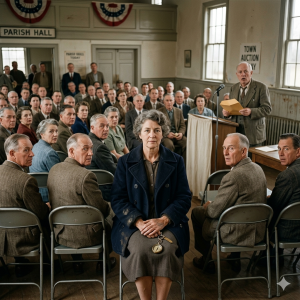
Sylvie Bormann had not set foot inside Blessed Harbor Parish Hall since the Tuesday afternoon in October when her then-husband handed her a manila envelope in front of sixty people who had come for a potluck supper.
Sixty people who watched.
Sixty people who said nothing.
She drove the two hours from Portland to Rockport on a gray Saturday in March because her friend Deb called in a favor — someone had to represent the historical society at the coastal auction, and Deb had a sick grandchild and a long drive she couldn’t make.
Sylvie almost said no four times.
She said yes once.
She wore her good navy peacoat and sensible boots and she drove with both hands on the wheel and the little brass compass on her keychain catching the winter light every time she turned a corner.
She’d had that compass for eleven years.
Her father gave it to her the summer she left for college, pressed it into her palm at the Greyhound station in Bangor, and said, *”You always know which way is north, Sylvie girl. Don’t let anybody tell you different.”*
She never took it off her keys.
Not even after the divorce.
The parish hall smelled exactly the same. Coffee and old wood and something like candle wax. The kind of smell that lives in the walls of a building and refuses to leave.
Sylvie signed in at the door, took her bidder number, and found a seat near the back.
She did not look at the corner where she had been handed those papers.
She looked, instead, at the items on the auction tables. Quilts and lobster traps and framed charts of Penobscot Bay. A hand-carved decoy duck. A watercolor of the harbor at dusk.
And then she saw it.
Third table from the left, under a small spotlight someone had angled just so.
A ship’s compass. Brass. Antique. Mounted in a mahogany box with a hinged lid and a small engraved plate on the front.
She walked over like she was being pulled.
The engraving read: *True North. For the one who finds their way home.*
Her throat did something she didn’t expect.
She picked up the description card. Estate item. Donated anonymously. Circa 1940s. Starting bid three hundred dollars.
She set the card down.
She looked up at the wall above the table — the one covered in framed parish photographs going back to the 1950s — and that’s when she noticed the picture.
A woman she didn’t recognize. Standing on a dock. Smiling at whoever held the camera.
And in the woman’s hand, hanging from a ribbon around her wrist, was a small brass compass.
Identical to the one on Sylvie’s keys.
Identical to the one in the mahogany box.
Sylvie stood there for a long moment.
Nobody else was looking at the photograph. Not one person in that crowded room.
Just her.
She went back to her seat. She sat with her bidder number in her lap and her sealed envelope in her coat pocket — the historical society’s maximum offer, which Deb had written out and sealed before Sylvie ever got in the car.
She did not open it.
She did not change it.
She just sat with it.
When the bidding reached the compass — lot number fourteen — the room got briefly lively. Two men near the front went back and forth in twenty-dollar increments. Someone in a green sweater raised her paddle twice and then set it down.
The auctioneer, a broad man named Carl who’d been running these sales for twenty years, called for final bids.
Sylvie raised her hand.
She passed her envelope to the volunteer who walked the aisle.
She watched Carl take it. Watched him note her bidder number on his clipboard. Watched him set it aside with the others for the sealed-bid portion, the way the rules required.
She sat back.
She waited.
And forty minutes later, when Carl reached into the stack of envelopes and pulled hers — still sealed, Deb’s handwriting on the front — she watched him break the tab.
He read the number to himself first.
The way they always do.
And then he looked up.
And the color left his face like a tide going out.
And every single head in that parish hall turned — following his gaze across the rows of folding chairs — until sixty pairs of eyes landed on the woman in the navy peacoat sitting quietly in the very back of the room.
Sylvie Bormann.
Who had not moved.
Who had her hands folded in her lap.
Who was wearing, on her keychain looped around one finger, a small brass compass catching the light.
Carl set the envelope down on his table very carefully, the way you set down something fragile. He cleared his throat once. Then again.
“Lot fourteen,” he said. “The ship’s compass. Going to — ” He stopped. Looked at his clipboard. Looked back up. “Bidder number forty-one.”
Sylvie’s number was thirty-seven.
She felt the room’s attention shift the half-second before she understood what that meant.
Carl was not looking at her.
He was looking at the man three rows in front of her, slightly to the left. The man who had not raised his paddle once during the bidding. The man who had submitted a sealed envelope of his own, which apparently contained a number large enough to make Carl’s face do what it did.
The man turned around.
And Sylvie recognized him.
Not from Rockport. Not from the historical society or the coastal auction circuit or any of the places she’d been operating in since the divorce.
She recognized him from a photograph. A photograph her father kept on the mantelpiece in Bangor until the day he died, one she’d looked at her entire childhood without ever once asking about it properly, the way children don’t ask about the things that seem like they’ve always just been there.
Two men standing on a dock. Young. Both squinting into the sun. One of them was her father at maybe twenty-five, twenty-six. The other one she never knew the name of.
This man, sitting in the third row of Blessed Harbor Parish Hall, was that other one. Older now, of course. Seventy if he was a day, with white hair and the kind of hands that had done physical work their whole lives. But the jaw was the same. The way he held his shoulders was the same.
He was looking at her the way people look when they’ve been expecting something and it has finally, after a very long time, arrived.
He stood up. He did not look away from her.
“My name is Walter Foss,” he said. Not loudly. Just clearly. “And I think you might be Henry Bormann’s daughter.”
The room was very quiet.
Sylvie said, “I am.”
Walter Foss nodded once, like that confirmed something he’d been carrying a long time.
“I was his roommate,” he said. “At the merchant marine academy. 1971 through ’73.” He paused. “Your father saved my life once. Out on the water. I never got the chance to pay that back in any way that felt like enough.”
He reached into the inside pocket of his coat.
He took out a small brass compass. Identical to hers. Identical to the one in the mahogany box on the table.
“He had two of them made,” Walter said. “Gave me one. Kept one himself.” He looked at the compass in his hand, then at the one on her keychain. “I donated the box compass to this auction forty-eight hours ago. Anonymously. Because I knew — I’d heard through people — that the historical society was going to be represented here. And I knew your friend Deb was the one who usually came.”
Sylvie understood something then. A slow, sure understanding, the kind that doesn’t crash into you but settles.
“You didn’t know Deb couldn’t make it,” she said.
“No,” Walter said. “I didn’t know it would be you.” He looked almost undone by that, in the careful way old men get undone by things. “I just wanted whoever came to find it. I thought maybe it would find its way back toward your family somehow. Through Deb, through the society’s collection, I didn’t know. I just couldn’t keep it anymore. I’m eighty-one years old and I have no children and the compass deserved to go somewhere it meant something.”
He stopped. He looked at the compass in his palm.
“I put the engraving on the box myself,” he said. “Three weeks ago. At a shop in Camden.”
*True North. For the one who finds their way home.*
Sylvie pressed her lips together until she trusted them.
There were sixty people in that room. Some of them were reaching for their phones. Some of them were very still. The woman in the green sweater had both hands pressed flat on her knees like she was trying to keep herself from doing something.
Sylvie stood up.
She crossed the rows of folding chairs — the same floor her marriage had ended on, the same walls, the same smell of coffee and old wood and candle wax — and she held out her hand.
Walter Foss shook it. Then, because apparently that wasn’t sufficient for either of them, he held on.
“He talked about you,” Walter said quietly. “All the time. His Sylvie girl.” His voice broke at the edges, just slightly. “Said you always knew which way was north.”
She laughed. She couldn’t help it. It came out wet and she didn’t apologize for that.
“He told me the same thing,” she said.
Carl the auctioneer, to his credit, gave them a long moment before he gently moved on to lot fifteen, a framed needlepoint of a lighthouse that sold for forty dollars to the woman in the green sweater, who needed something to do with her hands.
After the auction, Sylvie and Walter sat in the parish hall’s small side room with bad coffee in paper cups and talked for two hours. About her father. About the academy, about a night in 1972 in heavy swells off the Nova Scotia coast that Walter still dreamed about sometimes. About the forty years Walter had spent trying to locate Henry Bormann and the way grief gets complicated when someone just quietly drifts out of your life before you get to say what needs saying.
Her father had died eighteen months ago. Walter had read the obituary online, alone in his house in Camden, and he had sat with it for a long time.
“I should have looked harder,” Walter said.
“He moved around a lot,” Sylvie said. “After my mother. He wasn’t easy to find.”
“No,” Walter said. “But I should have.”
She let him have that. Some regrets you can’t take from people, and trying to is unkind.
Before she left, Walter pressed his compass into her hands. She tried to give it back. He shook his head with the absolute finality of an eighty-one-year-old man who has decided something.
“They should be together,” he said. “They were made together.”
She drove back to Portland with both compasses. Hers on the keychain. Walter’s in the cup holder where she could see it.
The gray had lifted sometime during those two hours in the side room and the late afternoon was doing that thing the Maine coast does in March when it decides to be beautiful without warning — low gold light over the water, the pines going dark against it, the road ahead of her clear and straight.
She called Deb somewhere around Brunswick.
“How did it go?” Deb asked.
Sylvie thought about sixty people watching her. About Carl’s face going white. About a man standing up in three rows ahead of her and saying her father’s name like a door opening.
About walking across the same floor where her marriage had ended and feeling, for the first time in three years, like that floor was just a floor.
“We got the compass,” she said.
“Worth the drive?”
She looked at the winter light on the water.
“Yeah,” she said. “It was worth the drive.”
She thought about her father pressing that small brass weight into her palm at the Greyhound station in Bangor, twenty-two years old and terrified and trying not to show it. The way he’d said it. Not like advice. Like a fact he was reminding her of.
*You always know which way is north, Sylvie girl.*
She kept both hands on the wheel.
She drove north.