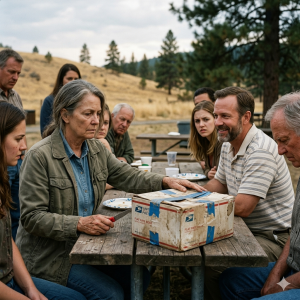
She brought a box to the family reunion.
A beat-up USPS flat-rate box, sealed with blue painter’s tape, carried in a canvas tote like it weighed nothing — and cost everything.
And when she set it on that picnic table in front of her brother-in-law, in front of the whole family, eighteen months of silence ended in about thirty seconds.
But I’m getting ahead of myself.
—
My name is Darlene Poole. Sixty-three years old. Retired postal worker, Harlan County, Tennessee. Thirty-one years sorting other people’s mail, and I never once stole so much as a rubber band.
My daughter Cassie died four years ago. Ovarian cancer. Forty-one years old. She had her daddy’s laugh and my stubbornness, and the world has been quieter and meaner without her in it.
After the funeral, the family came together — really came together, the way grief sometimes makes people do — and we decided to start a memorial fund. Something to help young women in Cassie’s county get access to the kind of early screenings she never got.
My brother-in-law Gary’s idea, actually.
Gary, who has a firm handshake and a story for every room he walks into. Gary, who can make you feel like the most important person alive for exactly as long as he needs something from you.
Gary volunteered to manage the account.
I should have known then. But I was still mostly underwater from losing Cassie, and trusting Gary felt like the least hard thing I’d had to do in months.
—
The first time I raised a concern, Gary laughed.
Not a mean laugh. Worse — a gentle one. The kind that says, Oh, Darlene. The kind that makes the room shift just slightly away from you.
By the time I raised it a second time, the whole family had a word for what I was doing.
Spiraling.
That was the word. Said with lowered voices and kind eyes and casseroles left on my porch like I was something fragile that needed managing.
Gary told my sister I’d never processed Cassie’s death properly. That grief does strange things to a person. That I was seeing shadows where there weren’t any.
And because Gary is the kind of man who tells you exactly what you want to hear until the moment he doesn’t need to anymore — they believed him.
I stopped talking.
But I didn’t stop watching.
—
I spent eighteen months doing what I’d done my entire career.
Documenting. Dating. Sending.
Every bank statement I could access. Every screenshot. Every receipt I found, every letter I photographed, every number that didn’t add up — I printed it, sealed it, and mailed it.
To myself.
One envelope a week. Sometimes two.
Priority mail. Return receipt requested.
And when each one arrived back at my door with that little green card and that official postmark — proof that on this date, these exact documents existed — I sealed it inside that flat-rate box with a strip of blue painter’s tape.
My daughter worked in insurance adjusting. She taught me that one. “Mama,” she used to say, “paper with a postmark is the closest thing to God in a courtroom.”
I kept the box behind the winter coats in my hallway closet.
I carried it to the reunion in a canvas tote bag.
I set it on the picnic table like it was a covered dish.
—
Gary saw it and smiled. Because Gary always smiles first and thinks second, and he didn’t know yet what thirty-one years of mailing things can build.
My sister was there. My nieces. Gary’s own kids, who are good people who deserved to know the truth about their daddy.
I reached into the tote.
I set the box down in front of him.
I pulled out my paring knife — the small one with the red handle I’ve used since 1987 — and I slid it under the blue tape on the first fold.
Gary’s smile didn’t move, but something behind his eyes did.
“I’ve been waiting fourteen months,” I said, “to open this in front of exactly the right people.”
The first envelope slid out.
And Gary’s wife — sweet Linda, who’d brought me casseroles and told me I was spiraling — made a sound that nobody at that picnic table had ever heard a grown woman make before.
Not a scream.
Not a sob.
Something in between that had no name.
Because she was reading the first page.
And she recognized the account number.
—
It was her personal checking account.
Not the memorial fund. Not some business account Gary had set up for appearances. Her personal checking account, the one she’d had since 1998 at First Federal in Harlan, the one her paycheck from the school district went into every two weeks without fail.
Gary had been moving the money into Linda’s account.
Not to hide it from the family. To hide it from Linda.
He’d been pulling it back out in cash withdrawals, fifty and a hundred dollars at a time, small enough that the bank never flagged them, frequent enough that over fourteen months they added up to just over eleven thousand dollars.
Eleven thousand, two hundred and forty dollars.
Raised in Cassie’s name.
Raised for women who couldn’t afford the screening that might have caught what killed my daughter before it killed her.
And Gary had spent it. On what, exactly, I didn’t know yet. But I had my suspicions, because two of those envelopes in the box contained something I hadn’t shared with anyone. Receipts I’d found photographed and printed and postmarked, receipts from a Holiday Inn Express forty minutes up the highway, receipts dated on weekends when Gary had told Linda he was at bass fishing tournaments.
I hadn’t planned to put those on the table.
But I’d brought them. Because I am my mother’s daughter, and my mother always said you go to a hard conversation prepared for it to get harder.
—
Linda sat down on the picnic bench.
She didn’t ask Gary to explain. She didn’t look at him at all. She just kept turning pages with the careful, deliberate movement of a woman who has decided that if she stops moving her hands, she will do something she cannot take back.
Gary said my name.
“Darlene.” Like I was the problem. Still. Even now.
My sister Renee was standing behind me, and I heard her take a breath that she didn’t let out for a long time.
Gary tried the smile again. Smaller this time. Rueful. The smile that means, now look, let’s all be reasonable adults here.
“There are explanations for all of this,” he said. “You’ve pulled things out of context, Darlene. You’ve always had a way of — ”
“Gary.” That was his son Marcus. Twenty-six years old, built like his father but nothing like him in any way that matters. “Gary, stop talking.”
Marcus said it quietly. The way you say something when you’re working very hard to stay in control of yourself, and everyone at the table knows it, and everyone at the table respects it.
Gary stopped talking.
—
I handed Linda the rest of the envelopes one at a time.
I didn’t narrate. I didn’t editorialize. I had spent eighteen months documenting so that the documents could speak for themselves, and I let them do their job.
Bank statements with deposits that matched, to the dollar, the fundraiser’s total collections in a given month. Withdrawals. Dates. Amounts. The pattern of it, which was the thing that turned your stomach once you saw it — not any single number, but the patience of it. The consistency. The way he had done it slowly and carefully over more than a year, the way you only do something like that if you have decided, on some level, that you are never going to get caught.
When I got to the Holiday Inn receipts, I put them face-down in front of Linda and I said, “You can look at those in private if you want. They’re not about the money. They’re about why he needed the money.”
Linda turned them over.
She looked at them for a long time.
Then she set them down, smoothed them flat with her palm, and said, in a voice I will carry with me to my grave: “I knew about the fishing tournaments.”
Nobody said anything.
“I knew,” she said again. “I just didn’t know I knew.”
—
Gary left the reunion on his own. I want to be clear about that. Nobody ran him off. Nobody screamed. It was almost worse than that — the family just stopped acknowledging he was there, the way a room reorganizes itself around a piece of furniture that’s been moved, until he was standing by the parking lot alone, waiting to see if anyone would follow him.
Linda didn’t follow him.
Marcus didn’t follow him.
His daughter Bree, who is twenty-three and the sharpest of his kids and the one I have always thought took after Linda’s side, walked past him to get to the cooler for a Coke, and she didn’t look at him, and I watched something go out of Gary’s face that I don’t think ever came back.
He drove away in that Silverado he loved so much. The one with the bass boat hitch he never used.
—
The next morning I drove to the county sheriff’s office with a copy of the box’s contents — I’d made three copies, kept one, mailed one to myself as a backup, and held the third for exactly this purpose.
The deputy who took my report was young. Maybe twenty-five. He kept his face very professional while I walked him through the documentation, but near the end, when I got to the part about Cassie and what the fund was supposed to be for, his jaw tightened and he looked down at his notepad for a moment before he looked back up.
“Yes ma’am,” he said. “We’ll be following up on this.”
They did.
Gary was charged seven months later. Misappropriation of charitable funds. The DA added wire fraud when they got into his phone records. His attorney negotiated a plea. He paid restitution — all of it, every dollar, because Linda’s attorney made it a condition of their divorce settlement that Gary liquidate part of his retirement account to make the fund whole before she signed anything.
Eleven thousand, two hundred and forty dollars went back into the Cassie Poole Memorial Fund.
The following spring, it paid for fourteen women in Harlan County to receive ovarian cancer screenings.
Three of them got follow-up referrals.
One of them caught something early.
I don’t know her name. The clinic coordinator told me there was a woman, she didn’t tell me who, and she didn’t have to. I drove home from that conversation and I sat in my kitchen and I cried for about an hour — not the gray, bottomless grief-crying I’d done for two years after Cassie, but something different. Something that felt like it had an edge to it. Like it was finite. Like it was ending rather than starting.
—
My sister Renee called me about three weeks after the reunion.
She didn’t open with an apology, which is very Renee, and I love her enough to not have needed one. She just said, “I brought you a casserole,” and I said, “I know you did, I can see you in the driveway,” and she laughed, and I let her in.
We sat at my kitchen table for three hours. She asked me to walk her through all of it — not the documents, but the feeling of it. What it was like to be the one who saw it when nobody would listen. What it cost me to keep quiet all that time while I built my case.
I told her the truth, which is that it didn’t feel like strength. It felt like stubbornness, which is a different thing, and which I came by honestly from my mother and passed on to Cassie, who passed it back to me like a baton in those last months when she was fighting harder than anyone had a right to ask her to fight.
Renee was quiet for a while.
Then she said, “She would have done the same thing. Cassie would have done exactly what you did.”
I said, “I know.”
I said, “That’s why I did it.”
—
The box is still in my closet.
I know I could throw it away. The case is closed. The money is back where it belongs. There’s nothing left to prove to anyone.
But I look at it sometimes when I’m getting out the winter coats, and I think about thirty-one years of mail moving through my hands. All those return receipt cards, green as go signals, proof that something sent in good faith arrived where it was supposed to. I think about Cassie explaining postmarks to me at my kitchen table, patient as a teacher, because she knew how a thing could be challenged and how you had to build it so it couldn’t be.
She was so careful with the things she loved.
So am I.
That box is the last thing I built with her, even if she never knew she helped me build it.
I’m not ready to let it go.
And I don’t think I have to be.